
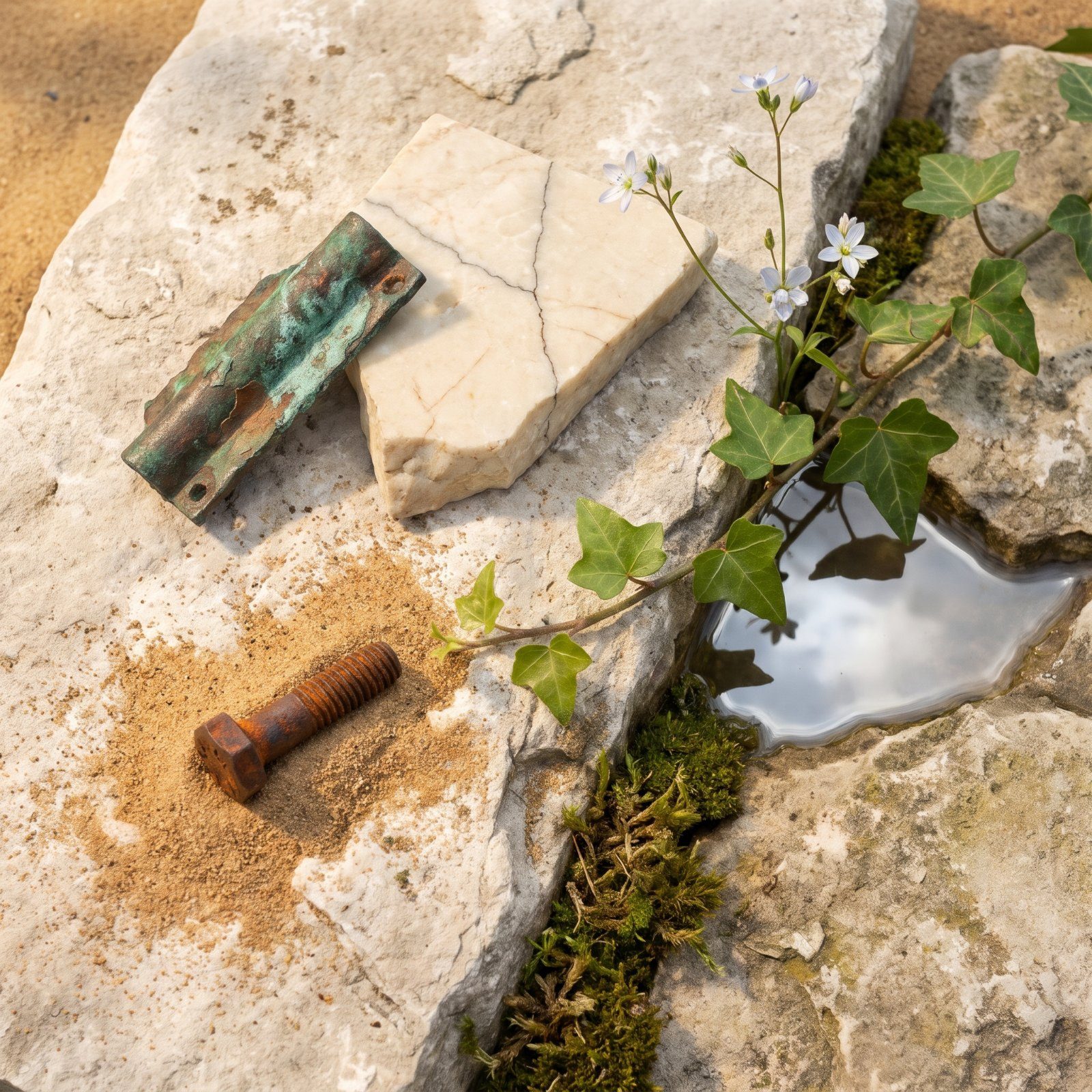
Concrete doesn’t last forever, and neither does iron, steel, or the carefully pinned marble of a wonder. Pull people out of the picture and the planet gets to work fast. Roots split foundations. Rust eats towers. Rivers reclaim their old channels and walk straight back into rooms we built. A thousand years is nothing to geology and everything to a building. What follows are grounded, science-informed pictures of landmarks you’d know in a heartbeat, softened and swallowed by the climates around them right now. Quiet, green, very much alive. Just not with us.
47. The Statue of Liberty Rises From a Flooded, Forested Island
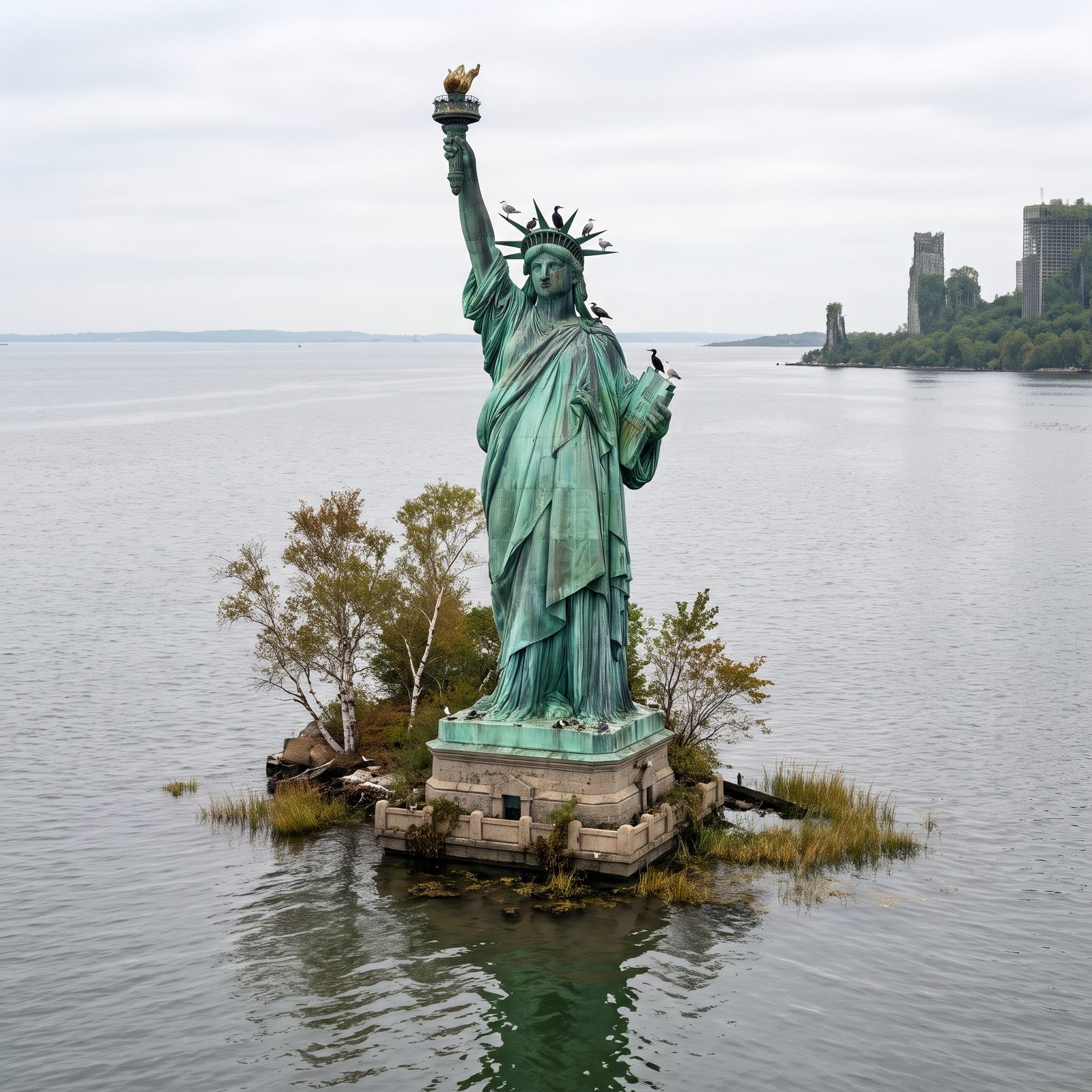
Copper is the quiet winner here. Her skin is only about as thick as two stacked pennies, and it’s already the famous green we think of as her real color. Centuries of weather just deepen the streaky stain, while the gilded torch flame still gleams untouched.
The iron skeleton underneath is the hidden worry. Gustave Eiffel’s interior framework can rust out of sight, yet here the copper shell still looks whole and unbroken. Add centuries of risen seas lapping at the weed-draped seawalls, and the island still holds above the water, leaving her standing tall on her intact stone pedestal above the overgrown grass, torch arm still up, birch trees rooting on the old grounds around her.
46. The Eiffel Tower Becomes a Rust-Streaked Iron Skeleton
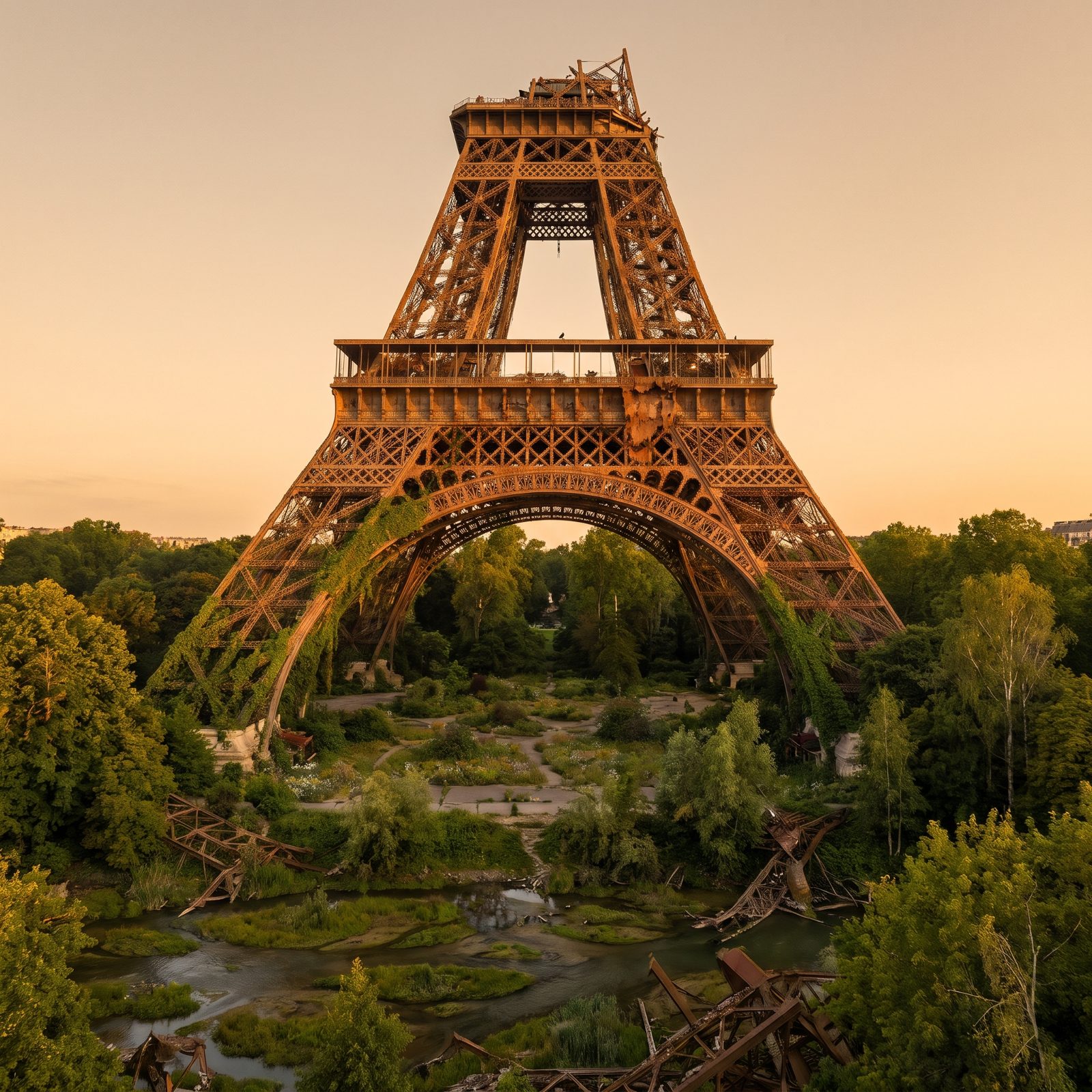
The tower survives on a coat of paint. That’s not a figure of speech. Crews strip and repaint the whole thing every several years, burning through tons of the stuff, just to keep the wrought iron from rusting through.
Stop painting and the clock starts. Rain gets into every rivet and every joint of the heavy, columned cornice band ringing the first level; the lattice streaks orange, then brown, then starts shedding itself in flakes. The top goes first — lightest, most exposed — and the whole elegant curve begins to slump. After a millennium you’d still read the shape instantly, standing in an oak forest where the gardens used to be. Lean on it and it would groan.
45. The Colosseum Turns Into a Vast Roman Garden
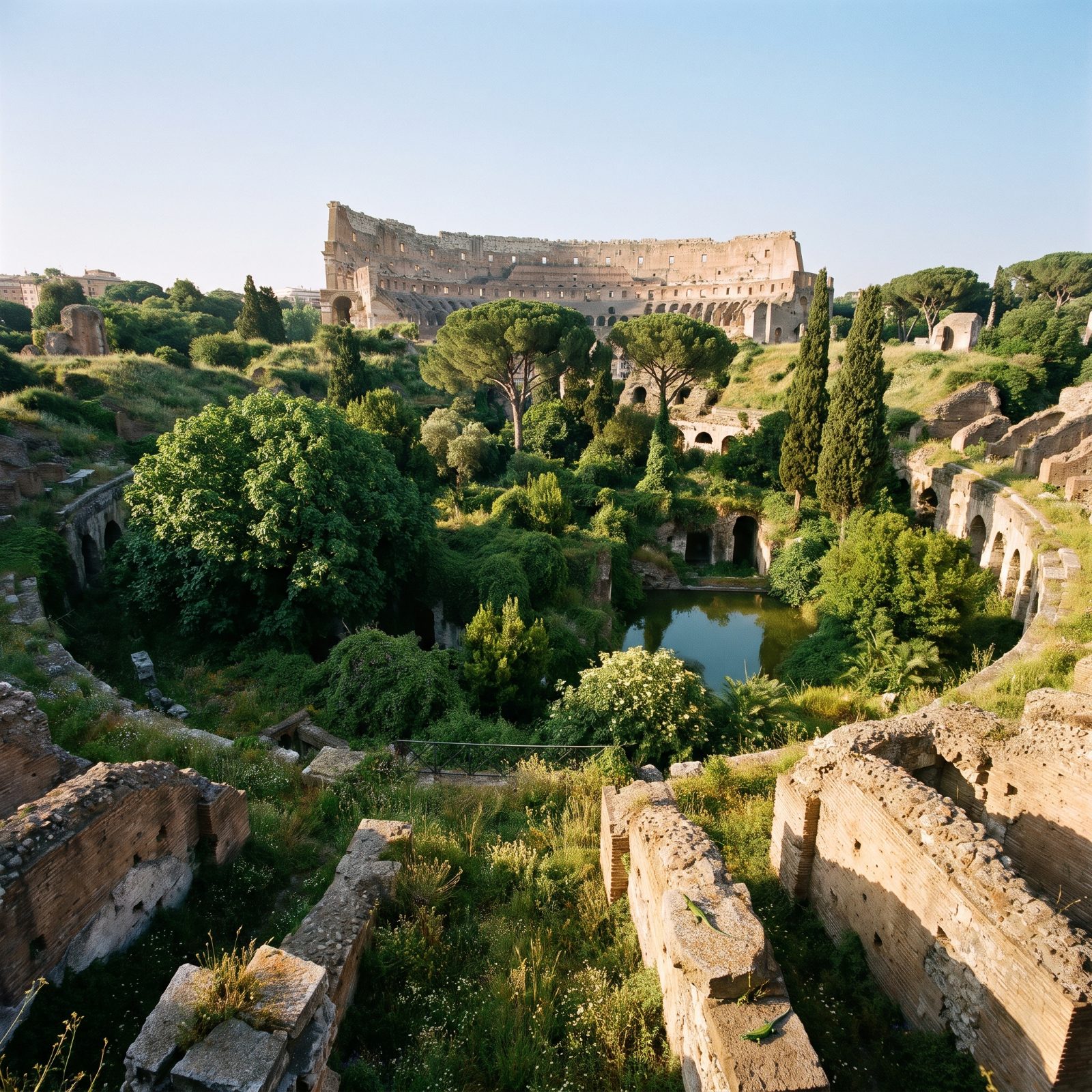
This one already happened once, which is the fun part. In the 1600s a botanist cataloged hundreds of plant species growing wild inside the abandoned Colosseum. Some of those seeds, the theory goes, had hitched in a thousand years earlier with the exotic animals shipped to the games.
Left alone again, it goes right back. Fig trees and caper bushes pry apart the travertine, the arena floor becomes a meadow, and the flooded underground tunnels turn into a still pond thick with frogs. The outer ring keeps collapsing, arch by arch, yet that horseshoe sweep stays legible for a very long time.
Rome’s deadliest arena ends its story as a sun-warmed garden full of lizards. There are worse retirements.
44. The Great Wall of China Fades Into the Mountains
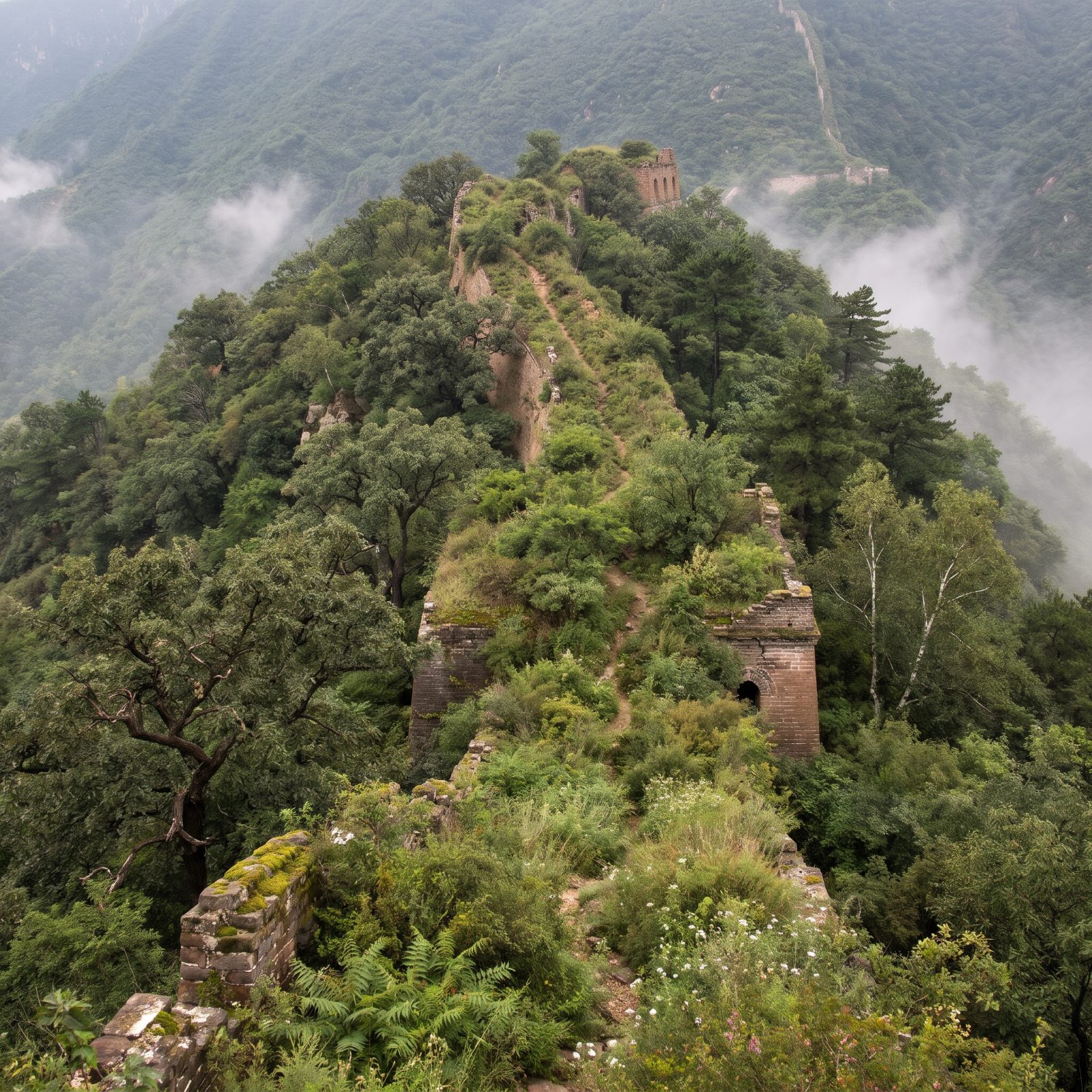
Most of the wall is already dust in slow motion. Long stretches, especially the older rammed-earth sections, have been crumbling for centuries, and surveys found that a good chunk has simply vanished.
Give it another thousand years with nobody patching, and the famous stone sections surrender too. Frost cracks the mortar. Roots do the rest. On the steep green ridges near Beijing, shrubs and trees swallow the walkway and moss creeps over the crumbling brick parapets, though in the distance the wall still runs as a clean, unmistakably man-made line up the mountainside. Watchtowers? Still standing for now, brick walls and arched doorways and windows intact, as the forest closes in around them.
43. The Taj Mahal Stands Weathered Above an Overgrown Reflecting Pool
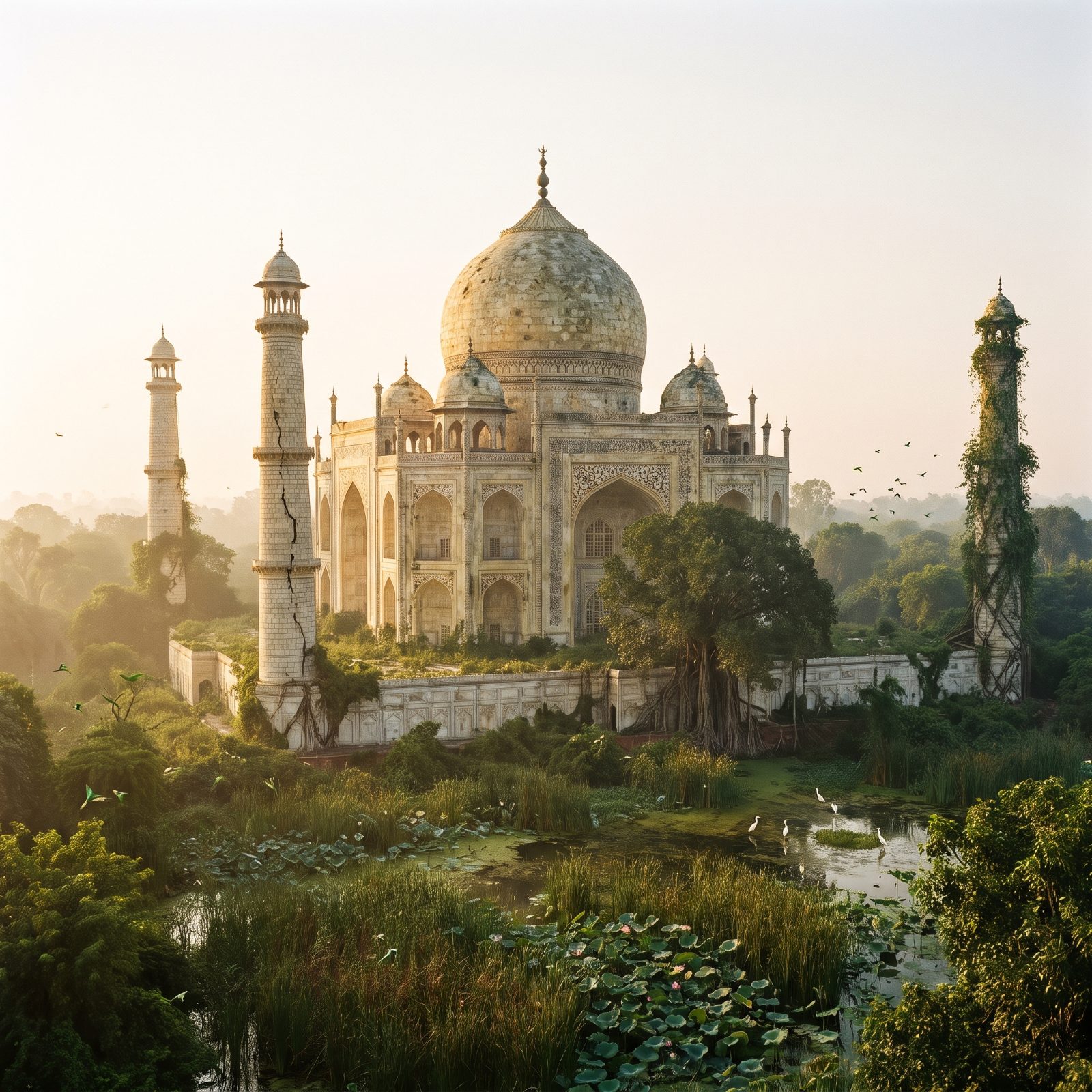
Marble is tougher than iron but softer than it looks. The Taj is already losing a slow fight with yellowing from pollution, and acid rain nibbles away at the surface of its white stone year after year.
With nobody scrubbing it, the marble goes cream, then grey-green with algae. The pietra dura inlay — all those semiprecious stones set by hand — pops loose piece by piece until the facades read like pockmarked skin. Peepal roots, the great wall-breakers of South Asia, get a grip on the plinth. The reflecting pool thickens into a lotus marsh. Yet the dome, minarets and enclosure walls, beautifully engineered, all still stand, cracked and vine-wrapped, rising above a swamp.
42. Big Ben’s Roofless Tower Is Wrapped in Ivy
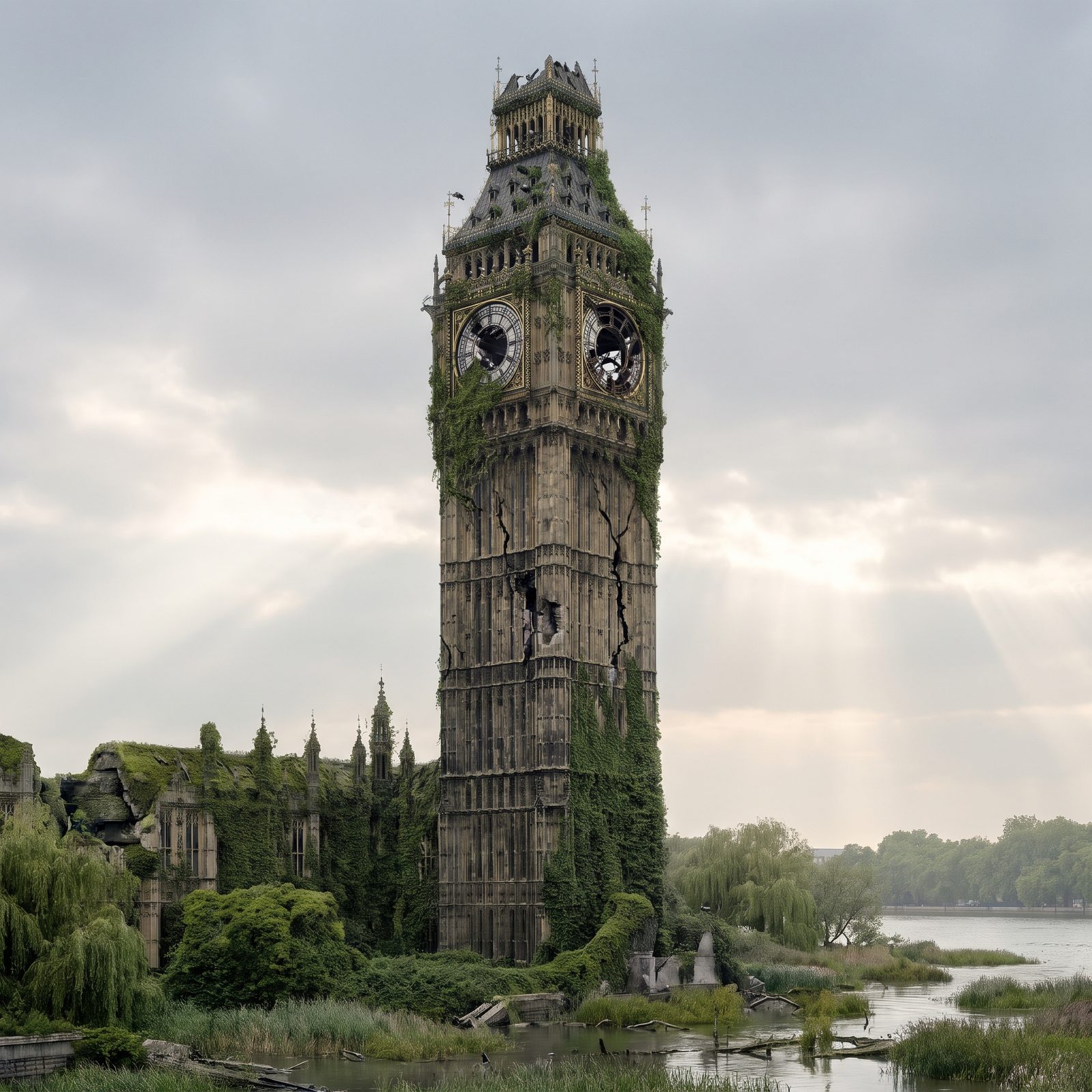
London’s damp does half the work for free. The tower is clad in limestone and sandstone — soft stones that already flake and sugar in acidic rain, which is exactly why it needs constant repair.
Leave it be and the stone shaft cracks and splits first, its blocks bursting open while the delicate Gothic spires and pinnacles somehow hold on even as the roof gives way. Water seeps into the shaft through the fissures, the great bell’s frame rusts, and the clock faces become empty eye sockets once the glass goes. Ivy, England’s patient demolition crew, climbs in through the windows and spreads over everything. Meanwhile the Thames, tidal here, creeps back across the embankment and turns Parliament’s ruins into a reed marsh.
41. The Sydney Opera House Becomes a Harbor-Side Shell Reef
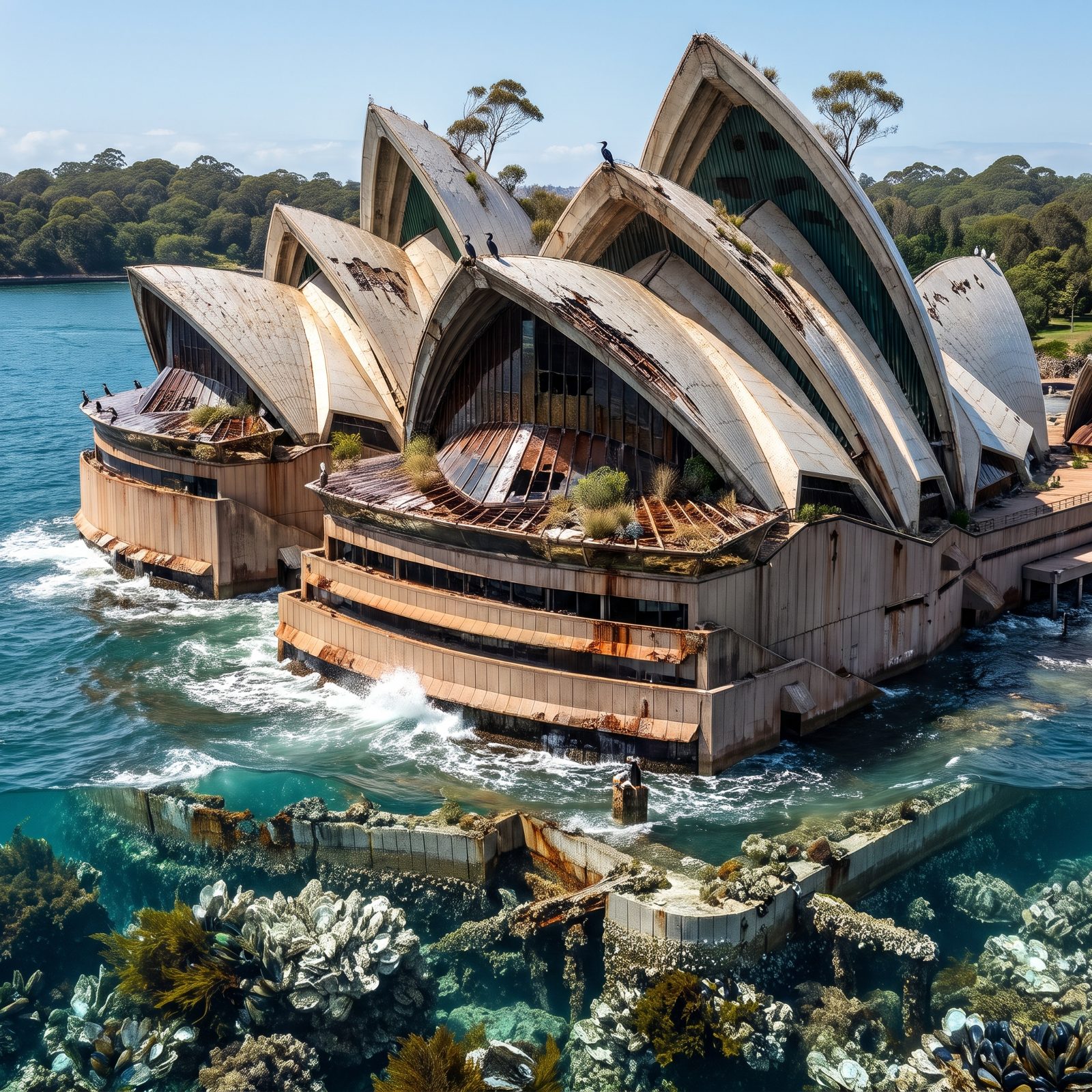
Those white sails aren’t solid white. They’re over a million glazed ceramic tiles glued to concrete shells laced with steel, and steel by the sea is living on borrowed time.
Salt air drives corrosion into the rebar, which rusts, swells, and splits the concrete from the inside — engineers call it spalling. The tiles pop off. The shells stain grey and start shedding chunks. But here’s the twist. As the harbor rises and floods the podium, the drowned lower structure becomes a reef. Oysters and barnacles armor the base in living shell while the ruined sails above host gulls and salt-blown shrubs.
40. Christ the Redeemer Watches Over a Rewilded Rio
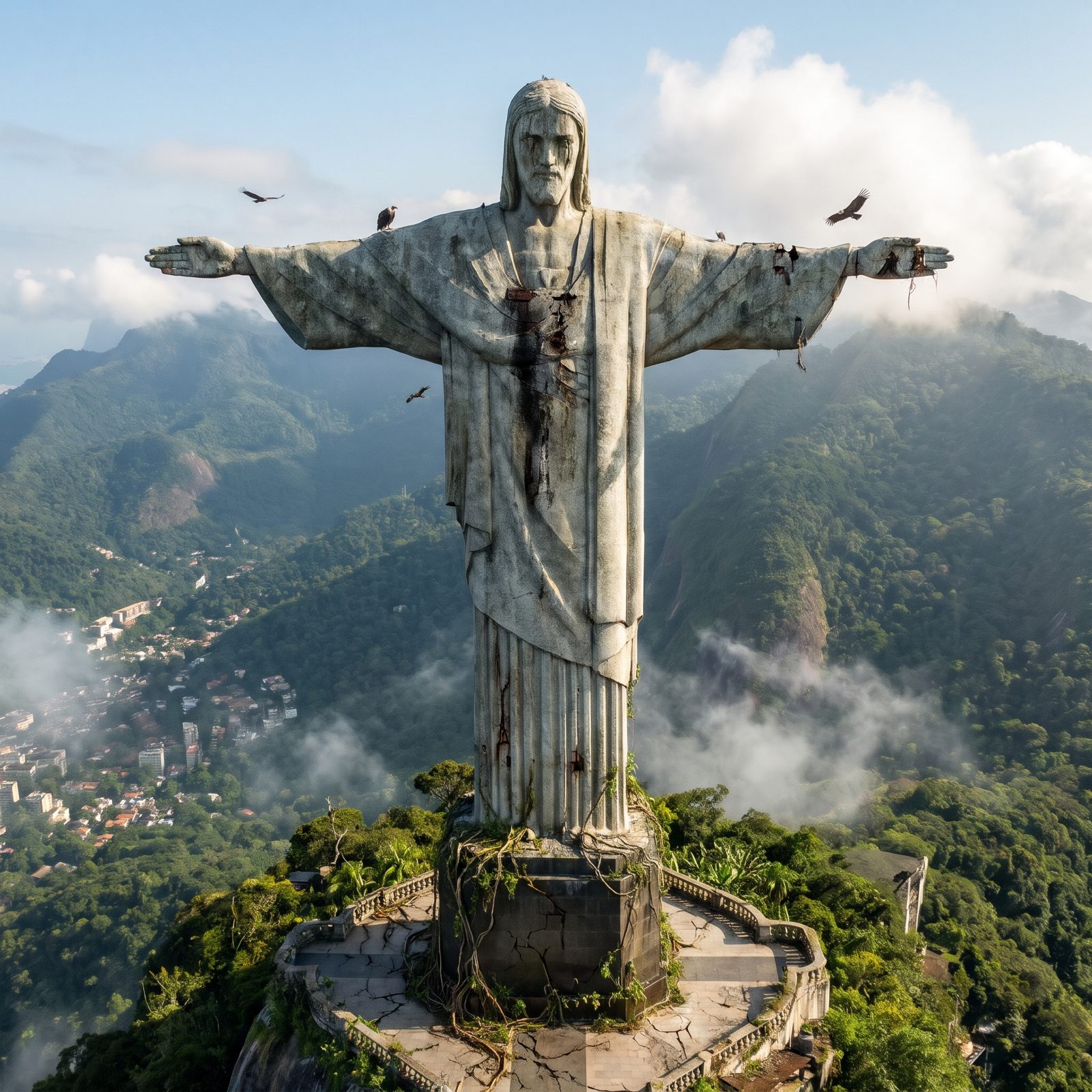
Lightning hits this statue several times a year. The exposed peak, the reaching arms, the humidity — it’s a magnet, and crews already patch up storm damage to the fingers and head on a regular basis.
Pull the crews and the strikes keep coming. Soapstone cladding cracks off in sheets, exposing the concrete core, which streaks black with the algae that thrives on warm, wet mountaintops. A fingertip breaks. The face goes soft. But the real story is happening below him. Rio’s Atlantic rainforest, among the most biodiverse on Earth and already regenerating, crowds the edges of the city’s high-rises and red-roofed neighbourhoods and climbs the slopes toward that weathered, arms-out figure still keeping watch.
39. The Great Pyramids Emerge From Shifting Desert Sands
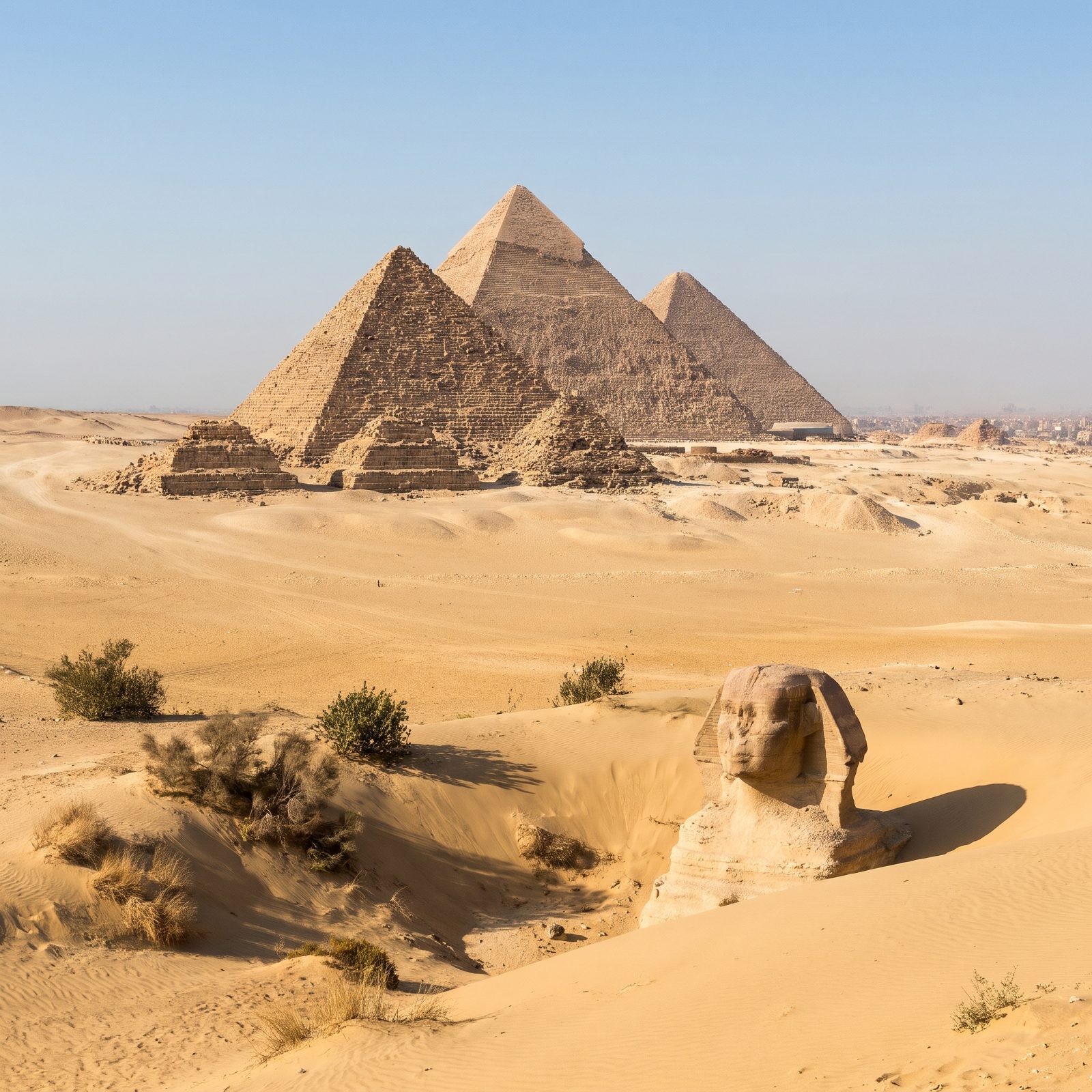
And here’s the one that barely changes at all. The pyramids are the oldest things on this list by more than a thousand years, and they’ve already survived without us before. Sand is gentler than rain.
A millennium of dry desert wind sands the edges a shade softer and shuffles the dunes around, burying and unburying the bases the way it has for ages. The Sphinx, carved from softer rock and forever drifting under sand, sits half-cradled in drifts, only its head and chest still standing clear of the sand, its long body buried beneath the dunes — a partial burial that has come and gone again and again across its long history. No ivy. No flood. No rust. Just slow erosion and the patient drift of sand.
38. Machu Picchu Disappears Beneath a High-Altitude Cloud Forest
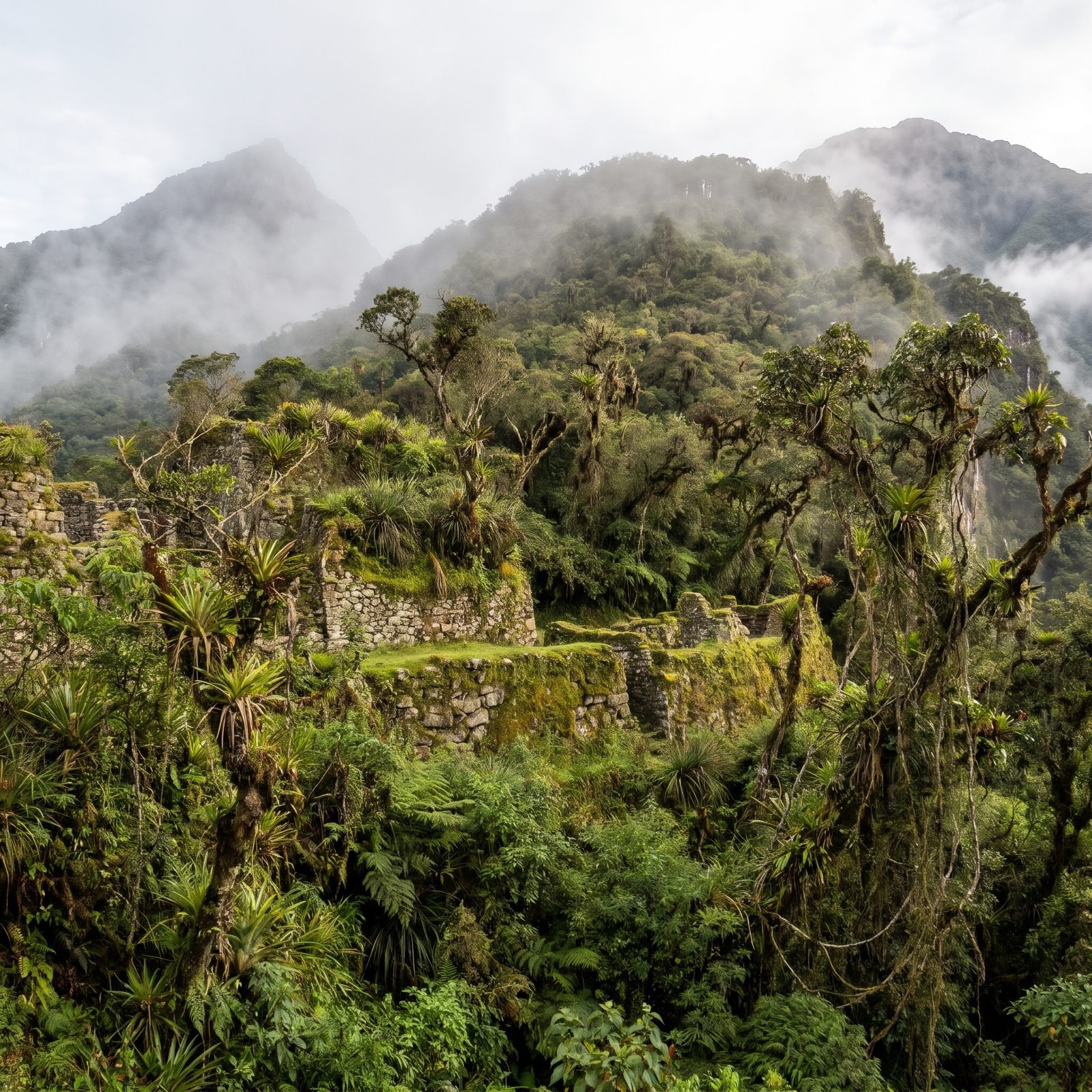
This is the easiest future to picture, because it already happened. Machu Picchu sat lost under cloud forest for roughly four centuries before the wider world took notice in 1911. The jungle had simply taken it back.
So a thousand years from now it does the same thing, only more thoroughly. The brilliance of the Inca masonry — blocks cut so precisely you can’t slide a knife between them — means the walls hold almost intact under the green. Moss, ferns, bromeliads and twisted cloud-forest trees blanket every terrace. From the opposite ridge you’d see faint grey lines in the mist and genuinely wonder whether anyone built them at all.
37. Angkor Wat Is Reclaimed by Giant Tropical Trees
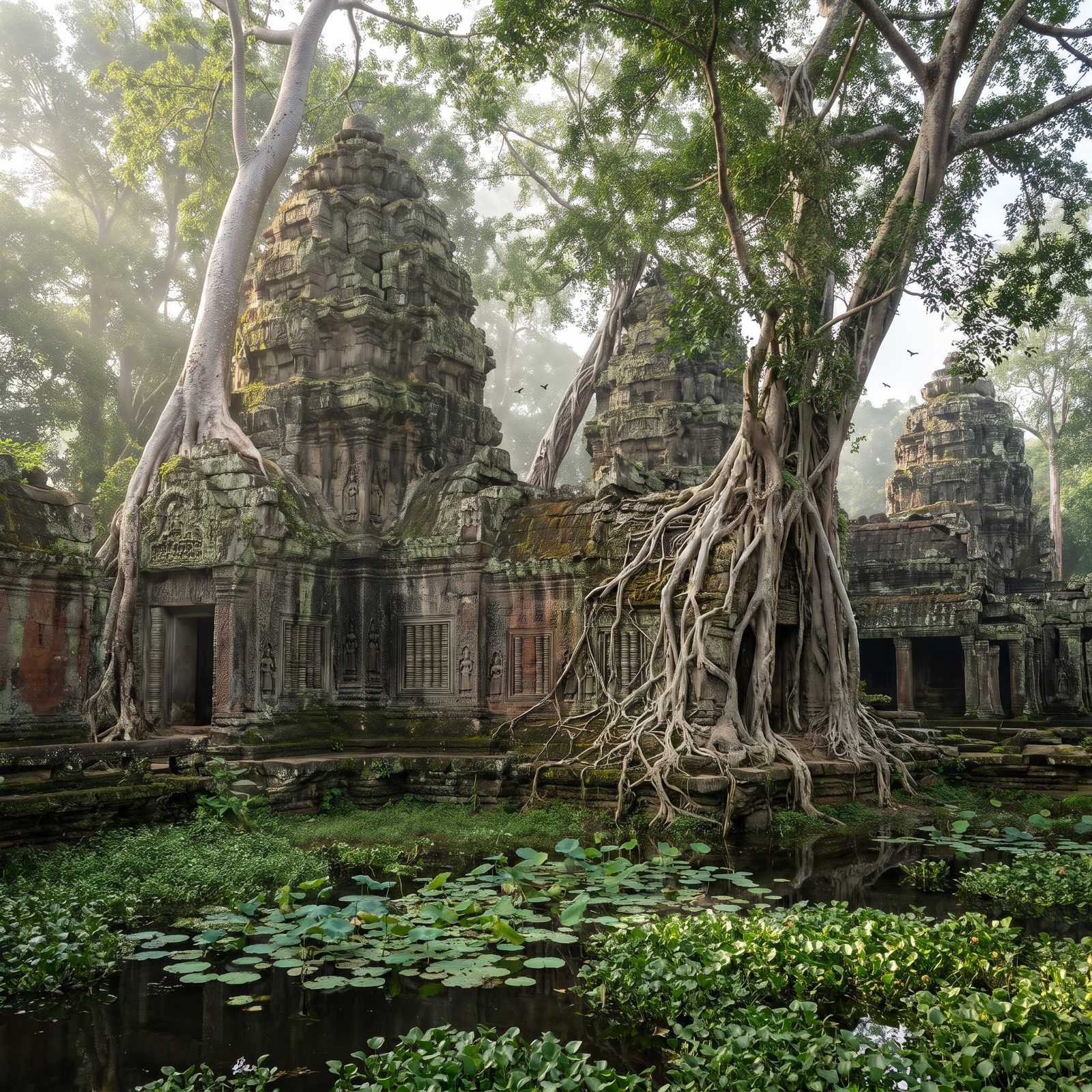
Angkor Wat already shows you the ending. Walk Ta Prohm next door and you’ve seen strangler figs pry temples apart root by root, stone and tree locked in a slow wrestling match the tree always wins.
Give the main temple a thousand years without a single groundskeeper and the jungle finishes the job. The sandstone here is soft, quarried from Phnom Kulen and hauled downriver, and monsoon rain eats into soft stone fast. So the towers lean, then shed, then feed the very roots climbing over them.
36. Petra’s Treasury Erodes Back Into the Rose-Colored Cliffs
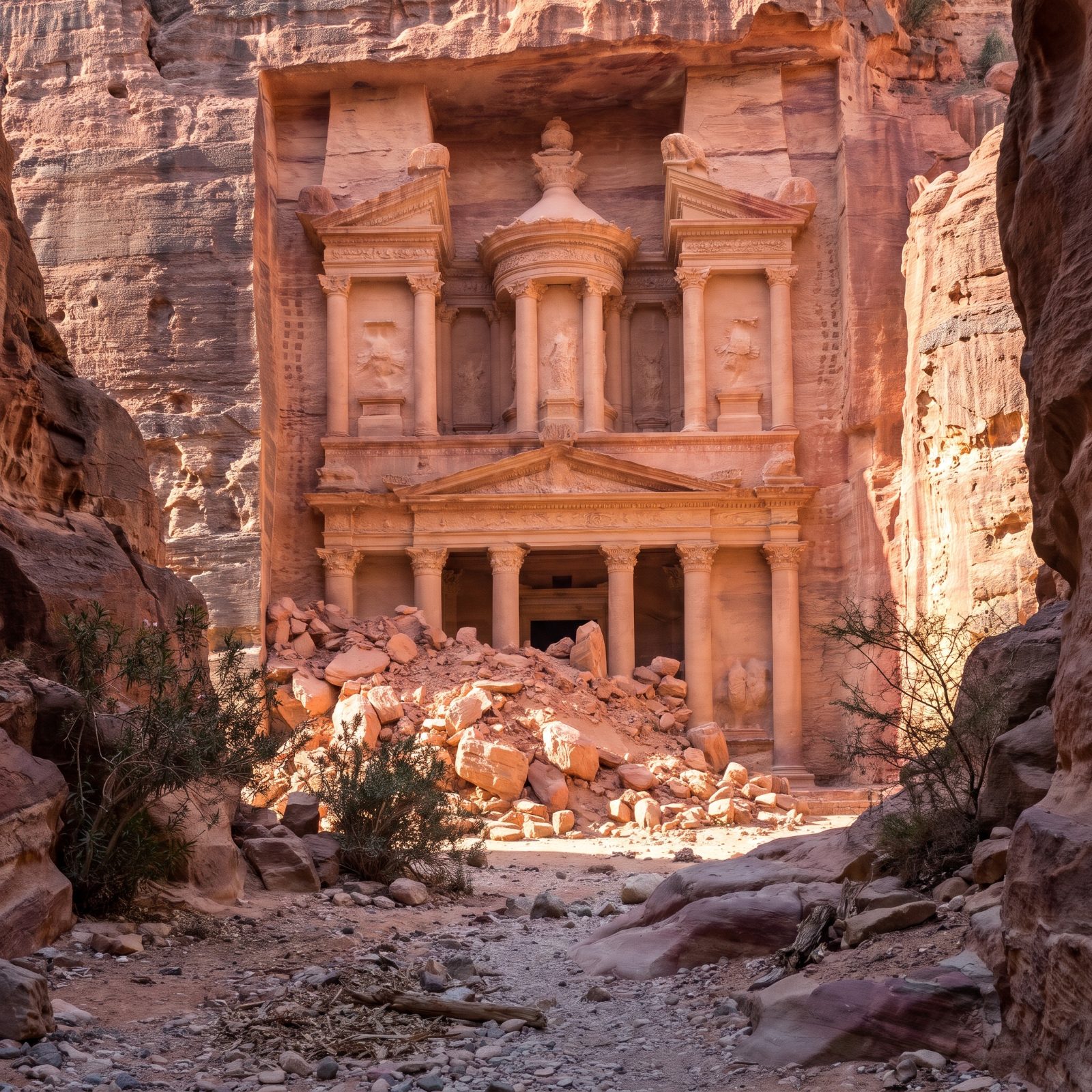
The Treasury isn’t a building. It’s a sculpture, carved straight into a living cliff by the Nabataeans more than two thousand years ago, and that changes everything about how it dies.
You can’t collapse a facade that’s already part of the mountain. What you lose instead is the detail. Wind-driven sand works like slow sandpaper, and it has a running order: the faces of the statues go first, while the crisp Corinthian capitals, pediments and cornices hold their edges far longer, and loose rock breaks away until it piles up as rubble at the doorway.
A thousand years from now you’d still know exactly what you were looking at. The capitals, friezes and cornices would still be sharp; only the worn statues and the heap of fallen stone at the door would show the famous rose rock slowly returning to the canyon it came from.
35. The Leaning Tower of Pisa Lies Among a Meadow of Marble Ruins
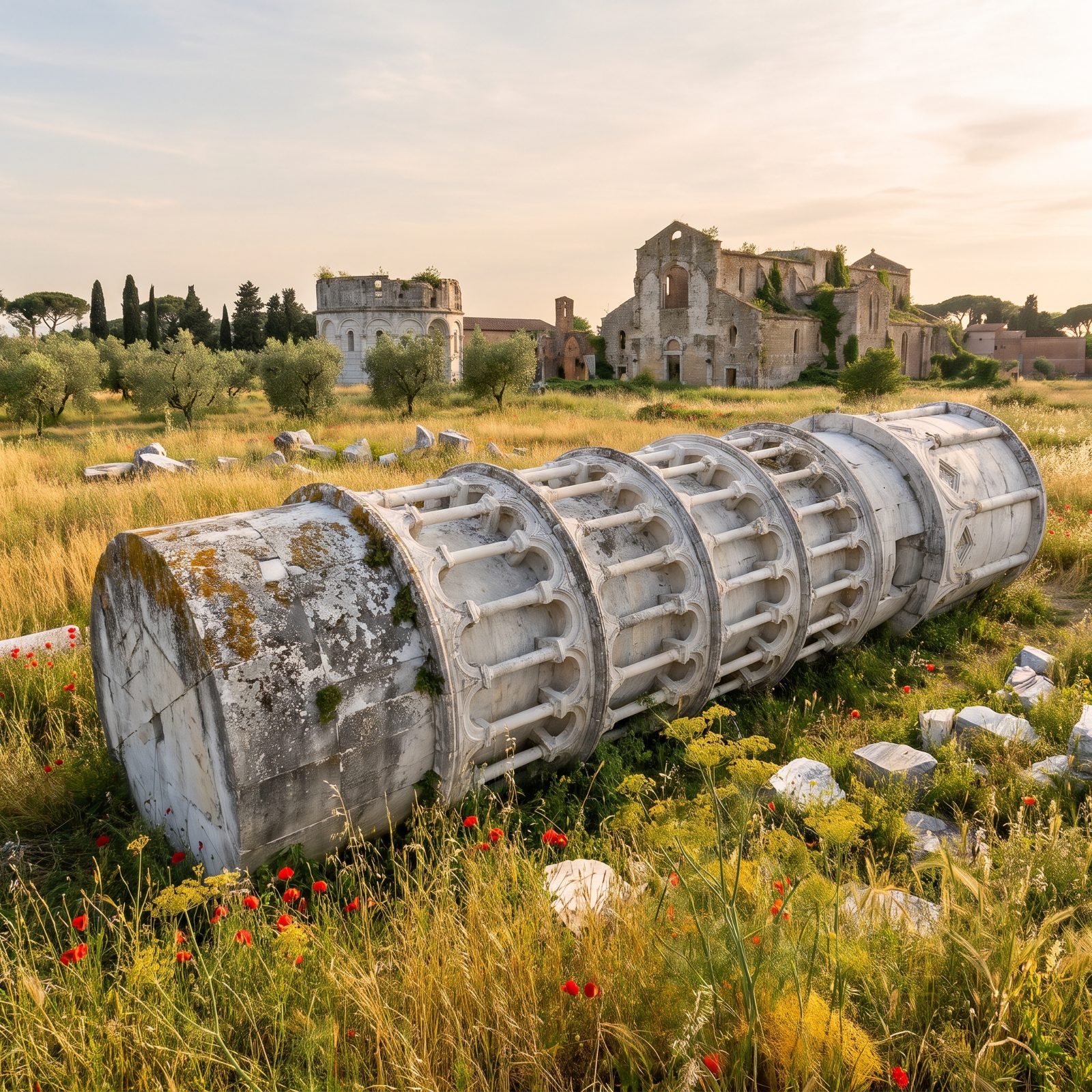
Here’s the irony. The tower leaned for eight centuries only because engineers kept fussing over it, counterweighting the base, pulling soil, buying it time, decade after anxious decade.
Remove the people and the fussing stops. That soft marine clay under Pisa that caused the tilt never stabilizes on its own. The lean keeps creeping, the center of gravity drifts past the base, and one wet winter the whole thing goes.
Picture it a thousand years out: the bell tower lying on its side across a meadow, broken into neat drum sections like a stack of coins somebody knocked over, poppies pushing up between the arches. Still obviously Pisa. Just finally at rest.
34. Notre-Dame Cathedral Becomes a Roofless Stone Sanctuary
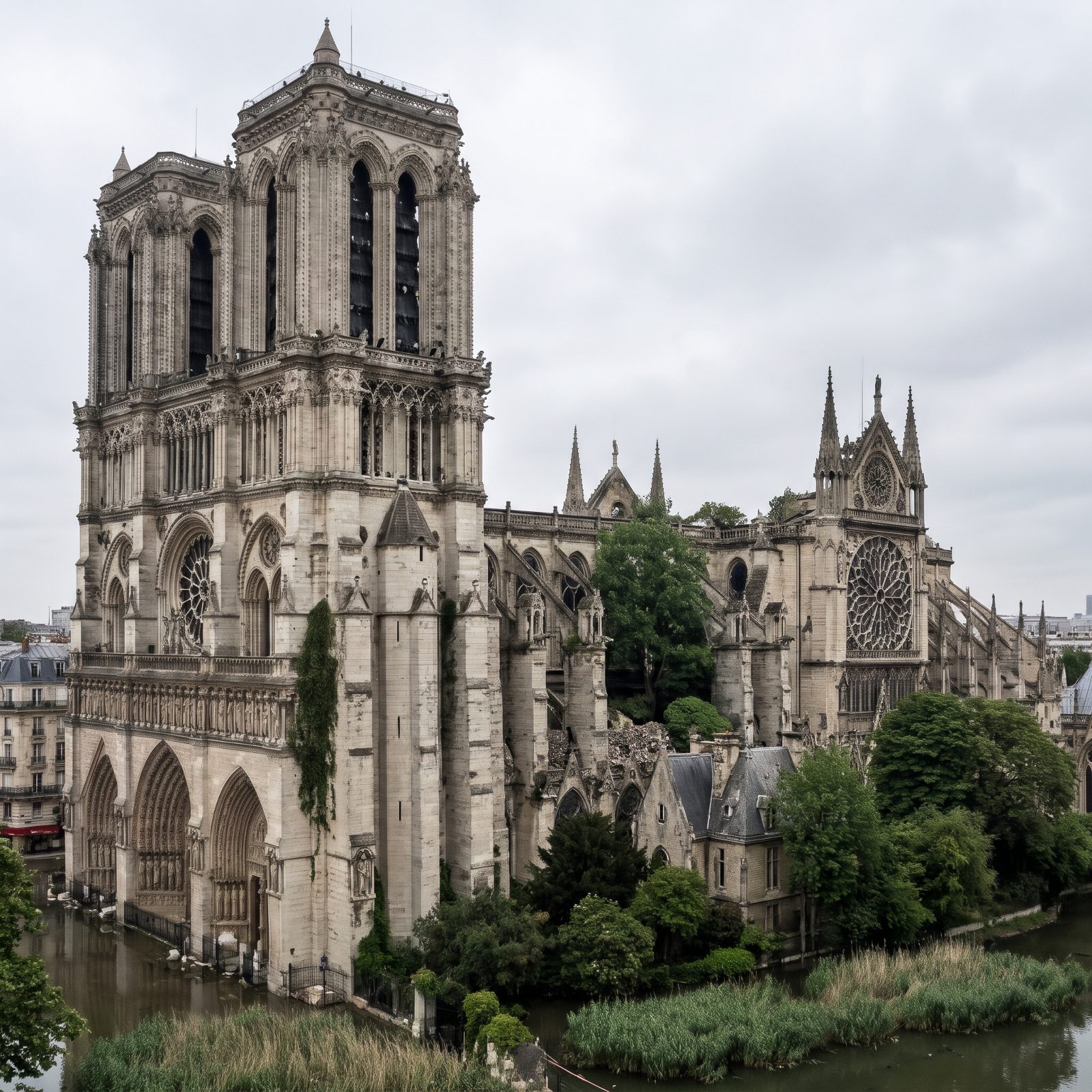
Notre-Dame’s limestone has already outlived a fire, a revolution, and eight centuries of Paris weather. The stone was always tougher than the timber.
And that difference decides how it ages. The oak roof structure, that medieval forest of beams, is the vulnerable part, and the spire has already burned once. But the load-bearing limestone walls and those famous flying buttresses are built to stand on their own, and they do, for a very long time.
What you get is a weathered stone sanctuary that still stands. The roofline, balustrades and tower railings hold, ivy climbs the facade, trees crowd the buttresses, and rubble piles at the foot of the nave. The Seine, left to its own devices, reclaims the low ground of the island around it.
33. The Burj Khalifa Becomes a Hollow Needle in the Desert
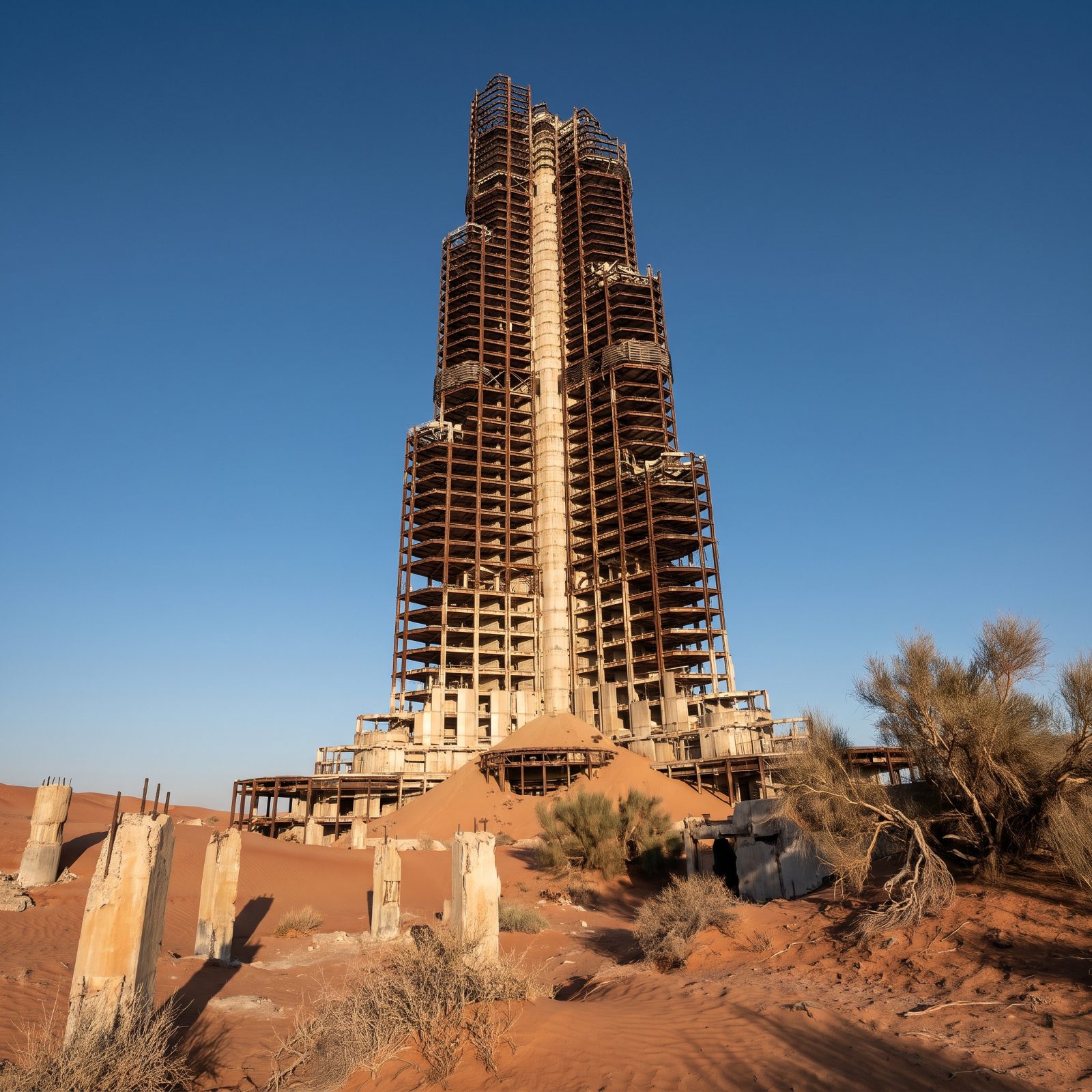
Glass curtain walls are the first thing to go on any modern skyscraper. No caulking maintenance, a few sandstorms and temperature swings, and the panels loosen and fall within a couple of decades. The Burj Khalifa sheds its skin fast.
Underneath is a reinforced concrete core, and concrete has a quiet enemy nobody thinks about. Rebar. Water seeps in, the steel inside rusts, rusting steel expands, and the expansion cracks the concrete from within. Engineers call it spalling. In Dubai’s salt-laden air it runs faster than most places.
A thousand years on, you’d see a rust-stained needle, half its upper floors gone, dunes drifting through the lobby.
32. The Empire State Building Rises Above a Forested Manhattan
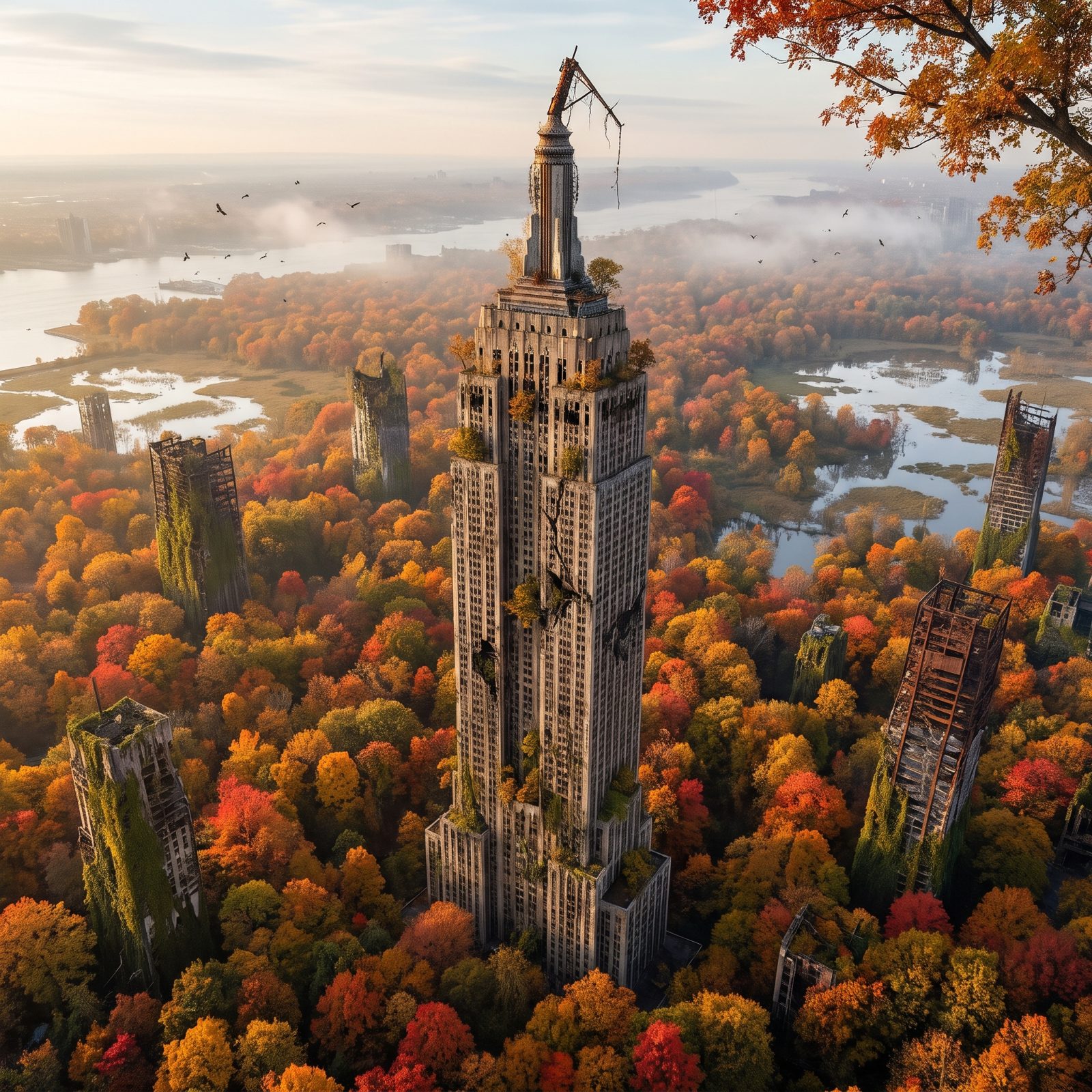
Manhattan wants to be a forest. It was one before 1626, all oak and chestnut and hickory, and the only thing holding off its return is the daily labor of millions of people pumping out the subway tunnels and hacking back the weeds.
Stop that labor and the water arrives first. The subway floods in days. Then come the plants. Seeds blow into cracked sidewalks, roots pry open the concrete, and within a century the street grid is woodland.
The Empire State Building’s steel frame and limestone skin hold on longer than most. A thousand years out it’s still a recognizable Deco spire, rusting at the mast, trees waving out of empty window frames, standing over a forest that finally took its island back.
31. Mount Rushmore’s Faces Blur Under Frost and Lichen
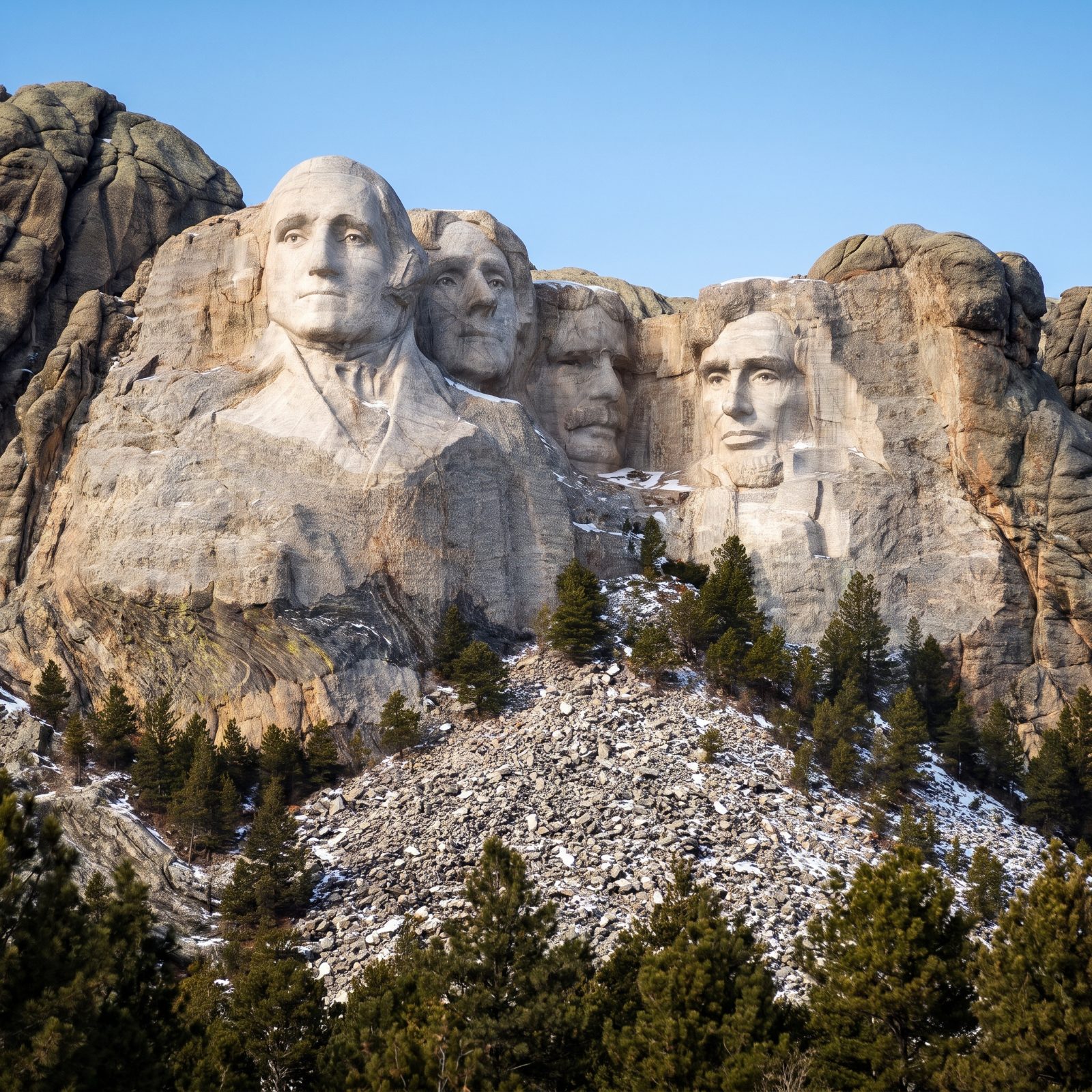
Granite is the slow one. Gutzon Borglum chose it precisely because it erodes at a crawl, something like an inch every ten thousand years on a clean face.
So the faces don’t melt, and they’ve barely blurred. The real damage comes from the natural cracks in the rock, the ones the carvers worked around. Water seeps into those seams, freezes in Black Hills winters, expands, and pries the stone apart a hair at a time. Freeze-thaw does in a thousand years what rain alone couldn’t manage in a hundred thousand.
Orange and green lichen and rust-coloured staining spread across the rock and creep onto the faces themselves. Washington’s nose, still crisp and sharply detailed. Lincoln, flatter, sunk into a squared-off niche like a relief on a wall, with blocky rectangular forms below his beard.
30. The Hollywood Sign Crumbles Across a Chaparral-Covered Hillside
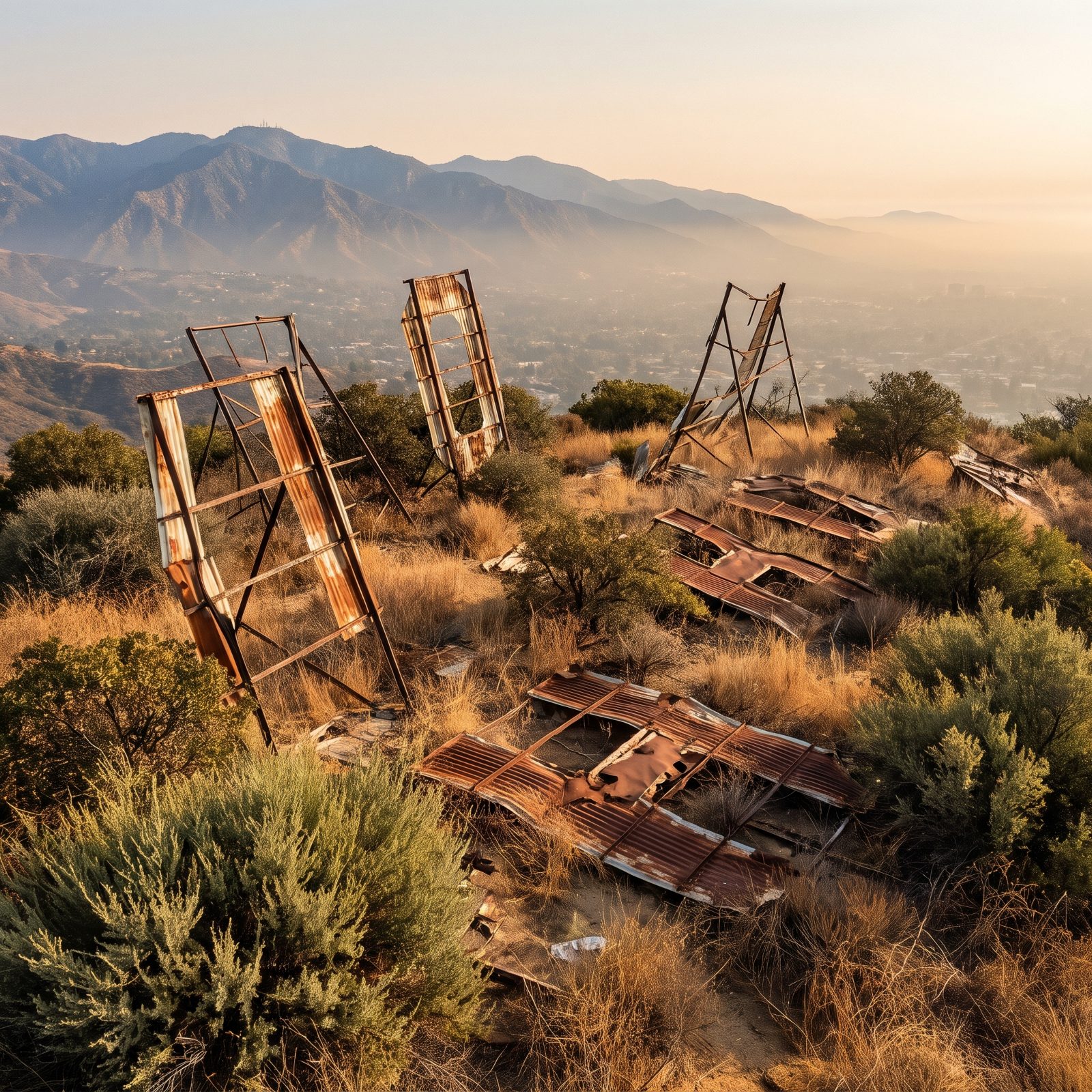
The sign was never built to last. It went up in 1923 reading HOLLYWOODLAND, a real estate ad meant to stand eighteen months, and it’s been rebuilt and rescued ever since. Which tells you exactly how it ends once the rescuing stops.
Sheet metal and steel in a dry fire-prone climate have one real enemy, and it isn’t rust. It’s wildfire. The chaparral below burns on a natural cycle, and a few hot seasons buckle and topple the letters down the slope.
A thousand years from now the brush has reclaimed Mount Lee, and the letters lie scattered and rust-eaten across the hill, still just legible if you know where to look.
29. The White House Becomes an Ivy-Covered Shell
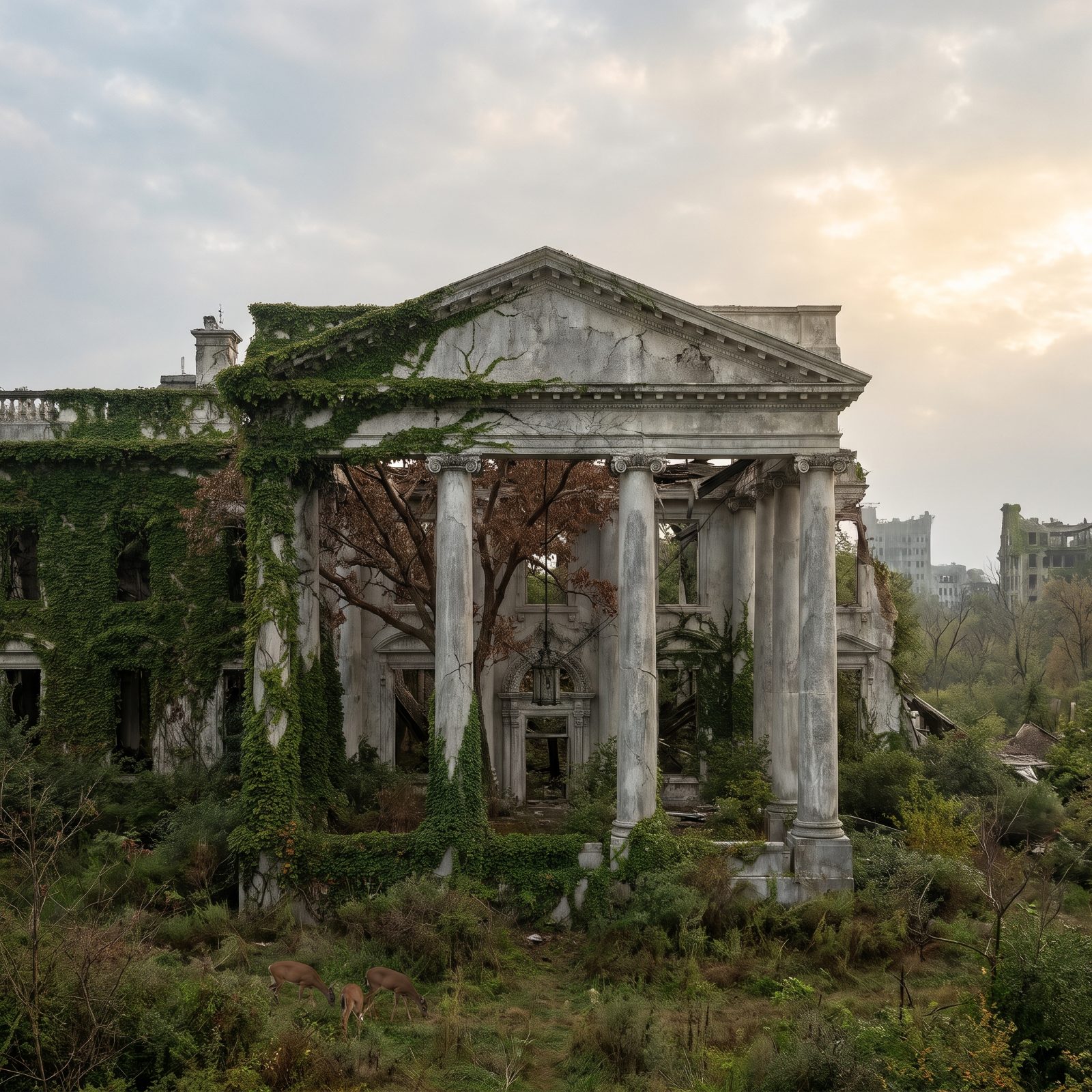
The famous white isn’t stone color. It’s paint, coat upon coat of it over porous Aquia sandstone that would otherwise soak up water and crumble. That paint is doing all the work.
Nobody refreshes it anymore, so the sandstone starts drinking. It weathers to grey, then cracks, then spalls. The timber roof goes early, as timber always does, and the interior opens to the rain.
Washington’s climate is humid and green, so the plants move fast. Ivy sheets the walls. A tulip poplar takes root in the East Room. The lawn becomes forest within a couple of centuries, while the columns of the North Portico hold out longest of all. A recognizable shell, wrapped in green, standing quiet in the woods.
28. The U.S. Capitol Dome Opens to the Sky
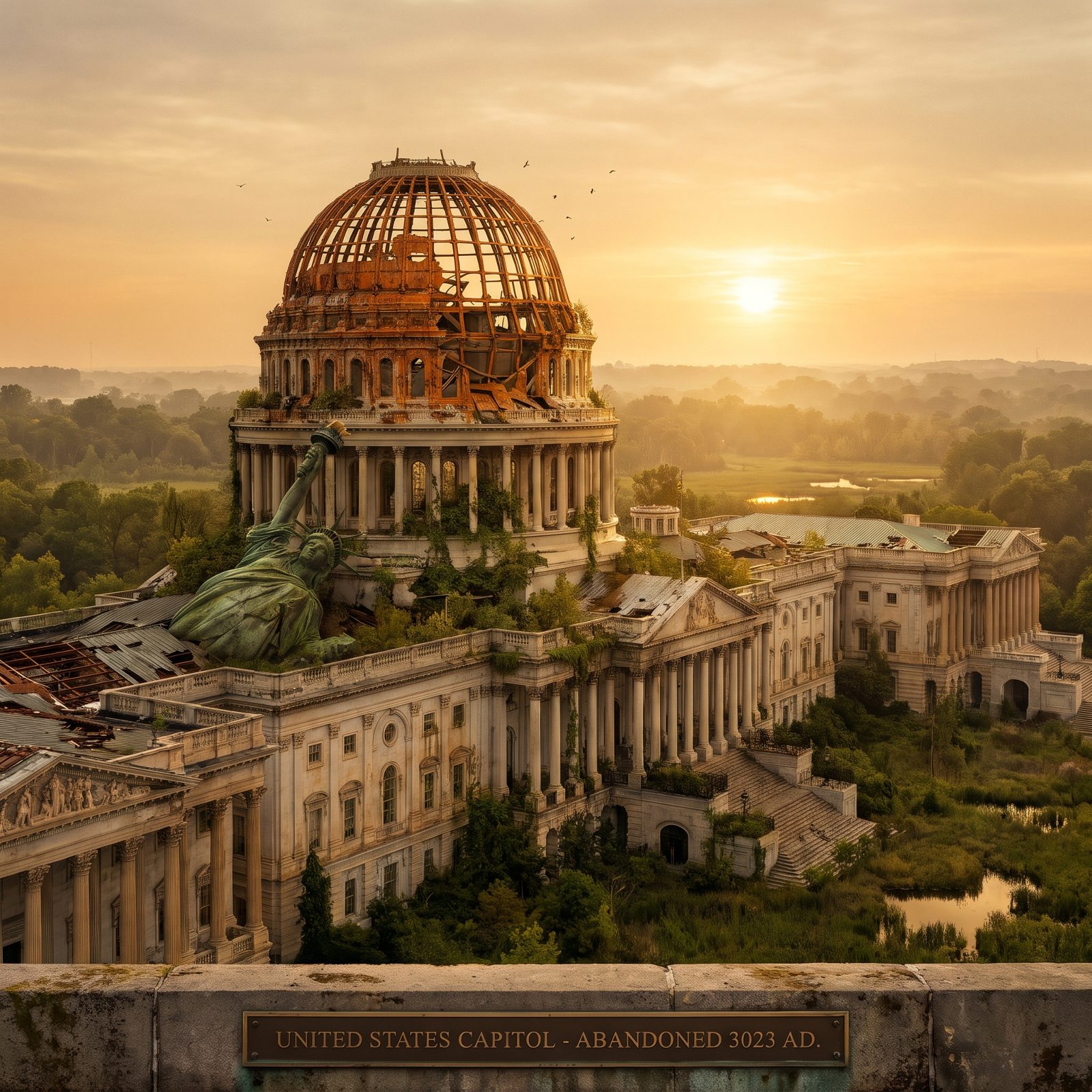
People assume the Capitol dome is stone. It isn’t. It’s cast iron, nearly nine million pounds of it, painted to pass for the marble below so the join would read as one material.
Iron rusts, and that rewrites the timeline completely. Without the constant repainting the whole dome depends on, oxidation sets in, plates weaken, and the structure starts failing from the side, panel by panel. The great coffered interior opens to weather, then to sky.
Give it a thousand years and the dome is a rusted crown, half caved in, shrubs sprouting from its ledges and from a gaping hole in its side, while the Statue of Freedom is gone, leaving only a broken ring of spiky debris where the lantern once stood. The sandstone wings stand longer. Around it, trees crowd in, and the Mall has vanished entirely beneath marsh, ponds and forest, with no lawns or paths left to trace.
27. The Brooklyn Bridge Sags Above a Rewilded East River
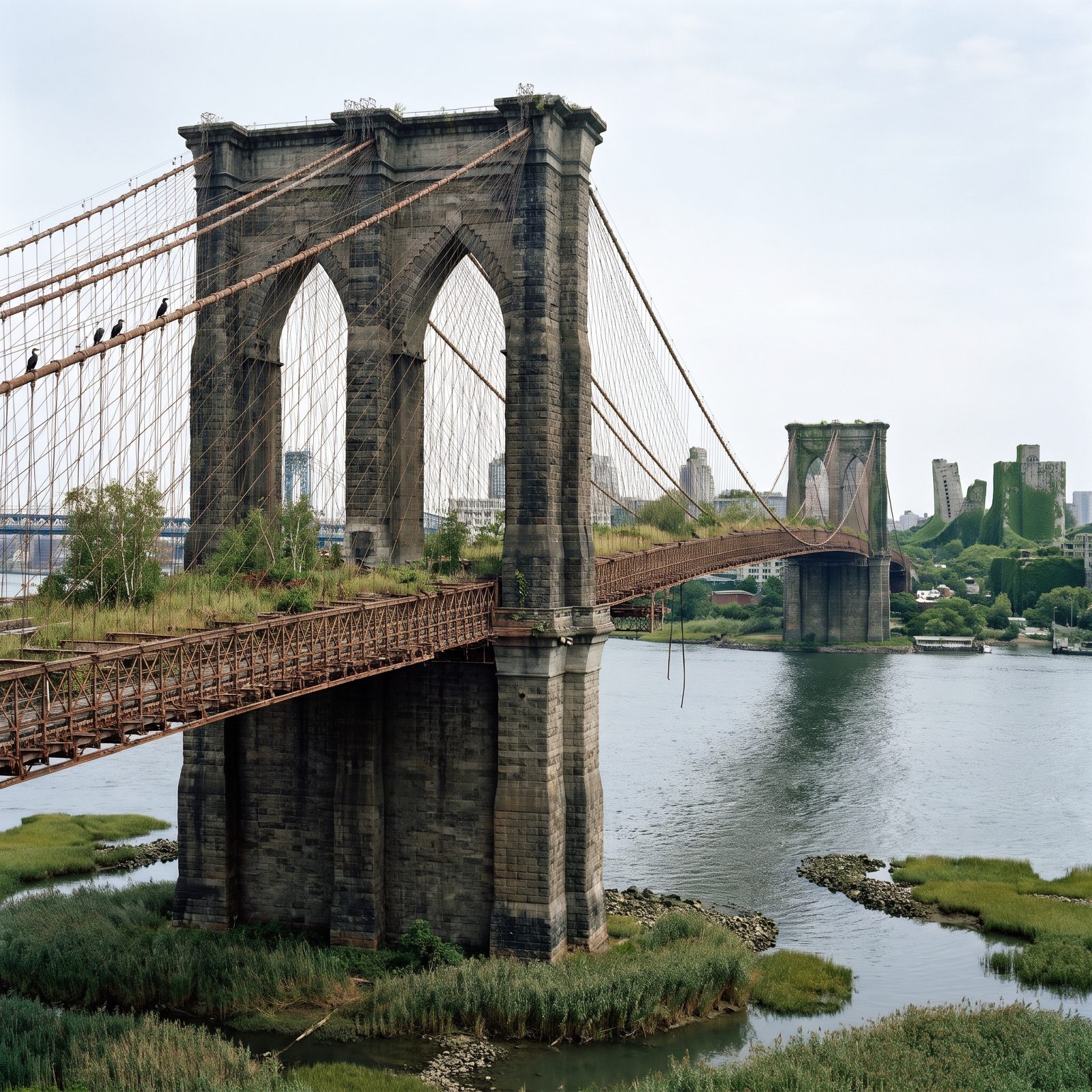
Here’s the surprise: the towers outlast the cables. That granite and limestone carrying the deck was built like cathedral piers, and stone shrugs off a millennium far better than steel wire wound into rope. So the cables go first, strand by rusting strand, until the deck droops into the river like a hammock nobody bothered to tie off.
But what rises underneath matters more than what falls. The East River was once a working harbor choked with industry — pull the people out and the oysters return, filtering the water clear enough to see bottom while reed beds colonize the old piers. The bridge stops being a crossing. It becomes a perch.
26. The Brandenburg Gate Stands Alone in a Birch Forest
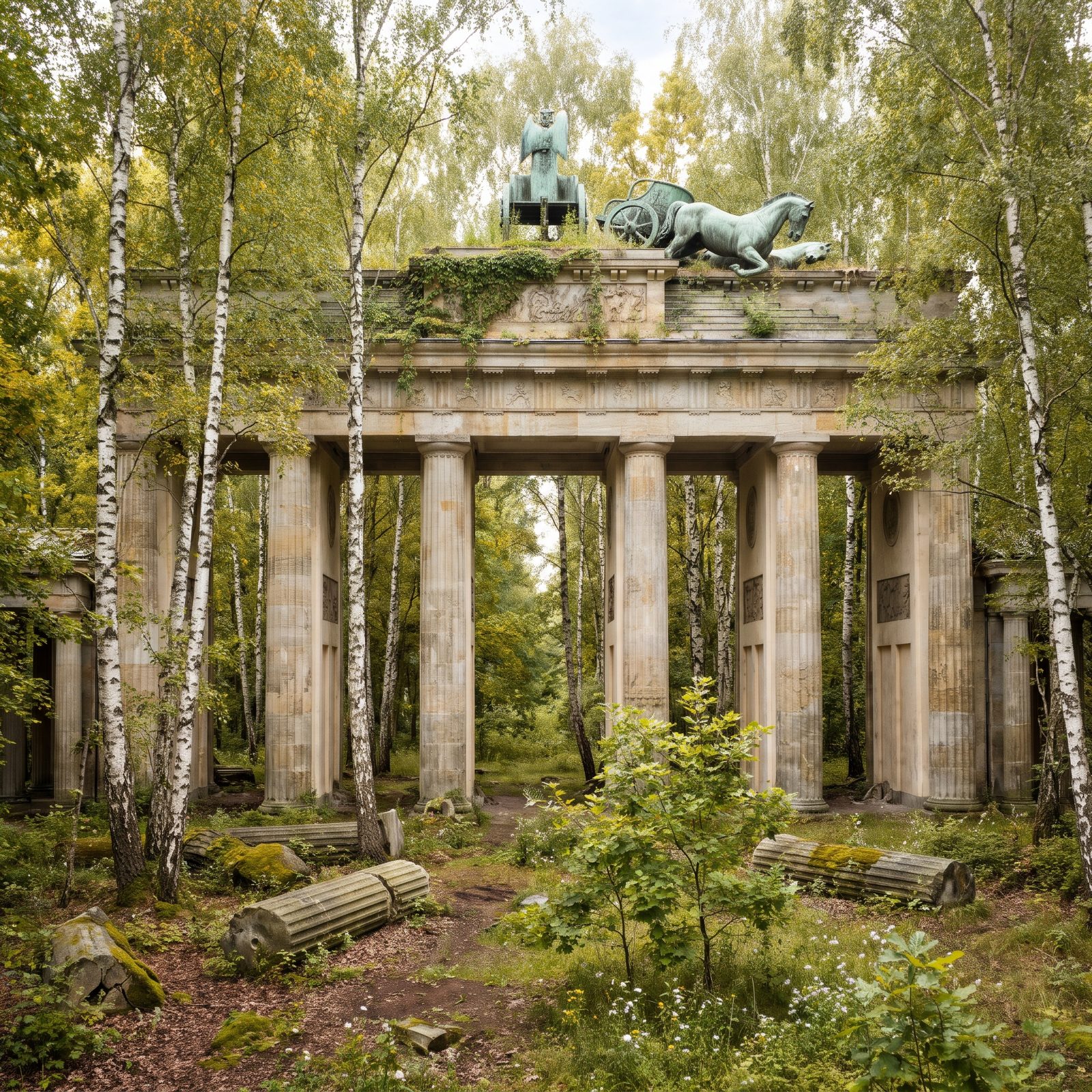
Berlin has already shown us a preview. After 1945, bombed-out lots filled with birch within a few summers — it’s a pioneer tree that colonizes rubble faster than almost anything in a temperate climate. Give the city a thousand years and the gate stands inside a young forest of white trunks, light flickering between them.
Sandstone is the vulnerability. Soft, thirsty, flaking layer by layer under frost, the columns stain and crack, yet all six still stand, their fluting crisp and sharp, while loose fluted drums lie scattered in the undergrowth before them. The bronze Quadriga on top — a winged figure in a chariot drawn by four horses — is far tougher, though not unscathed. Atop the still-standing columns it holds its place on the roof, green amid the rooftop grass, one horse collapsed on its side at the attic ledge, a second horse’s head jutting out beside it.
25. The Parthenon’s Remaining Columns Weather on an Empty Acropolis
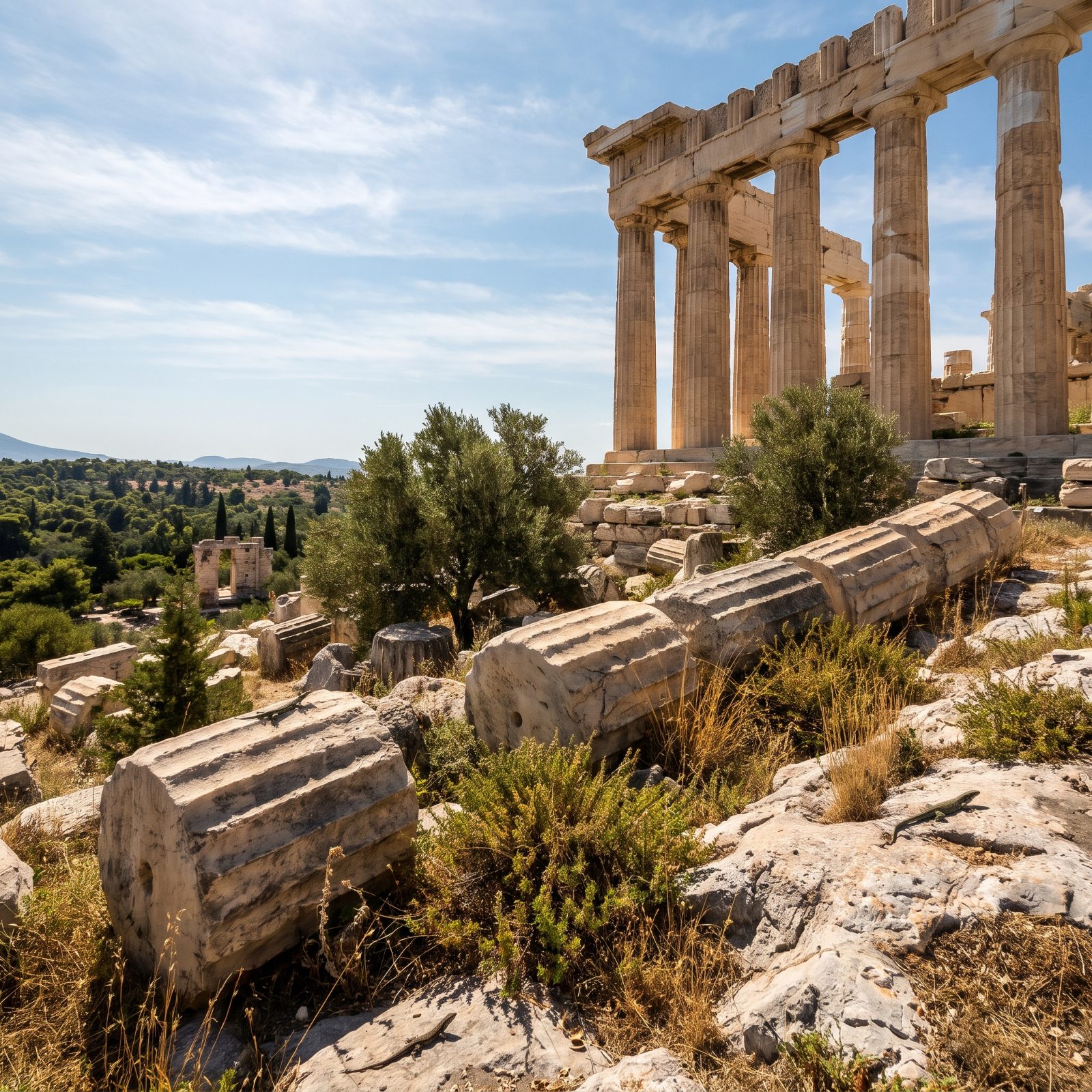
It is already a ruin, which makes the thought experiment honest. The Parthenon has stood roofless since a Venetian shell found the Ottoman gunpowder stored inside it in 1687. So a thousand years from now isn’t collapse so much as continuation.
Pentelic marble has a quiet enemy — acid. Rain and pollution dissolve the calcium carbonate grain by grain, turning crisp fluting into a sugary, rounded surface. A few more columns give way, their drums rolling apart like stacked coins knocked over, and wild olive and thyme root in the gaps, the same tough plants that have always owned this dry hill.
24. Hagia Sophia’s Great Dome Opens Above a Wild Courtyard
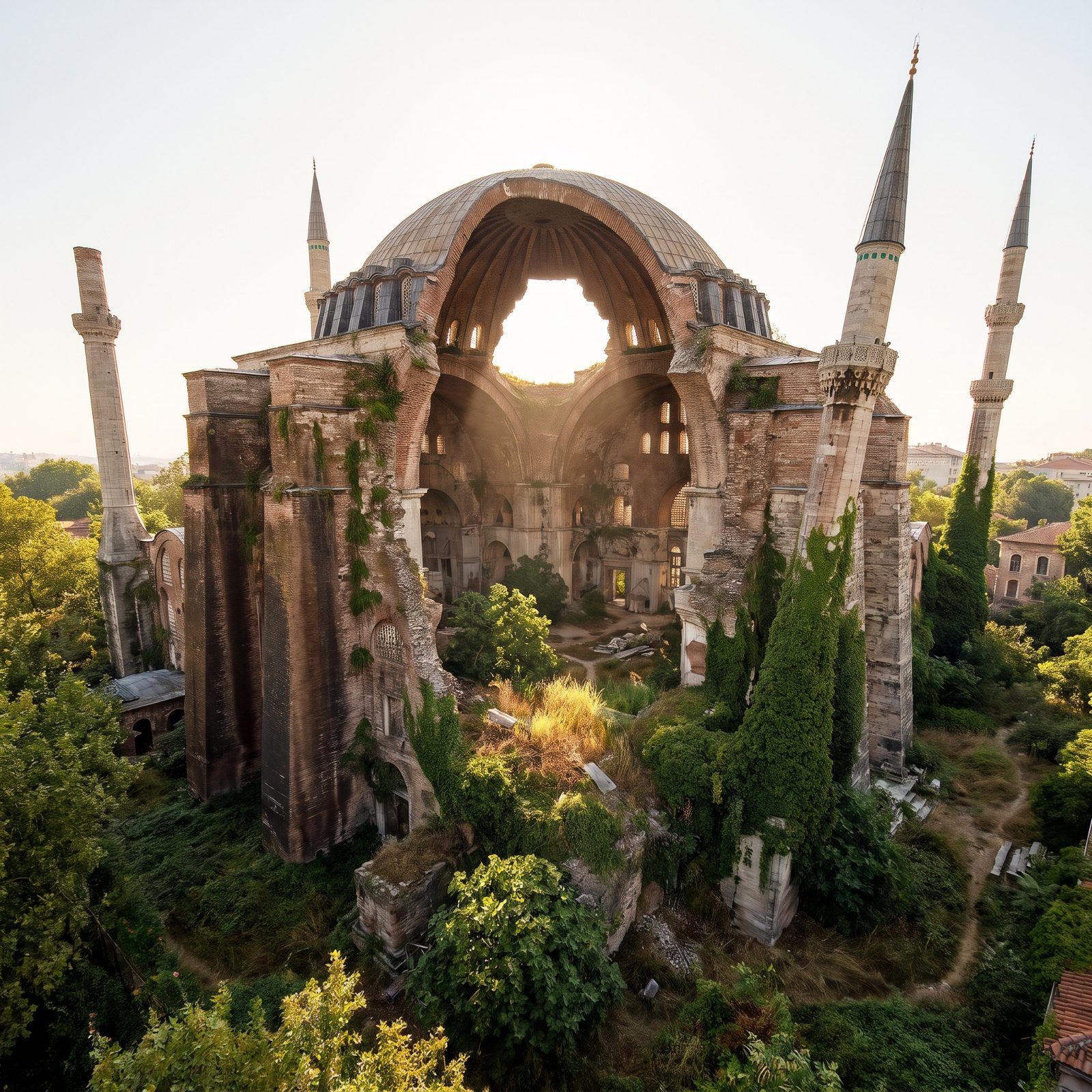
For nearly a thousand years this was the largest enclosed space on Earth. The dome spans over 100 feet and seems to float — a trick of hidden ribs and the ring of windows around its base — and that span is also its weakness. It has caved in before, after earthquakes in 558 and again across the 10th and 14th centuries, and every time, people climbed back up and rebuilt it.
Nobody does this time. One side gives way. Sunlight pours through the gap into the nave, and in that falling column of light a fig seed finds the rubble, sprouts, and grows straight toward the hole in the roof. The minarets — those slender Ottoman afterthoughts — mostly hold, spires intact, though the tall one out front tilts and bows along its shaft, while another loses its cap and leans outward, truncated, its broken top ragged against the sky.
23. St. Basil’s Cathedral Loses Its Colors Beneath Moss and Snow
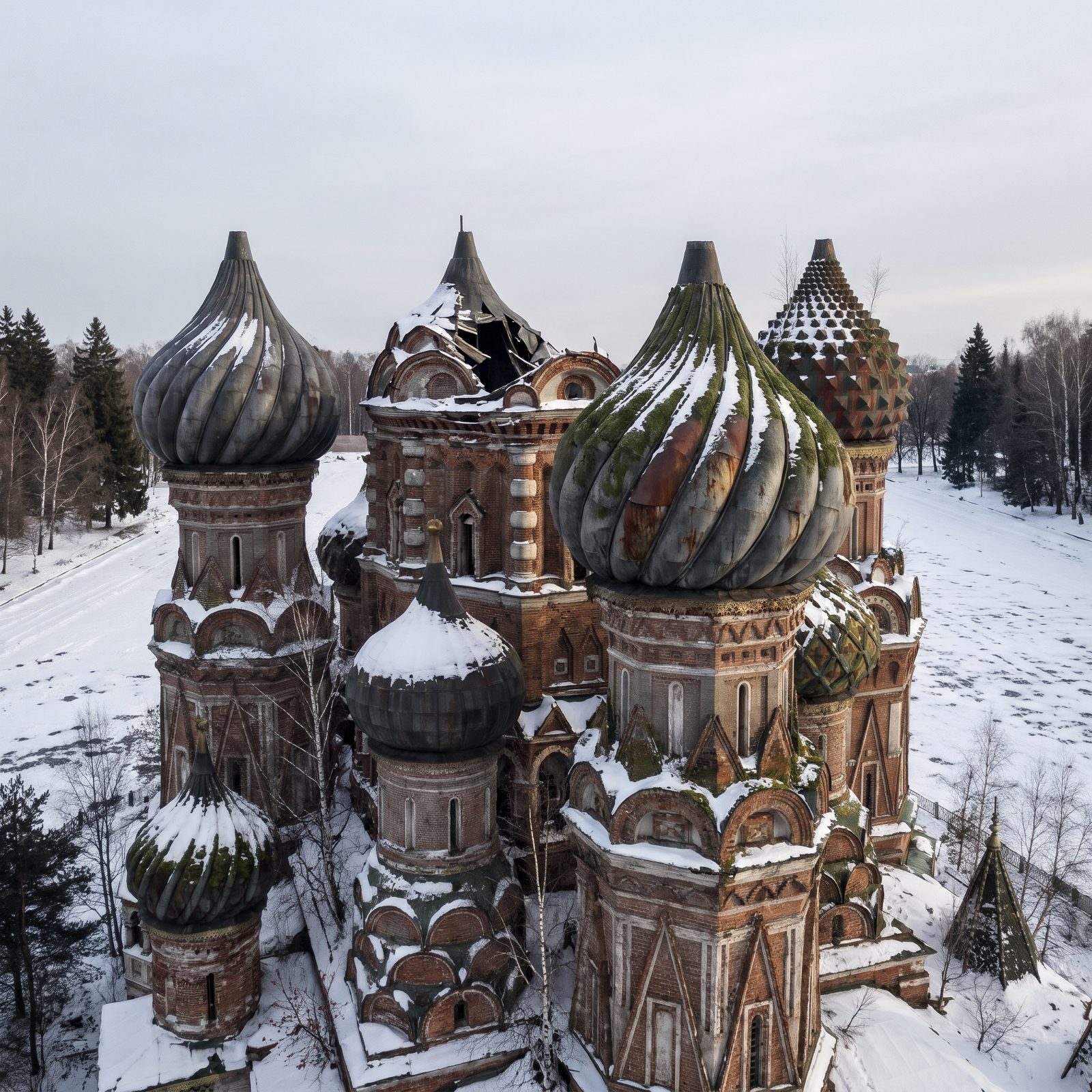
The riot of color has faded. Those swirling reds, greens and golds were paint and glazed tile — a skin now worn down to dull grey metal on the domes, with only faint traces of green, red and rust, above brickwork weathered to a muted, patchy brown. Yet the shape was always the real genius of the place. You’d know it by silhouette alone, out there in the snow.
Then Russian winters start their slow demolition: water seeps into brick, freezes, expands, and splits it apart, one freeze-thaw cycle after another until a dome or two finally caves. Birch and rowan — stubborn northern colonizers — sprout from the ledges wherever a little soil collects.
22. The Moai of Easter Island Sink Deeper Into the Grasslands
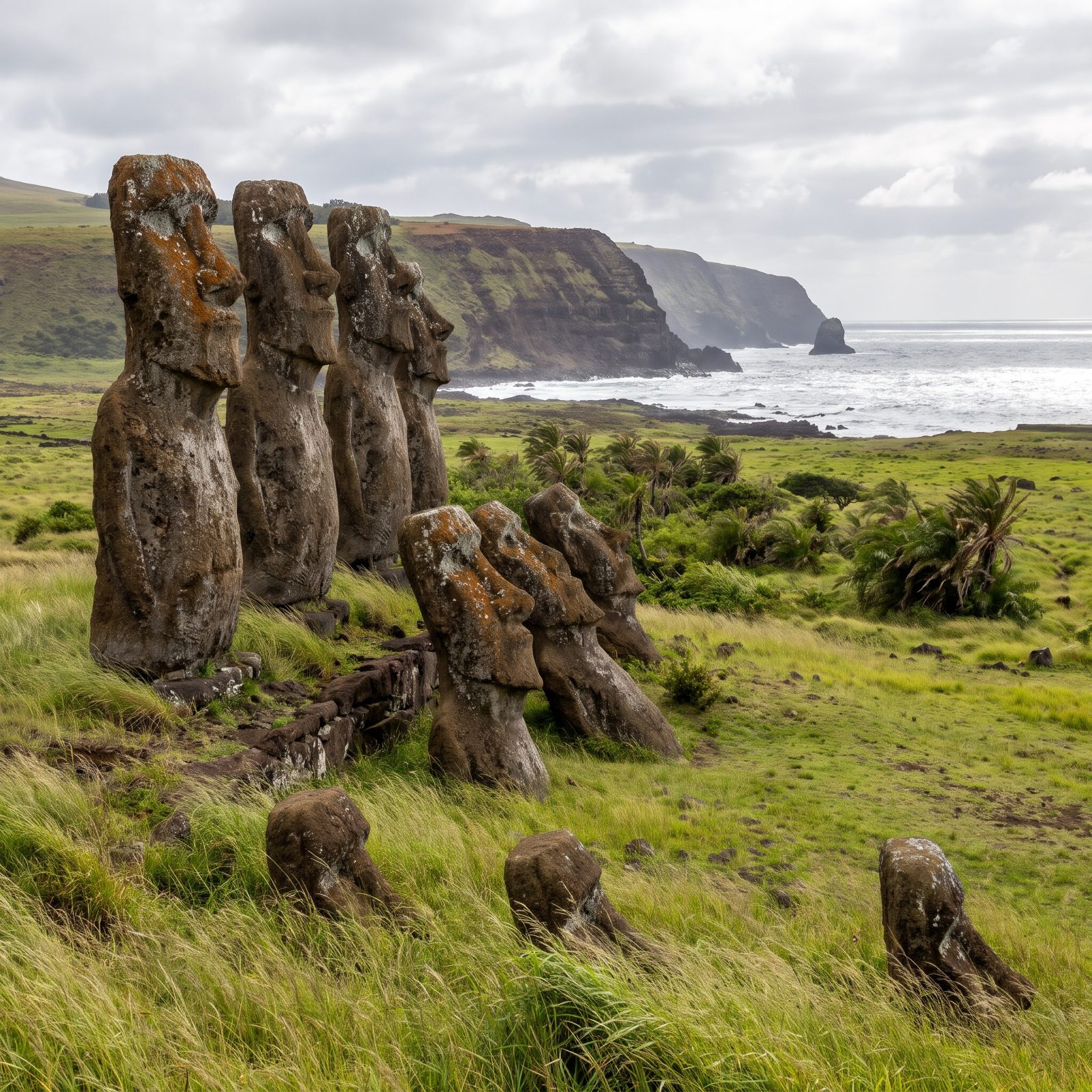
They were sinking before we left. The famous “heads” aren’t heads at all — they’re full-body statues whose torsos were gradually buried by a thousand years of soil creep and erosion washing across the coastal meadow. Give them another thousand and they go deeper still, foreheads barely breaking the grass.
The moai are carved from volcanic tuff, soft and porous, and the features here are already going. Salt wind and rain have rounded off the noses, brows and lips of the buried heads, leaving featureless, rounded lumps; meanwhile lichen claims the standing figures, stitching a crust of orange and grey across every face. The island keeps the wind, the grass, the sea. The watchers slowly sink into the ground beside the platform they once stood on.
21. Chichén Itzá Returns to the Yucatán Jungle
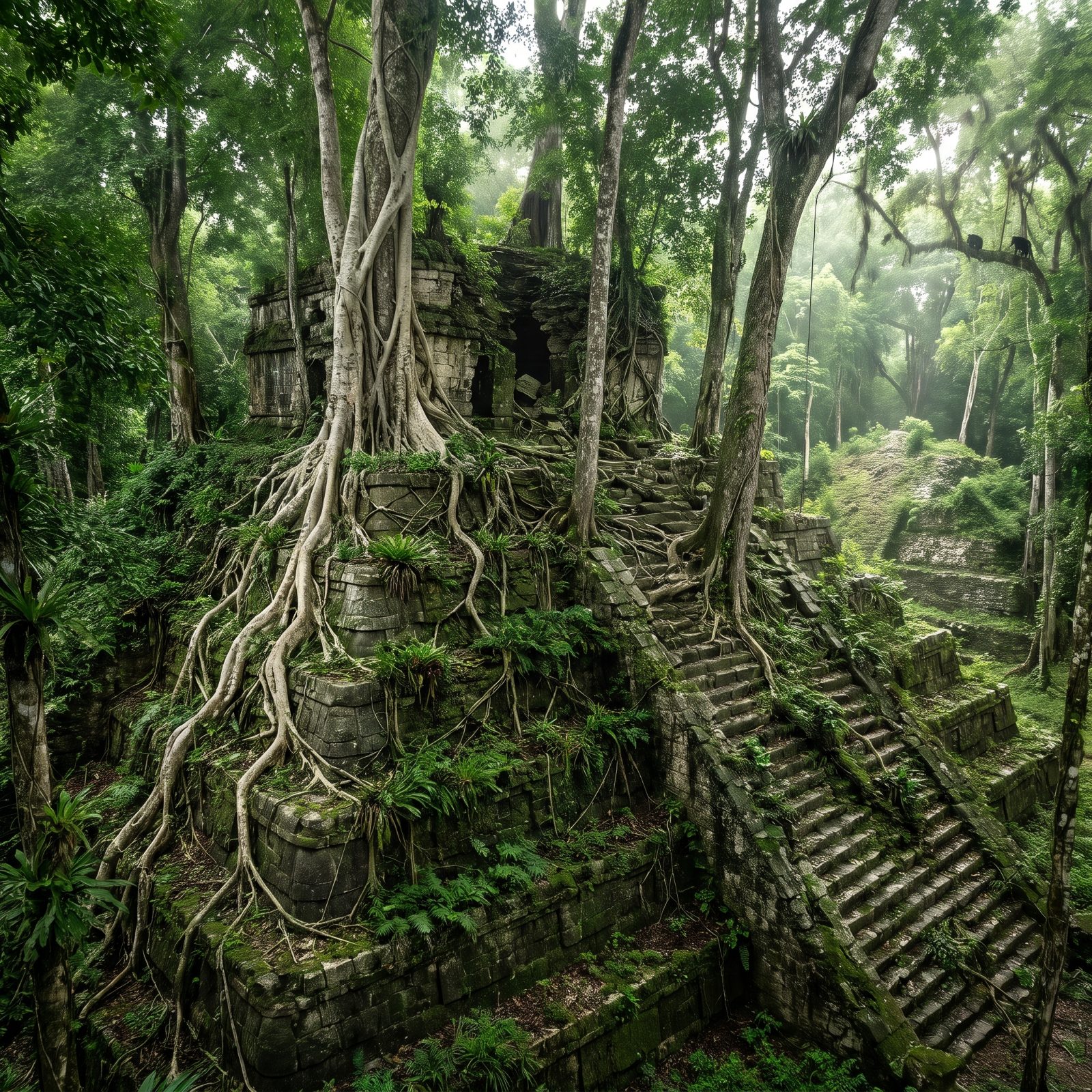
This is the easiest future to picture, because it already happened once. Chichén Itzá sat lost under jungle for centuries before anyone cleared it. The forest has muscle memory for this site.
In the Yucatán, the strangler fig does the demolition. Its seed lodges in a crack, sends roots down into the joints, and slowly pries the limestone apart as it thickens. El Castillo keeps its stepped outline, but the crisp edges soften into green-furred slopes, stairs buried under rubble and leaf litter. Ceiba trees — sacred to the Maya — grow straight out of the upper terraces, and howler monkeys reclaim the acoustics of a plaza that once echoed with crowds.
20. The Forbidden City Turns Into a Walled Urban Forest
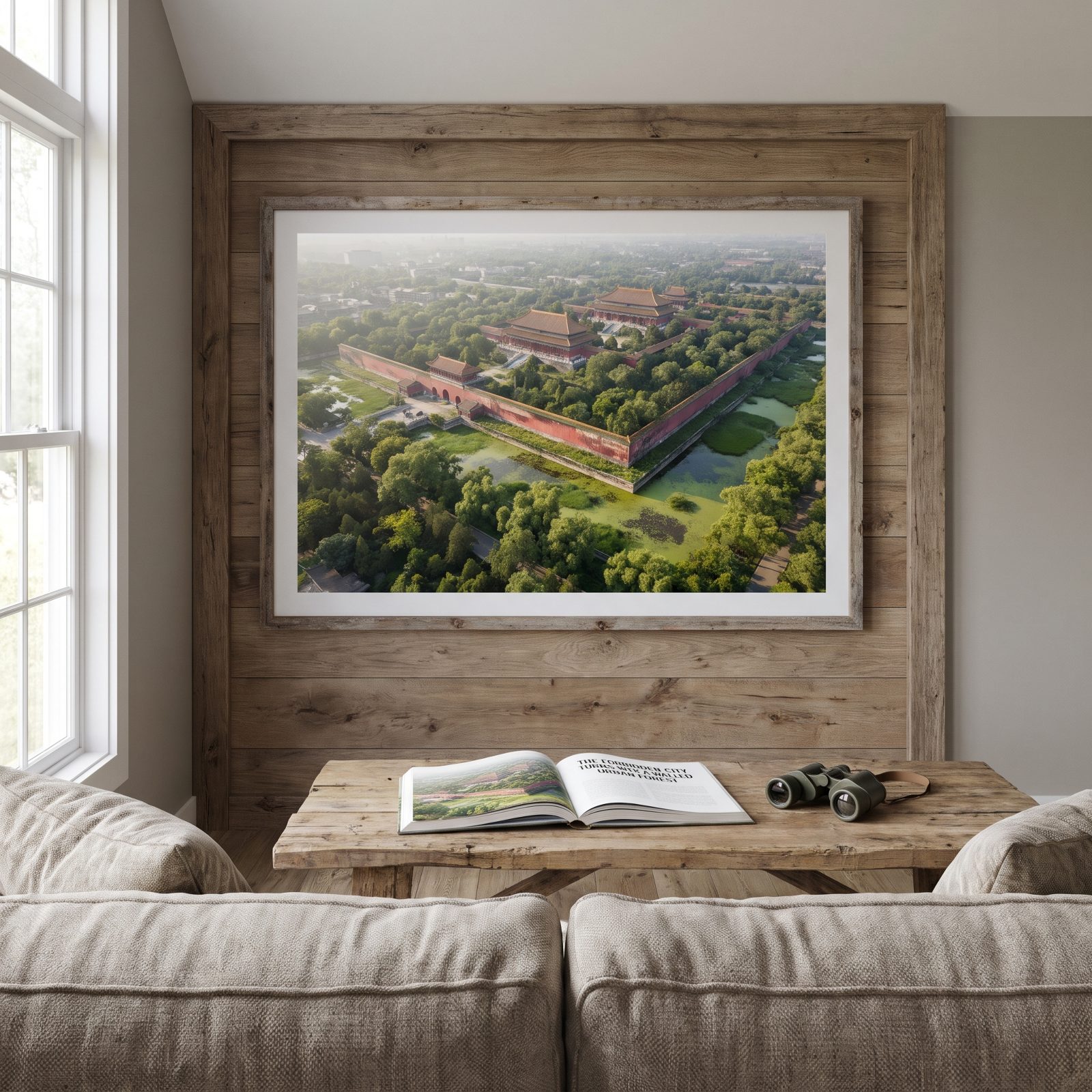
The walls are the headline. Pounded earth faced with brick, thick and tall, they hold their rectangle firm, and from above you’d still read the plan — a great red frame around a green wilderness.
The halls still stand. Chinese palace architecture rests on wooden columns and bracket sets, and here they hold: the glazed yellow roofs, once reserved for the emperor alone, keep crisp, unbroken ridgelines above clean white terraces, while the trees press in around them. What was the most controlled space in all of China becomes an enclosed woodland of pagoda trees and elms, the moat turned to reed marsh loud with frogs.
19. The Terracotta Army Reemerges in a Collapsed Earthen Vault
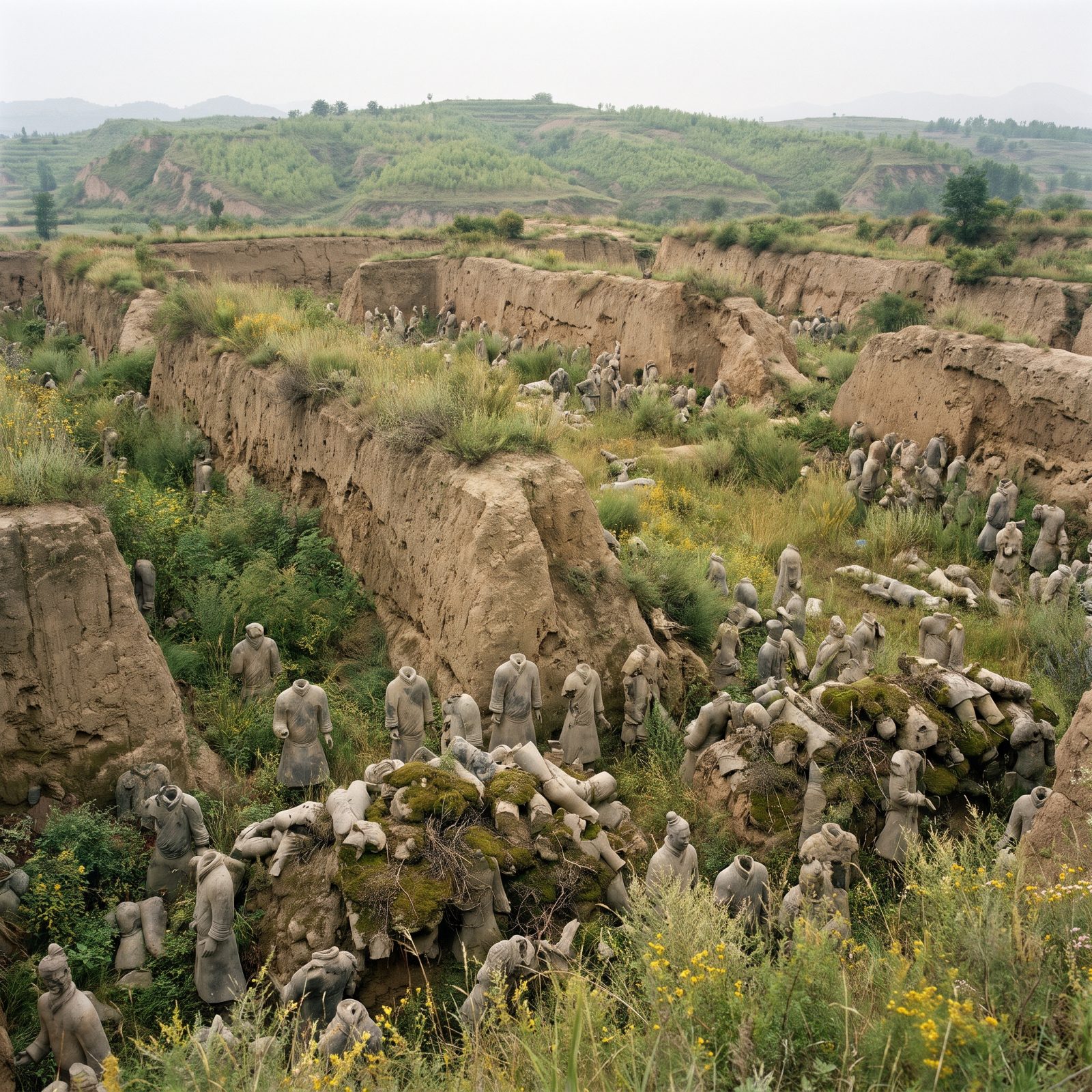
They were buried once and dug up once. Qin Shi Huang’s clay army, over 8,000 figures strong, spent more than two thousand years underground before farmers hit them digging a well in 1974. The modern hangar sheltering them is young and fragile by comparison.
Pull the roof away and the loess does what loess does. This fine, windblown soil slumps easily, so the earthen walls between the trenches collapse back over the ranks, half-reburying the soldiers who survived the dig. Fired terracotta is tough stuff, but a millennium of frost and root pressure cracks it. Some figures stand headless in grass. Others lie toppled in rows, as if the formation finally broke after a very long watch.
18. Fushimi Inari’s Torii Gates Wind Through Untamed Woodland
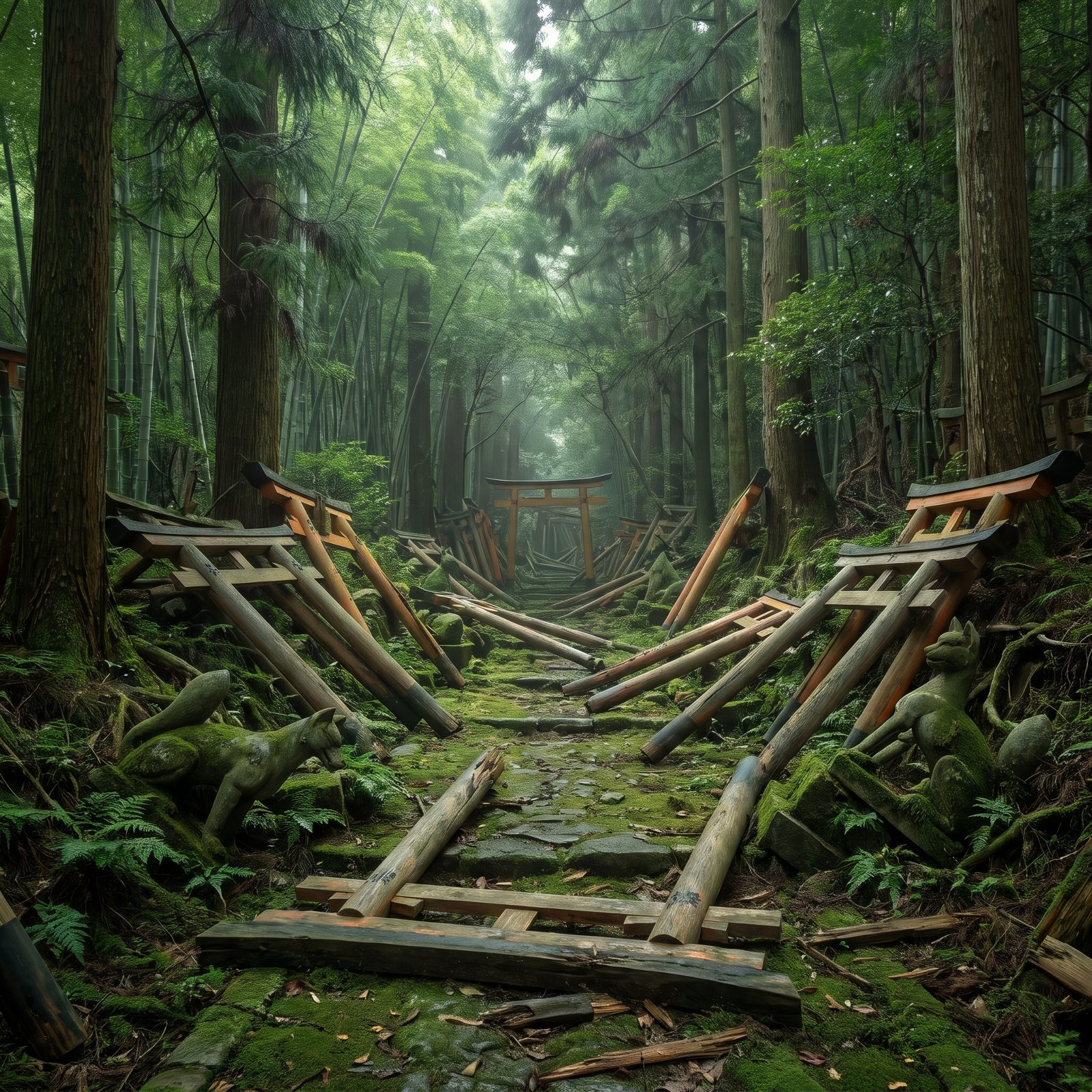
Thousands of vermilion gates climb the mountain behind Fushimi Inari, each one donated and repainted on a cycle that has run for centuries. Stop the repainting and color is the first casualty — the cinnabar fades to grey, and then the gates start coming down.
They’re among the most perishable landmarks here. Japanese cedar left to Kyoto’s wet climate rots fast, and torii were built to be replaced, not to last a thousand years in the first place. Most fall and lie across the path, moss stitching them into the forest floor, while a scattered few still stand, leaning, framing a trail that cedar and bamboo have swallowed whole. The stone foxes keep watch, still upright and green with moss.
17. Marina Bay Sands Stands Stranded in a Tropical Wetland
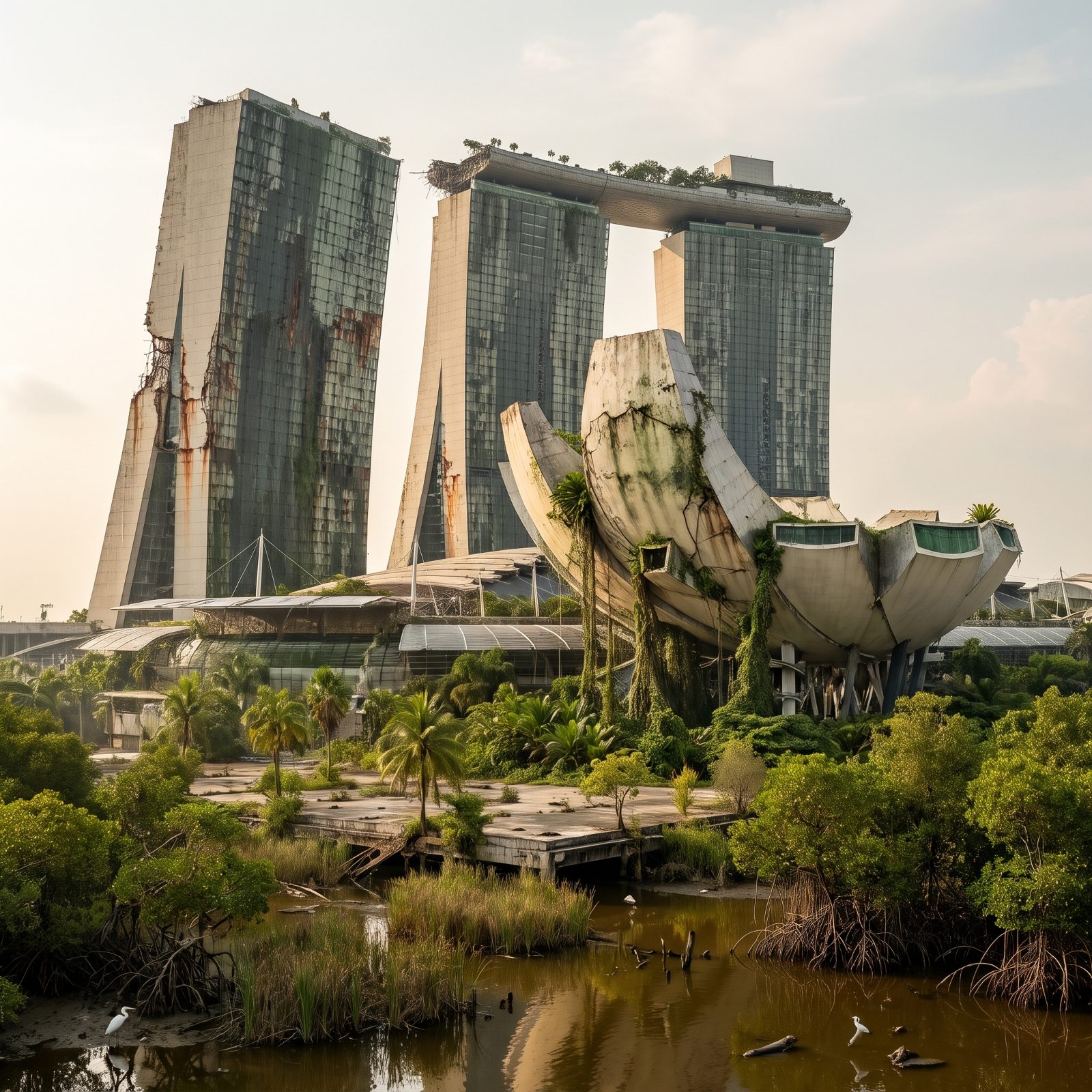
The resort that once balanced a ship on three legs is, remarkably, still balancing it. Concrete is tough, but a millennium of monsoon rain, salt air, and seismic shivers finds every weak joint, and the rebar inside rusts, swells, and splits the slab from within. Yet the cantilevered SkyPark still holds across two of the three towers, observation-deck railing and all, the third tower standing bare with nothing on top, while the low curved roofs at its feet buckle and fall first.
What rises in its place is older than the city. Singapore sat on mangrove swamp before anyone reclaimed it, and left alone the sea and the roots take it back, root by root, tide by tide.
16. Borobudur Becomes a Moss-Covered Mountain of Stone
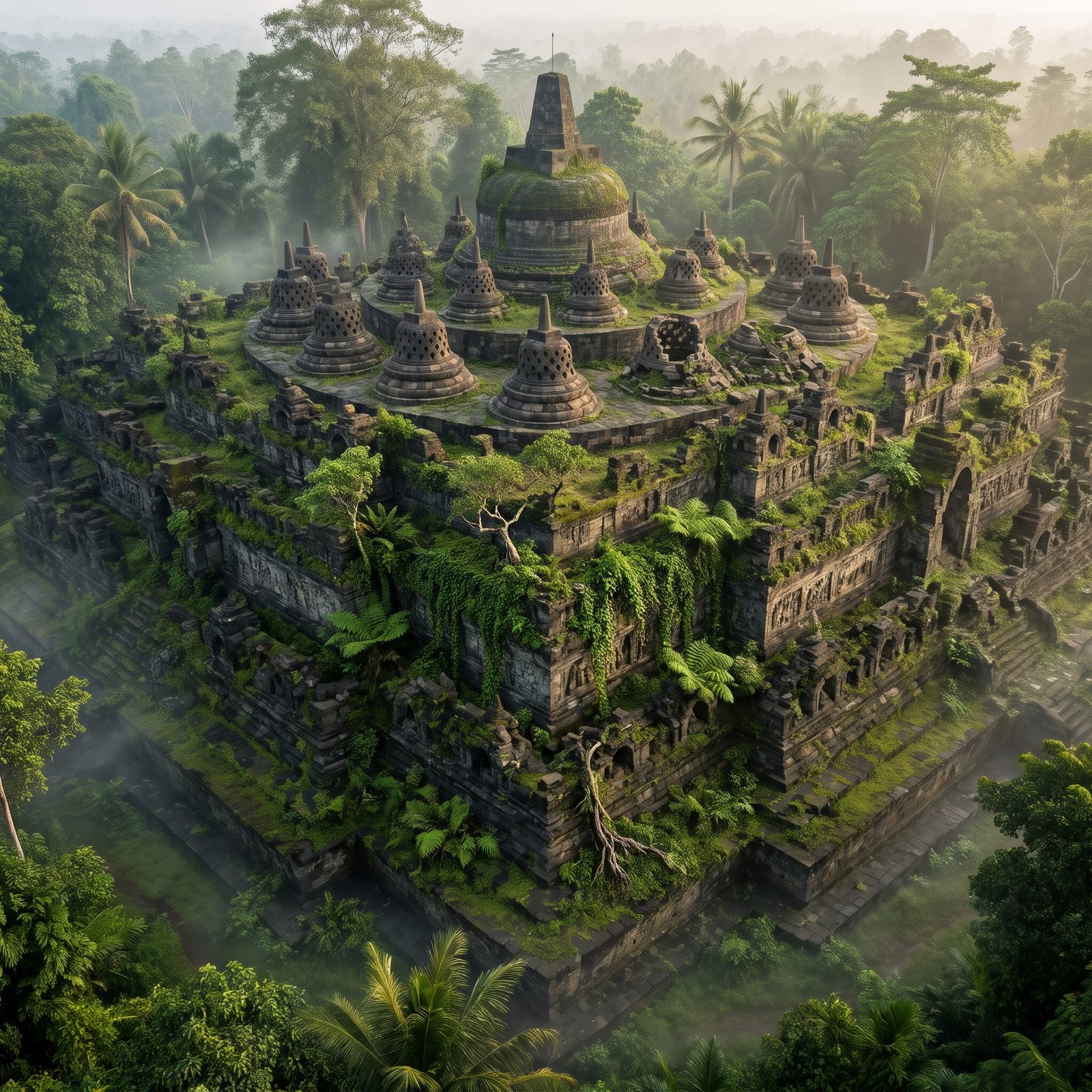
Borobudur has done this before. For centuries it sat buried under volcanic ash and jungle, forgotten until the 1800s. Give the forest a thousand uninterrupted years and it returns to that green sleep, only deeper.
The volcanic stone blocks hold up well. What fails is the mortar-free fitting between them — water seeps, moss grows, roots wedge in, and while most perforated stupas still stand like unlit lanterns, some have cracked open or crumbled into rubble. Yet the nine stacked terraces keep their stepped shape. That silhouette is stubborn.
The carved reliefs, over a thousand panels tracing the Buddhist path, vanish behind dense curtains of hanging vines and ferns, the stories half-hidden in the stone. Honestly, there is something fitting about that.
15. Bagan’s Temples Become Islands in a Forest Canopy
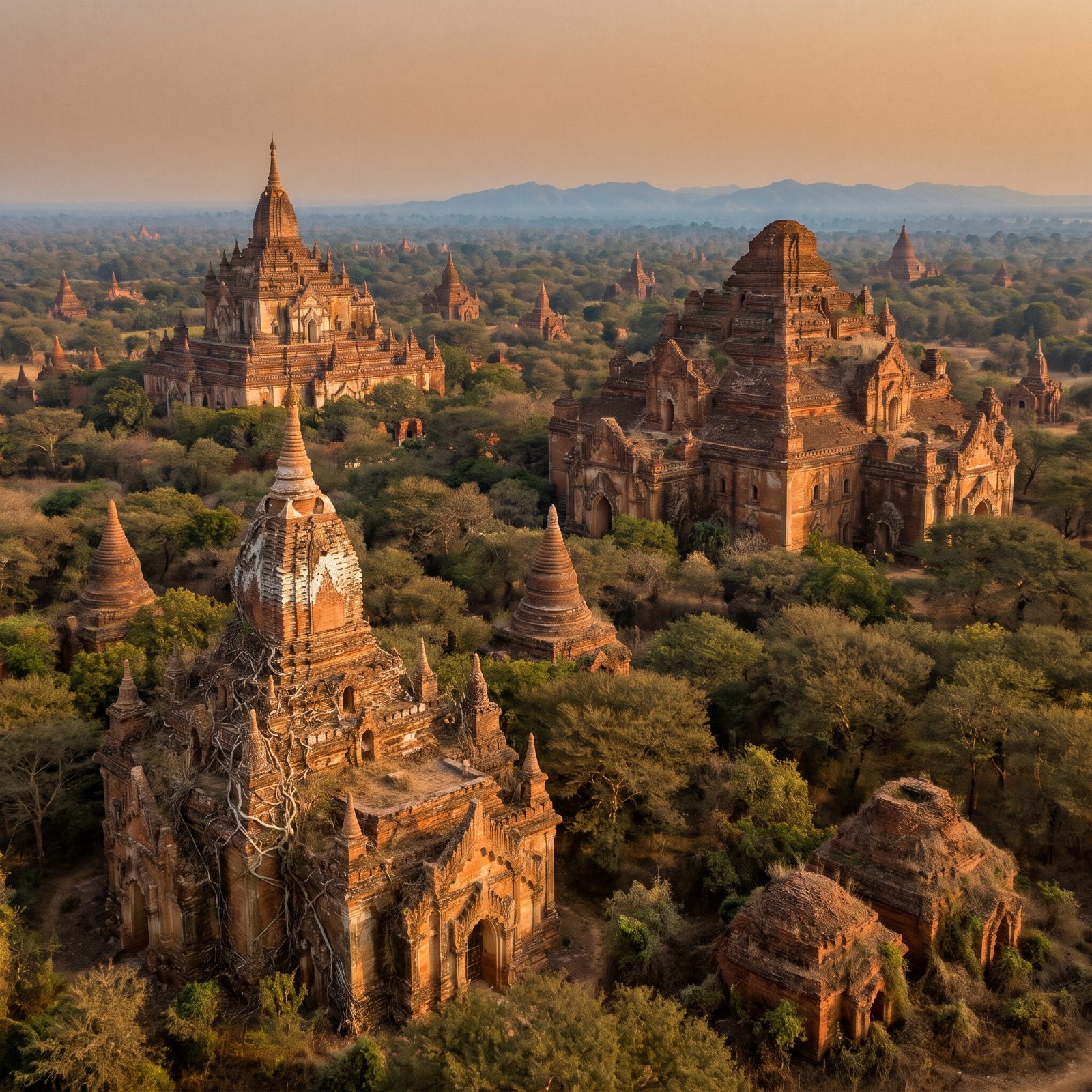
Bagan already looks half-ghost. Thousands of brick temples scattered across a dry plain, many of them battered by the 2016 earthquake. Brick is the weak point. Fired clay without maintenance spalls, softens, and sheds its outer skin in the heat and the rains.
The outer skin and the ornament go first, yet the spires are oddly stubborn: nearly every temple here still holds its sharp, fully intact spire or finial. That is why a thousand years on the plain reads as a cluster of brick islands poking through a forest that has swallowed everything shorter. Myanmar’s dry forest moves in fast once nobody is cutting it back.
14. The Gateway of India Faces a Flooded Mumbai Waterfront
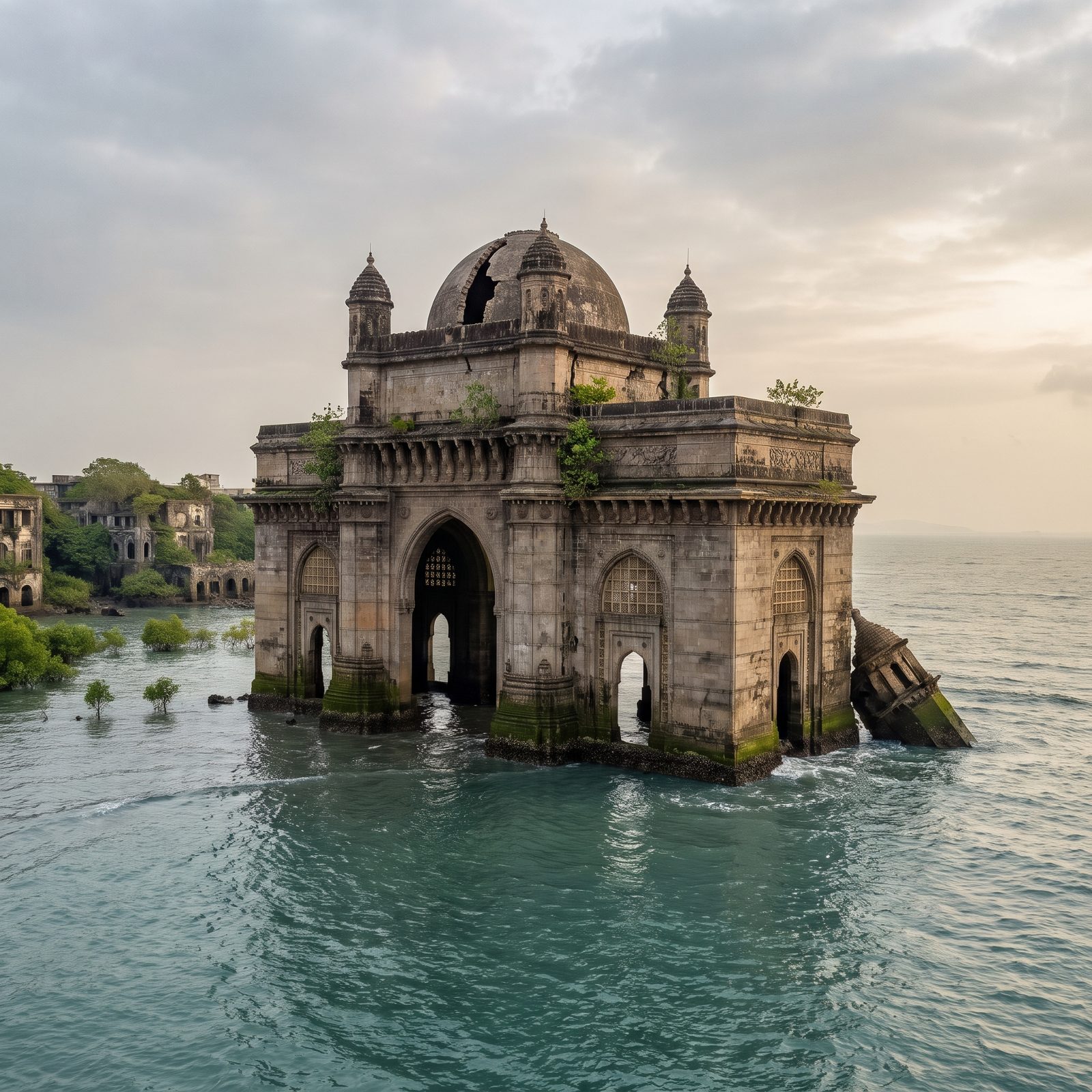
The arch was built to greet ships. A thousand years on it greets the sea itself.
Mumbai sits low and crowded against the Arabian Sea, built across reclaimed islands. Rising water does not need to be dramatic to matter — a few meters over centuries puts the plaza underwater and turns the Gateway into a tidal marker, basalt streaked with algae, barnacles crusting the stone where crowds once gathered to pose.
Indian basalt is durable, so the arch keeps its outline long after its ornamental turrets drop. Salt and tide chew the lower courses. What you would recognize is the shape. What would surprise you is standing ankle-deep to see it.
13. Palm Jumeirah Erodes Into a Broken Chain of Sandbars
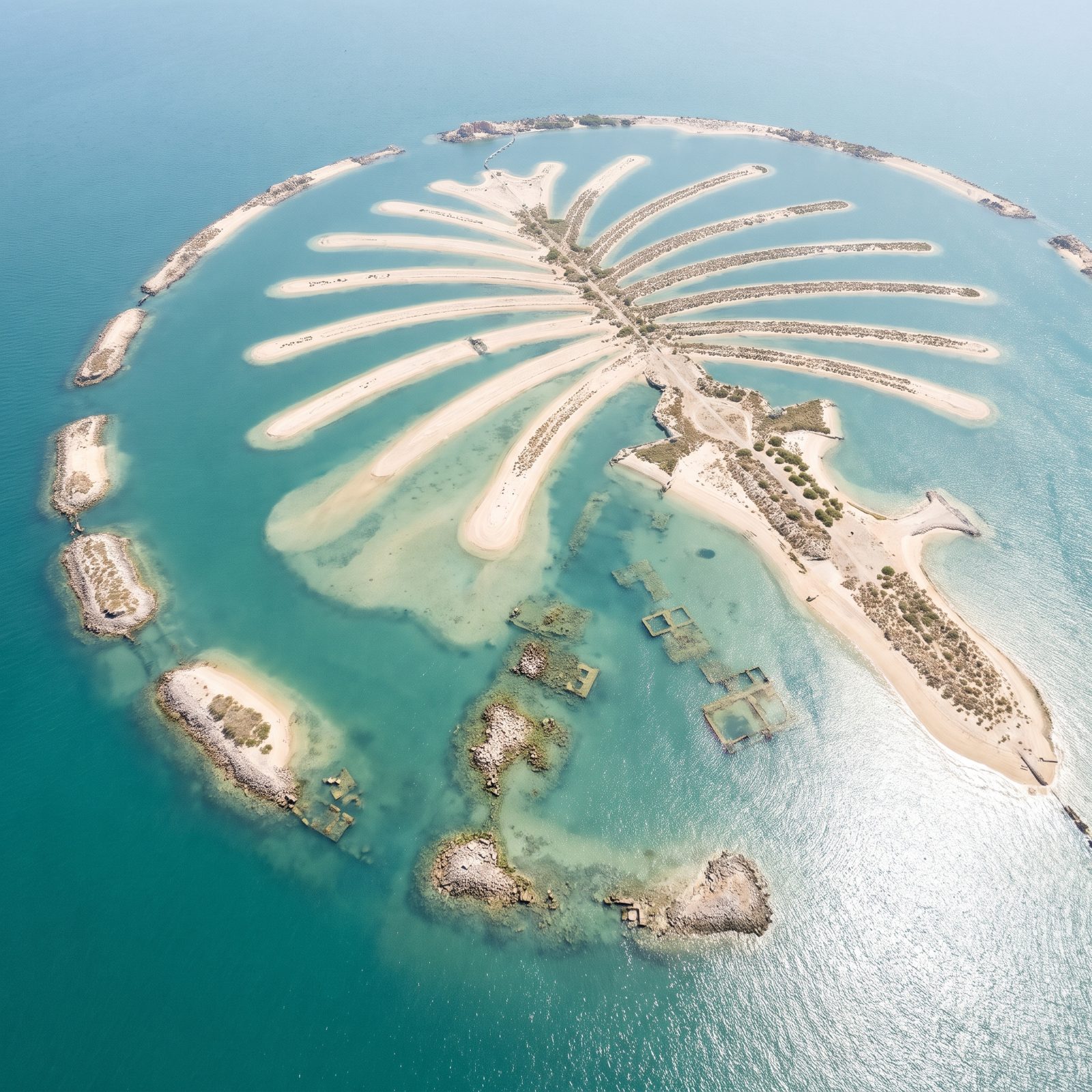
This one is starting to break apart, and that is the point. The Palm was never real land. Sand dredged from the seabed and piled into a shape, held together by a rock breakwater and constant pumping. Stop the maintenance and the Gulf takes it apart with patient waves.
Only the top of the outer crescent is still continuous; the rest of the arc has shattered into a broken chain of rubble islands where the sea has pushed through. The delicate fronds — the whole reason it photographed so well — are holding at the top, but the lower ones are smearing and dissolving into broad shallow sand flats around a mostly intact trunk. From above, the palm still reads, though half-sunken structures in the shallows hint at what is coming.
12. The Alhambra’s Courtyards Become Woodlands Fed by Ancient Channels
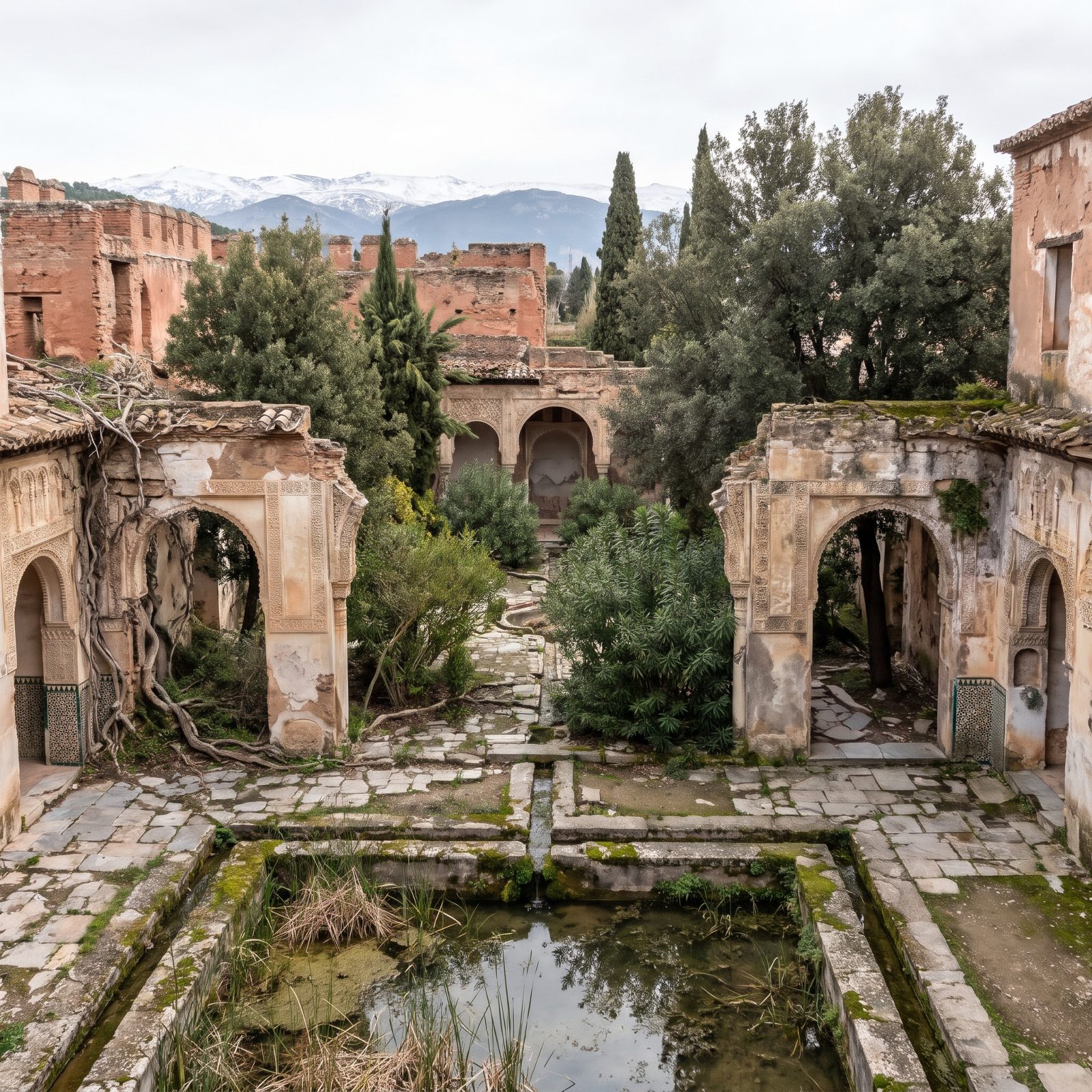
Here is the strange twist. The Alhambra might feed its own forest.
Its genius was water, channeled by gravity from the mountains through an elaborate network of courts, pools, and fountains built by Nasrid engineers. Those channels want no pumps. They need only a source and a slope, and the Sierra Nevada supplies both. So even abandoned, water keeps trickling through parts of the system, turning ornamental courtyards into reed-choked ponds and well-watered groves.
The red walls fade and fall. The fine carved stucco, among the most delicate work in the medieval world, washes away in the rains. But the water that made it famous keeps running, feeding oaks and myrtle where sultans once walked.
11. The Louvre Pyramid Collapses Into a Sunken Courtyard Garden
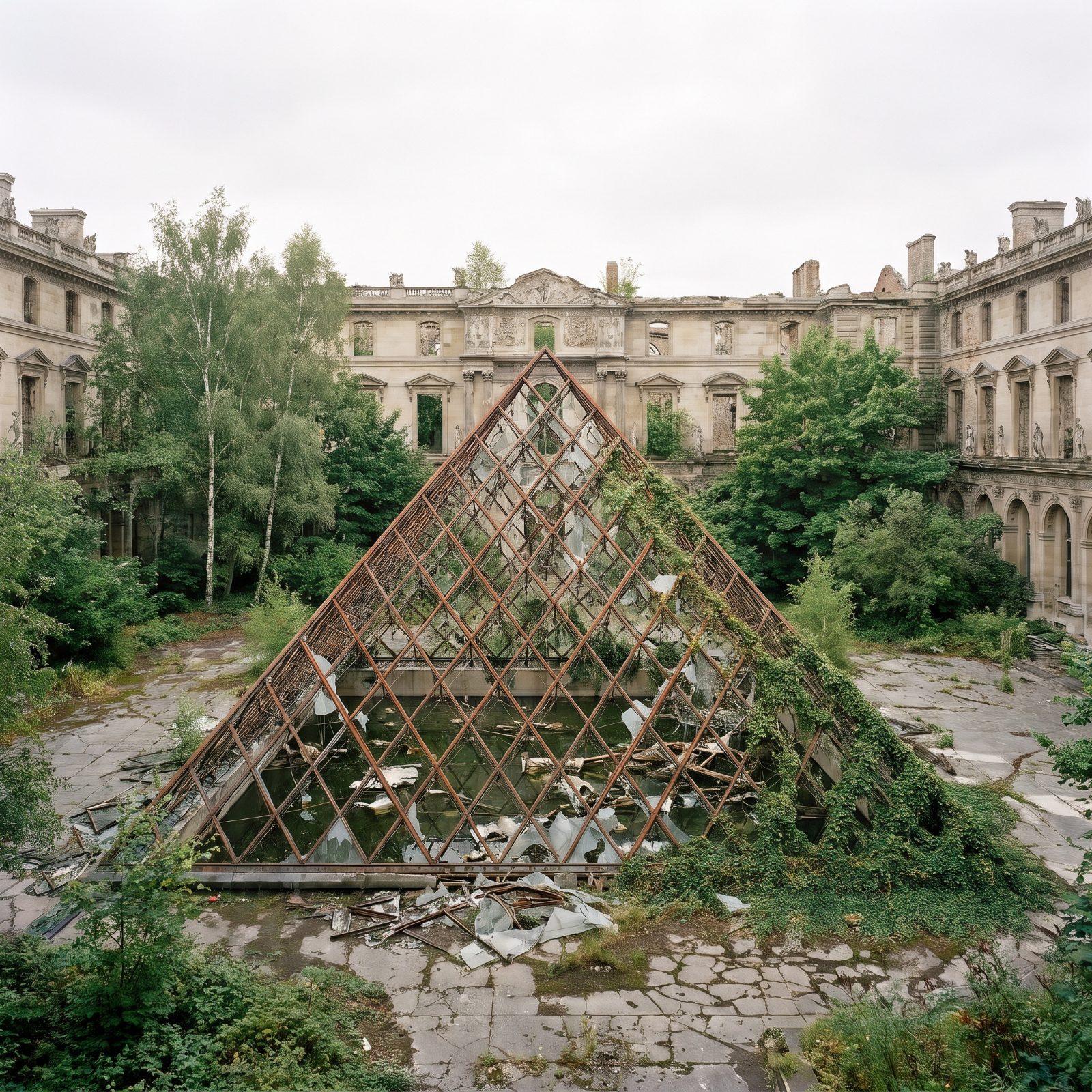
Glass is honest about its lifespan. The pyramid’s panes, held in a slender steel frame, would not last centuries unmaintained. Freeze-thaw cycles, wind, and the slow failure of every seal bring them down pane by pane until only a rusted skeleton remains, sagging over the sunken lobby.
That lobby fills with rainwater and leaf litter and becomes a quiet pond. Birch and ash seed themselves in the cracked limestone paving while the old palace wings stand roofless around it, softening year by year.
10. Mont-Saint-Michel Becomes an Isolated Tidal Ruin
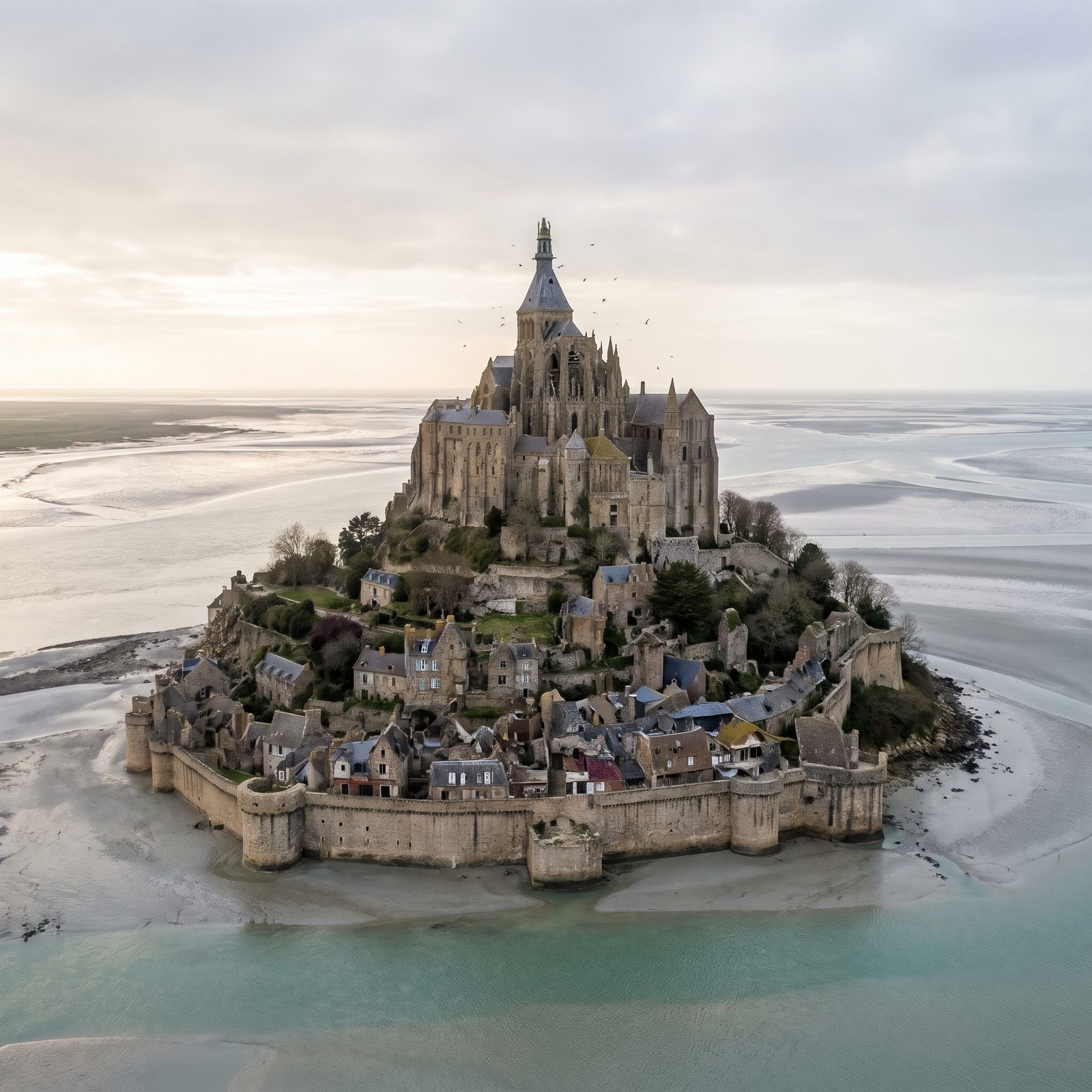
Mont-Saint-Michel spent most of its life as an island, cut off twice a day by some of the fastest tides in Europe. The modern causeway was always a temporary insult to that, and it washes away quickly, returning the mount to what it was: a rock surrounded by racing water and silver mudflats.
The granite base is nearly indestructible. The abbey perched on top holds up too. Its spire and vaulted church keep their roofs, their walls stand unbreached, and the whole silhouette stays crisp against the sky. Only a few buildings on the lower slope have crumbled into ruin. The gilded archangel still crowns the summit.
Seabirds take the towers. The bay does the rest.
9. Neuschwanstein Castle Crumbles Above an Alpine Forest
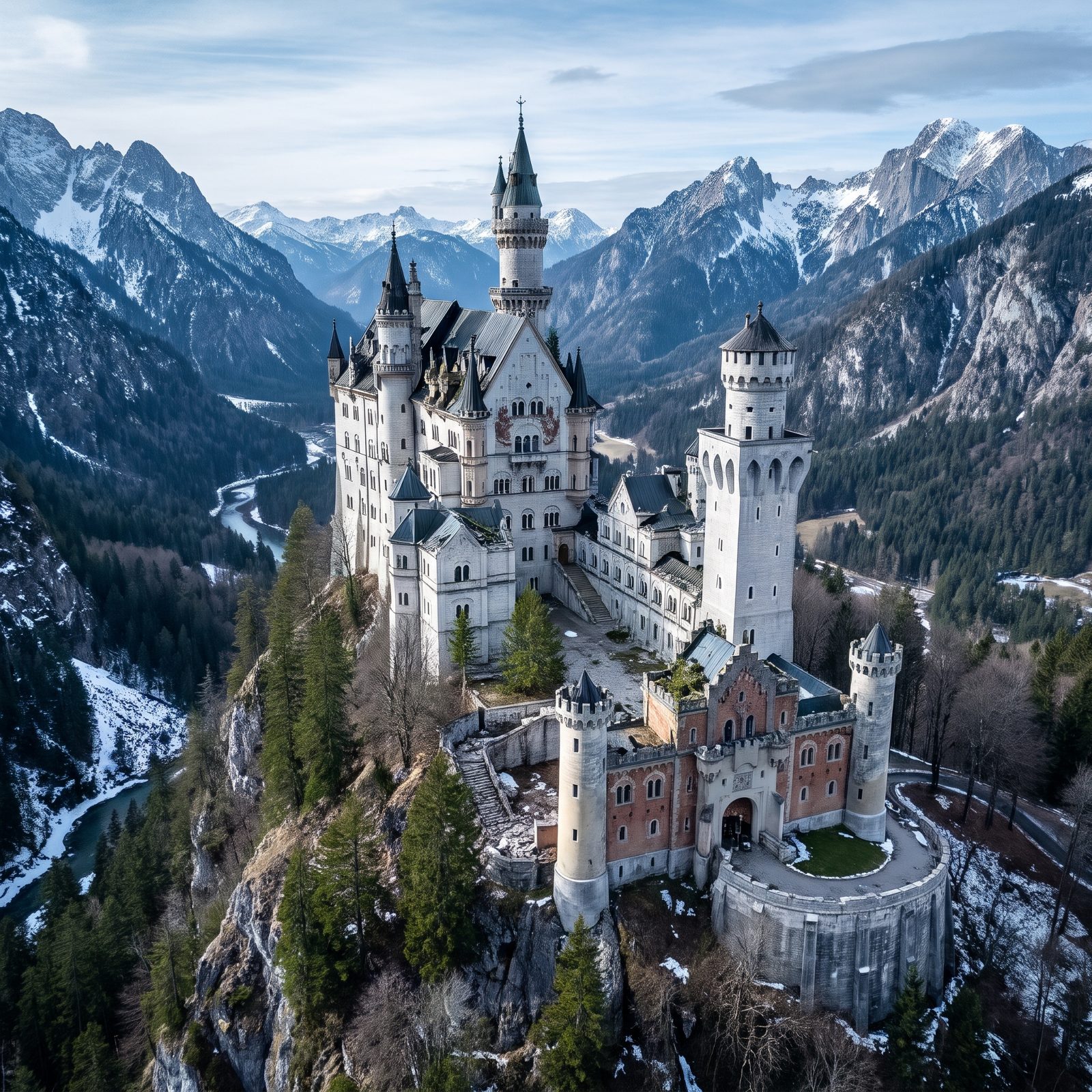
Far from crumbling, the castle is whole, and the irony here is thick. Neuschwanstein was built in the 1800s as a romantic fantasy of a medieval castle, never meant for war, never truly finished. Yet here it stands fully intact, every roof and spire in place, still playing at the medieval past it never had.
Alpine weather is brutal on a building. Hard freezes, heavy snow load, and relentless freeze-thaw test the limestone and the steep roofs, yet both hold firm. The slender turrets, so good in photographs, still rise sharp against the peaks. Spruce and fir close in from the gorge below, crowding right up to the walls.
8. The Atomium Turns Into a Corroded Cluster of Giant Spheres
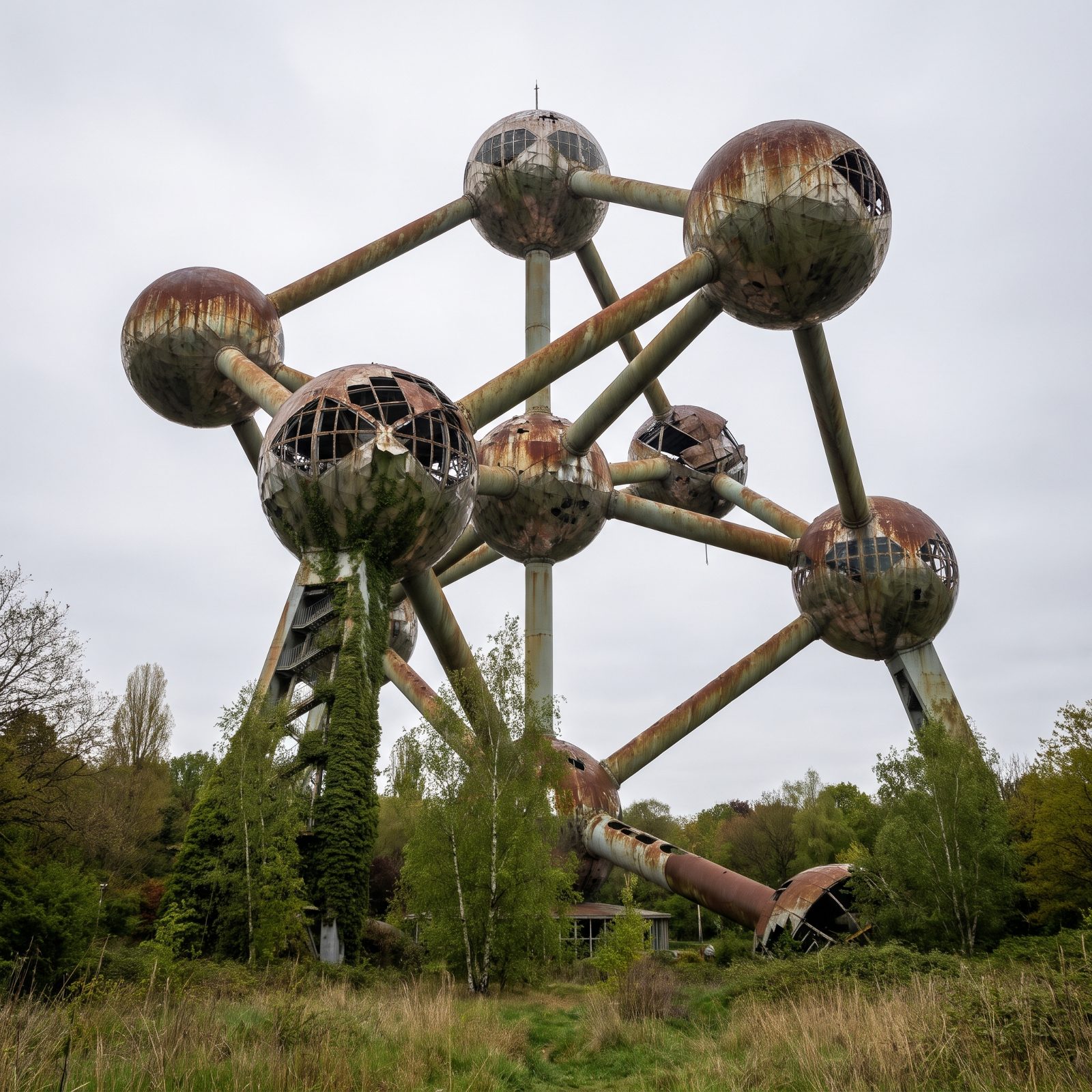
The Atomium is a 1958 World’s Fair model of an iron crystal magnified billions of times. Fitting, then, that iron is exactly what does it in. The gleaming metal skin, originally aluminum and later stainless cladding, corrodes and peels in Belgium’s damp temperate climate, exposing the steel frame underneath to rust in earnest.
Nine spheres on diagonal struts is a lot of weight on slender supports. Over a thousand years connections fail, a tube drops, and an upper sphere sags out of line. The silhouette survives though — this odd molecular diagram standing in a wet birch woodland that has forgotten what it was supposed to represent.
I find it oddly cheerful. A monument to the atom, going quietly back to rust and grass.
7. The Kinderdijk Windmills Sink Into Expanding Wetlands
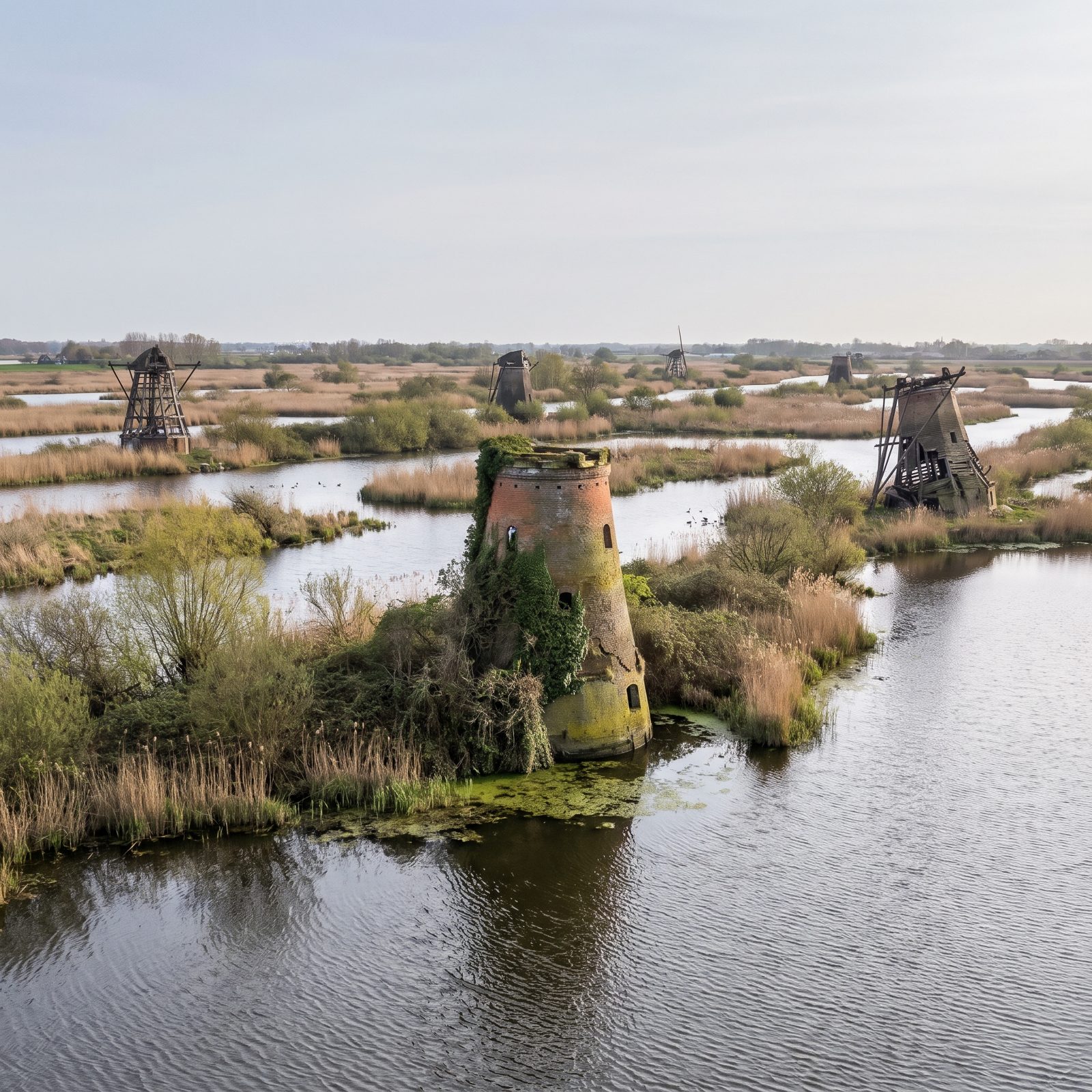
These mills only ever had one job: pump water out. Built in the 1700s to drain a polder sitting below sea level, they fought gravity every single day. Stop fighting, and the water wins.
A thousand years on, it has won. The pumps are silent, the dikes breached, and the reclaimed land has slumped back into what it always wanted to be — marsh. The brick towers lean where the peat settled unevenly beneath them, soft and acidic, about the worst foundation you could ask anything heavy to stand on.
6. Abu Simbel Is Half-Buried by Returning Desert Sands
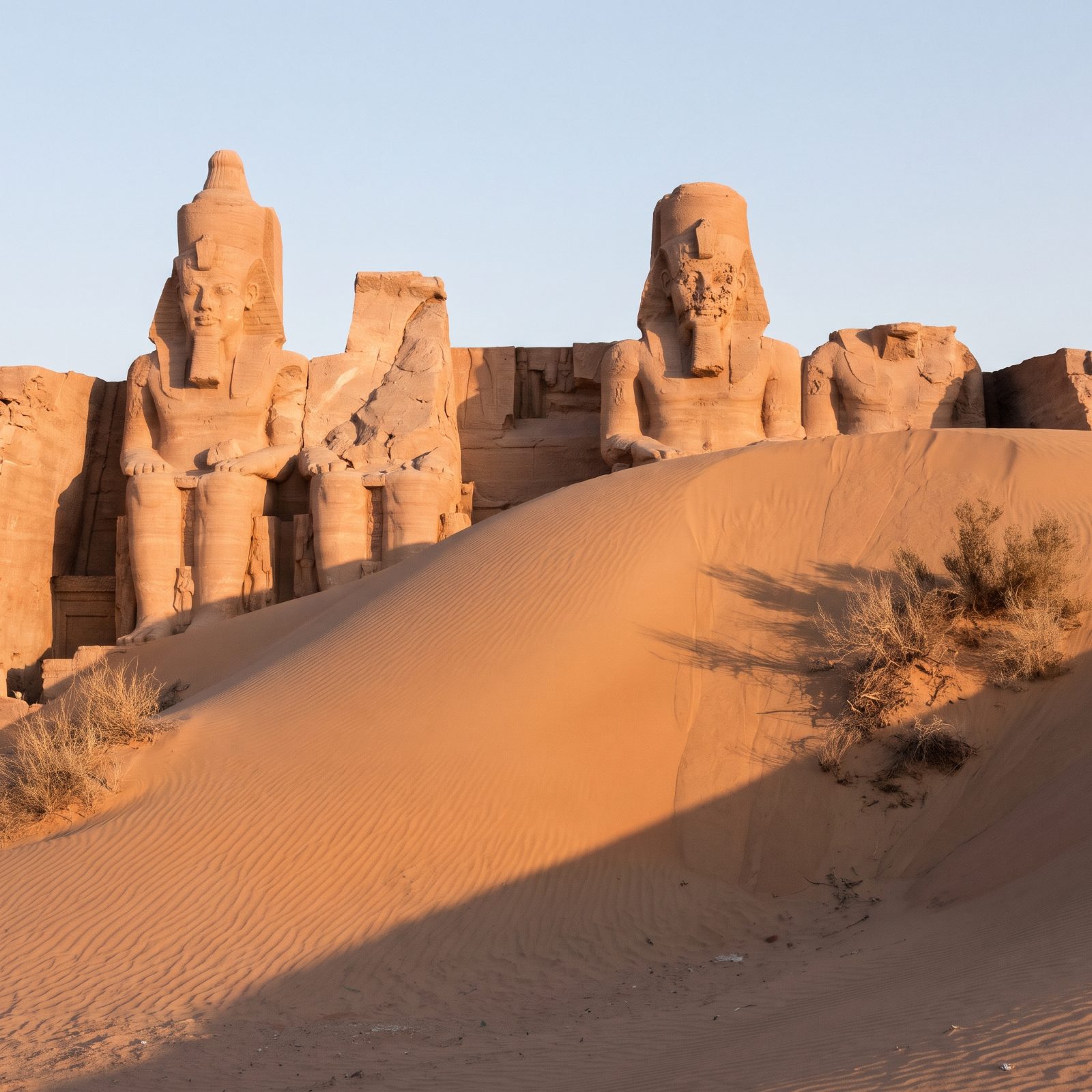
Here’s an irony the desert seems to enjoy. In the 1960s, engineers sliced Abu Simbel into blocks and hoisted the whole temple higher to save it from Lake Nasser, the reservoir backing up behind the Aswan High Dam. A rescue that cost tens of millions at the time.
The desert has no interest in rescues. Left to itself, the Sahara does exactly what it did for three thousand years before archaeologists cleared the site in 1817: it creeps up the colossi, already swallowing the right-hand figures to the waist and lap while the left pair still stand clear to their feet. Sandstone is soft, and wind carrying grit is a slow sandblaster that never clocks off. The faces blur first. Give it long enough and Ramesses becomes a rumor in the dune.
5. Lalibela’s Rock-Hewn Churches Fill With Plants and Rainwater
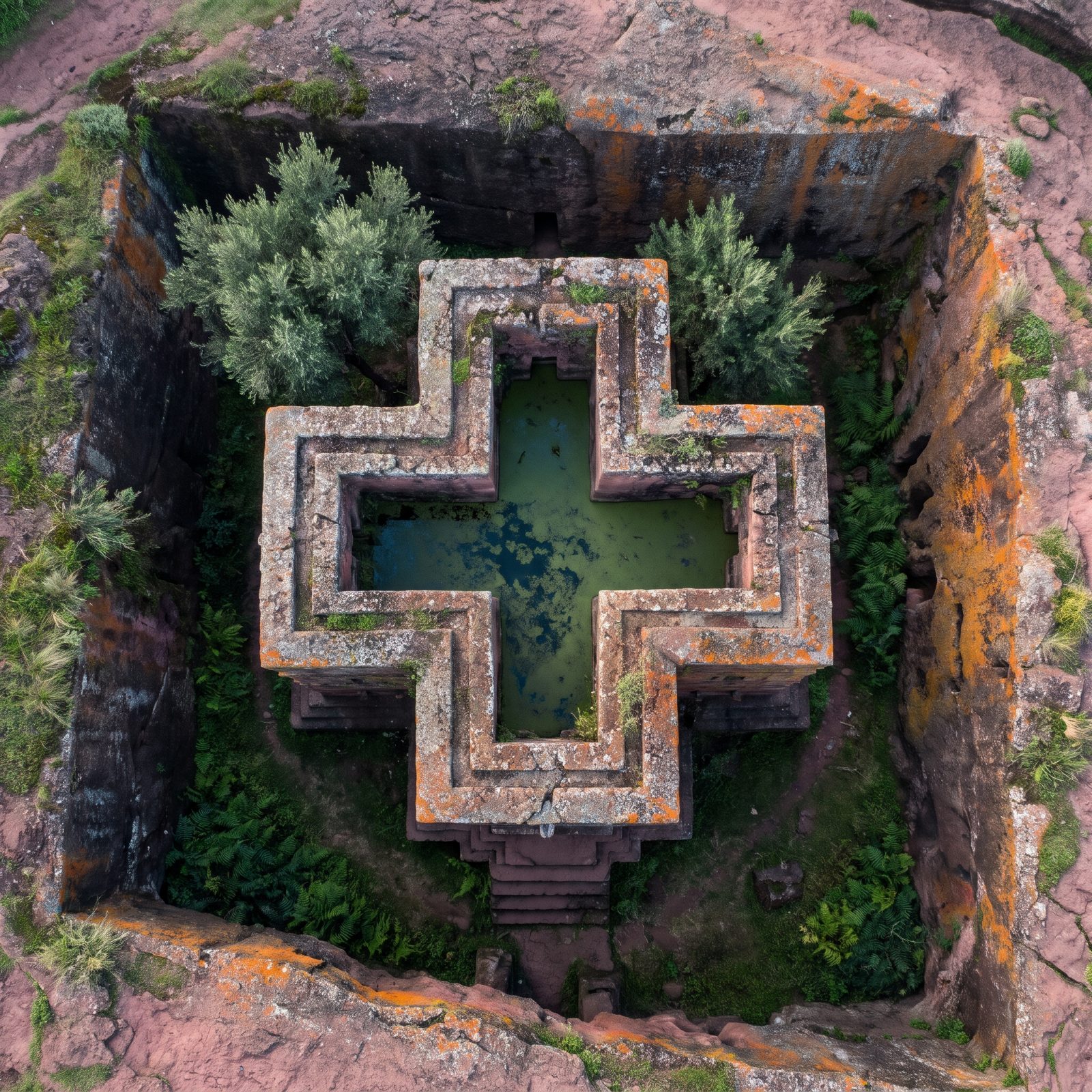
Most ruins are things that fell down. Lalibela is a ruin carved down, and that one difference changes how it ages.
These eleven churches from the 12th and 13th centuries weren’t stacked up from blocks — they were cut down into living volcanic rock, whole buildings excavated out of a hillside the way a sculptor frees a figure from stone. Bete Giyorgis, the famous cross, sits at the bottom of a deep pit.
And pits collect things. A thousand years of highland monsoon pools in the sunken courtyards, leaf litter rots into soil, seeds drift in, roots split the tuff, and the crisp carved crosses soften into mossy green ponds. The rock itself stays. It’s the water and the ferns doing the rewriting.
4. The Nazca Lines Grow Faint Beneath Centuries of Wind
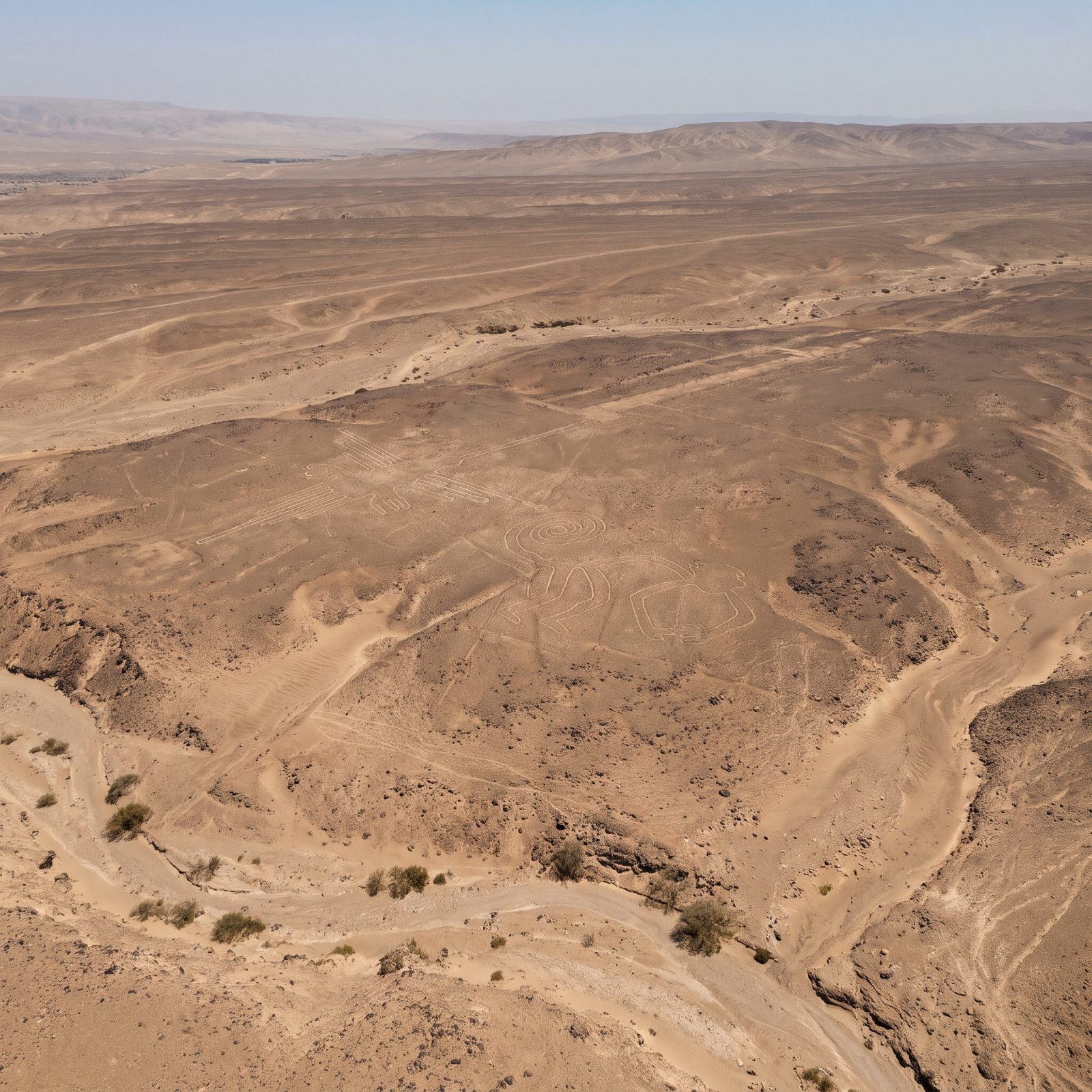
The Nazca Lines survived two thousand years for a strange reason: almost nothing happens there. It’s one of the driest places on Earth, so still and stable that scuff marks made two millennia ago simply stayed put.
But “almost nothing” isn’t nothing. The figures are barely skin deep, made by clearing dark surface stones to expose the pale ground beneath, and wind keeps nudging those stones back where they came from. A rare flash flood carves fresh channels around the plateau’s edges, creeping closer to the hummingbird’s wings. Over a thousand years with nobody around to brush them clean, the monkey and the spider don’t so much vanish as dissolve into static — visible only to a sharp eye, from the right angle, at the right hour.
3. Hoover Dam Becomes a Cracked Wall Above a Narrowing Reservoir
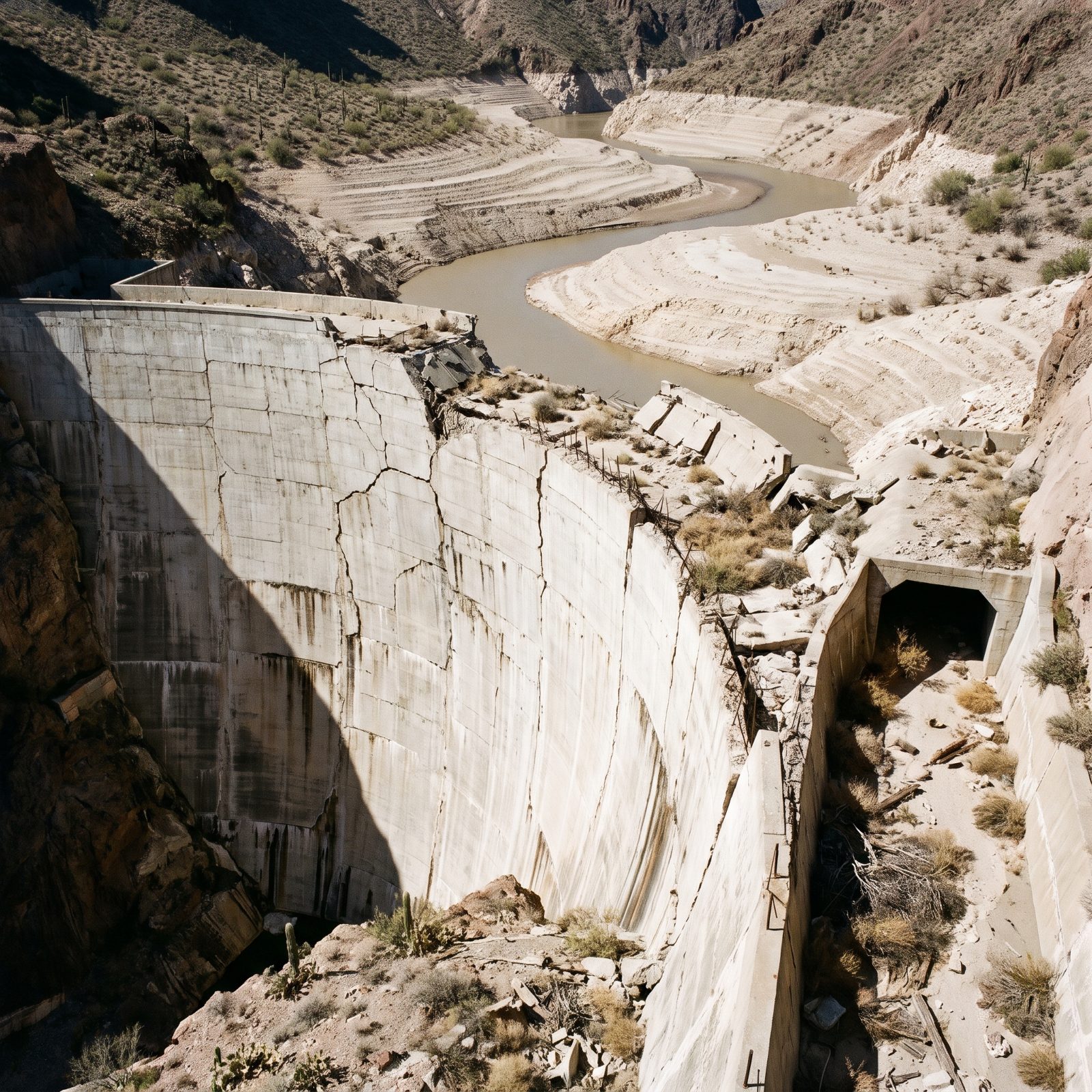
Concrete does not last forever, and the engineers who poured Hoover Dam in the 1930s knew it cold. They knew it so well they built the thing in interlocking blocks threaded with cooling pipes, because a solid pour that thick would have cracked under its own curing heat and taken a century just to cool down.
Without people, two clocks start ticking at once. The concrete carbonates and cracks while water worries at every weakness. And all the while the Colorado keeps delivering silt — a canyon’s worth over the centuries — filling the reservoir from the bottom up. Eventually the river simply flows over or through whatever’s left of the wall, and Lake Mead goes back to being a canyon with a weird grey cliff standing in it.
2. The Panama Canal Locks Become Waterfalls in a Tropical Forest
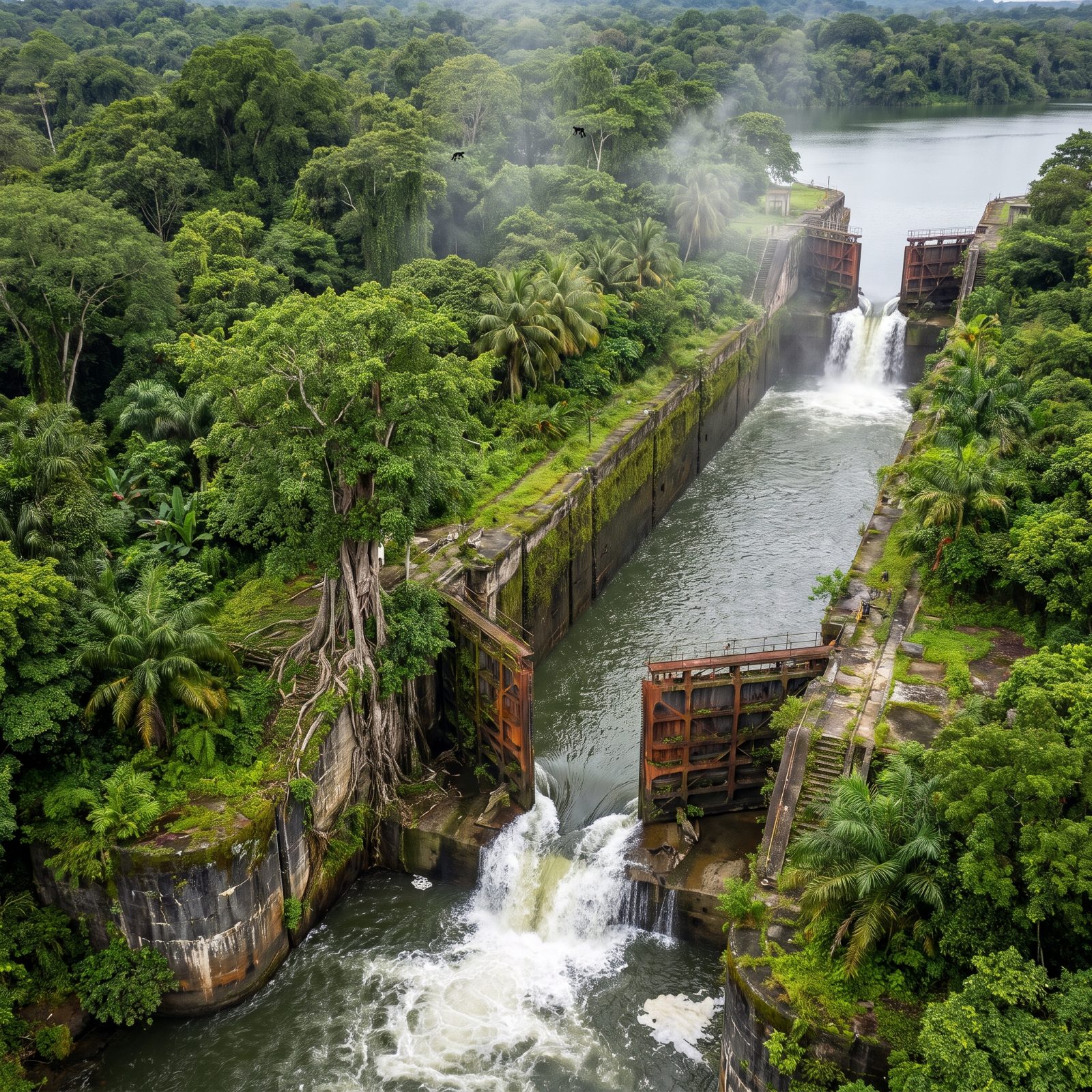
The Panama Canal isn’t a ditch at sea level. It’s a water staircase. Ships ride roughly 85 feet up to Gatun Lake, cross over, then get lowered down the far side, the whole trick run on gravity and lake water sloshed in and out of giant chambers.
Take away the people who work the gates, and gravity keeps doing its half anyway. That elevated lake wants out. The rusted steel gates give way, and the lake drains through the locks the only direction it can — downhill, over the shattered walls, in a chain of falls. In that heat the jungle moves fast. Within a century the concrete goes green; within ten, you’ve got a waterfall in a forest that no longer remembers it was ever a shortcut between two oceans.
1. The Golden Gate Bridge Hangs in Broken Sections Above the Bay
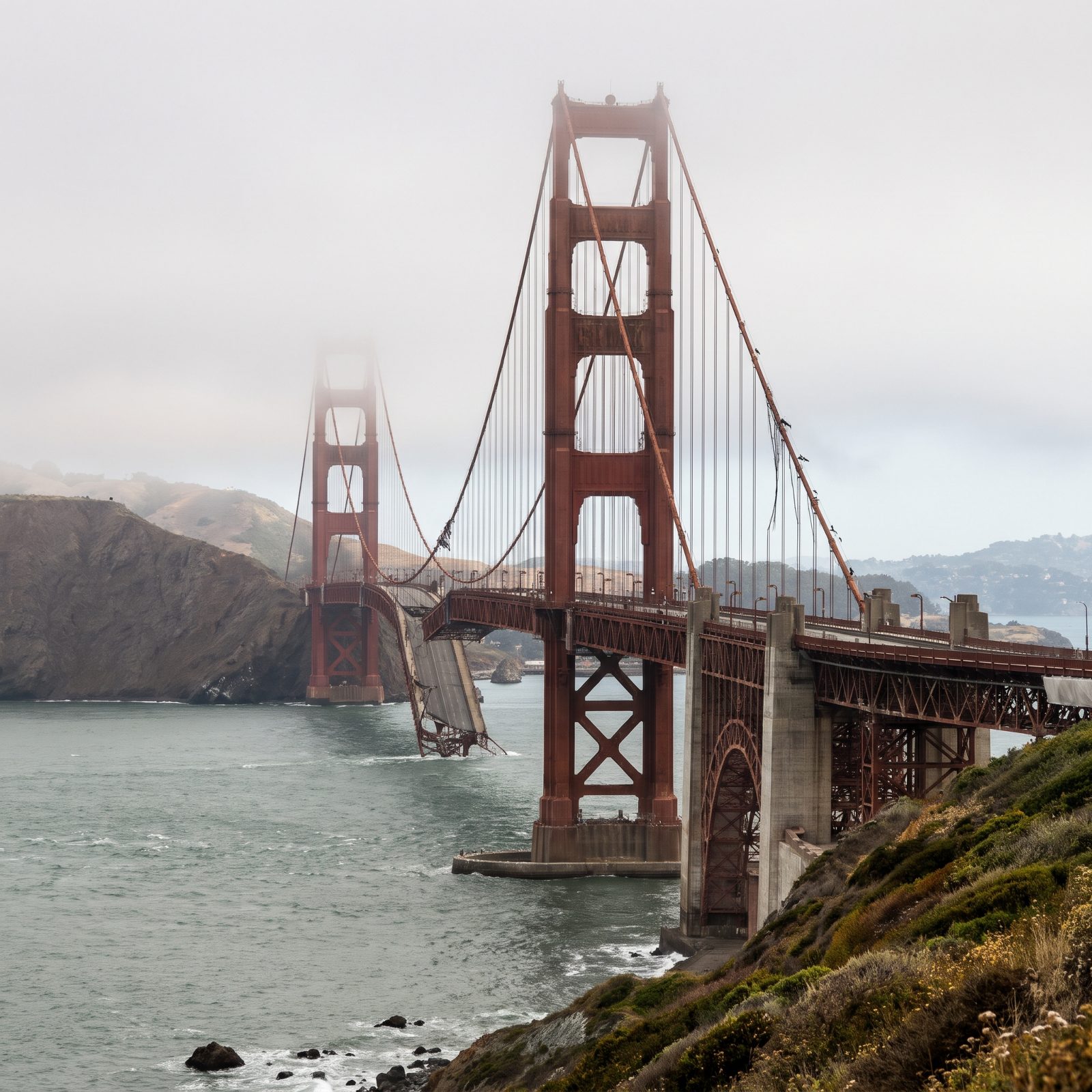
The Golden Gate is never actually finished being painted. Crews work it round the clock, because salt fog off the Pacific eats steel for a living, and that famous orange coat is the only thing standing between the bridge and the rust.
Stop painting, and the countdown begins.
A suspension bridge is a conversation between steel cables and gravity. The paint is just the referee. Take the referee away and gravity wins the argument eventually.
Those massive towers will stand the longest. The cables are the weak point — thousands of thin wires bundled together, and corrosion only needs to pick them off a few at a time. Once enough let go, a single stretch of deck tears loose and drops into the strait, while the rest of the roadway still hangs, the orange paint still bright, the railings and streetlights still standing. The first span falls long before the bridge even looks old.