
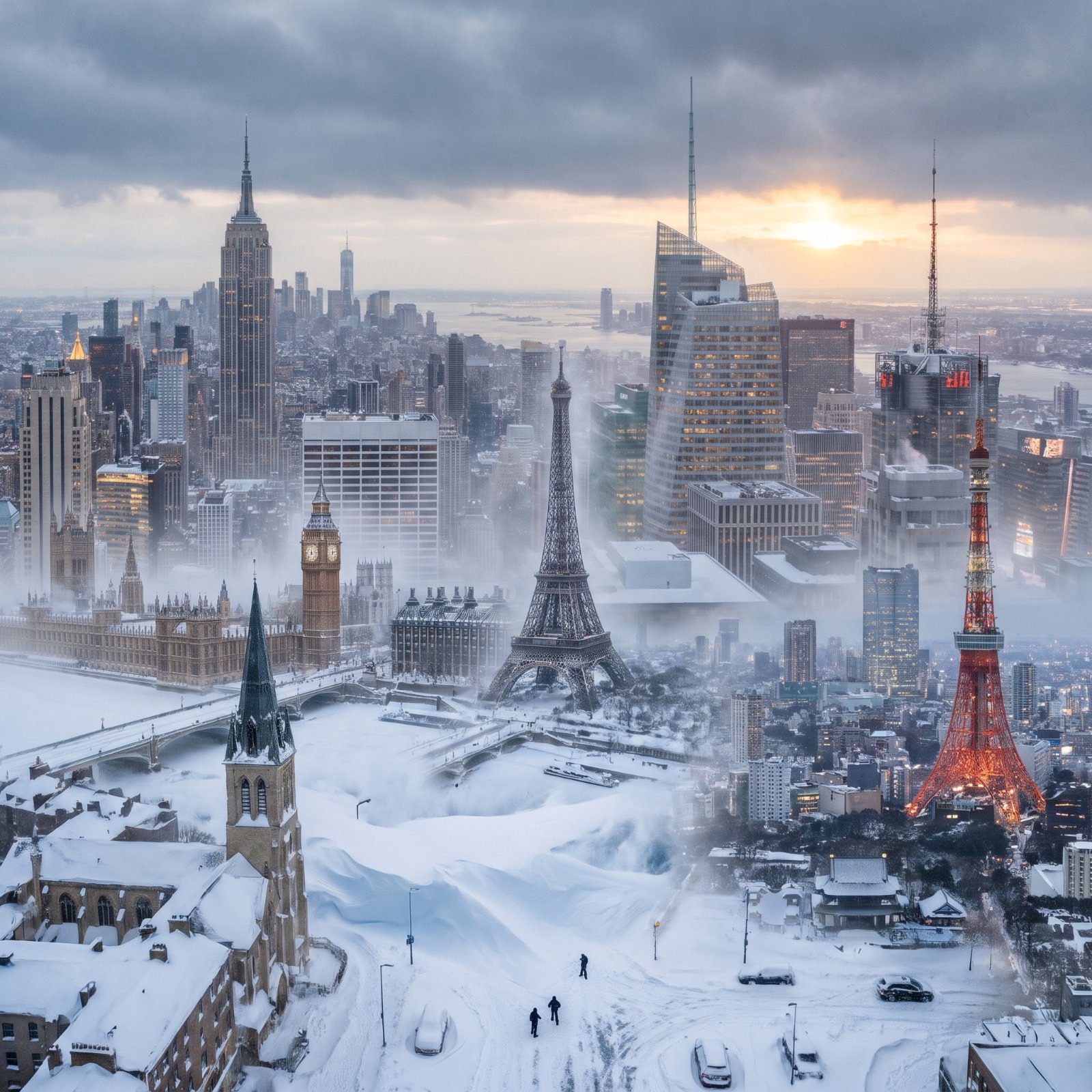
Dubai has recorded snow exactly never. The Pyramids of Giza have seen one dusting in the last century, and it made international news. So what would a once-in-a-lifetime Christmas storm look like if it ignored geography entirely and dumped three feet on every famous skyline at once? We fed that question to an image model and watched landmarks, many of which have never known real winter, vanish under drifts, ice and blowing powder. None of it is real. All of it follows how snow actually behaves against stone, steel and water. Pour something warm and come see a world that briefly forgot the rules.
41. New York City: Times Square Beneath Towering Snowdrifts

Times Square never goes quiet. This is the one scenario where it might. Picture the LED billboards still blazing reds and golds through a curtain of falling snow, the light smearing into the storm haze instead of hitting clean glass.
The detail that sells it is the yellow cab, its roof nearly bare, still pushing slowly through the snow-covered street. Snow this heavy turns the brightest place on Earth into a muffled tunnel of glowing color and dark, trudging figures.
40. Paris: The Eiffel Tower Vanishing Into a Whiteout
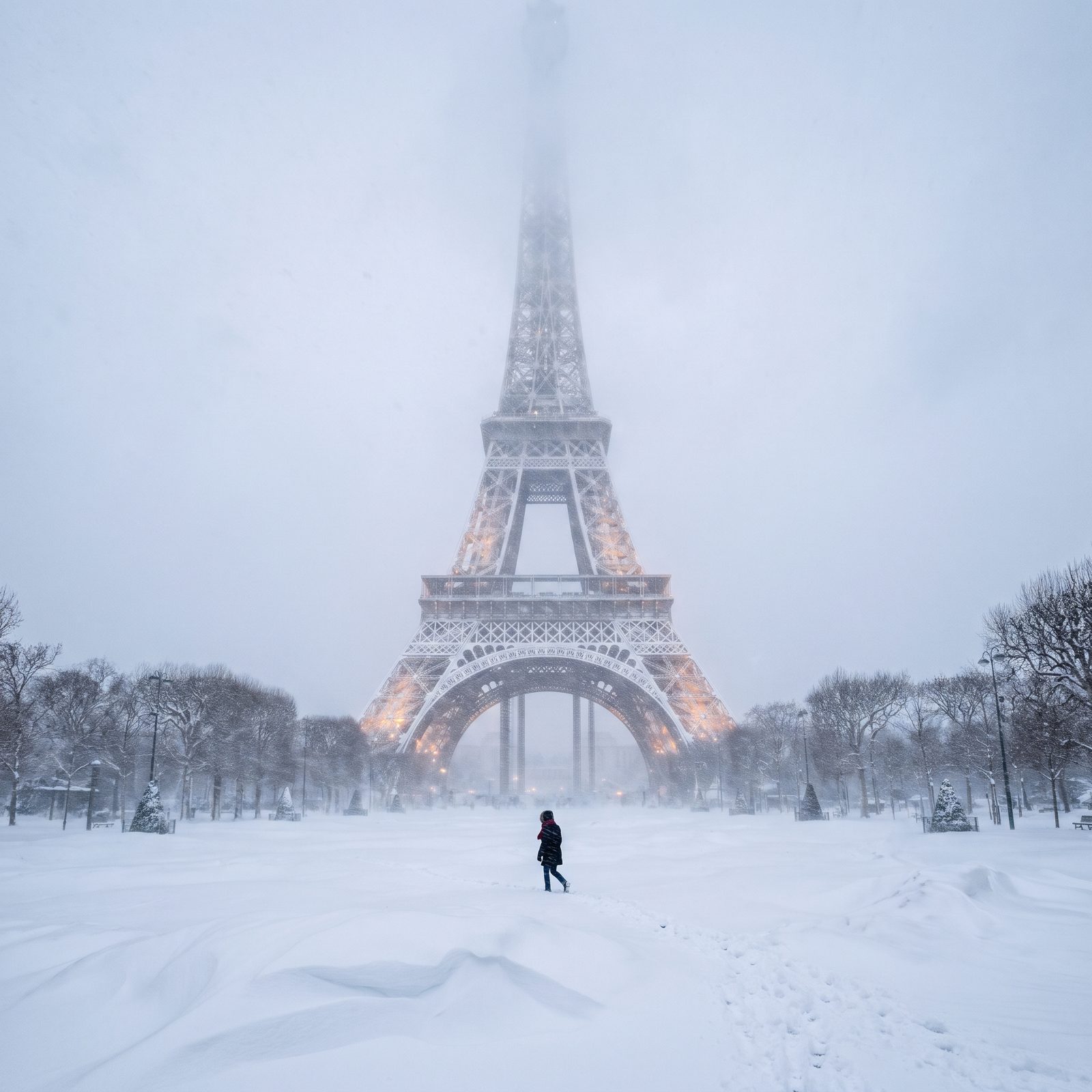
The top of the tower is gone. Not hidden — erased, swallowed into white where the iron should be. That is what a real whiteout does to anything over 500 feet.
What makes this one work is the snow catching on every crossbeam, tracing the lattice in white until the whole structure reads like an X-ray of itself. One figure in a red scarf cuts the only path across the Champ de Mars, and everything else is untouched dune.
39. Dubai: Burj Khalifa Rising Above a Desert Blizzard
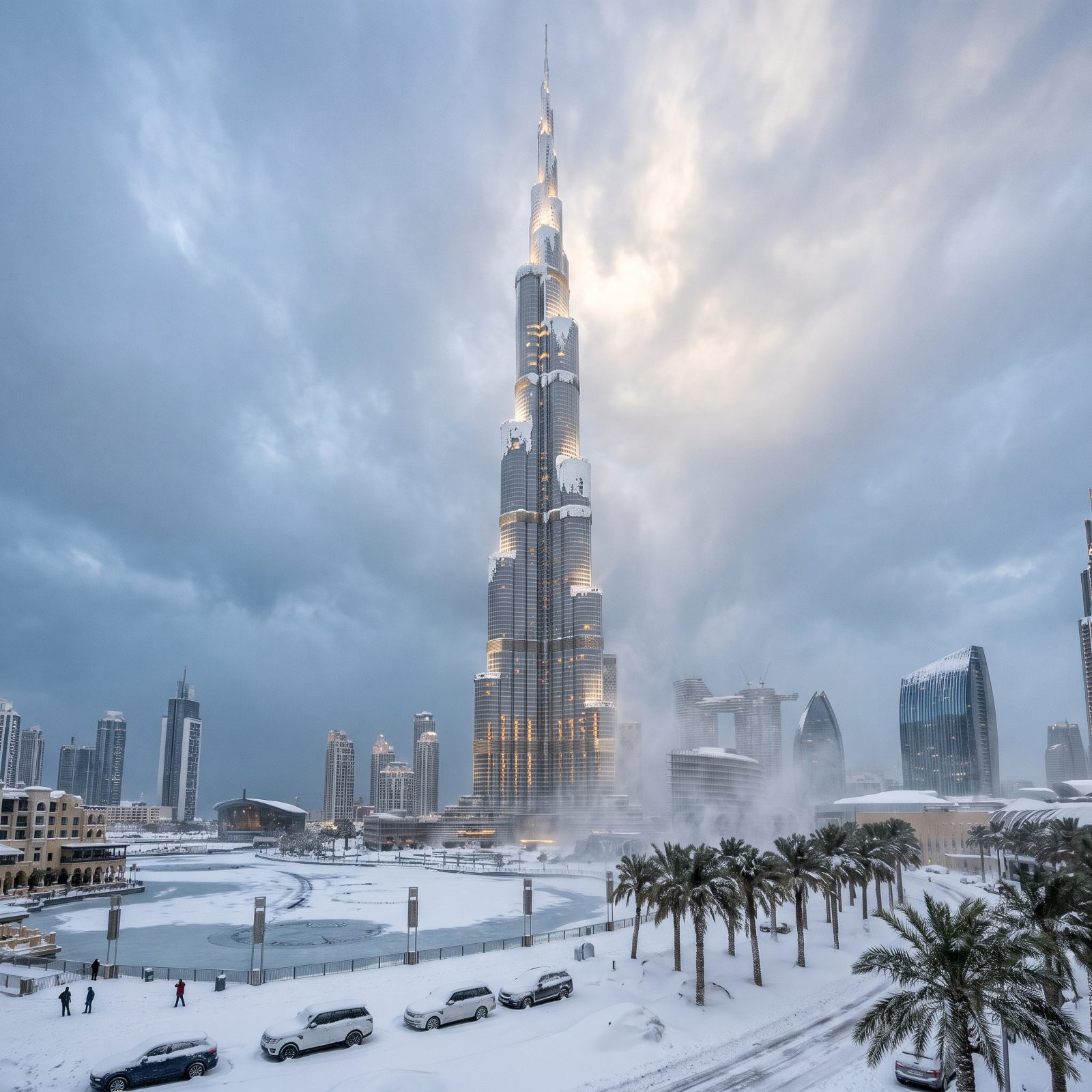
Dubai and snow belong in different universes. That is exactly why this image stops you.
The tallest building on the planet, each stepped setback holding its own ledge of white, powder swirling around floors that normally sit above the clouds. Palm trees bow under a weight they were never built to carry while thousands of windows glow gold through the storm. The frozen fountain lake is the quiet gut-punch — a crust of ice where jets usually dance for tourists sweltering in 100-degree heat.
38. Tokyo: Shibuya Crossing During a Silent Snow Emergency
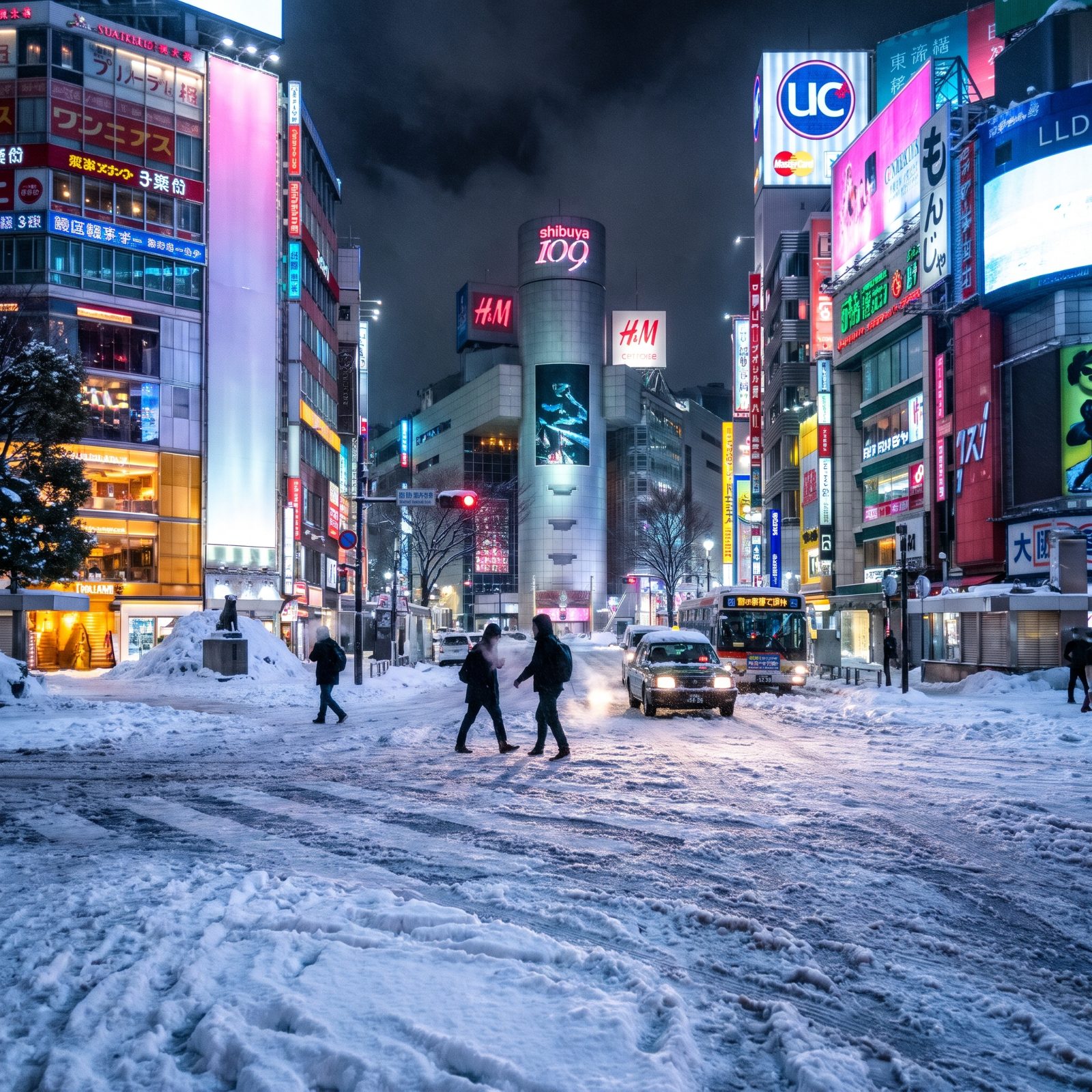
Shibuya’s whole identity is the crowd — thousands of people pouring across at once, one of the busiest intersections anywhere. Empty it, bury it, and you get something eerie: neon still screaming pink and blue overhead, snow nearly swallowing the painted crosswalk lines, the zebra stripes only faintly showing through, a handful of figures where there should be a river of them, their breath hanging in the cold.
Honestly, this is the most unsettling one of the set. The lights keep promising motion. The street just delivers silence.
37. Venice: Frozen Gondolas Along the Grand Canal
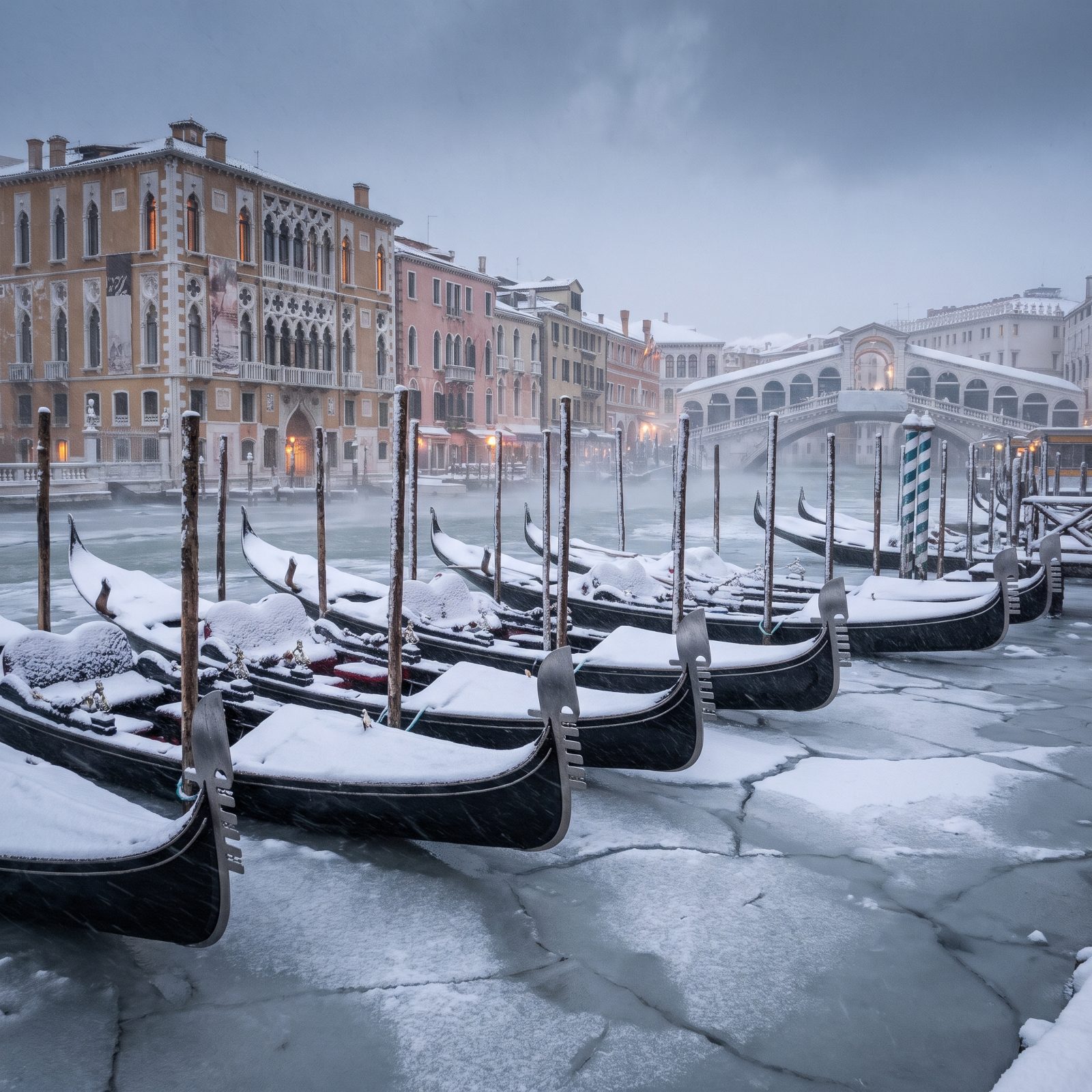
Venice has flooded for centuries. It has almost never frozen.
Here the Grand Canal is a sheet of cracked grey ice with gondolas trapped in it, snow heaped on their velvet seats. Those candy-striped mooring poles wear little white caps, and the Rialto Bridge sits buried in the haze behind.
36. Cairo: The Pyramids Disappearing Behind Blowing Snow
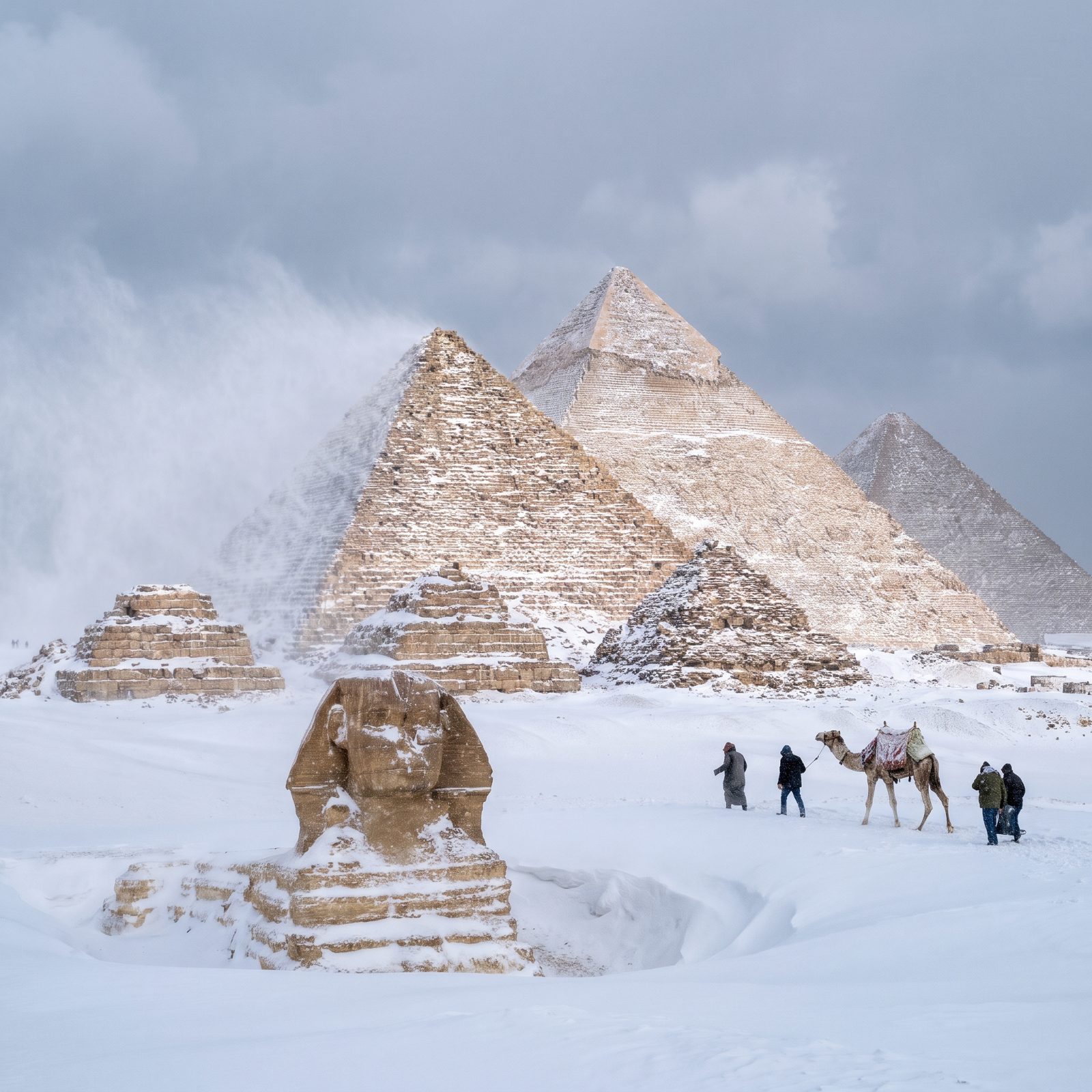
Snow on the Pyramids is the image that breaks people’s brains the fastest. Four and a half thousand years of desert, powdered white.
Look closely and the physics hold. Wind scours the windward limestone back to warm tan while snow packs into the sheltered crevices — exactly how drift behaves on any angled surface — and the Sphinx catches it in every weathered fold of its face. A snow-dusted camel stands in for scale. Possibly the single most absurd detail in the whole gallery.
35. Sydney: The Opera House Wrapped in Ice
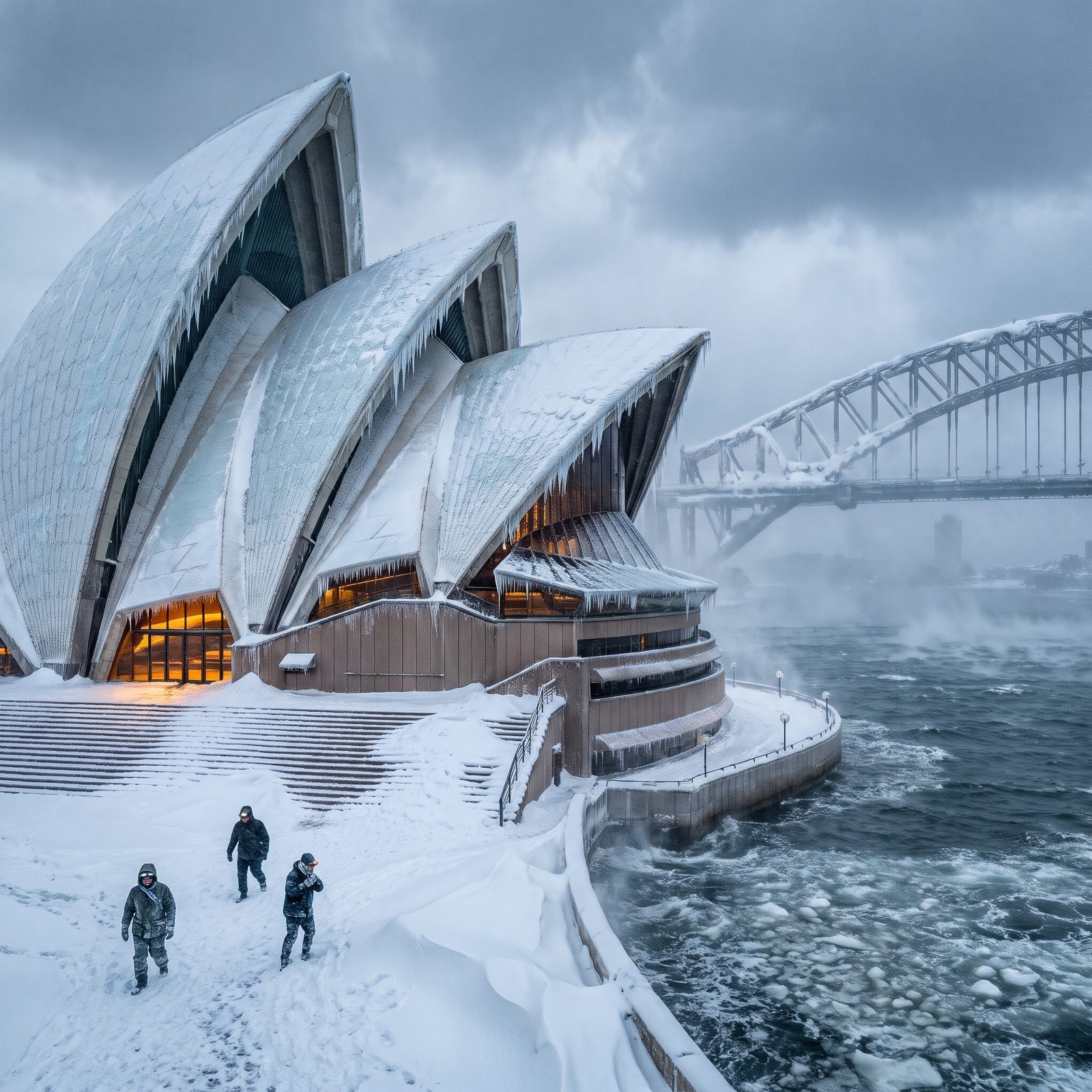
Sydney spends Christmas on the beach. December there is summer, so an iced-over Opera House is the hemisphere flipped inside out.
The sail shells, already white, now wear real snow and a glaze of ice, with icicles hanging off their ribbed edges. The harbour behind has gone grey and slushy, and warm light leaks from the glass foyer — the only thing in frame that still looks like it remembers warmth.
34. Rome: The Colosseum Filled With Windblown Snow
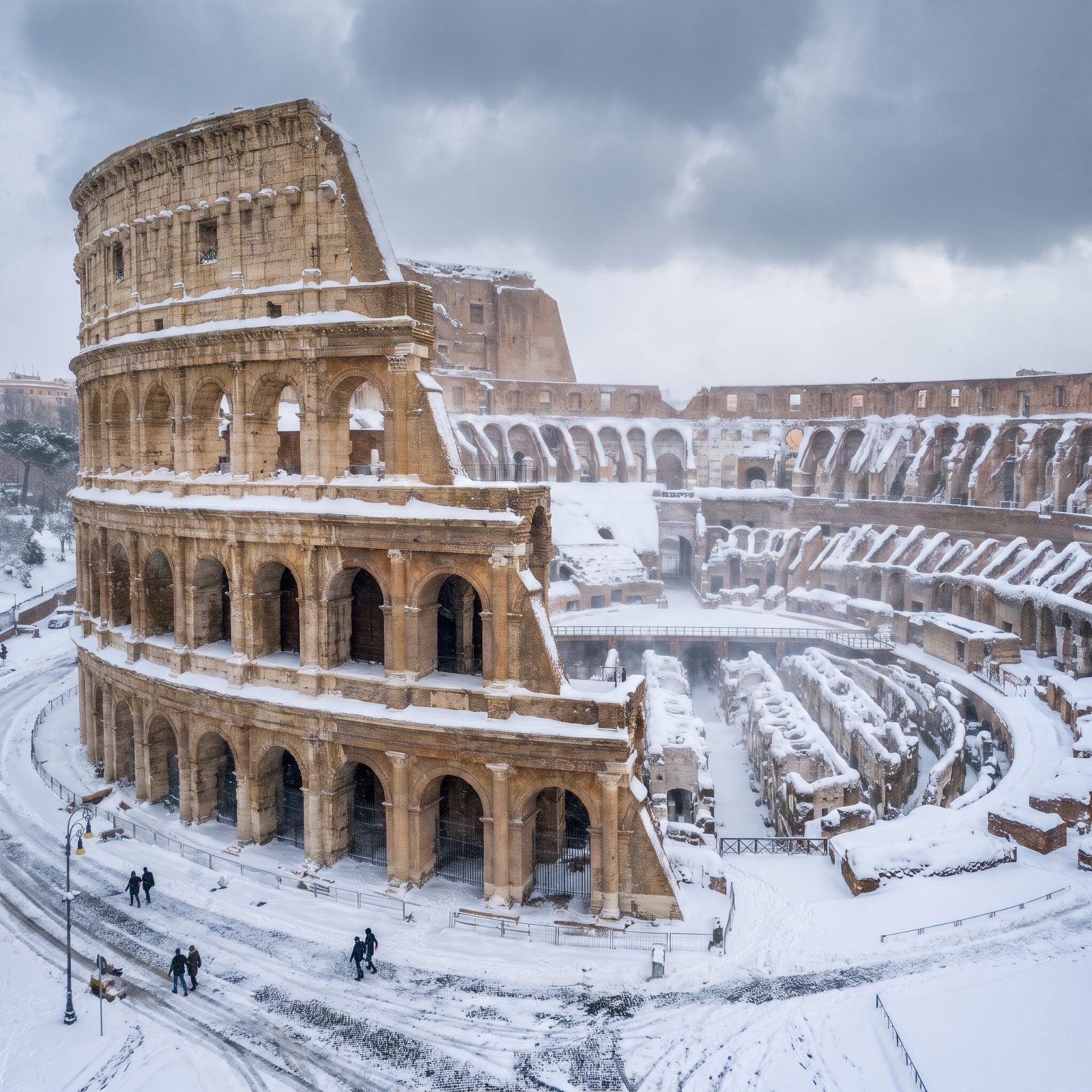
Rome does get the occasional snow. A proper blizzard filling the Colosseum is a different animal.
Every tier of arches holds a ledge of white, and the ruined floor fills with windblown powder that softens two thousand years of stone. The nicest touch is the warm golden travertine still showing through where wind has stripped the exposed faces clean, so the building reads as half-buried rather than painted over. Snow drifting through those open arches is what tips it from monument into storm-in-progress.
33. London: Big Ben Behind a Frozen Westminster

London snow is usually a polite inch that shuts the trains anyway. This is the apocalyptic version.
Big Ben’s pale clock face stares out through blowing powder while its upper spire stands crisp against the white, and every pinnacle on Westminster wears a load of snow. The Thames below has vanished into a flat white snowfield.
Then there, on a clear Westminster Bridge, a red double-decker carrying on across as if it were any other day. That one streak of red against all the cold blue is the whole image.
32. San Francisco: The Golden Gate Bridge in an Arctic Squall
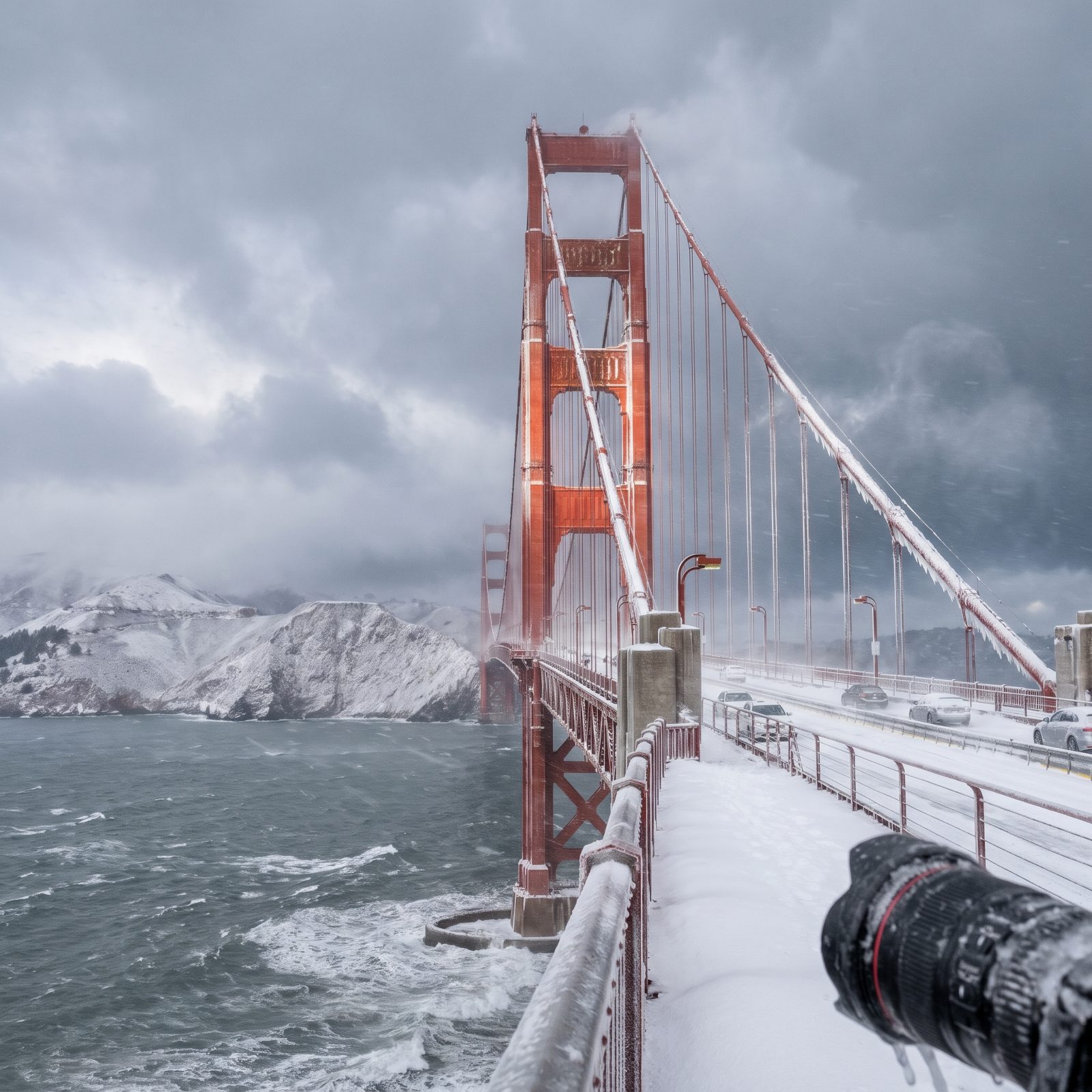
Here’s the one that fights its own colour. International Orange against a snowstorm is a contrast the bridge was never built to make.
Snow and ice cling to the cables as the tower stands sharp, top to crossbeams, against the squall’s clouds. Behind, the Marin headlands trade their usual gold-brown grass for a blanket of white, and the Pacific churns grey and slushy below.
Here is the detail we love. Wind scours the orange paint clean on the windward faces while snow packs the lee side, so the towers read as striped — precisely how ice loads a real suspension bridge in a storm. None of this happened. All of it could be drawn straight from physics. That gap is the whole reason these images stick.
31. Singapore, Marina Bay Sands Under an Impossible Snowstorm
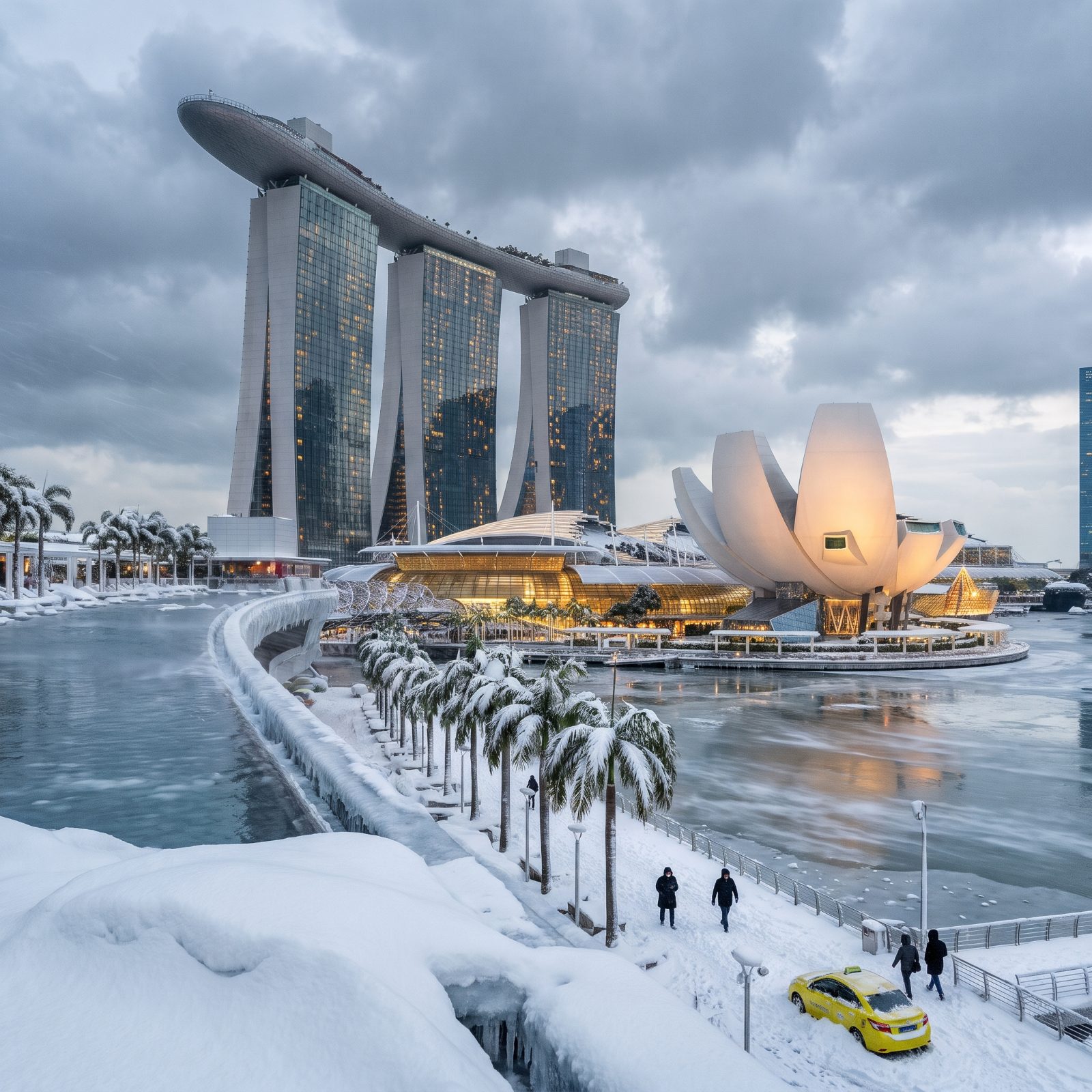
Singapore sits one degree north of the equator, and it has never snowed there — not once in recorded history. That’s exactly why this scene stops you cold. The boat-shaped SkyPark riding above three towers is instantly recognizable, and seeing it capped in white feels like a glitch in the planet.
The closest reality has ever come was a chilly morning back in 1934, and even that was just cool, not cold. Tropical cities lack the machinery for snow entirely: no sustained freezing air aloft, no cold fronts barreling through. Gorgeous here. Impossible out there.
30. Amsterdam, Snowbound Bicycles Beside Frozen Canals
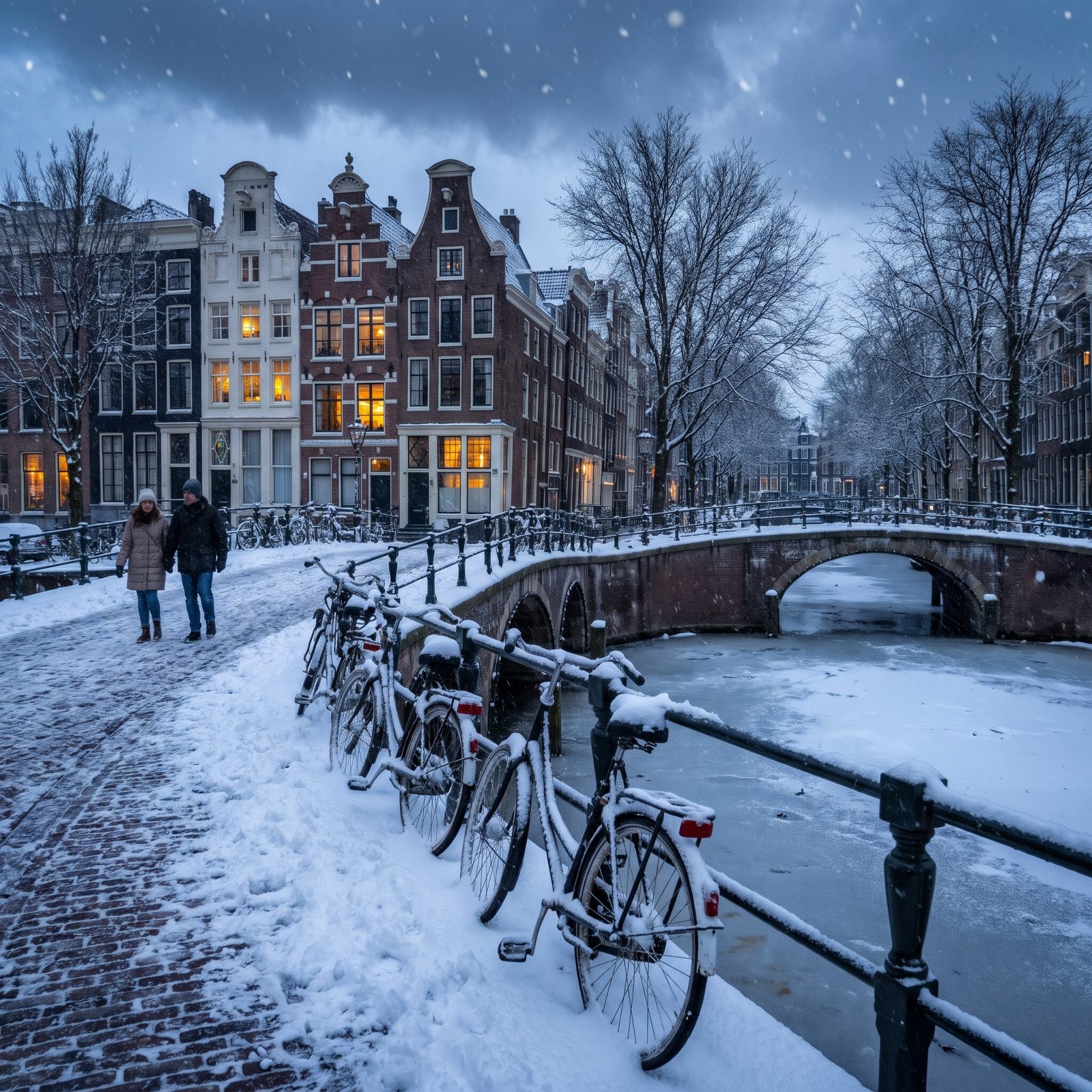
Amsterdam actually knows this feeling, sort of. When the canals freeze hard enough, locals lace up skates and glide the whole network, a tradition centuries old. The catch? A proper deep freeze now shows up maybe once a decade, if that.
But the buried bicycles are the real heartbreaker. This is a city that owns more bikes than it has people — picture every single one of them wearing a little snow hat, wheels locked in a drift, going absolutely nowhere until spring. That’s the detail that makes the cold feel real.
29. Istanbul, Hagia Sophia Ringed by Deep Christmas Drifts
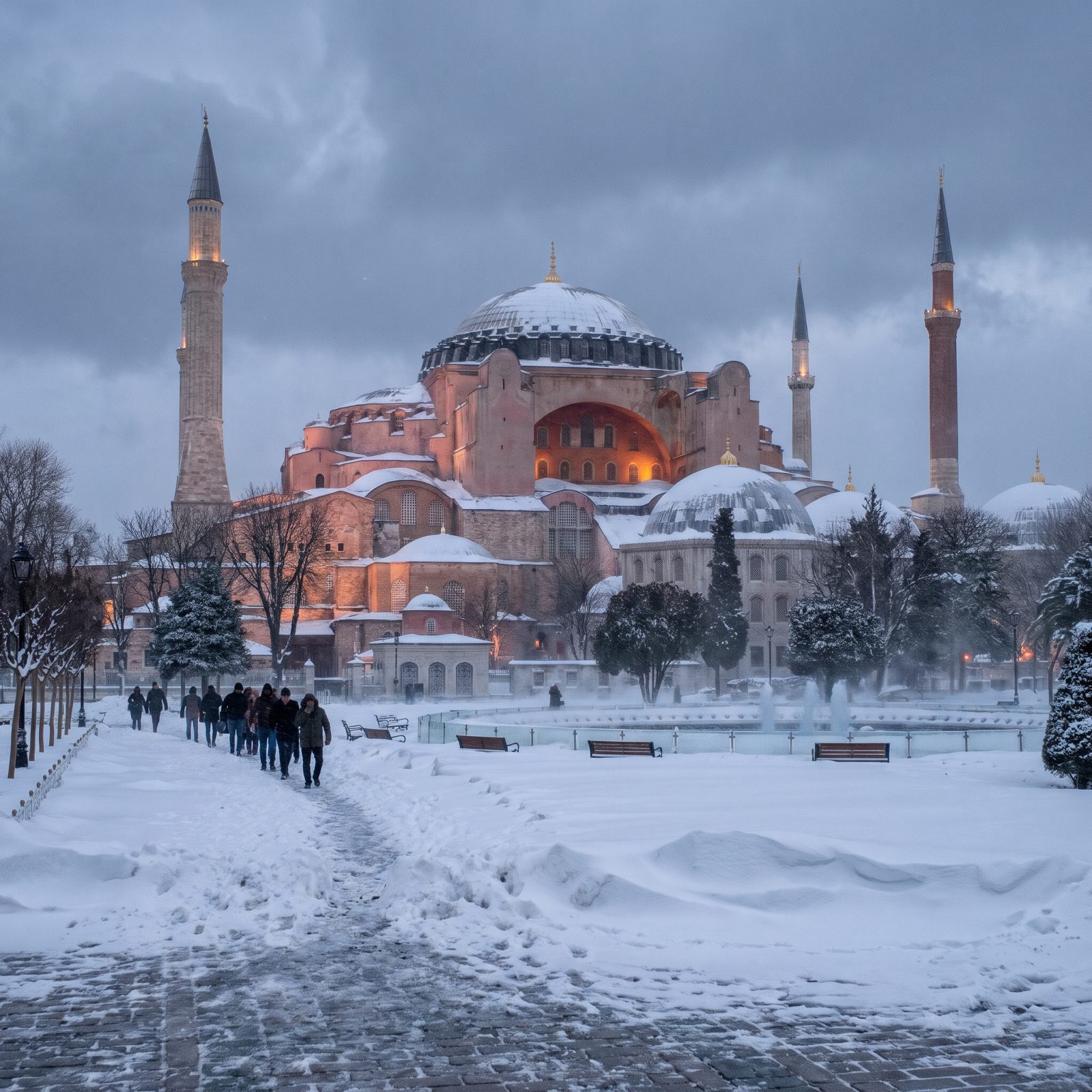
Istanbul does get snow, and plenty of it. Sitting where Europe meets Asia, the city catches cold air sweeping down from the Balkans and the Black Sea, and a good winter storm can shut the whole place down.
What’s extraordinary is the building holding steady through it. Hagia Sophia has stood since 537 AD — the largest cathedral on Earth for nearly a thousand years, then a mosque, then a museum, now a mosque again. That dome has watched something like fifteen centuries of winters come and go. One more blizzard barely registers.
28. Hong Kong, Victoria Harbour Frozen Beneath Storm Clouds
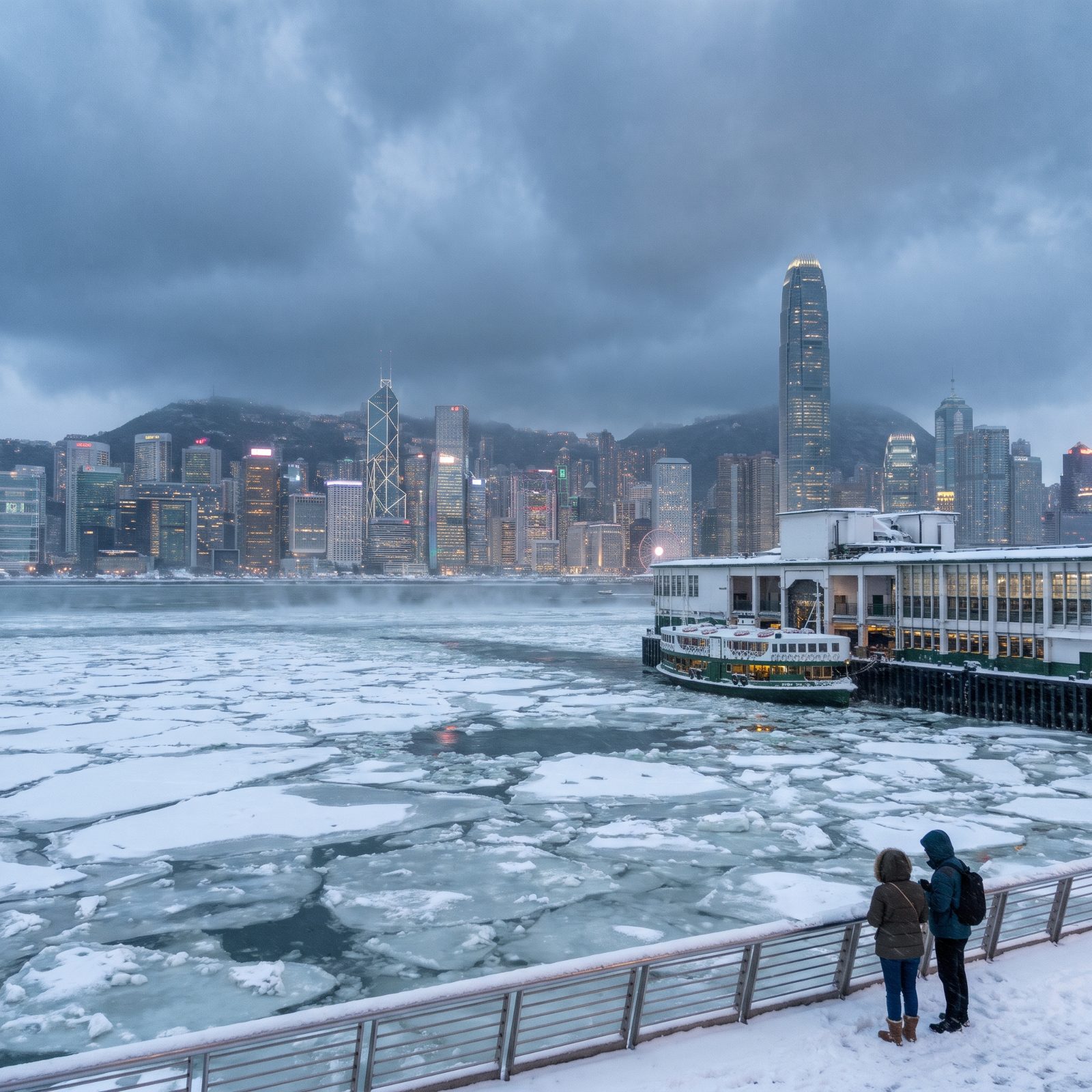
Hong Kong’s winters are mild and humid, and snow in the city proper is basically mythical. Frost and a rare flurry have turned up on the highest peaks like Tai Mo Shan during brutal cold snaps, but that’s about the ceiling of it.
A frozen Victoria Harbour? That pushes well past rare and straight into fantasy. This is one of the busiest shipping channels on the planet, water that never stops moving — and seeing it crusted with ice sheets, ferries locked in place, is the kind of image that makes you blink twice and look again.
27. Los Angeles, Hollywood Boulevard Buried Before Christmas
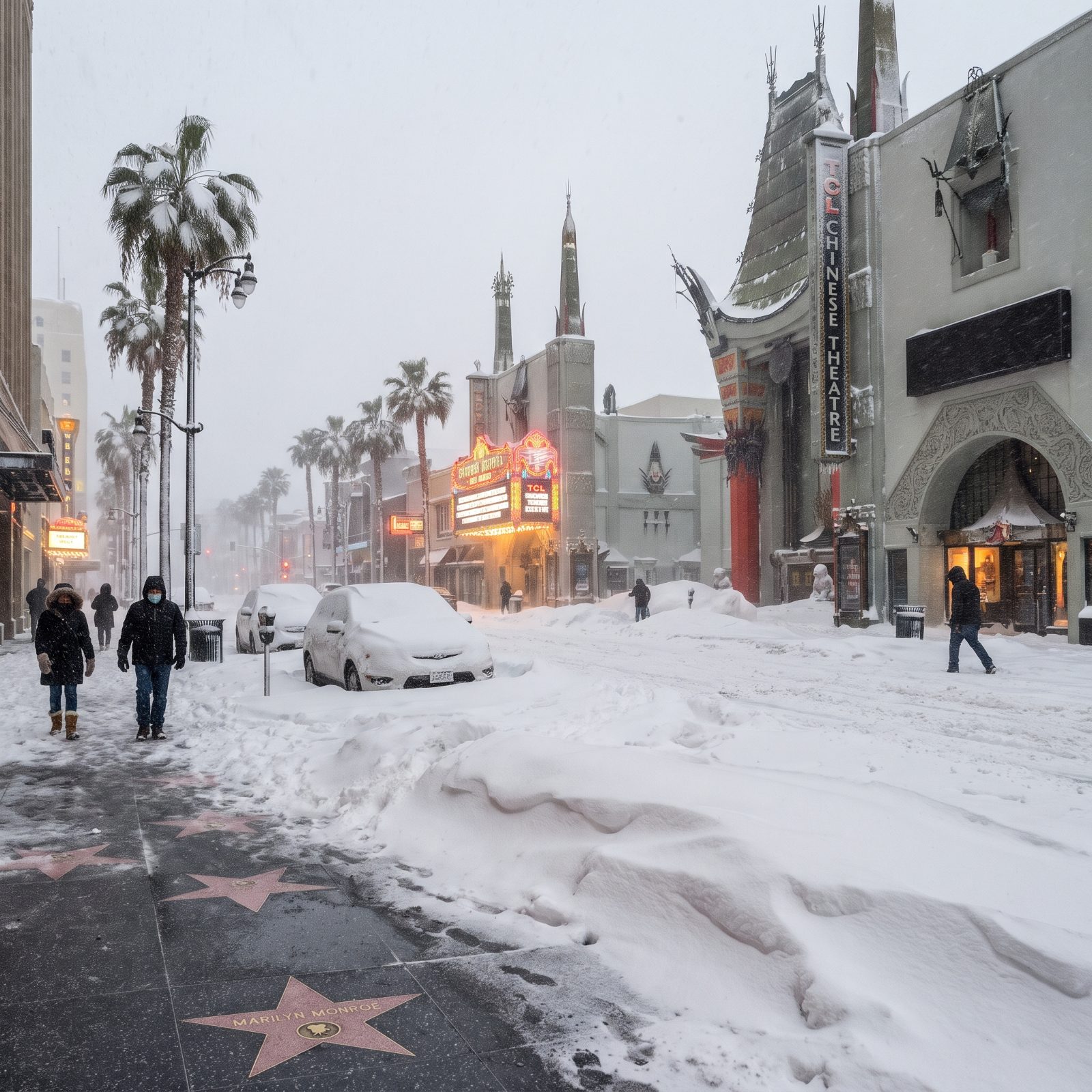
Snow on the Walk of Fame is pure impossibility, and that’s the fun of it. LA’s last meaningful citywide snow landed in January 1949, when a freak storm dropped real flakes downtown and people actually built snowmen in the Hollywood Hills. Residents still talk about it like it was yesterday.
Palm trees wearing snow is the detail that breaks your brain a little. These trees evolved for heat — load their fronds with ice and the whole scene reads as beautifully, gloriously wrong.
26. Barcelona, Sagrada Família Rising Above Frosted Streets
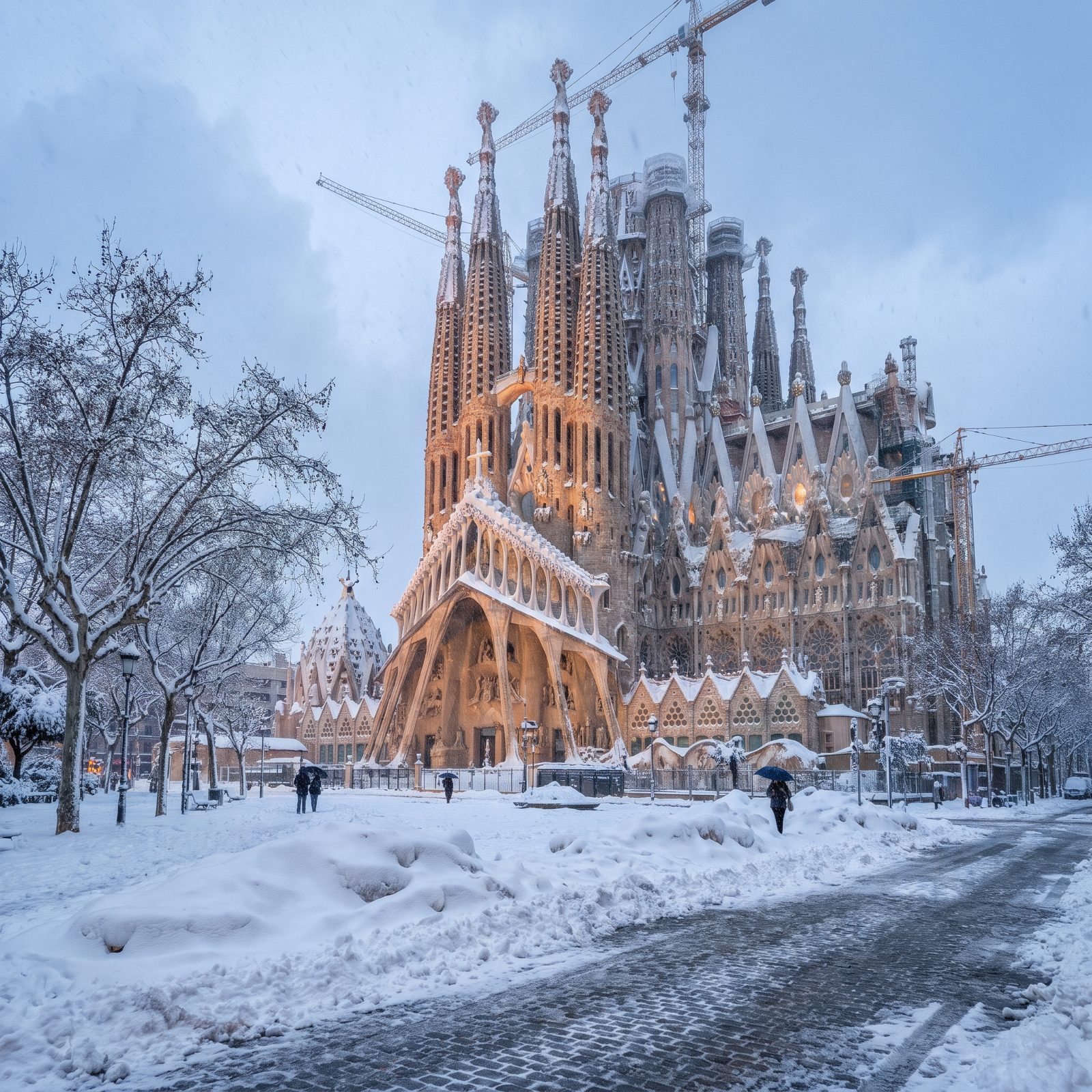
Barcelona gets the occasional snowfall, though it’s rare and the city grinds to a halt the moment it happens. A memorable 1962 storm blanketed the streets and lodged itself in local memory for generations.
Gaudí designed the Sagrada Família’s spires to echo mountains and dripping sandstone — all curves and organic swells. Add snow and the illusion finishes itself: the towers stop looking built and start looking grown, geological, like something glaciers carved rather than masons laid up stone by stone. More than 140 years into construction, and a blizzard only makes the thing stranger.
25. Moscow, St. Basil’s Cathedral in a Christmas Whiteout
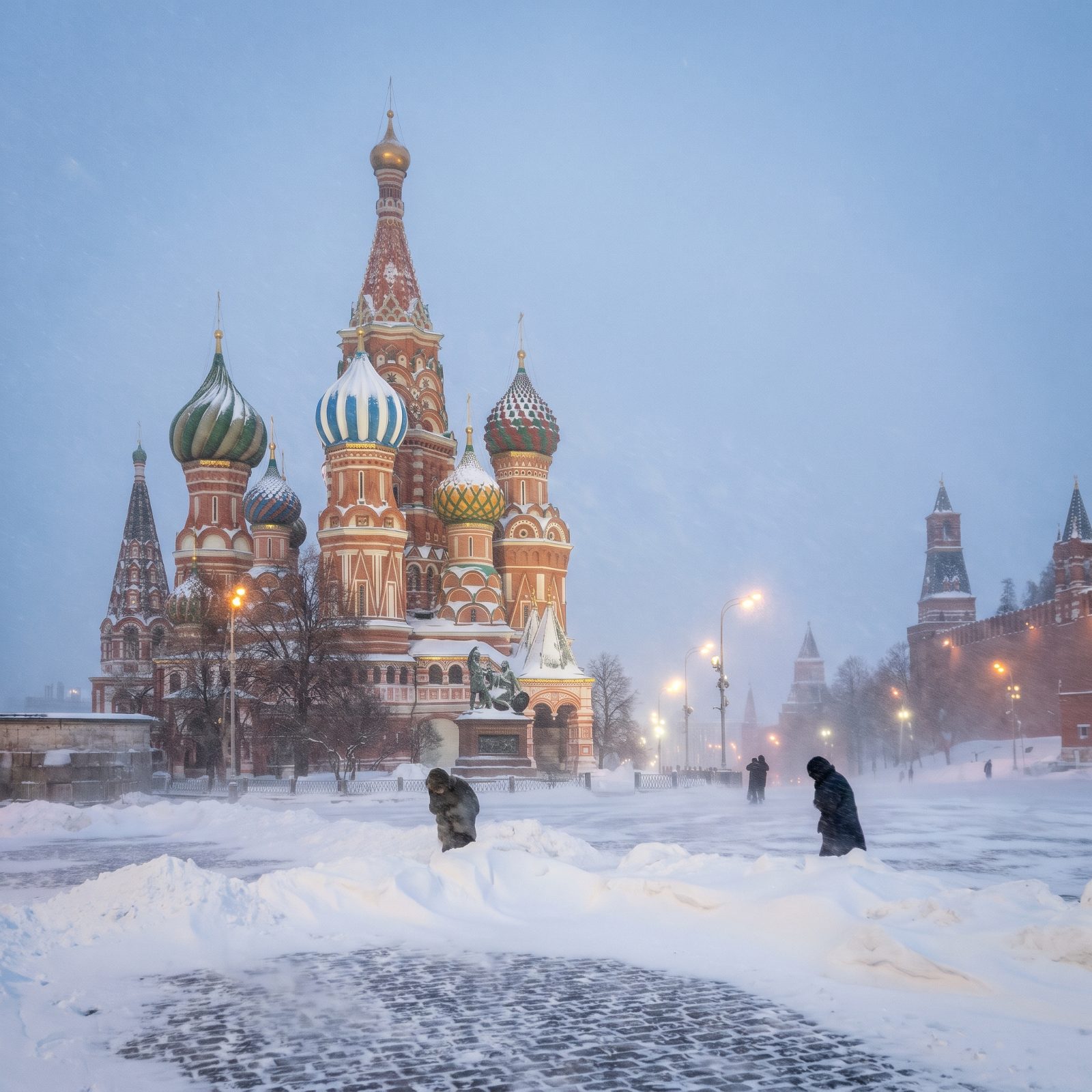
This one’s almost documentary. Moscow does winter properly, routinely dropping well below freezing, and St. Basil’s spends months with snow packed onto its onion domes. A December whiteout here isn’t fantasy. It’s Tuesday.
The payoff is the color. Those candy-striped swirling domes, ordered built in the 1550s, blaze against a white sky like nothing else anywhere. Snow doesn’t dull them — it isolates every red, green and gold until the whole cathedral looks hand-painted straight onto the storm.
24. Cape Town, Table Mountain Above a Snowbound Waterfront
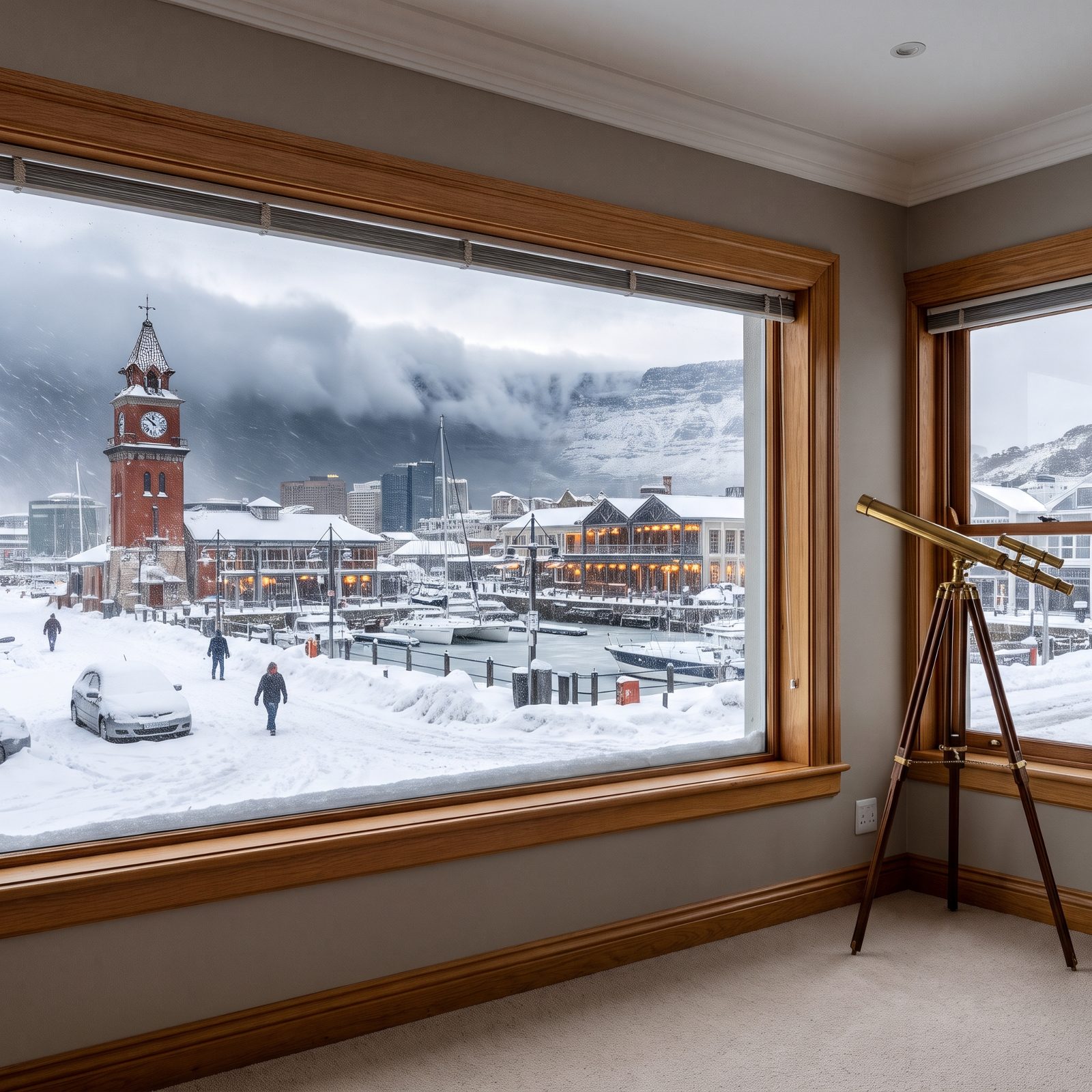
Here’s the twist most people miss: it does snow near Cape Town. Not on the city often, but the surrounding mountains like the Hottentots Holland range get genuine winter snow most years. Table Mountain itself sees a light dusting on its summit only in the coldest winters.
A fully snowbound V&A Waterfront, though — that’s the stretch. The famous flat top wearing a thick white cap, harbour boats iced in, December heat swapped out for drifts. And remember, it’s summer down there in December, so this scene flips the season twice over.
23. Bangkok, Wat Arun Shimmering Through Falling Snow
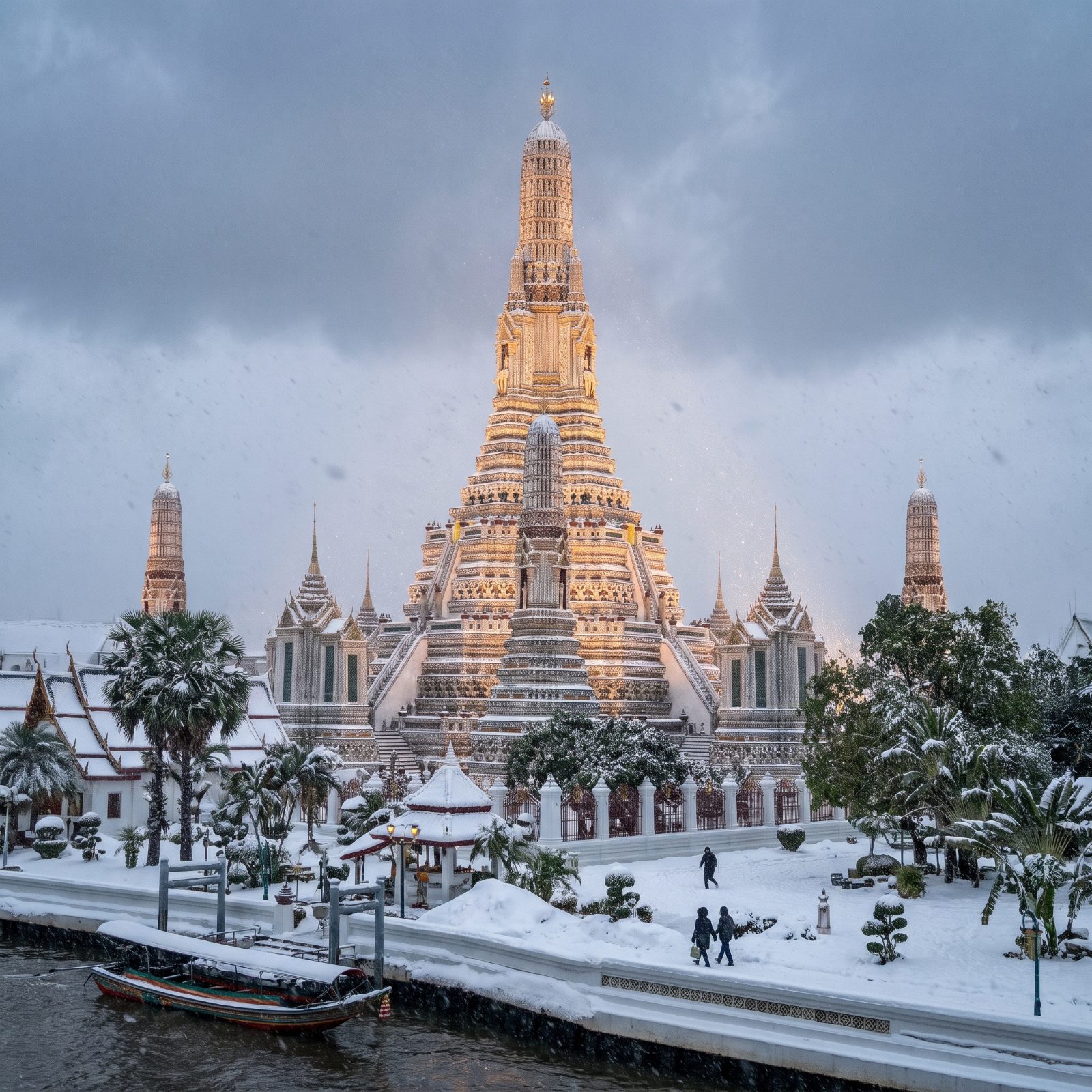
Thailand has never recorded a single snowfall. Bangkok runs hot and humid year-round, and the whole concept of a flake landing on Wat Arun belongs purely to imagination.
Which is precisely what makes the mosaic spire magical here. The Temple of Dawn is covered in thousands of bits of colored porcelain and seashell — fragments from broken Chinese pottery pressed into the plaster centuries ago. In snow and floodlight, every shard catches the glow the way frost catches winter sun. It’s a scene that genuinely couldn’t exist, and maybe the one you’d most want to see anyway.
22. Chicago, A Frozen River Beneath Snow-Choked Skyscrapers
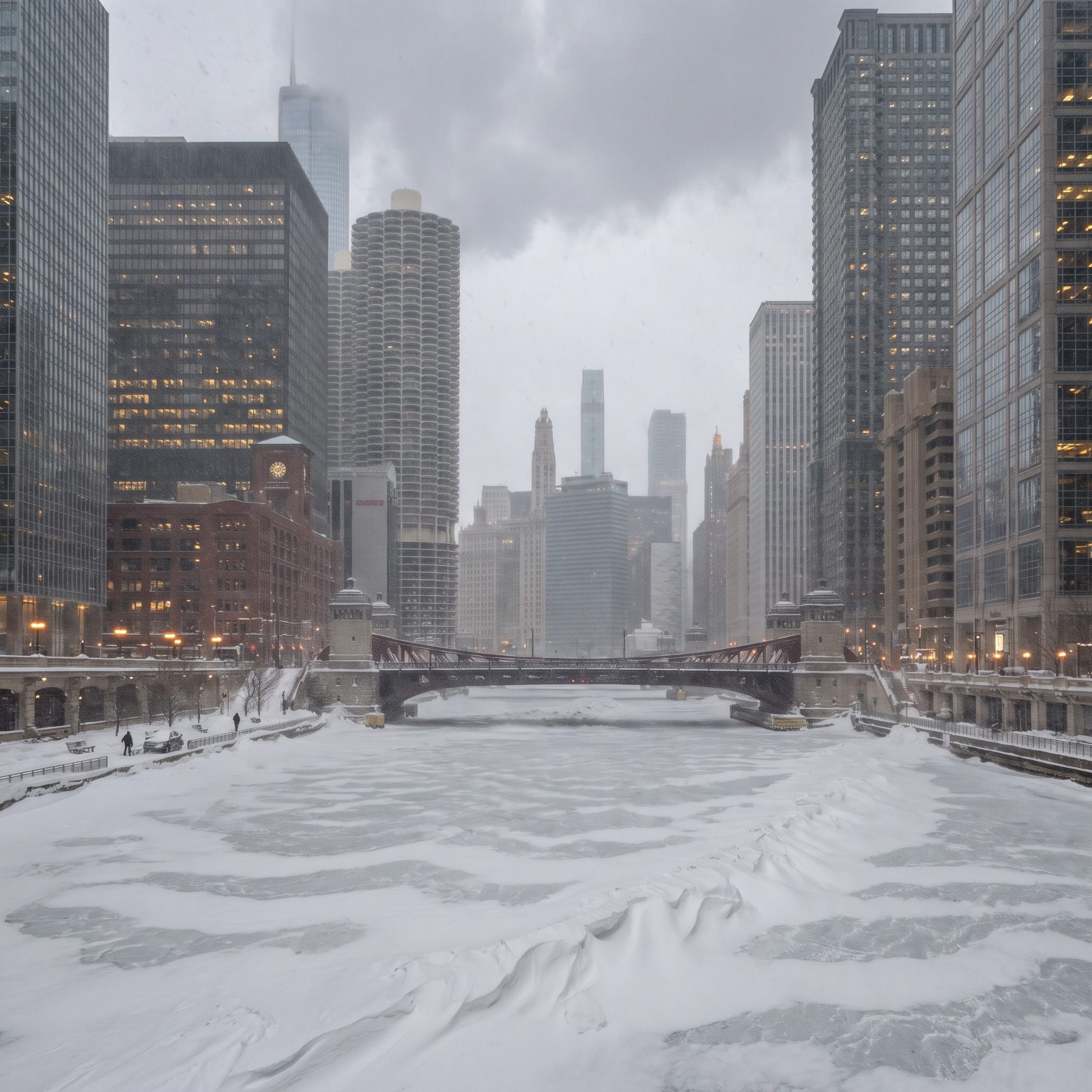
Chicago earns this one. The Windy City knows real winter, and the river has iced over in brutal cold snaps before. Lake-effect snow rolling off Lake Michigan can bury the place in a hurry.
And there’s history here. The legendary 1967 blizzard dumped close to two feet in a single storm, the biggest on record, stranding thousands of cars and shutting the city down for days. So this scene isn’t fantasy so much as memory, pushed to its absolute limit.
21. Athens, The Acropolis Crowned With Snow
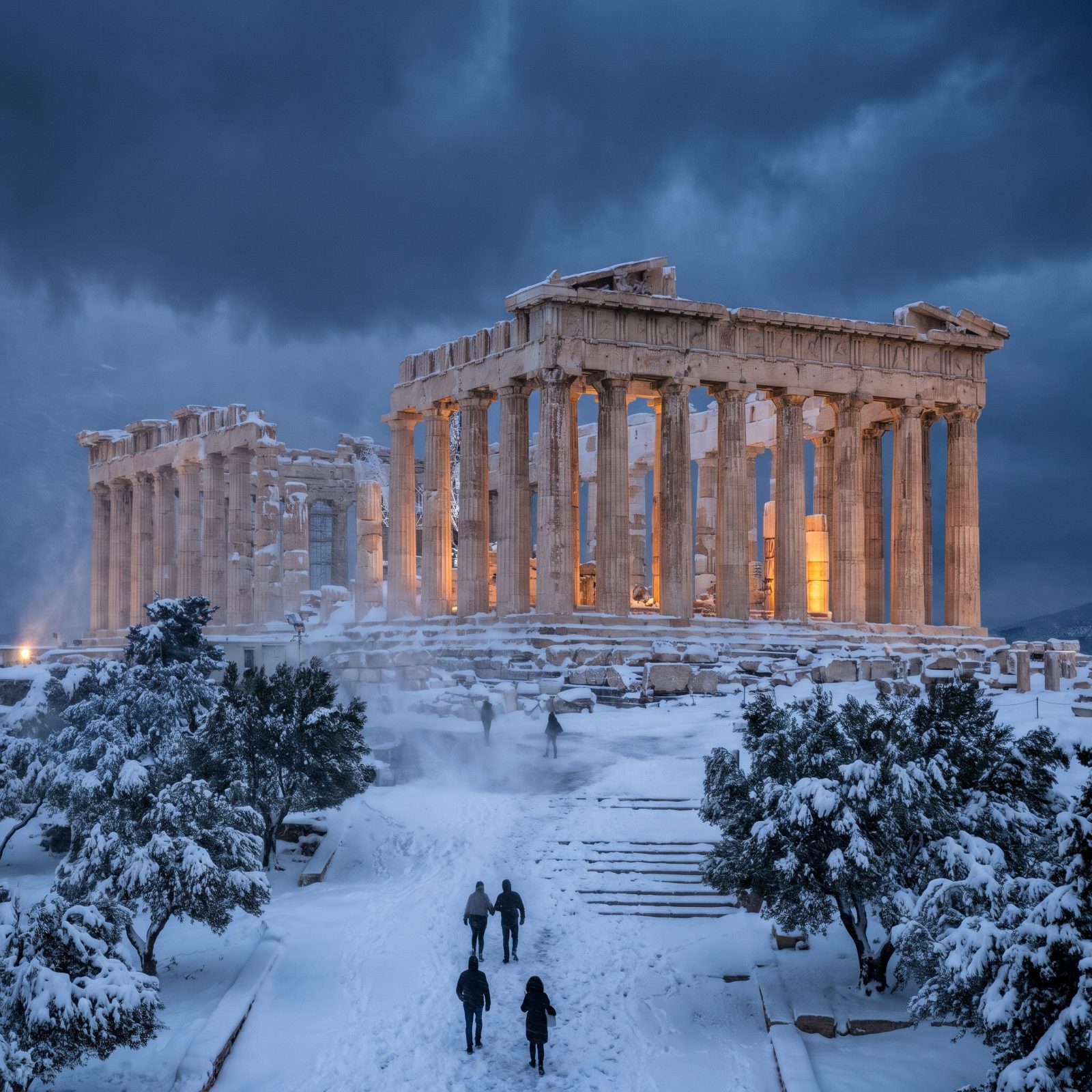
Snow on the Parthenon reads like a visual joke, because Athens barely sees frost. The city sits in a bowl ringed by mountains, where Mediterranean winters rarely push below freezing at the Acropolis, and the rare snow that does fall dusts the marble and vanishes by noon.
This scene leans into the extreme version: columns iced over, drifts banked against 2,500-year-old stone. Here’s a detail that sells it — the Pentelic marble the ancient Greeks quarried turns faintly golden with age and oxidation, so it drinks up warm light against the cold white.
20. Kyoto, Fushimi Inari’s Red Gates Lined With Snow
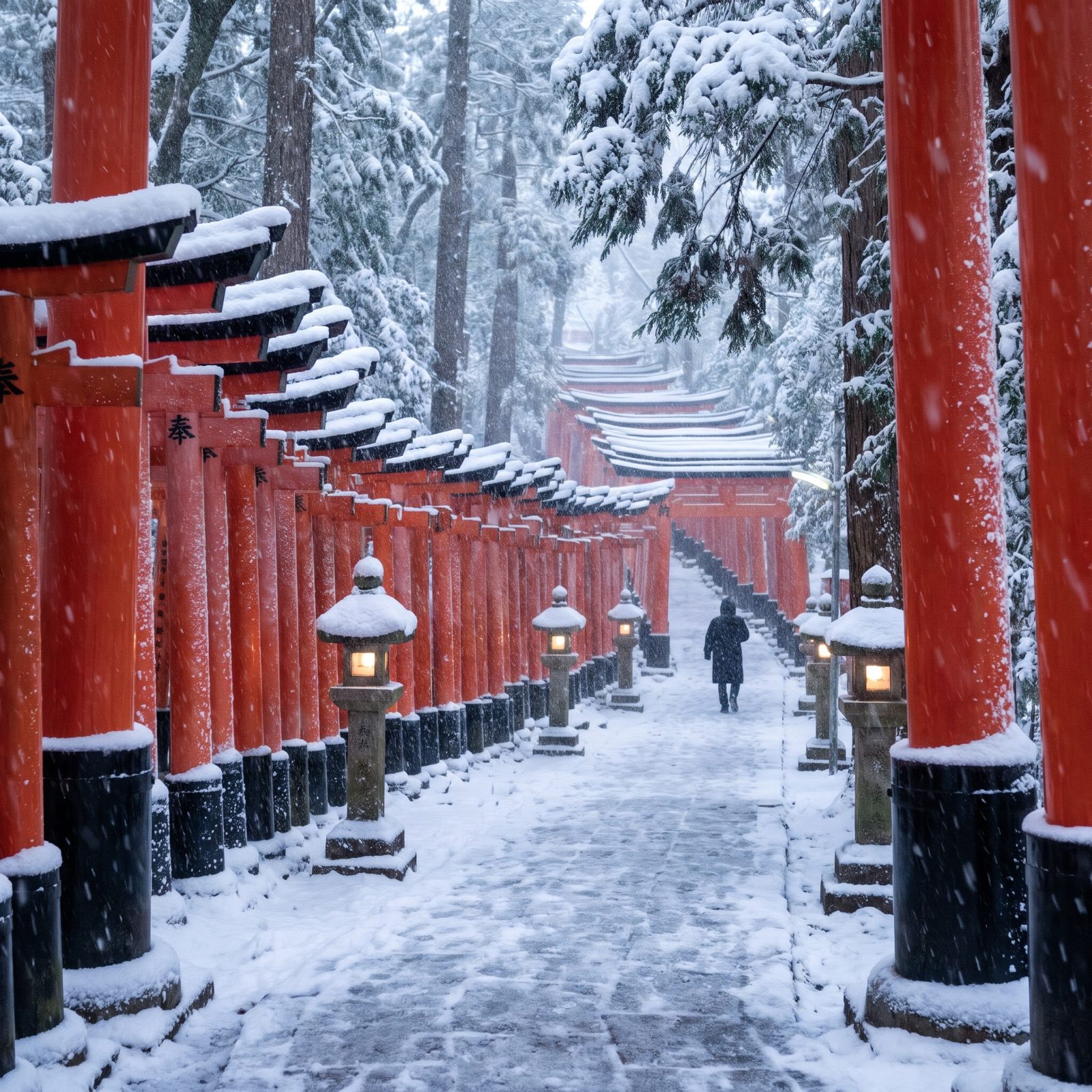
Kyoto actually gets more snow than most of Japan’s big cities, thanks to cold air sweeping off the Sea of Japan and dumping over the mountains. A heavy fall at Fushimi Inari is rare but real. When it happens, photographers lose their minds.
The vermilion of those roughly 10,000 torii gates comes from a mercury-based pigment used in Japan for centuries, believed to ward off evil and keep rot at bay. Pile snow around it and that red stops looking like paint — it looks lit from inside. That contrast is the whole image.
19. Marrakech, Jemaa el-Fnaa Transformed Into a Winter Square
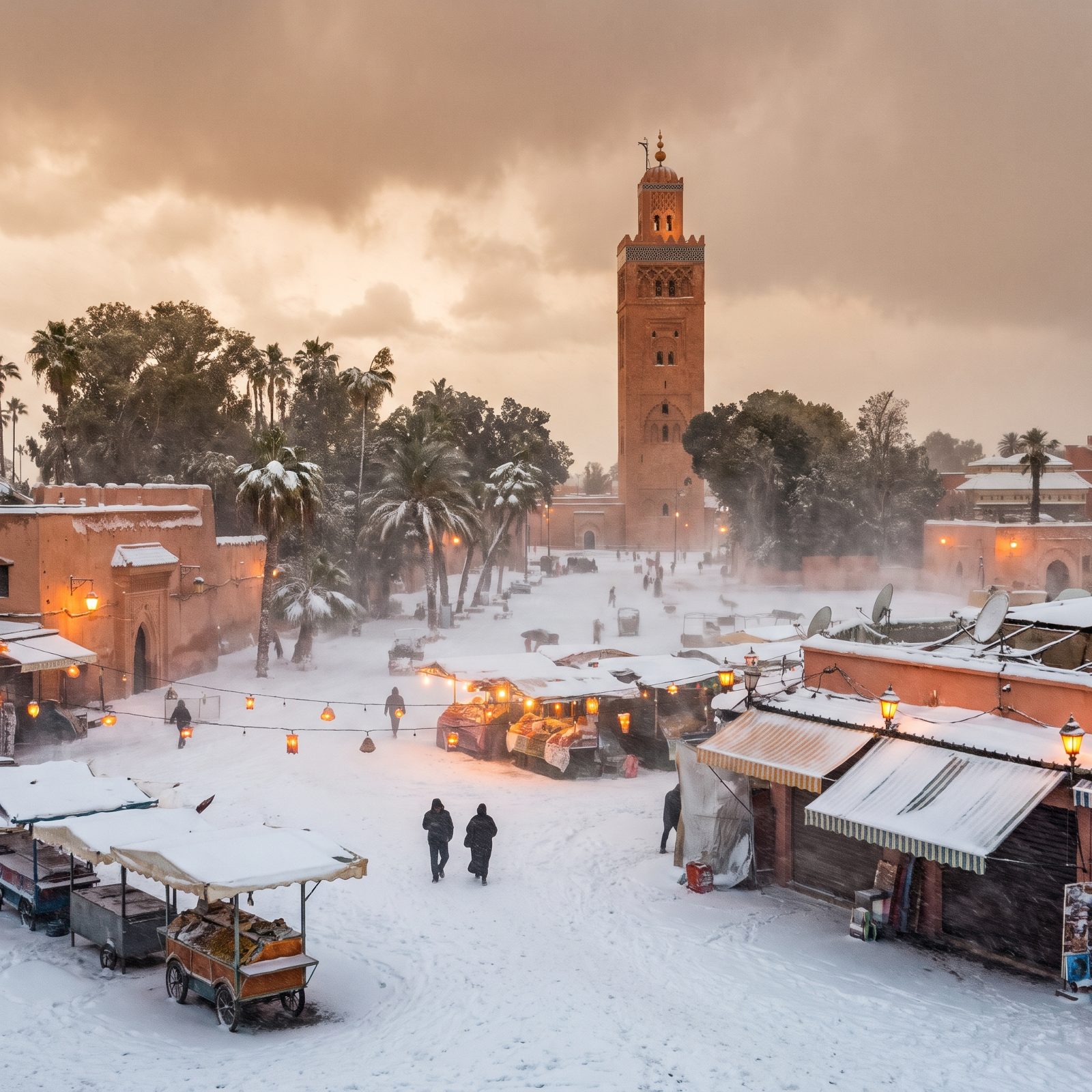
Snow in Marrakech is nearly unthinkable. The city sits at the edge of the Sahara’s reach, where summer highs push past 100°F. And yet the Atlas Mountains just south get serious winter snow every year, their white peaks visible from town on clear days.
So this scene bends reality without quite breaking physics. The square’s red-ochre walls get their color from local clay — the reason Marrakech is called the Red City. Under snow, that warm clay against cold white is the most unlikely color pairing you’ll find here.
18. Lisbon, Yellow Trams Trapped on a Frozen Hill
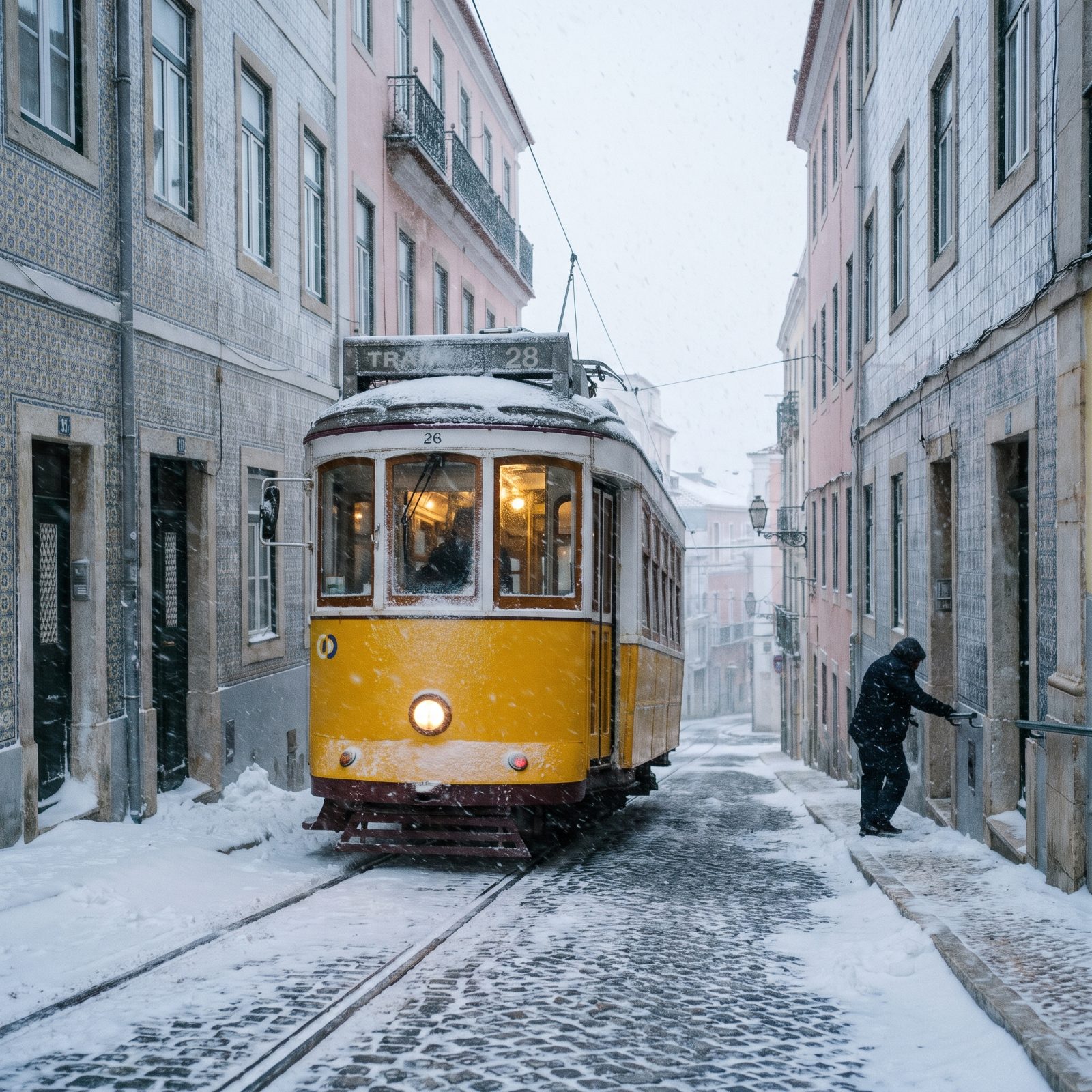
Lisbon’s hills are brutal on a dry day. Ice them over and Tram 28 — the century-old route that grinds up the Alfama district — would simply stop, because those cobbled streets drain water fast but hold ice like glass.
The yellow trams are Remodelado models, mostly built in the 1930s, still clattering along because the streets are too steep and narrow for anything modern. A blizzard would strand them exactly where this image puts them: mid-climb, lit from inside, going nowhere. Lisbon hasn’t seen measurable snow downtown in living memory, which makes the scene pure invention with accurate bones.
17. Beijing, The Forbidden City Under Windswept Snow
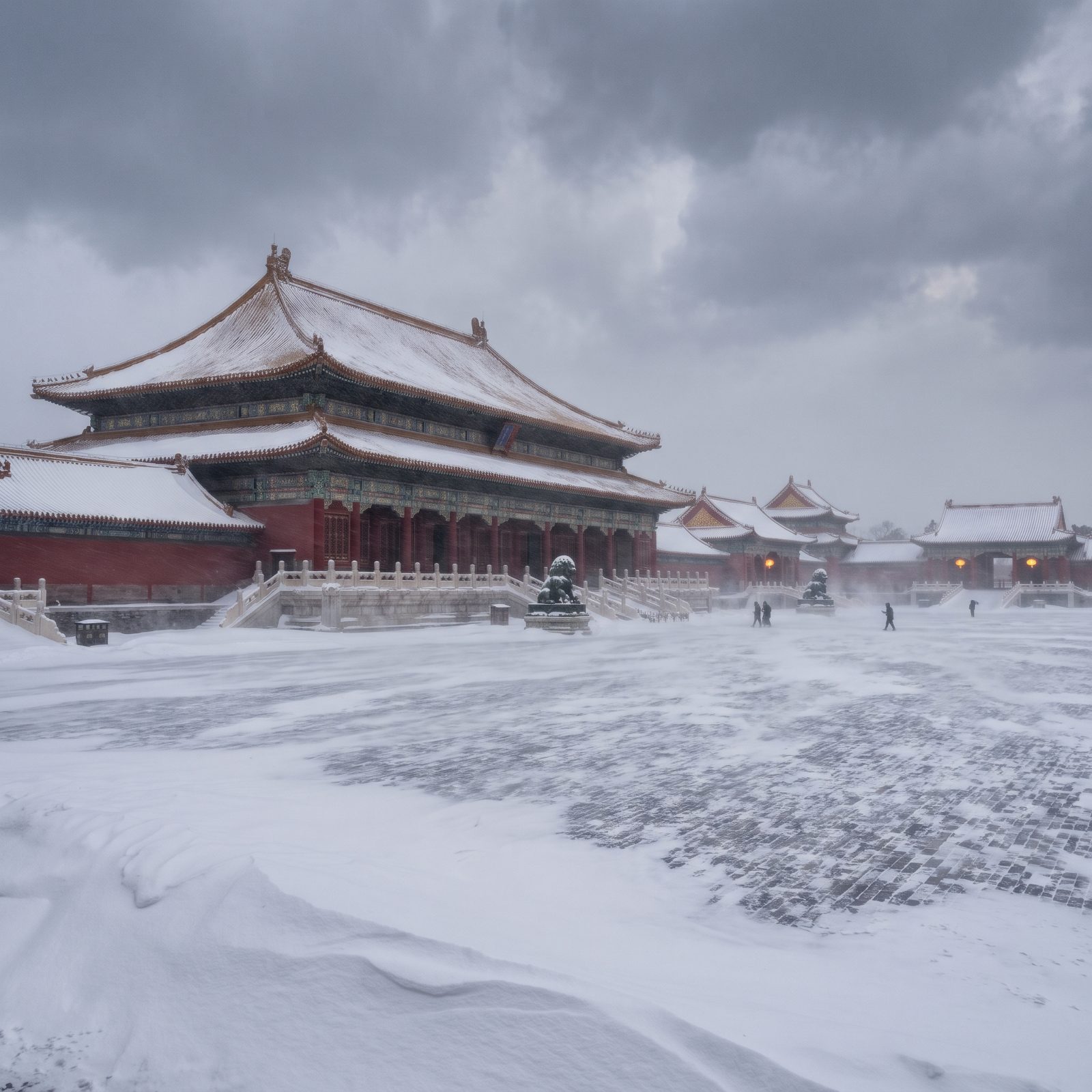
Beijing actually gets snow, so this one reads more like a bad winter than a fantasy. The city sits in a cold, dry continental climate, and the Forbidden City under white is a genuine sight people queue for.
The color code is what makes it sing. Those roofs are imperial yellow glazed tile, a shade once reserved for the emperor alone, and the walls are deep oxblood red. Snow drops the whole saturated palette into a frozen hush, leaving only those two colors glowing.
Nearly 1,000 buildings sit inside those walls, and in a real blizzard the whole 180-acre complex goes silent.
16. Havana, Vintage Cars Stranded in Deep Snow
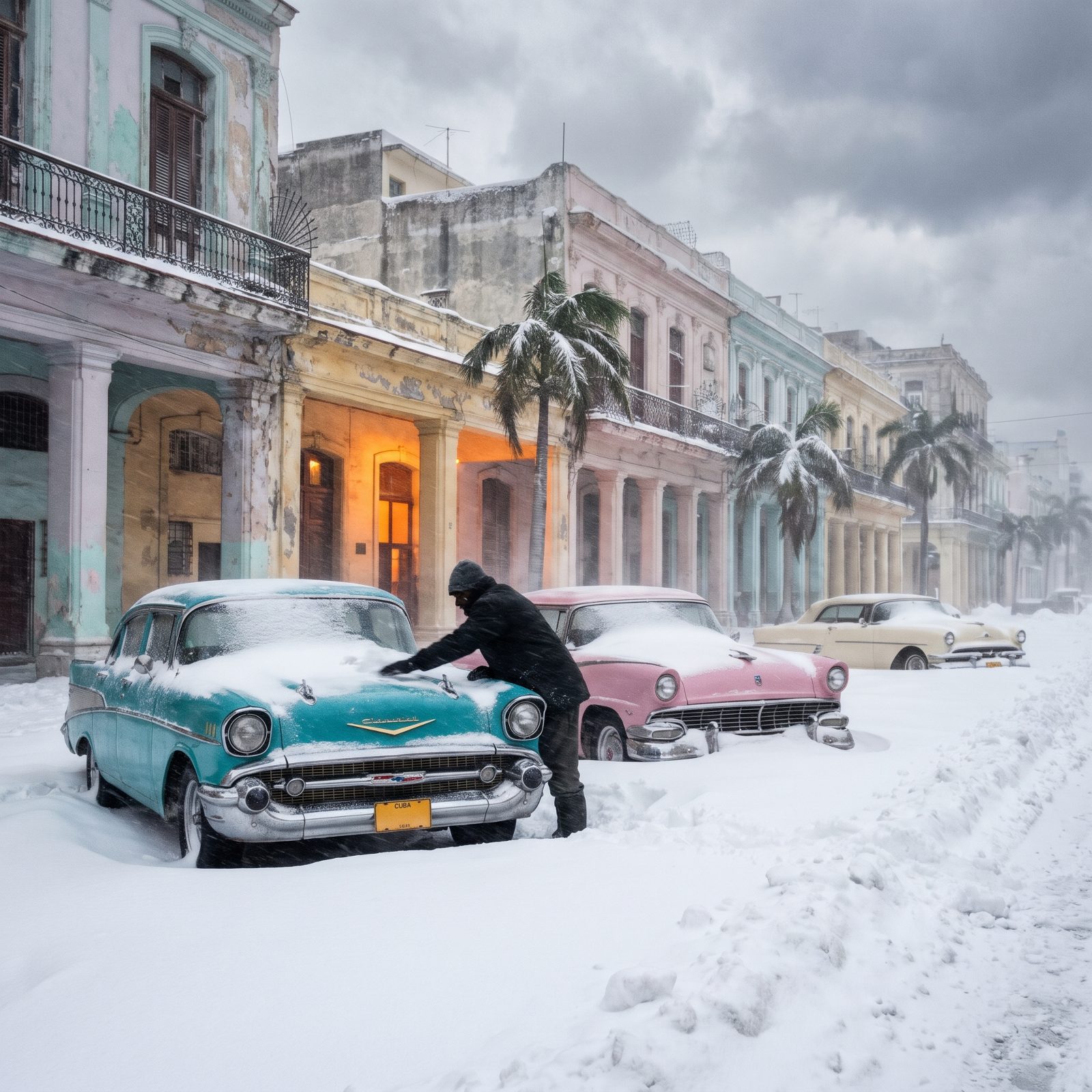
Havana has never seen snow. The city sits at 23 degrees north, deep in the tropics, where winter means a sweater at most. Cuba’s one recorded flurry was a few flakes back in 1857, and even that’s disputed.
Which is precisely why this image lands. Those candy-colored 1950s cars — the Bel Airs and Fords kept running for seventy years because the US embargo choked off new imports — are Havana’s whole visual identity. Bury them to the fenders and you break every rule the city lives by.
15. Edinburgh, The Castle Above a Buried Royal Mile
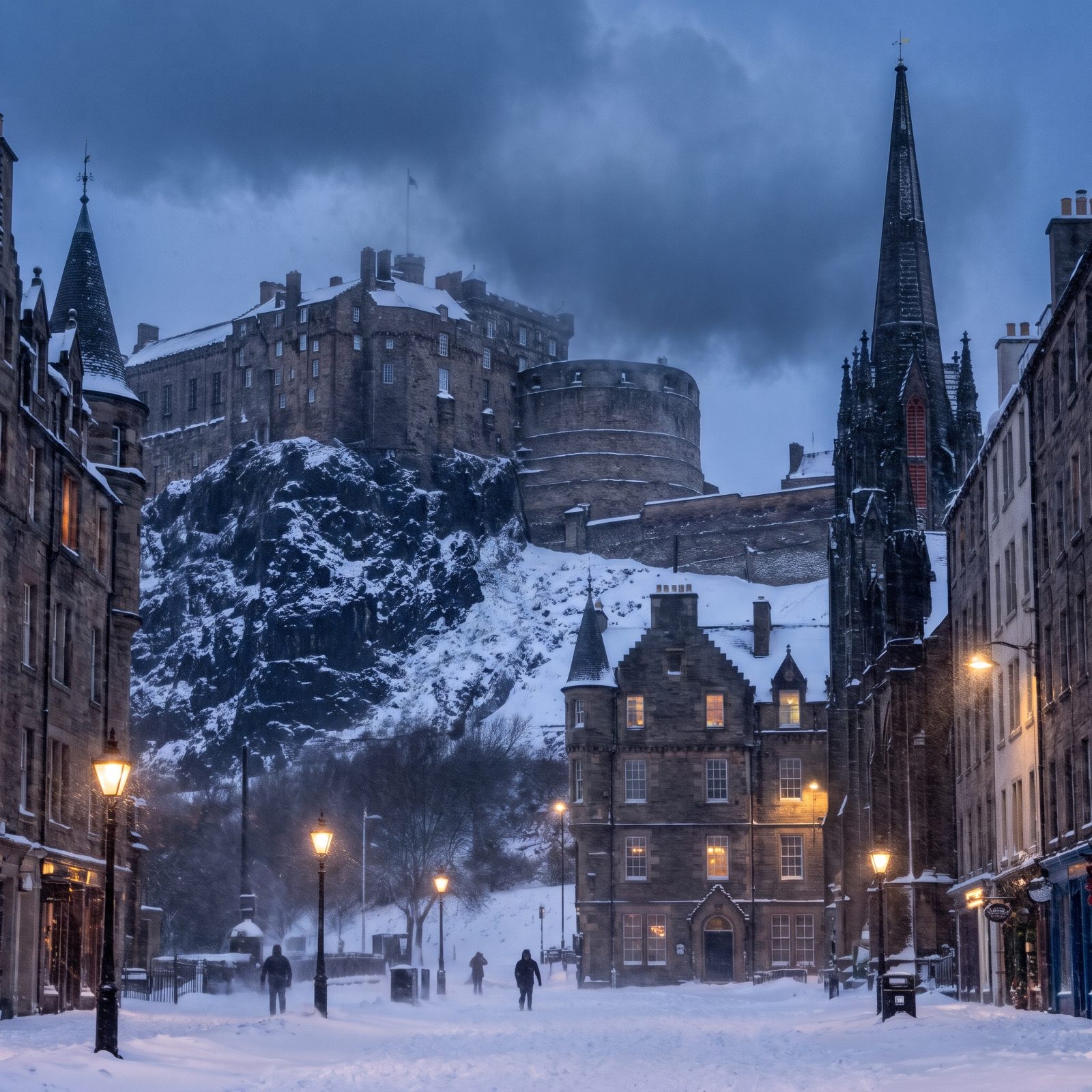
Edinburgh does get snow, and when it comes down hard the Old Town turns genuinely medieval. The Royal Mile runs along a glacial ridge, the castle perched on an extinct volcanic plug called Castle Rock, which is why the whole city tilts and rolls.
Heavy snow buries those cobbles and dusts the castle’s battlements beneath a brooding sky of low cloud, just as shown here, while the gothic spires and tall tenements funnel the wind into vicious little channels. This is one of the few scenes that could actually happen in a rough winter — and Edinburgh has had plenty.
14. Vienna, Schönbrunn Palace Beneath Fresh Christmas Snow
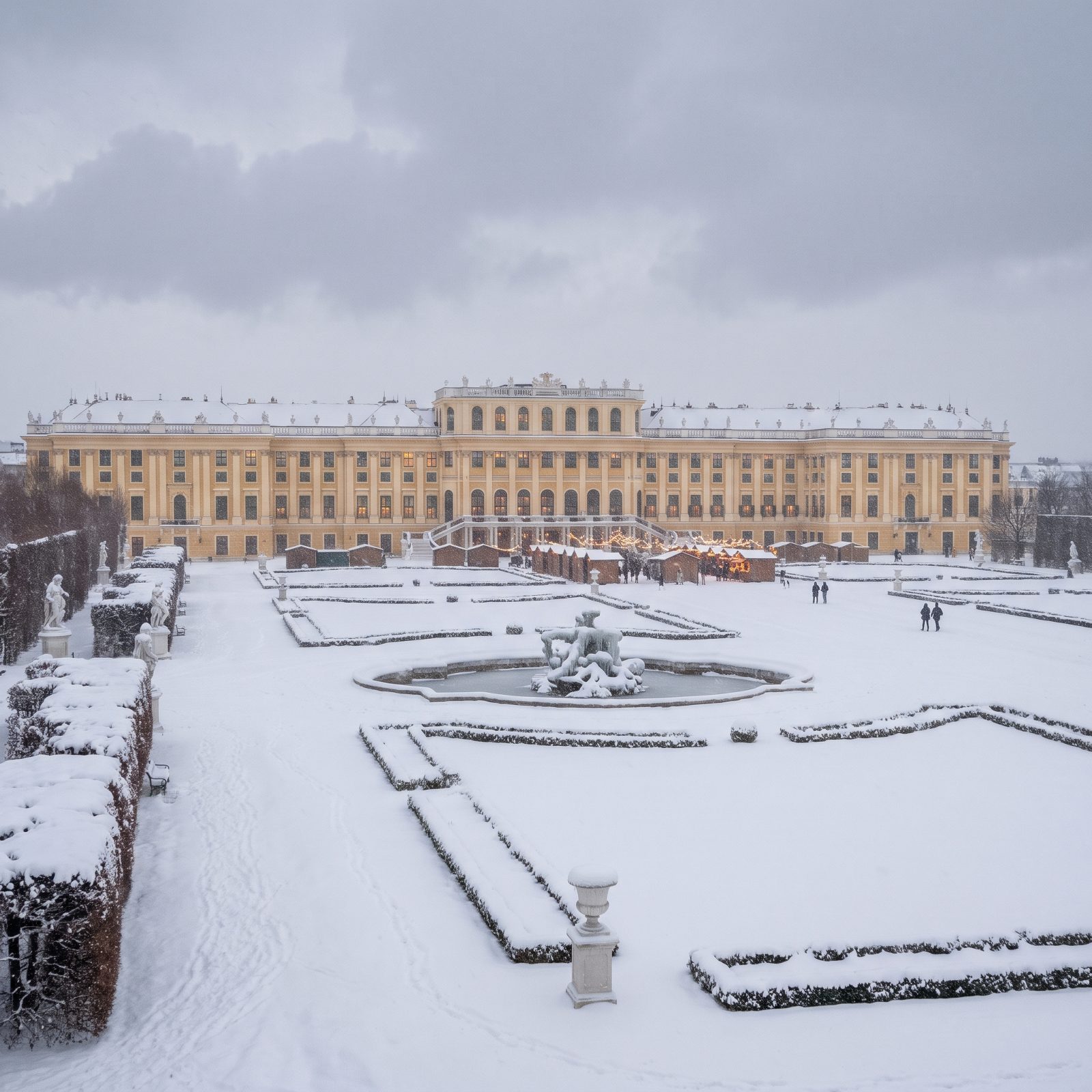
Vienna knows snow, and Schönbrunn under a white blanket is a Christmas card made real. The palace wears that specific warm ochre the Habsburgs loved, officially called Schönbrunn Yellow, chosen to read as gold without the cost of actual gilding.
Against fresh snow it practically glows. The gardens were laid out in strict baroque symmetry back in the 1700s, so a clean snowfall makes every line and hedge pop like a pen drawing. Add the Christmas market stalls in the forecourt, and warm light spilling from a palace with 1,441 rooms, and the storm turns the whole estate into one enormous lantern.
13. Mumbai, The Gateway of India Behind Coastal Snowdrifts
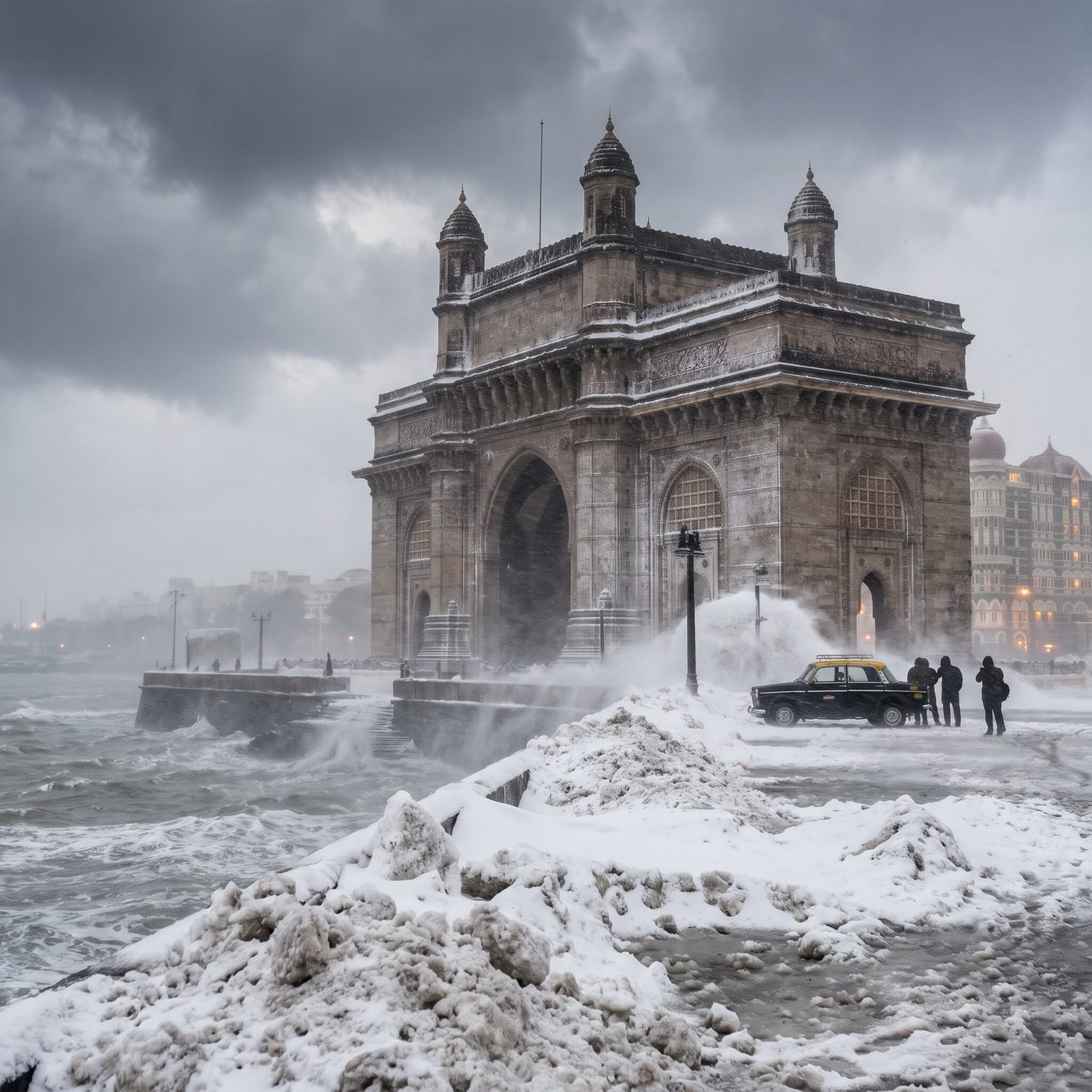
Mumbai and snow don’t belong in the same sentence. The city hugs the Arabian Sea at 19 degrees north, where December means low 80s and ice is pure science fiction.
That’s the entire point of this one. The Gateway of India, finished in 1924 to mark a royal visit, was carved from honey-colored basalt and yellow Kharodi stone to shrug off monsoon sea spray — not snowdrifts. Put slush at the waterline and frost on the domes and you’ve got the single most climatically impossible scene here. India’s only real snow falls far north in the Himalayas, a different country of weather entirely.
12. Las Vegas, The Strip Glowing Through a Desert Whiteout
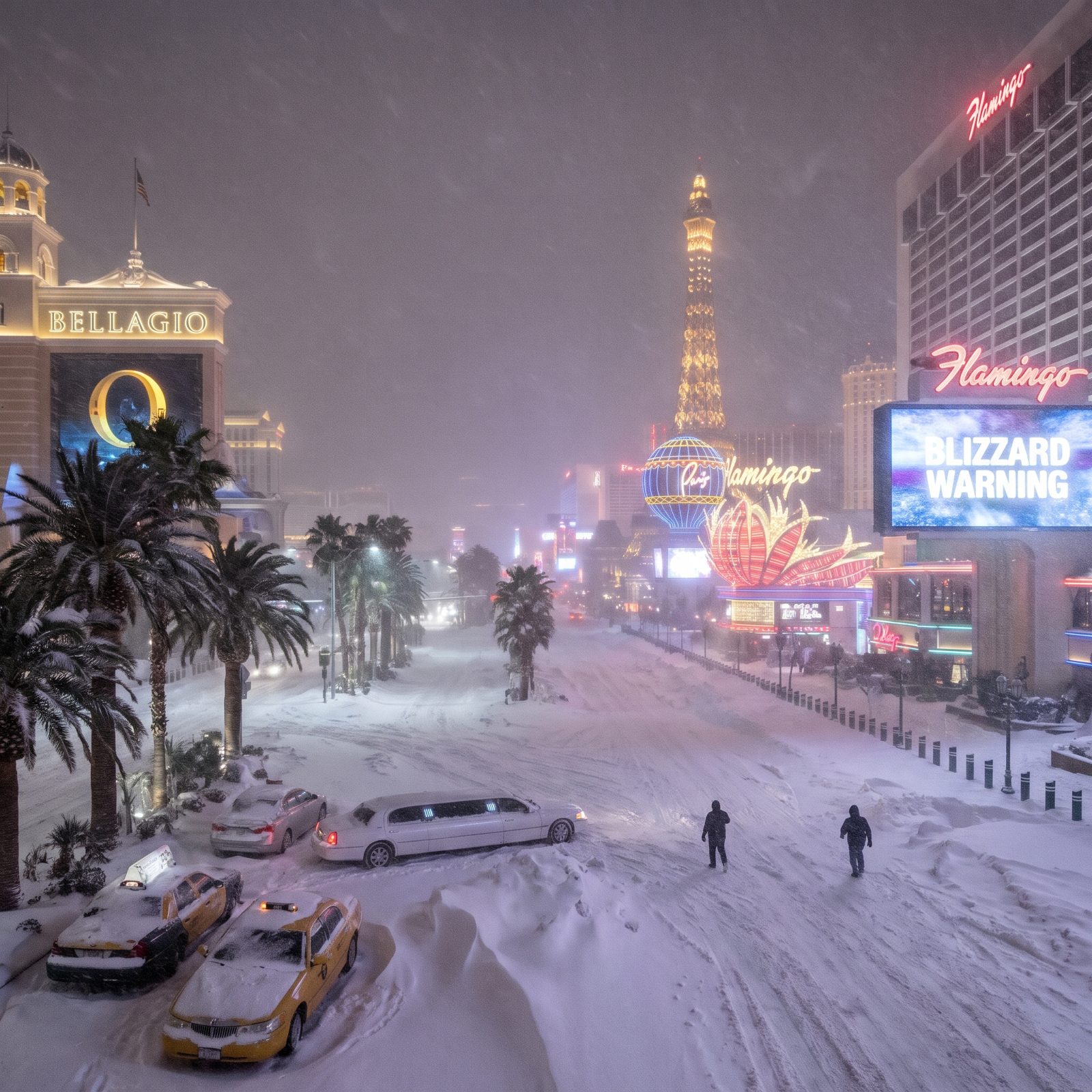
Vegas sits in the Mojave Desert, so a Strip whiteout sounds absurd — and mostly it is. But the city has seen snow. A freak storm in December 2008 dropped several inches on the Strip and shut the airport, and a lighter dusting hit in early 2019.
So this scene carries just enough truth to unsettle you. A mile of neon, the replica Eiffel Tower, the LED marquees, every bit of it built to burn through the night. Pour snow into all that light and it scatters off each falling flake, which oddly makes the storm glow brighter. The desert does the one thing it swore it never would.
11. Budapest, Parliament Reflected in an Icebound Danube
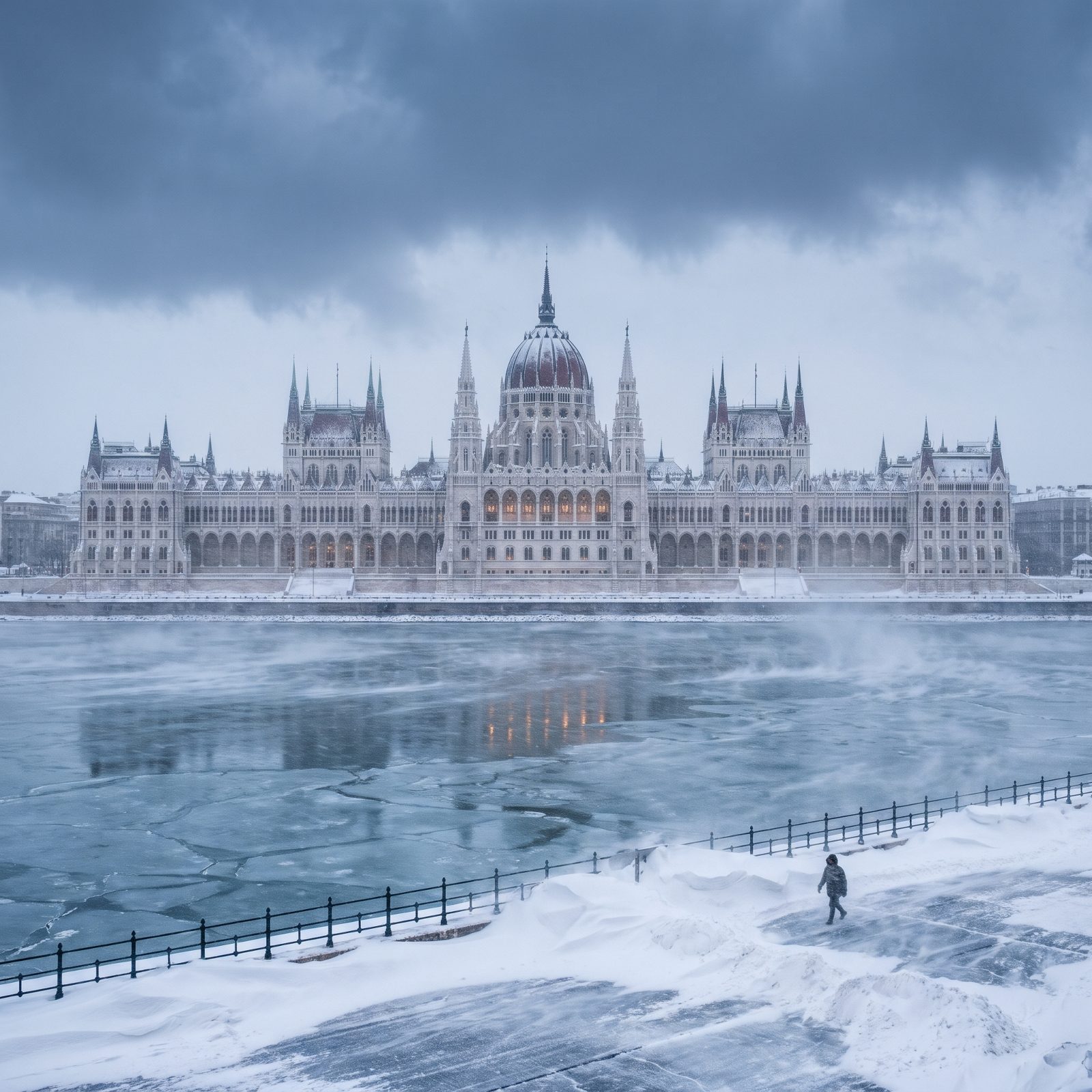
The Danube rarely freezes solid anymore. Back in the brutal winters of the early 20th century it iced over completely and locals actually walked across it. This scene imagines that returning on Christmas Eve, the river a seized sheet of blue glass holding the Parliament’s reflection hostage.
That building is doing all the heavy lifting here. Imre Steindl’s neo-Gothic beast has 365 spires, one for every day of the year, and every one of them catches snow differently. Load it with drifts and the whole silhouette softens into something out of a fairy tale that got a little too cold.
10. Mexico City, The Zócalo Under a Blanket of Snow
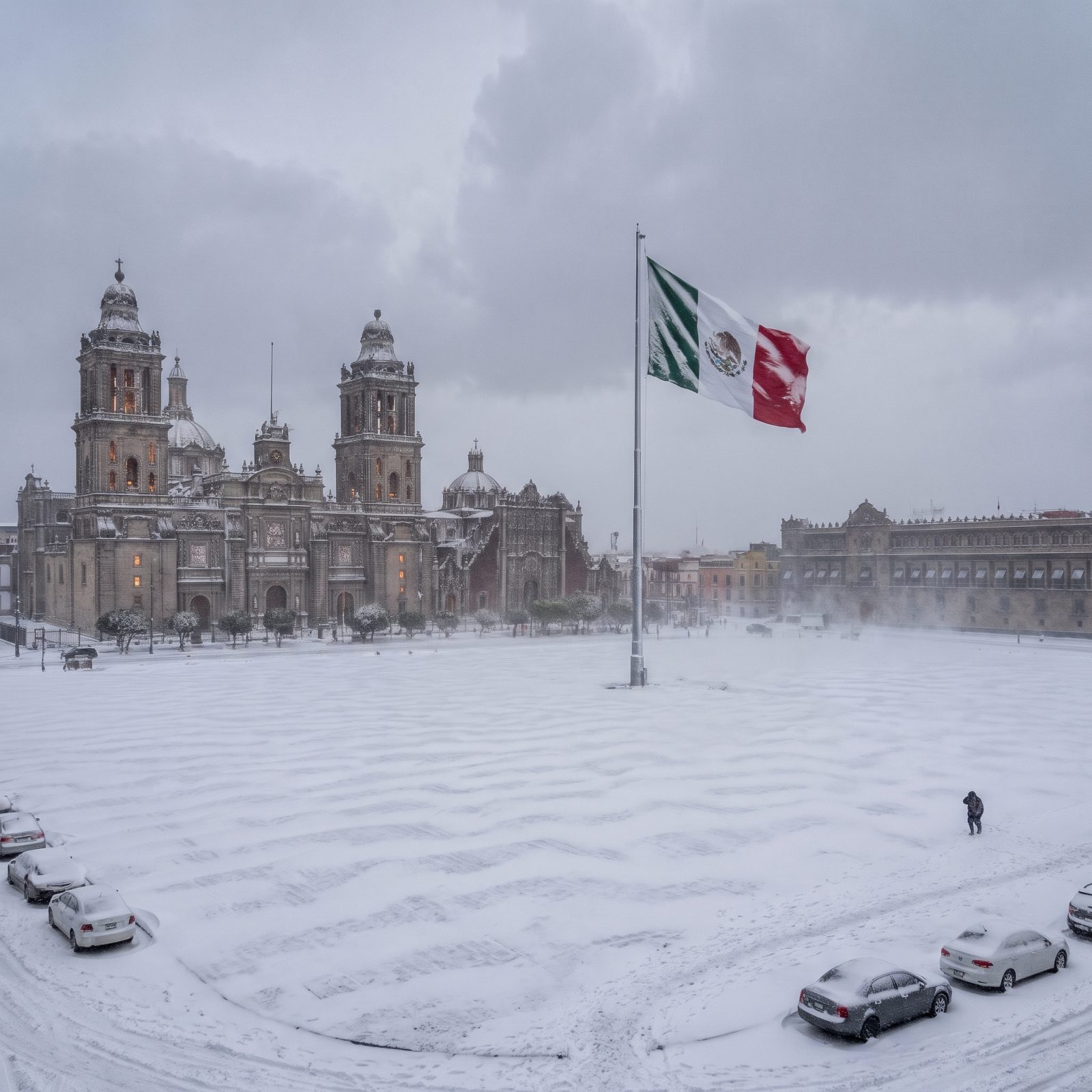
Snow in Mexico City is almost science fiction. The place sits high enough to stay cool, but genuine accumulation in the historic center is vanishingly rare. The last meaningful flurries reached the valley in 1967, enough to dust rooftops and stop traffic cold.
Pile real snow onto the Zócalo and something strange happens. One of the largest city squares on the planet, usually baking under high-altitude sun, becomes a white plain with the Metropolitan Cathedral floating at its edge like an iceberg. And that giant flag, frozen mid-snap? That’s the detail that sells the whole lie.
9. Brussels, Grand-Place Beneath Frosted Christmas Lights
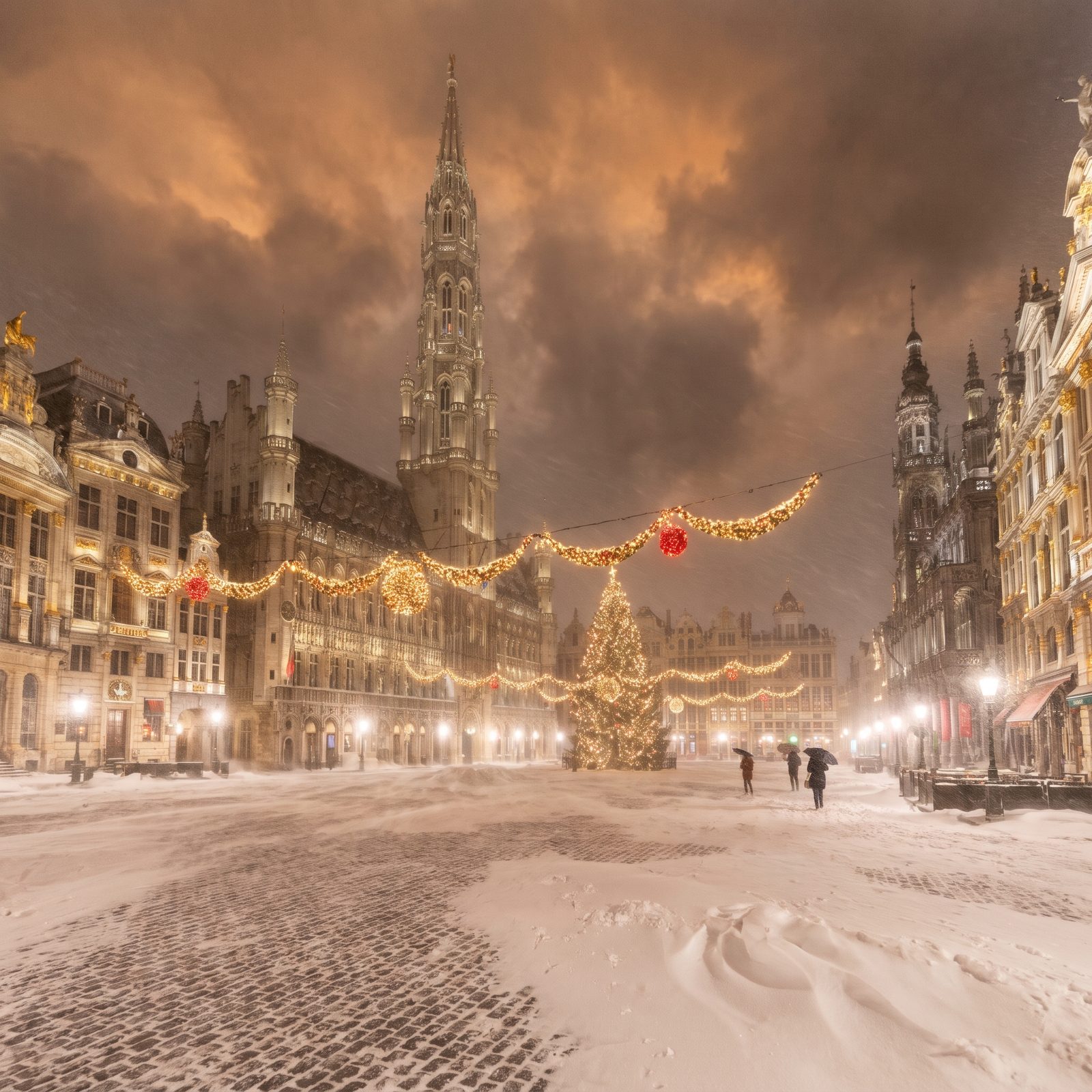
The Grand-Place already looks unreal in summer, all that gold leaf on 17th-century guildhalls and the Town Hall spire climbing almost 300 feet into the sky. Add a Christmas blizzard and the square turns into a snow globe someone shook too hard.
Brussels does get snow, so this one bends believability less than most. What makes it work is how the warmth swallows the storm: holiday lights burning amber through peach-tinted powder, the gilded facades catching every flake. You can almost smell the frites and roasting chestnuts cutting through the freezing air.
8. New Orleans, Bourbon Street Beneath Snowy Balconies
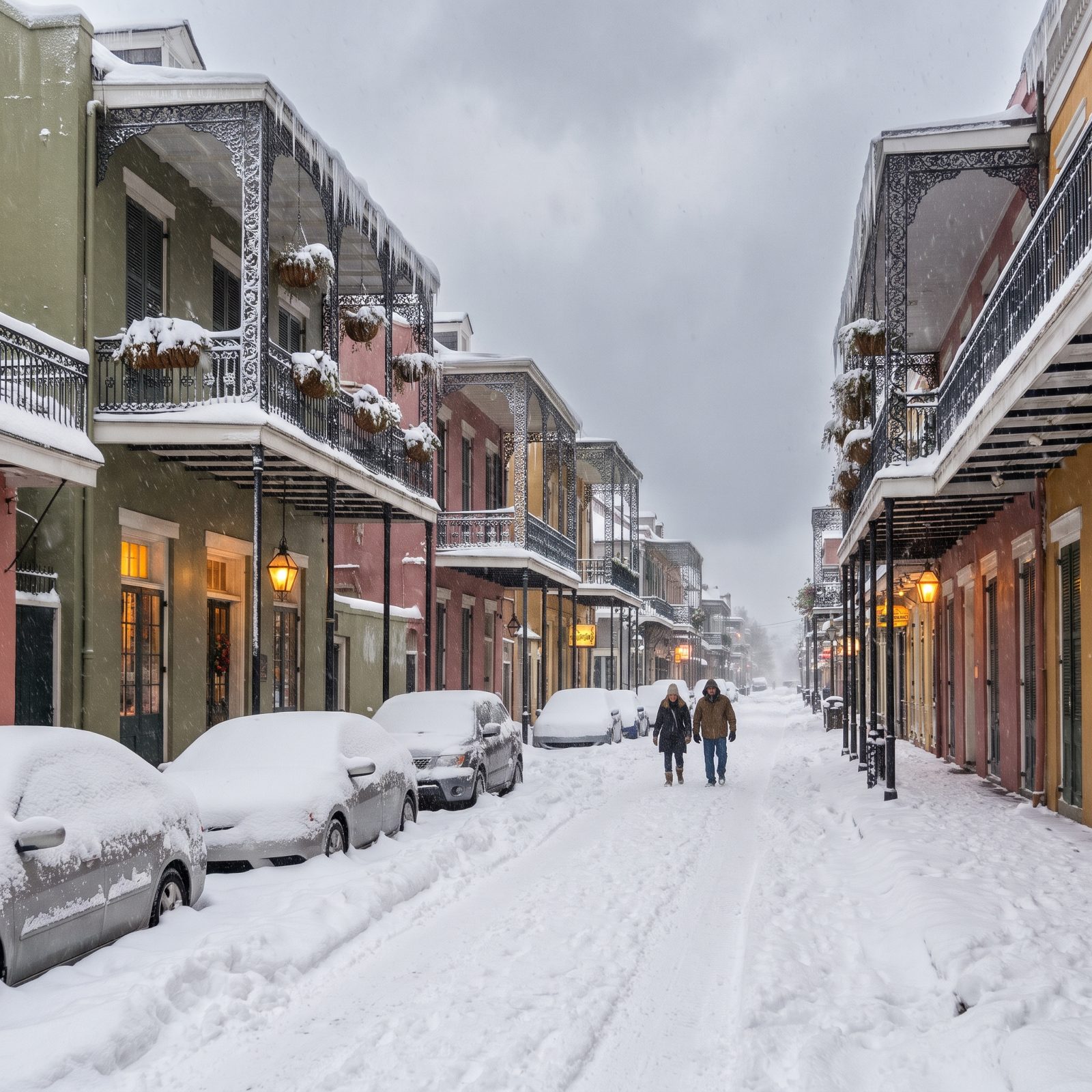
New Orleans and snow is the whole joke. The city sits near sea level in the subtropical Gulf, and measurable snowfall is a generational event. That famous Valentine’s Day storm back in 1895 dumped several inches, and people still bring up the surprise dusting on Christmas Day of 2004.
Here’s the gorgeous contradiction: those wrought-iron balconies were built to shed heat and rain, never to carry a load of snow. Frost the ironwork, hang icicles off the ferns, and the whole French Quarter looks like it borrowed a costume from somewhere much colder and can’t quite pull it off. That awkwardness is exactly what makes it charming.
7. Seoul, Gyeongbokgung Palace During a Fierce Winter Storm
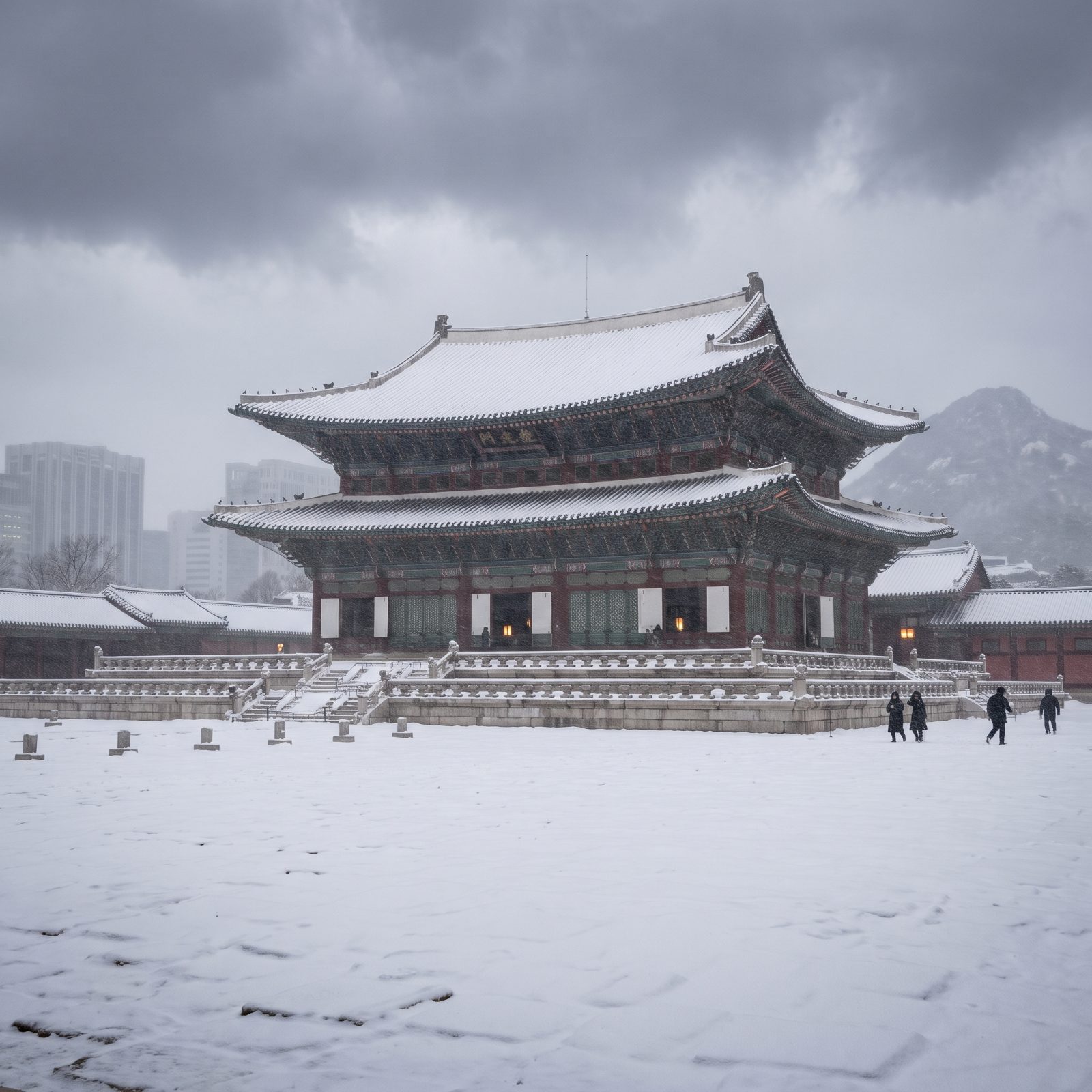
Seoul knows snow. The city sees real winters, and the palace under a heavy fall is genuinely one of the sights of the Korean cold season.
A fierce storm does something sly to Gyeongbokgung: it reveals why the architecture is shaped the way it is. Those dramatically upturned eaves and steep tiled roofs were built partly to shoulder snow load and fling meltwater clear of the timber. Bury the courtyard, let the dancheong paintwork peek through the white in muted red and green, and the 14th-century throne hall squares off against the glass towers of modern Seoul like two centuries caught in one storm.
6. Geneva, The Jet d’Eau Turned Into an Ice Monument
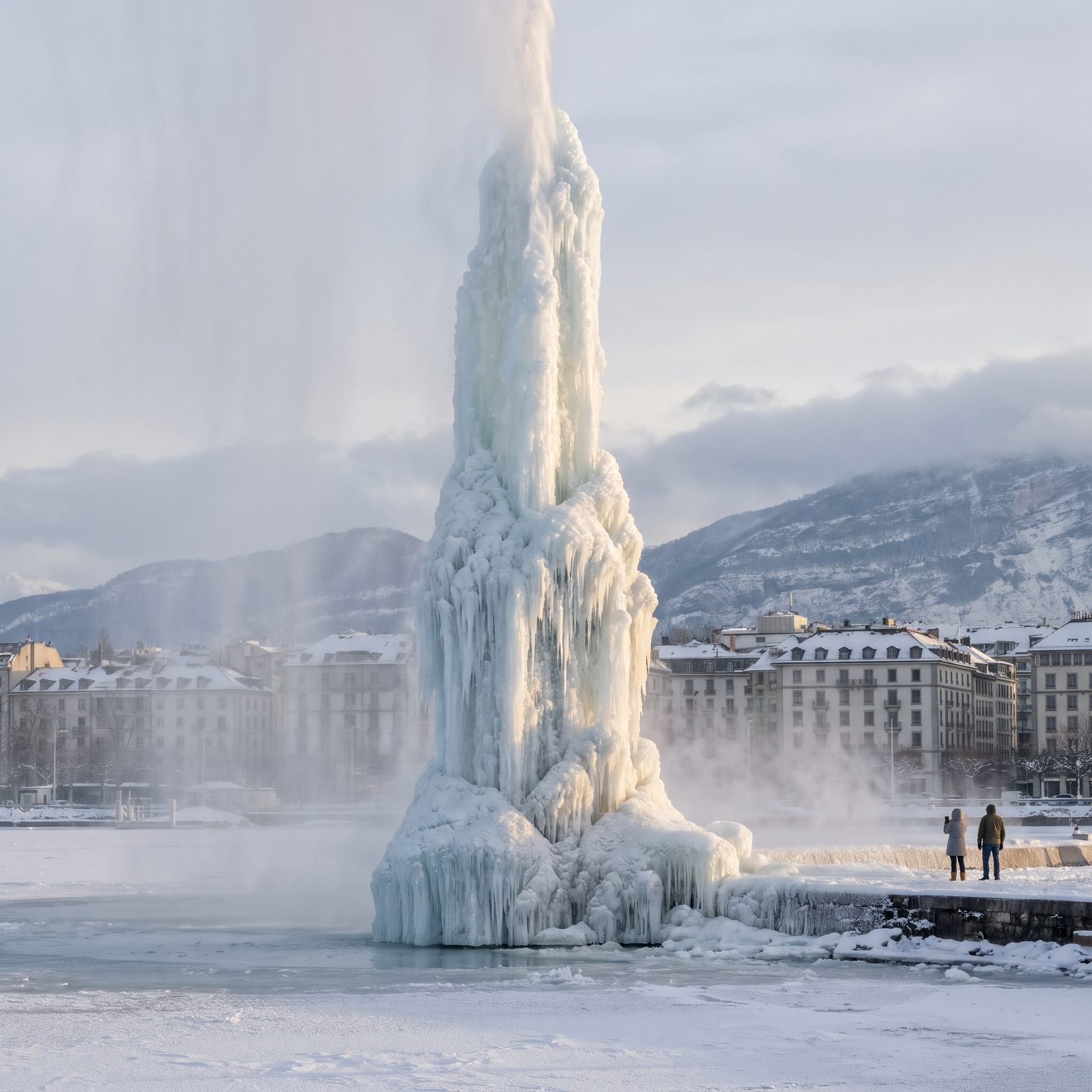
Geneva’s Jet d’Eau fires lake water some 460 feet into the air, roughly 132 gallons a second leaving the nozzle at highway speed. In a normal winter it keeps running, a plume of white against grey sky.
Now imagine a cold snap so severe the spray starts freezing on the way down. The scene turns the fountain into a rising sculpture of ice, a glittering column with cascades of frost locked mid-fall. Physically it would never fully happen, since the water moves too fast and the jet shuts off in hard freezes. So treat this one as pure imagination. Beautiful imagination, but imagination.
5. Monte Carlo, Superyachts Frozen Into the Harbor
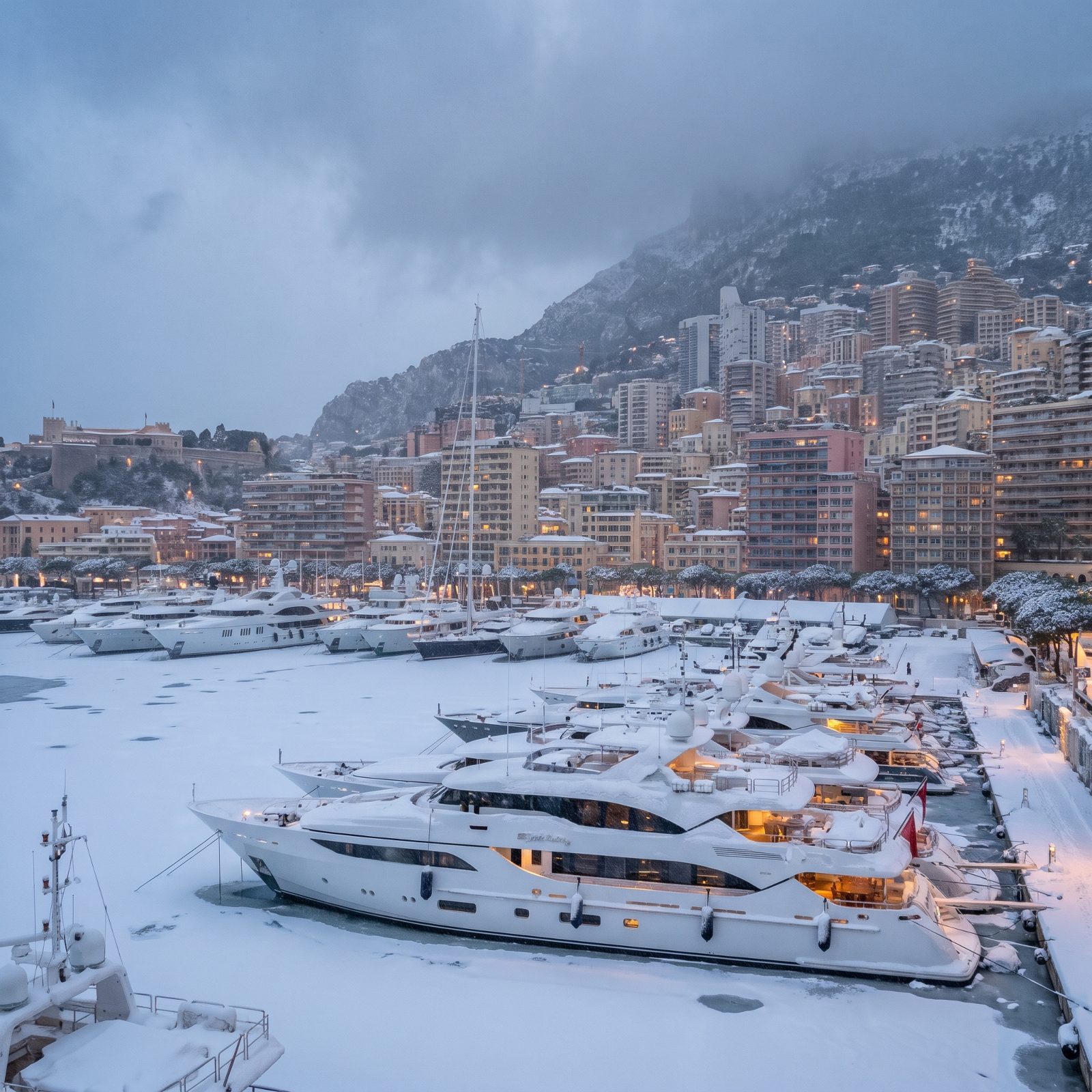
The Mediterranean doesn’t freeze. That’s the point of this one, and the reason it tips firmly into fantasy. The sea off Monaco runs far too warm for harbor ice.
Run with it anyway. Picture the fleet of white superyachts at Port Hercule, the ones that host the Grand Prix crowd every May, locked into grey harbor ice with snow banked on their decks and rigging. All that absurd wealth meeting the one thing money absolutely cannot buy its way out of: a storm that doesn’t care how much the boat cost. There’s a quiet satisfaction in that image.
4. Nairobi, The Skyline Beyond a Snow-Covered Savanna
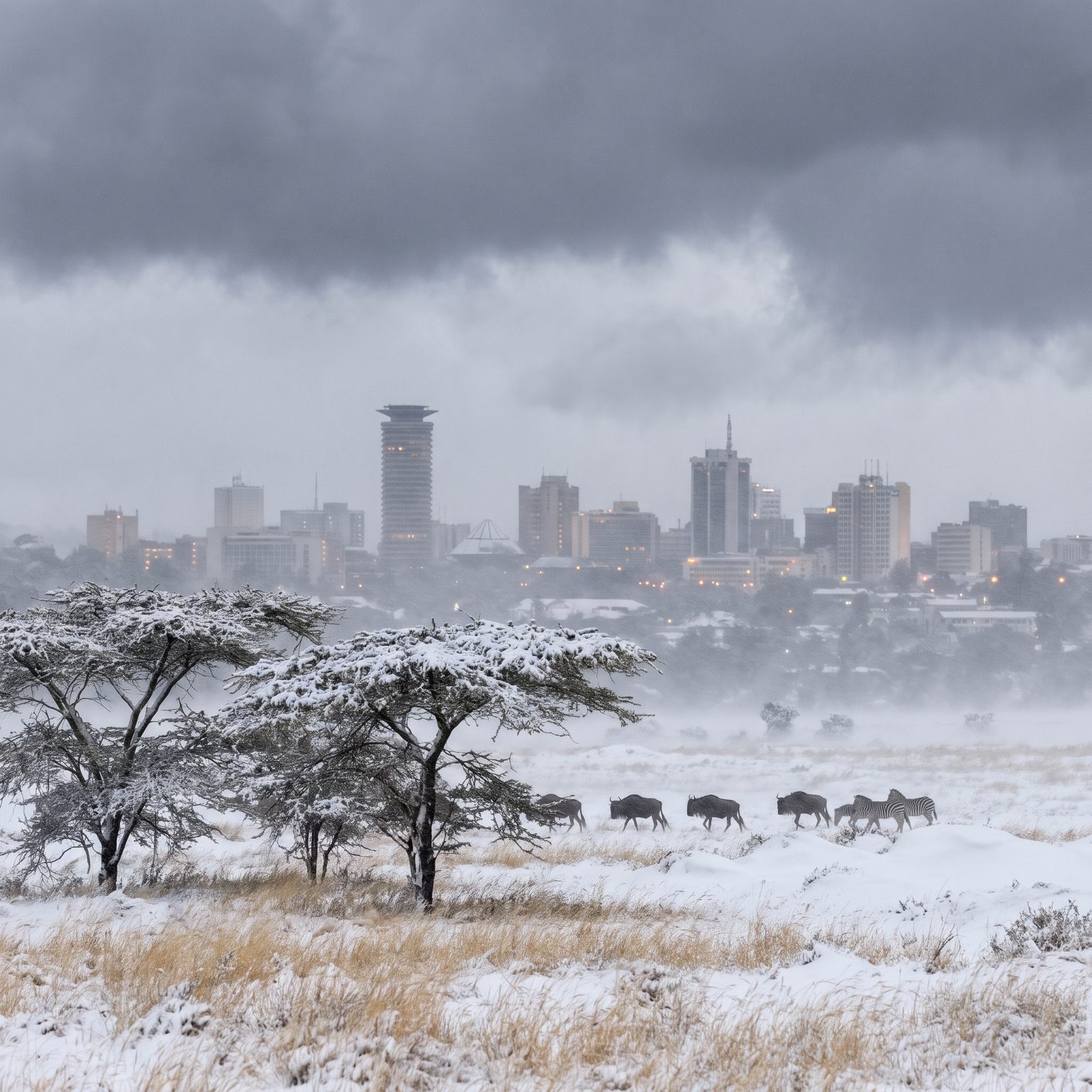
Nairobi sits almost exactly on the equator. It turns cool and misty in July, but snow in the savanna is biologically and climatically impossible. This is the most surreal image in the set, and it knows it.
Which is the whole appeal. Flat-topped acacia trees, that signature silhouette of the East African plain, standing under a load of snow. The Kenyatta Convention Centre tower rising through the storm on the horizon. It’s a dreamscape, equal parts wrong and wonderful, the kind of picture that makes you stop and wonder whether the planet you live on could ever bend that far. It can’t. But look anyway.
3. Washington, D.C., The Capitol Beyond a Snowbound National Mall

D.C. and snow share a genuinely dramatic history. The Knickerbocker Storm of January 1922 dropped 28 inches and caved in a theater roof. Then came the 2010 blizzards, nicknamed Snowmageddon, which buried the capital and shut the federal government for days.
So a snowbound National Mall isn’t fantasy, just an extreme version of something real. The Capitol dome weighs nearly 9 million pounds of cast iron, and with the Statue of Freedom standing watch under a storm sky, it loses none of that heft when it’s buried. If anything the snow strips away the summer crowds and leaves just the building and the white plain. Which, honestly, is how a lot of people secretly prefer it.
2. Jerusalem, The Old City Beneath Christmas Snow
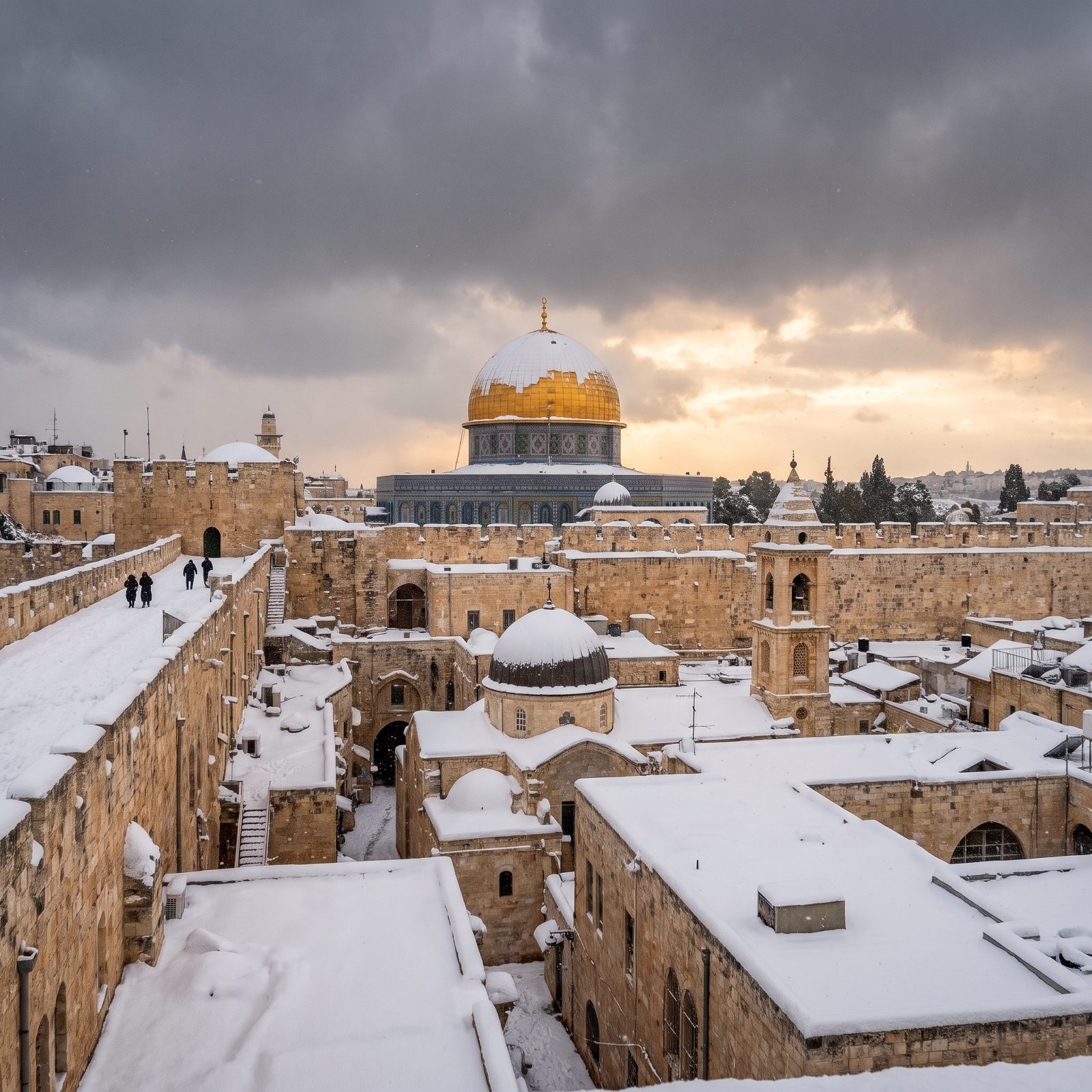
Jerusalem actually does this. It sits up in the Judean hills, and every few winters a storm rolls in off the Mediterranean and whitens the Old City. The big one hit in December 2013, when the heaviest snow in decades cut power and sealed the ancient gates.
The magic is the color. That honey-gold limestone, mandated by law for every building facade, glowing warm beneath a cold white cap, and the Dome of the Rock’s gilded top catching a break in the storm clouds. Few cities on earth hold this much history. Watch snow settle on walls that have seen three thousand years of it and something tightens in the chest that you don’t quite have a word for.
1. Rio de Janeiro: Christ the Redeemer Standing Over a Snowbound Carioca Christmas
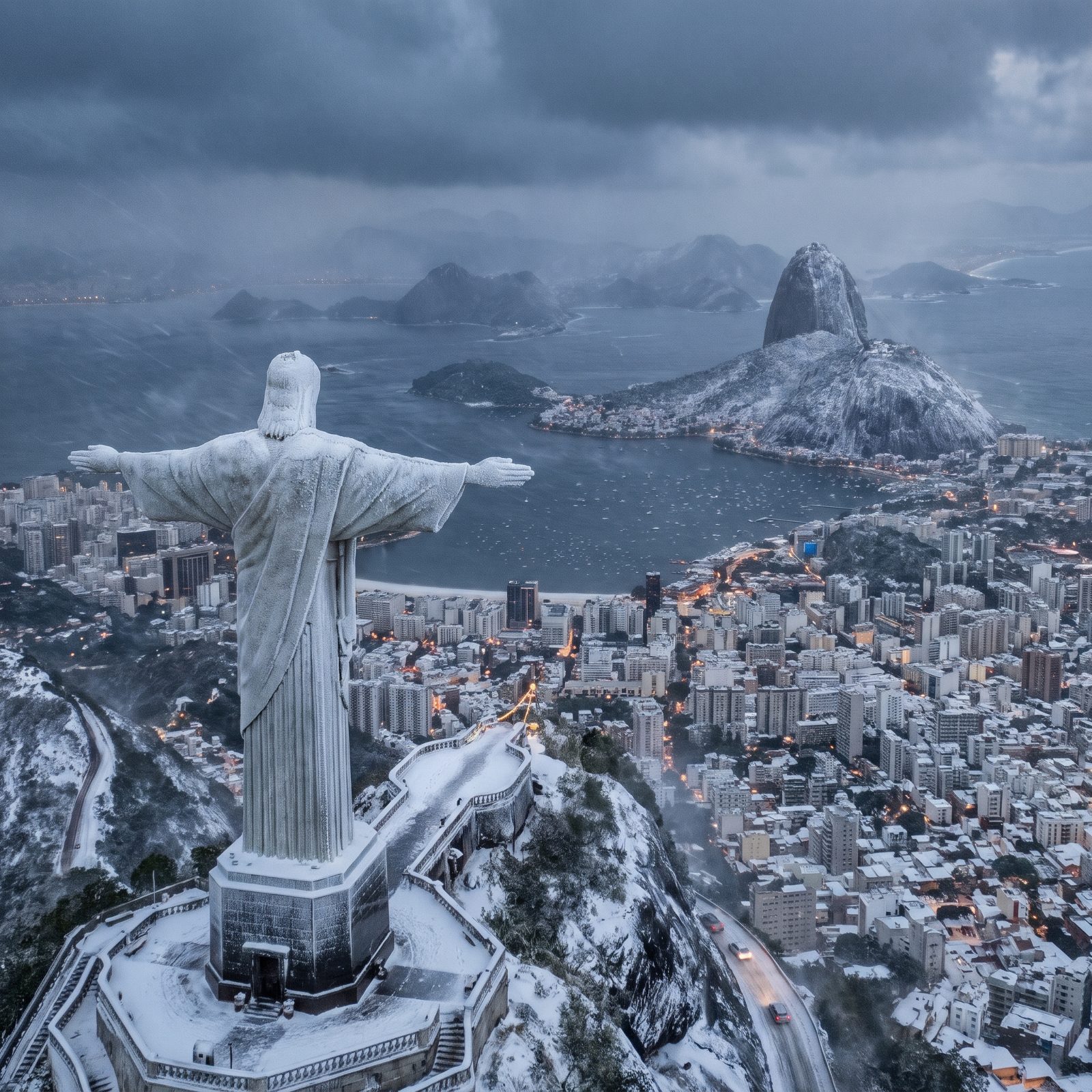
Rio does not do snow. The city runs hot all year, Christmas lands in the thick of a tropical summer, and the beaches stay packed while everyone north of the equator is digging out their cars. So imagine the opposite, and the scene hits hard.
Drop a blizzard on Corcovado and that famous silhouette suddenly looks like a stranger. The statue rises 98 feet over a peak already 2,300 feet above the waves, and in this version the outstretched arms gather snow where they usually gather sunlight. Soapstone turns to porcelain white. Guanabara Bay? Still there, Botafogo cove dotted with boats and Sugarloaf dusted white beneath the storm clouds.
And those window lights, fighting their way through the blue dusk — warm little pinpricks against all that cold. A tropical city buried in weather it has never known. That’s the part that lingers.