
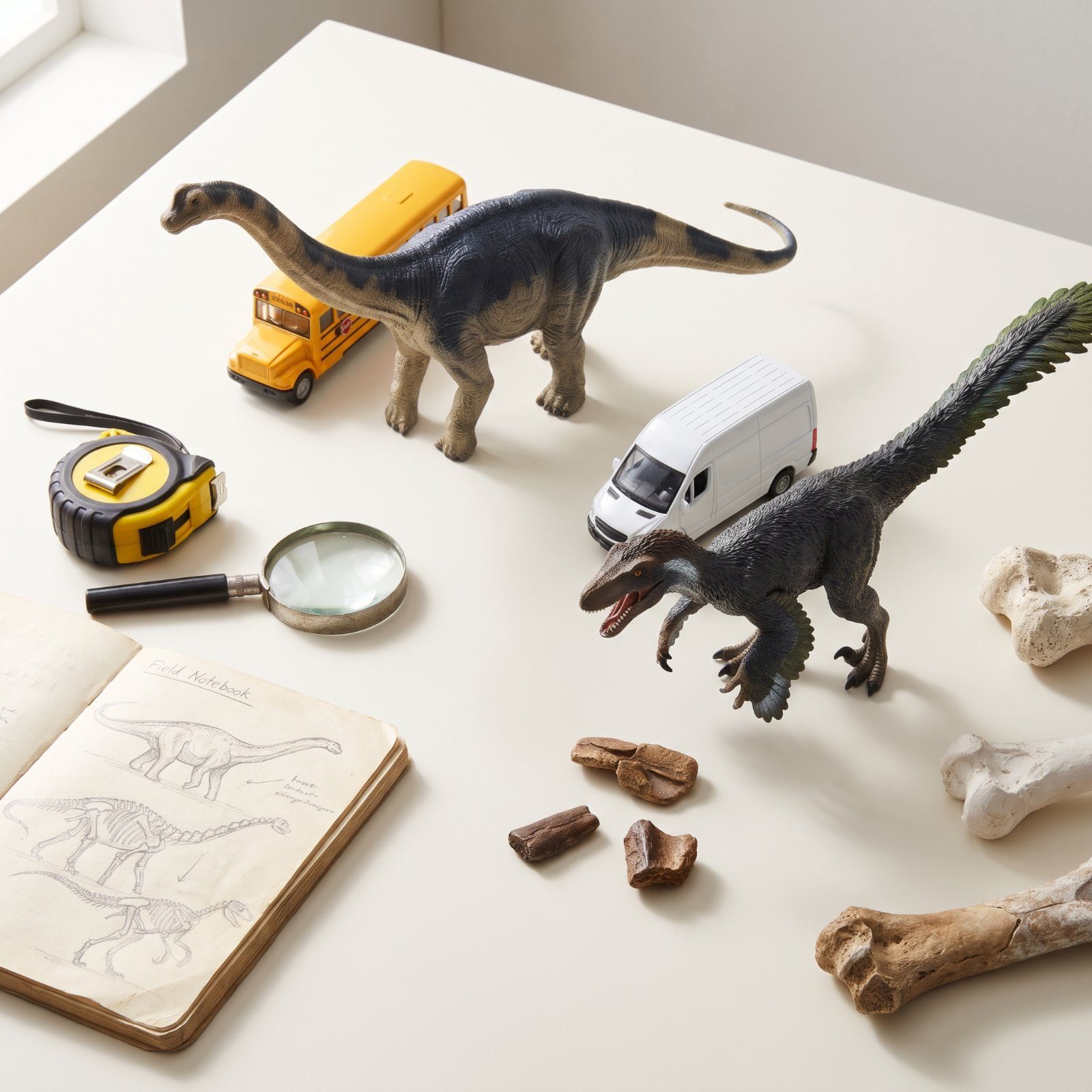
A basketball court is 94 feet long. A fully grown Argentinosaurus was longer. Read that twice, because the number on paper never lands the way a picture does.
Fossil measurements stay abstract until you drop the animal next to something you’ve stood beside, driven, or watched roll down a bowling lane — and suddenly the scale stops being trivia and starts being unsettling. These reconstructions follow current paleontology, not monster-movie guesswork: the right feathers, the right posture, the right soft tissue hanging off the bones. Every one gets parked beside a familiar object at honest scale. No tricks. Just the animal, the thing, and the shadow they cast together.
41. Argentinosaurus Beside a Full NBA Basketball Court
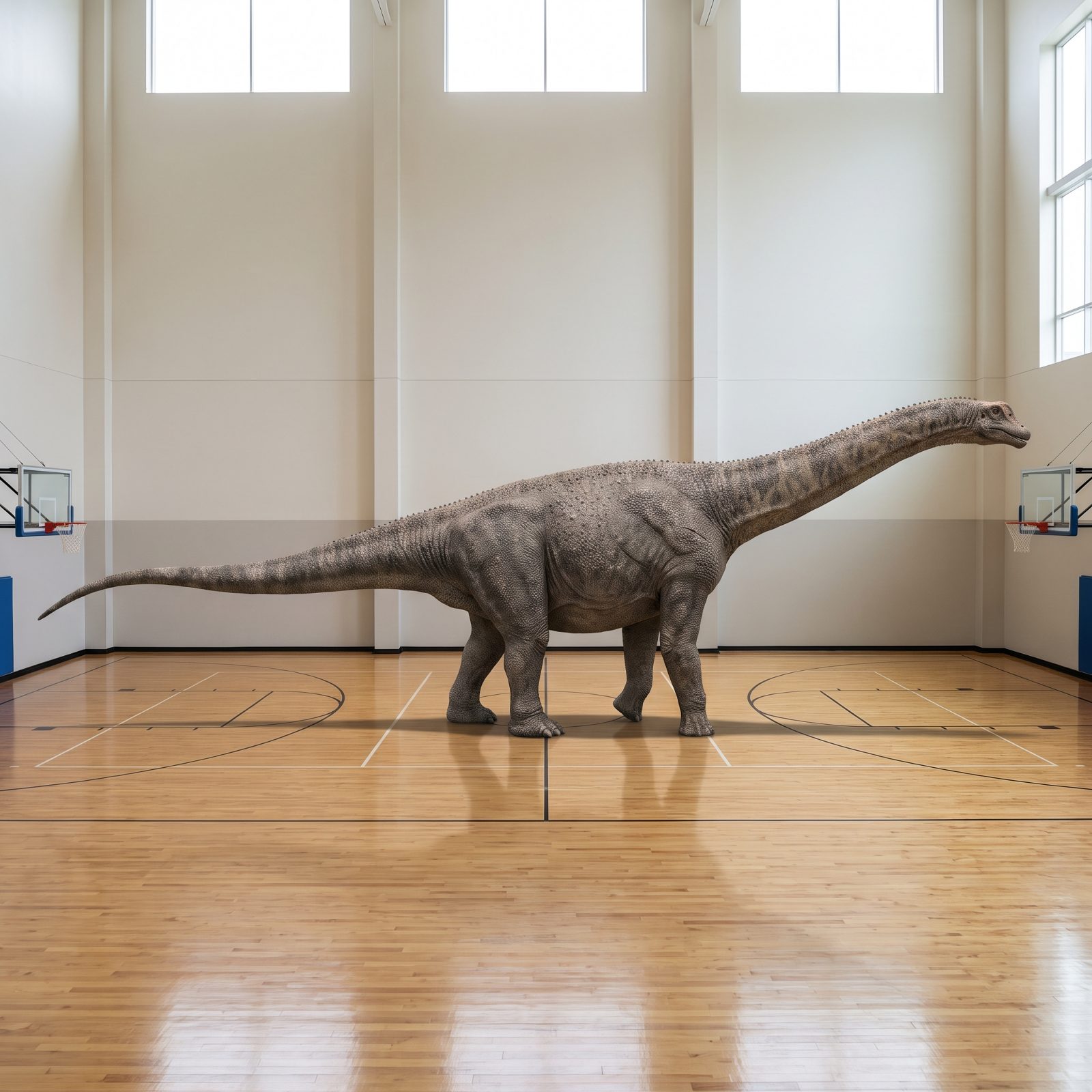
Picture the biggest land animal you’ve ever heard mentioned, then stretch it the full length of a regulation basketball court — and you’re still a little short.
Argentinosaurus, from the Late Cretaceous of Argentina’s Neuquén Province, is known from frustratingly few bones, so every weight estimate carries a shrug. Most figures land somewhere around 70 to 100 tons. The length is easier to picture. Nose to tail tip, this titanosaur ran past the full 94 feet of an NBA court. A player sprinting a fast break would cover the animal end to end and arrive winded.
40. Patagotitan Beside a Ten-Pin Bowling Lane
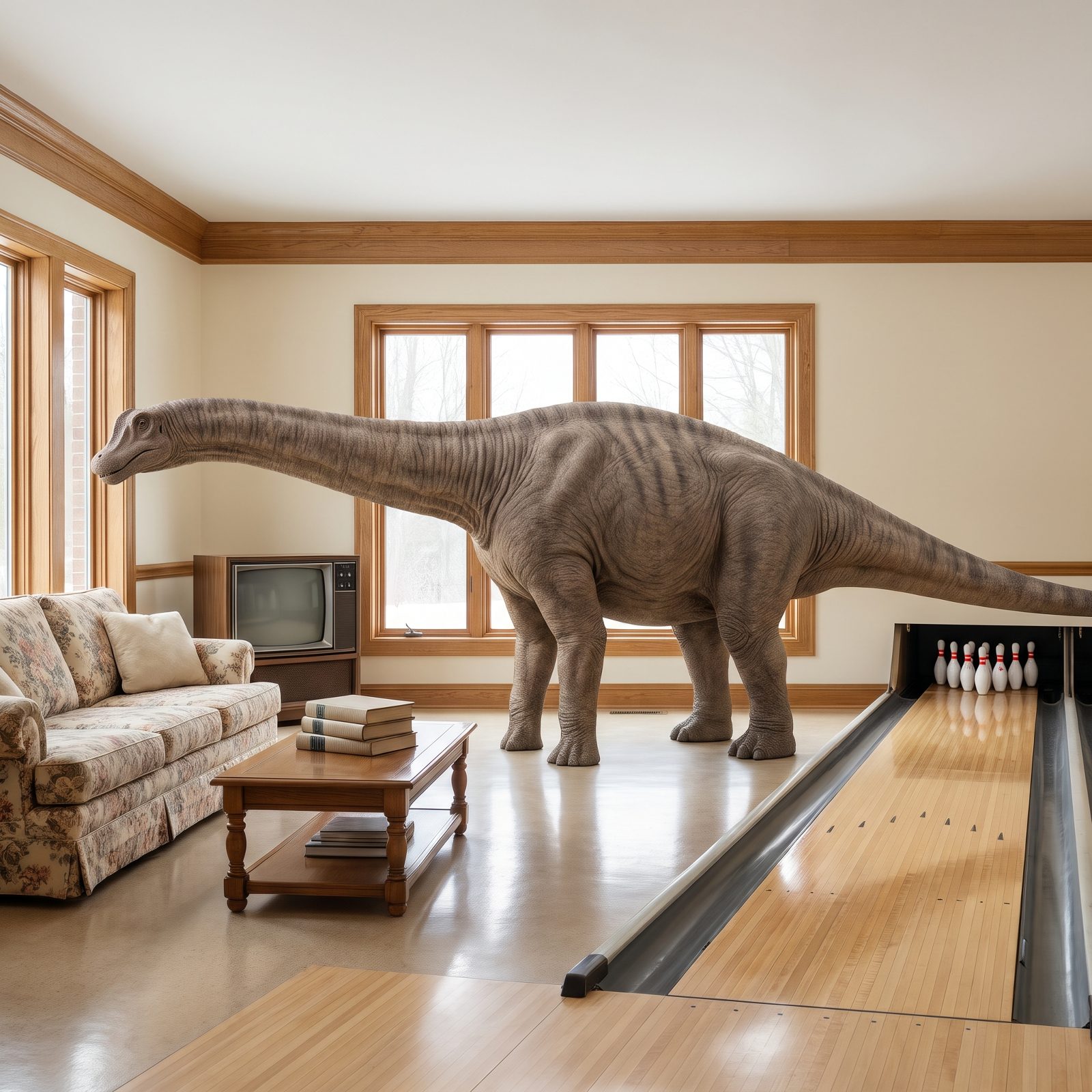
A bowling lane runs 60 feet from the foul line to the head pin. At full size, Patagotitan would overshoot the pins with room to spare.
Discovered in Patagonia and formally named in 2017, Patagotitan is one of the best-documented giants we have, because it’s known from multiple partial skeletons rather than a lonely vertebra. That’s why its size estimates — roughly 100 to 120 feet long and somewhere north of 50 tons — sit on firmer ground than most contenders for the “biggest ever” crown.
39. Brachiosaurus Beside a Four-Story House
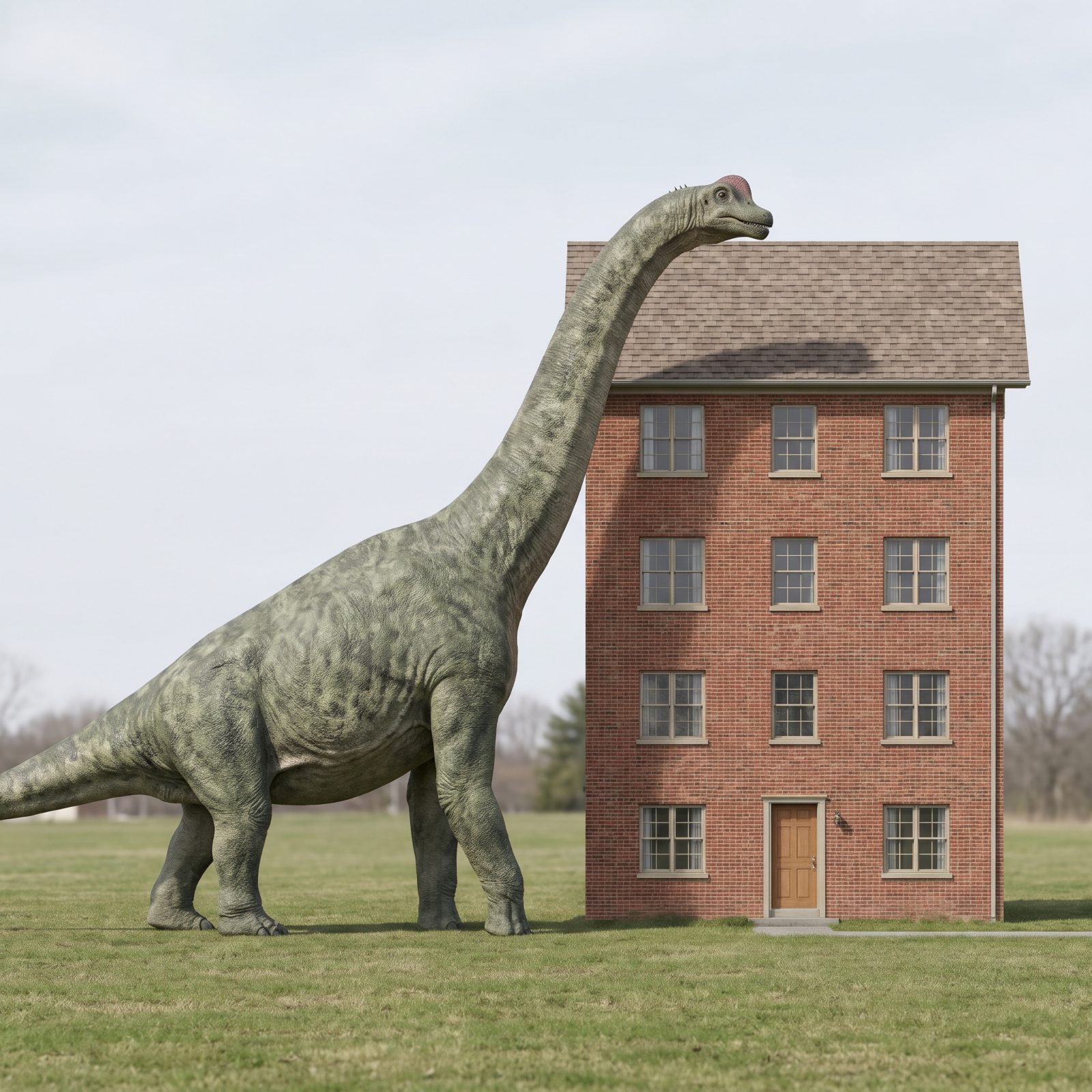
Most sauropods carried their necks out sideways, like a drawbridge. Brachiosaurus didn’t. Its front legs ran longer than its back legs, tilting the whole body up so the neck rose like a construction crane.
Park it next to a four-story house and the head clears the top floor. This Late Jurassic giant came out of the Morrison Formation across Colorado, Utah and Wyoming, the richest dinosaur rock in North America. Height was its signature move, not length — it fed where nothing else could reach, a slow, patient kind of dominance you have to respect.
38. Amargasaurus Beside a Stretch Limousine
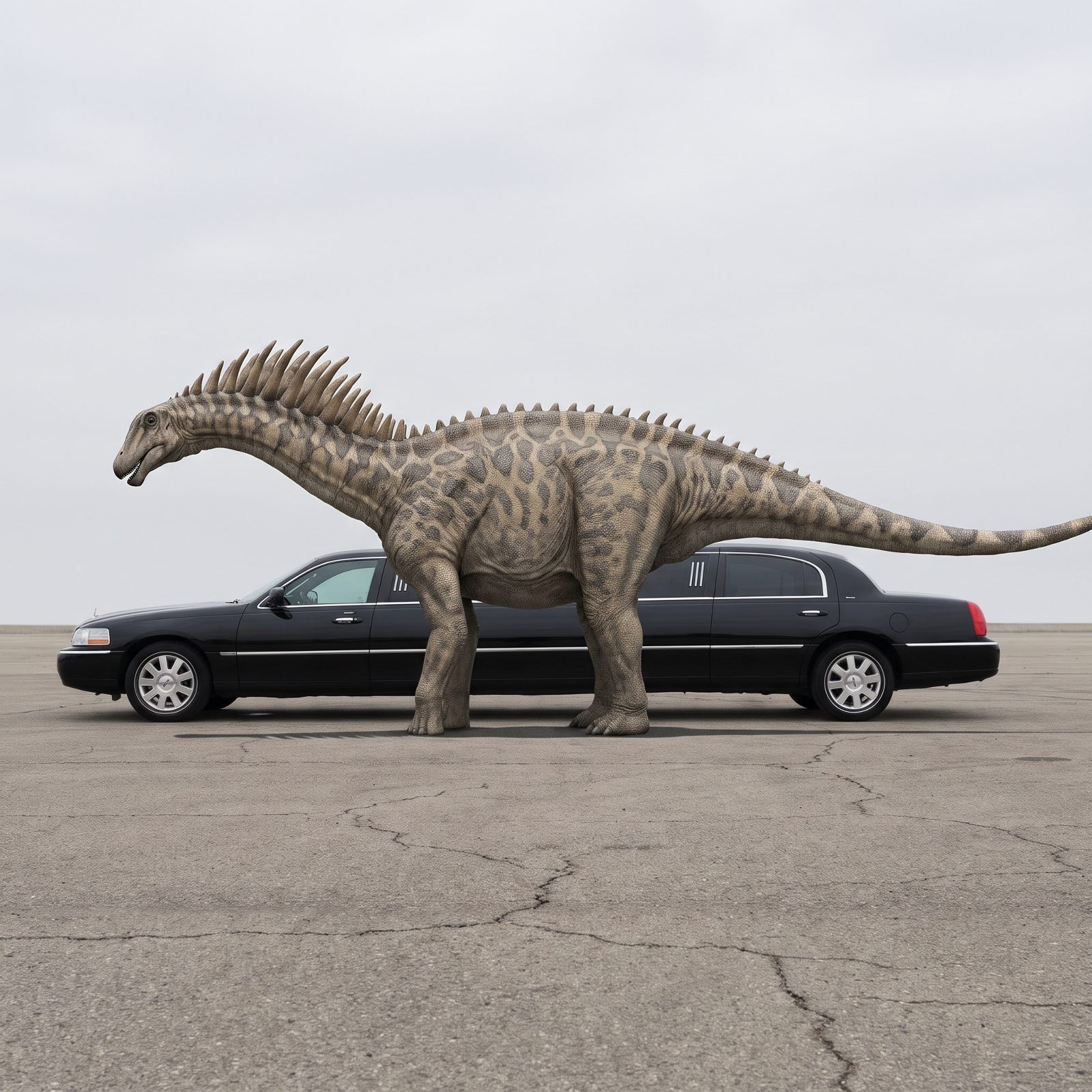
Here’s a sauropod that would fit in your driveway. Amargasaurus ran about the length of a stretch limo, roughly 30 feet, which by long-necked-dinosaur standards is practically compact.
What makes it unforgettable is the hardware. Two parallel rows of tall spines rises straight out of its neck and back like a picket fence, and nobody’s fully settled the argument about what they were for. Display? Defense? A sail of skin, a neck that rattled? It came from Argentina’s La Amarga Formation, Early Cretaceous. Small, strange, and bristling with equipment we still can’t quite explain.
37. Nigersaurus Beside a Family Minivan
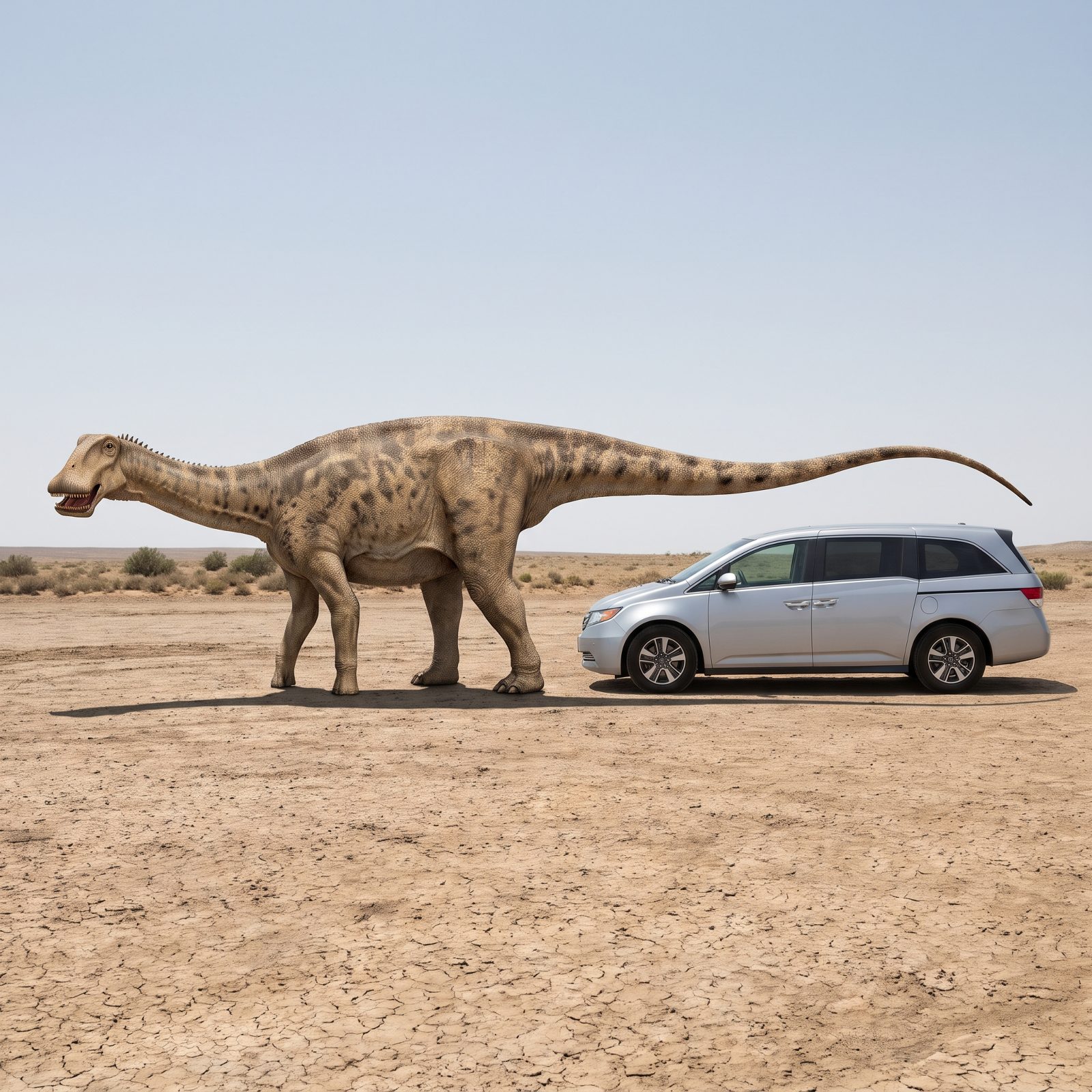
Roughly minivan-sized and built like a living lawnmower. Nigersaurus kept its head low, angled toward the ground for grazing.
In the real animal, the mouth was the headline: a wide, straight-edged muzzle built for cropping plants at ground level. More than 500 teeth sat in rows, with replacements queued behind each one, cycling through so fast that fresh teeth arrived every couple of weeks. Its skull was so thin and riddled with openings that light passes through parts of it. Found in Niger’s Elrhaz Formation, mid-Cretaceous, this was a sauropod the size of your school run, carrying the most specialized set of jaws in the whole dinosaur family.
36. Spinosaurus Beside a Full-Size Tour Coach
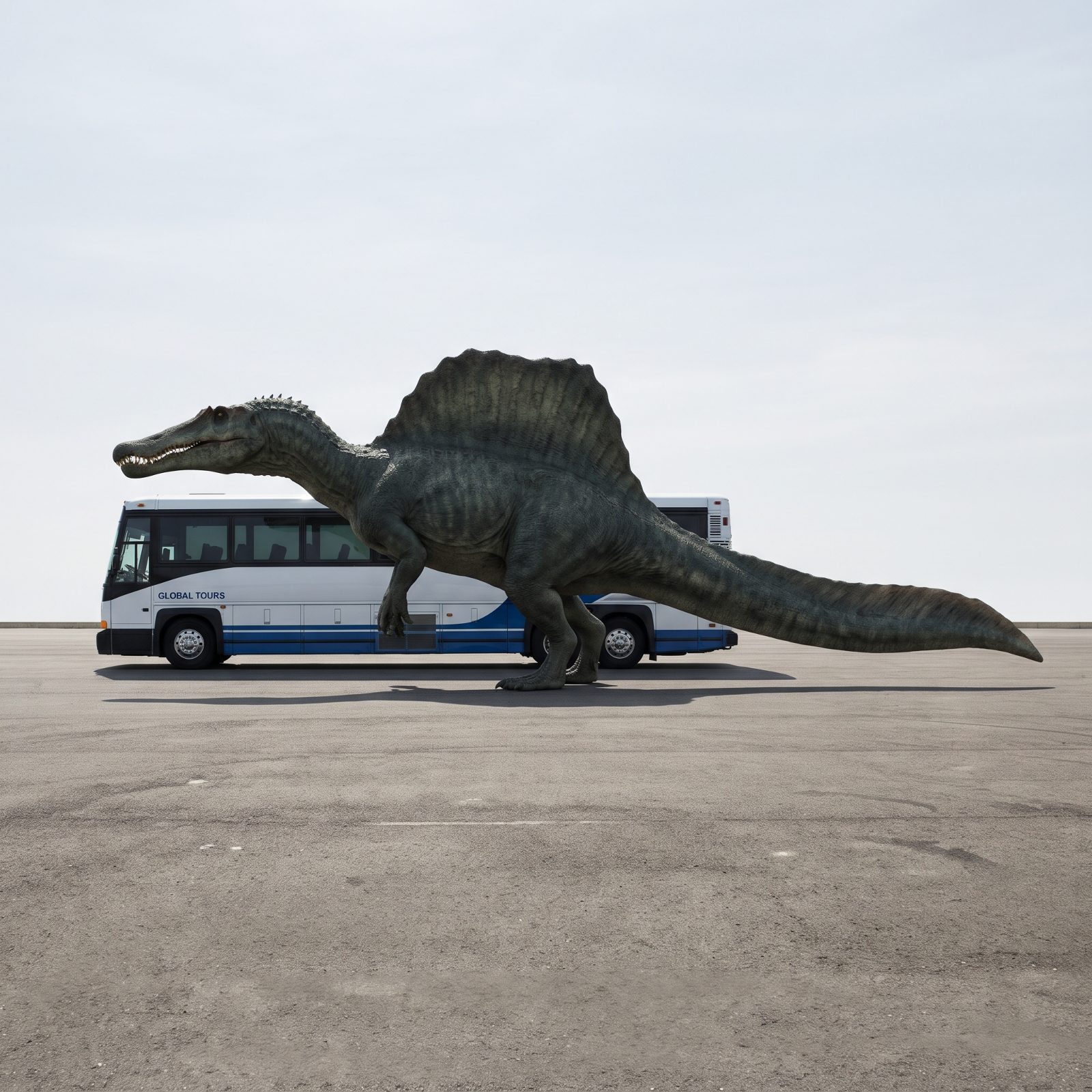
This is not the Spinosaurus the movies taught you. Forget the upright, T. rex-style monster from the films.
It carried a crocodilian snout for snatching fish, and a 2020 study of a near-complete tail, dug from Morocco’s Kem Kem beds, has since recast the animal as a river-going predator. It likely spent more time in the water than on land. Line it up beside a touring coach and it stretches roughly the coach’s length, its head and sail towering well above the roof, making it the longest predatory dinosaur we know of.
35. Giganotosaurus Beside a 53-Foot Semi Trailer
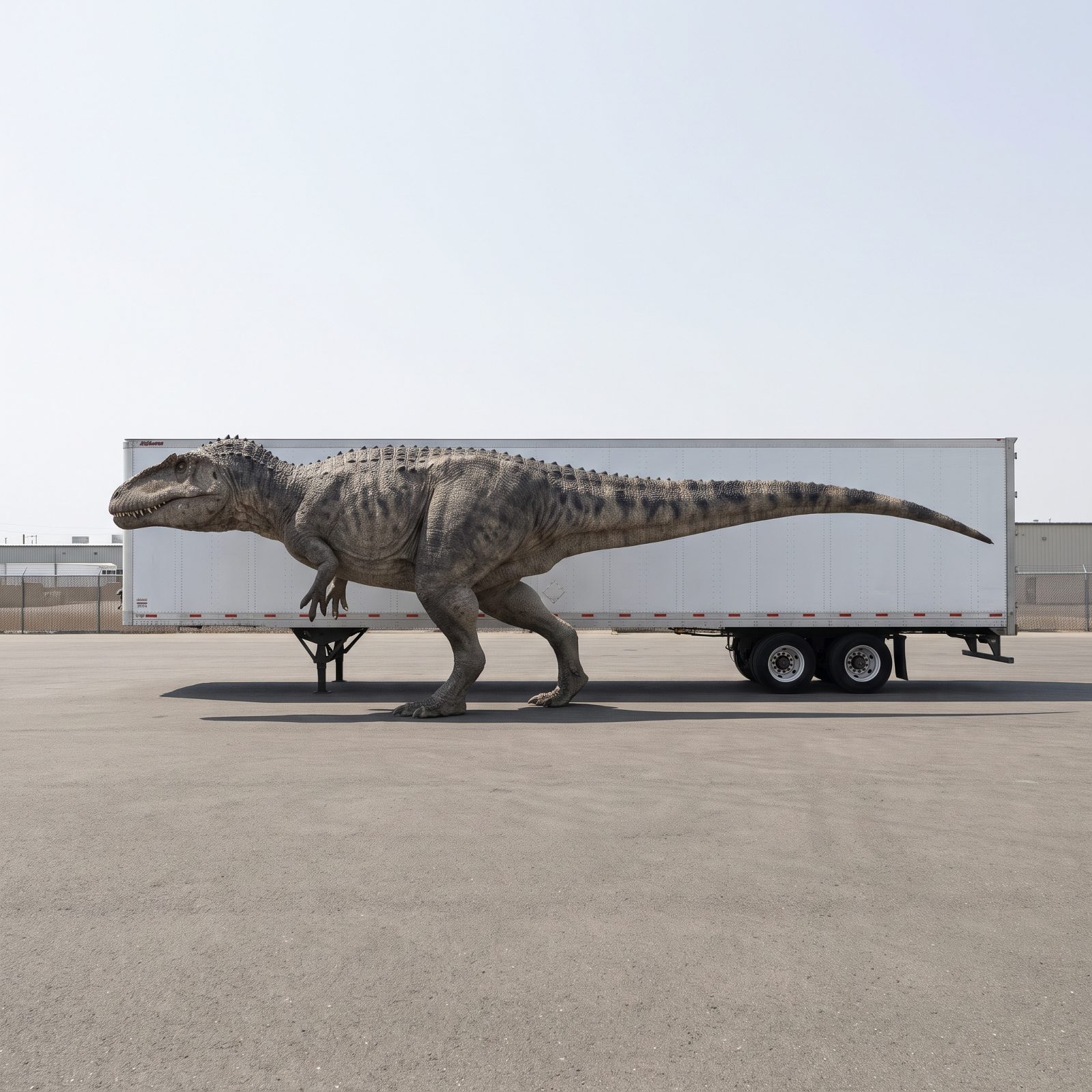
A 53-foot trailer is the one you’ve seen a thousand times on the interstate. Pull Giganotosaurus up against it and this South American predator runs nearly the full length of the box.
From Patagonia’s Candeleros Formation, Late Cretaceous, it ranked among the largest meat-eaters ever to walk the planet — slightly edging out T. rex in length, probably a touch lighter. Its skull was long and narrow with blade-like teeth built for slicing rather than bone-crushing. Different weapon, different strategy. This one cut and bled its prey instead of pulverizing it.
34. Suchomimus Beside a Ski-Ready Speedboat
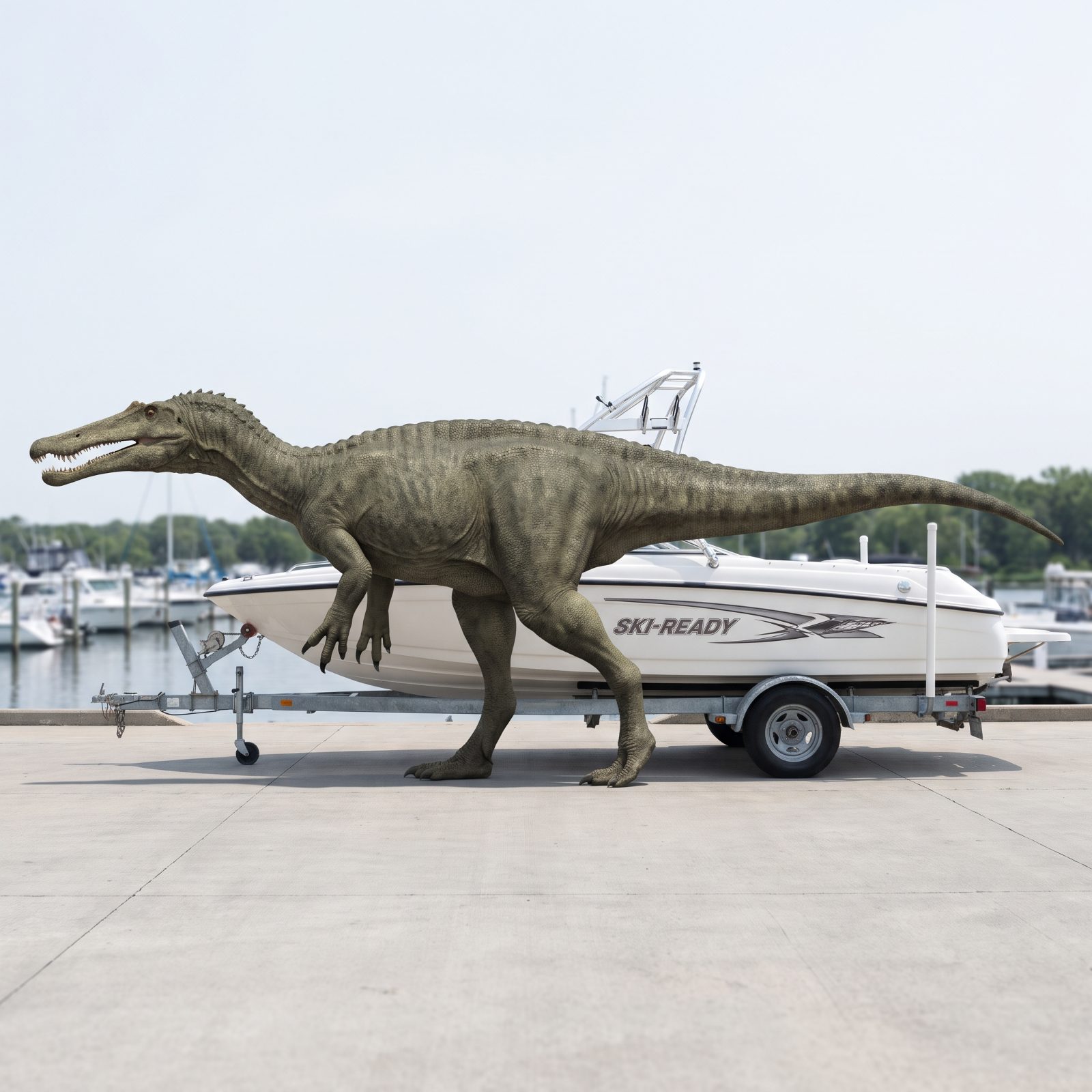
A fisherman built like a dinosaur, or a dinosaur built like a fisherman. Suchomimus had a long, slim, crocodile-shaped snout and big hooked thumb claws, both tuned for hauling fish out of water.
Only a little longer than a 20-foot trailer-ready speedboat, about 1.2 times its length, it came from the same Niger rock layer as Nigersaurus. The name means “crocodile mimic,” and the resemblance is no accident. It worked riverbanks the way a heron does — just with a ton of muscle and a mouthful of conical teeth instead of a beak.
33. Allosaurus Beside a Standard Delivery Van
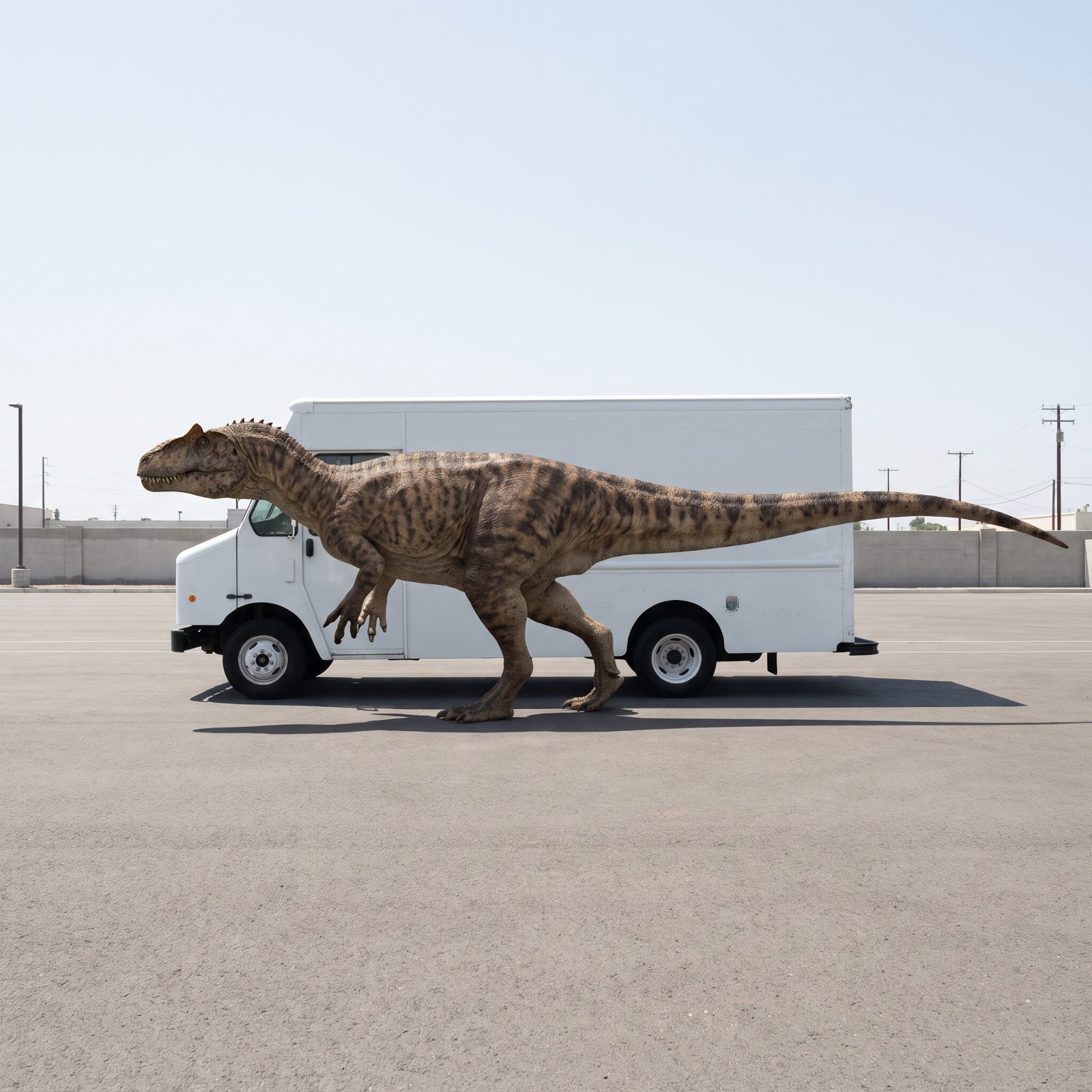
Put a delivery van in a parking lot and stand Allosaurus beside it. Same rough length, around 30 feet — and that’s the point. This was a mid-size predator, not a giant, and it was the most common big hunter of its day.
It comes from the Morrison Formation of the American West, Late Jurassic. We know it better than almost any other theropod because so many individuals have turned up, including a bonebed at Utah’s Cleveland-Lloyd Quarry packed with dozens. Twin ridges sat above its eyes. Those usable arms and slicing teeth made it the working predator of its world, not a headline act.
32. Carnotaurus Beside a Parked Ambulance
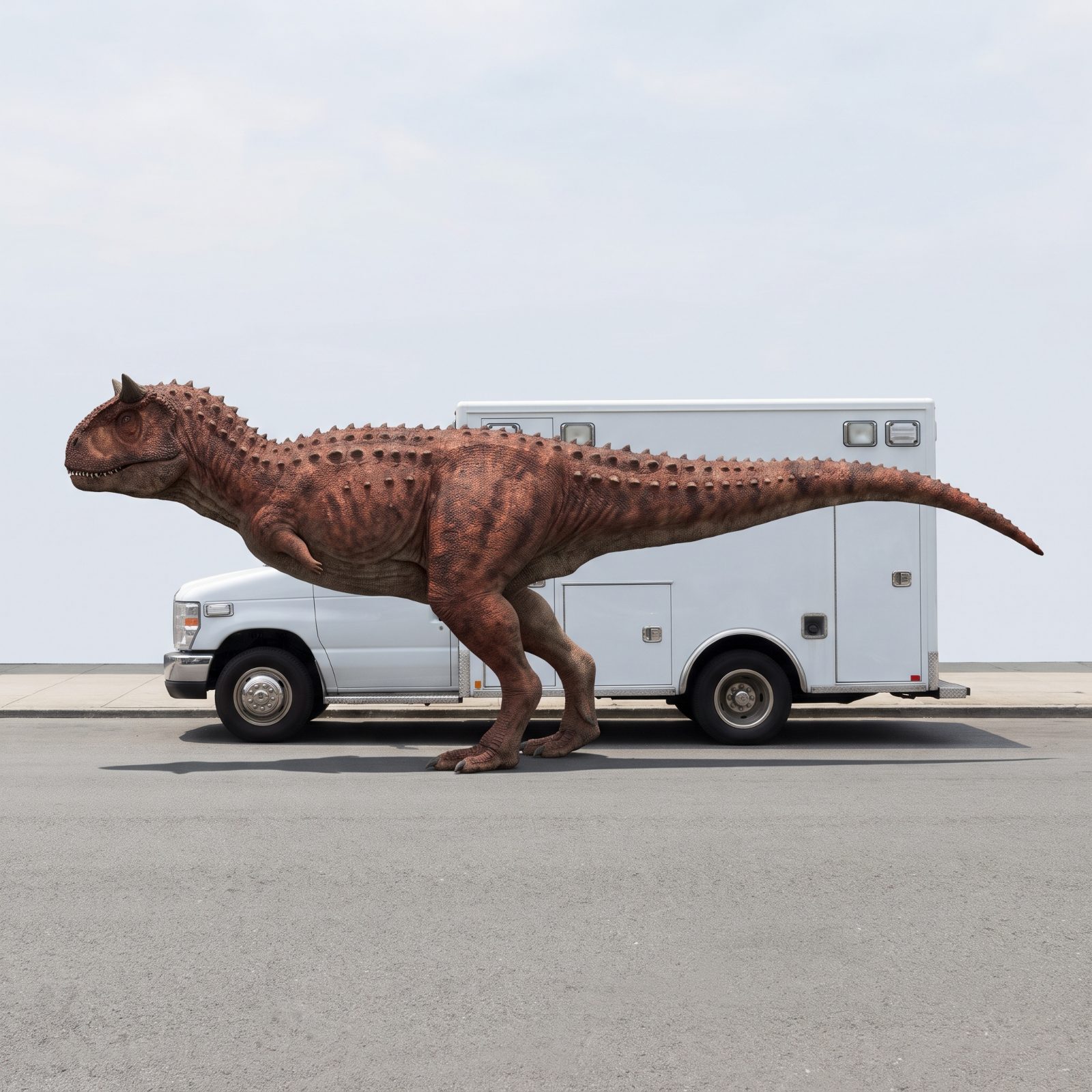
The arms are a joke and the horns are not. Carnotaurus had forelimbs so stunted they make a T. rex look well-equipped, plus a pair of thick bony horns jutting over its eyes that gave the animal its name: “meat-eating bull.”
Roughly ambulance-length, around 28 feet, from Patagonia’s La Colonia Formation. Its leg muscles suggest real speed, which fits a predator that had basically given up on its hands and bet everything on bite and pursuit. And here’s the part I love: we have fossilized skin impressions showing rows of knobbly scutes, so the texture of its hide isn’t a guess. For once, we actually know what the living surface looked like.
31. Deinocheirus Beside a Cherry Picker
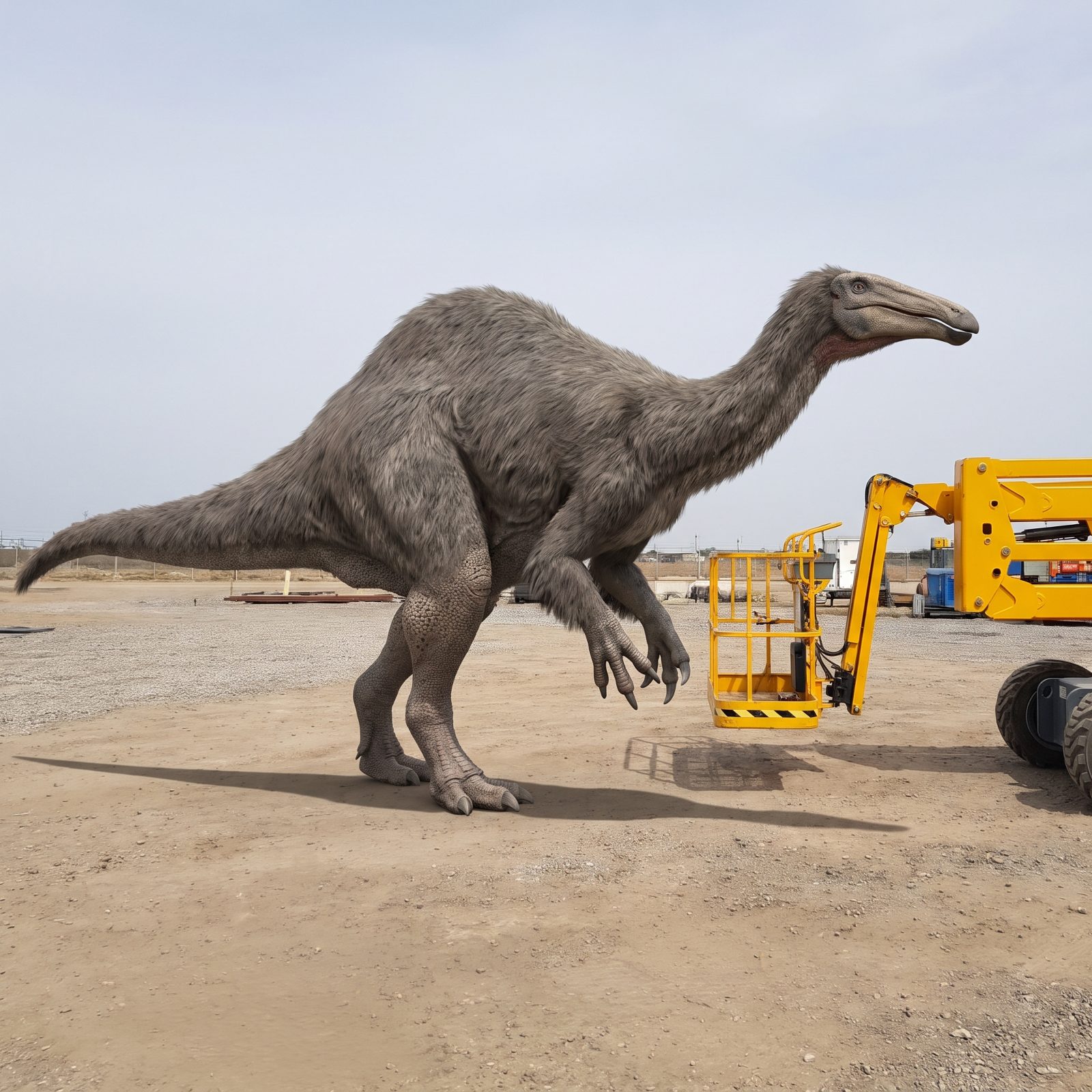
For decades this animal was a pair of giant arms and nothing else. Discovered in Mongolia’s Nemegt Formation, Late Cretaceous, the arms alone ran nearly eight feet and handed paleontologists a mystery that sat unsolved for fifty years. The rest of the body finally turned up around 2014.
And it was weird. A humped back, a flat beak like a duck crossed with a bus, a body built to wade and strip plants from riverbeds. Stand it next to a cherry picker and the scale clicks: this was a six-ton giant that could’ve peered into a second-story window.
30. Therizinosaurus Beside a Basketball Hoop
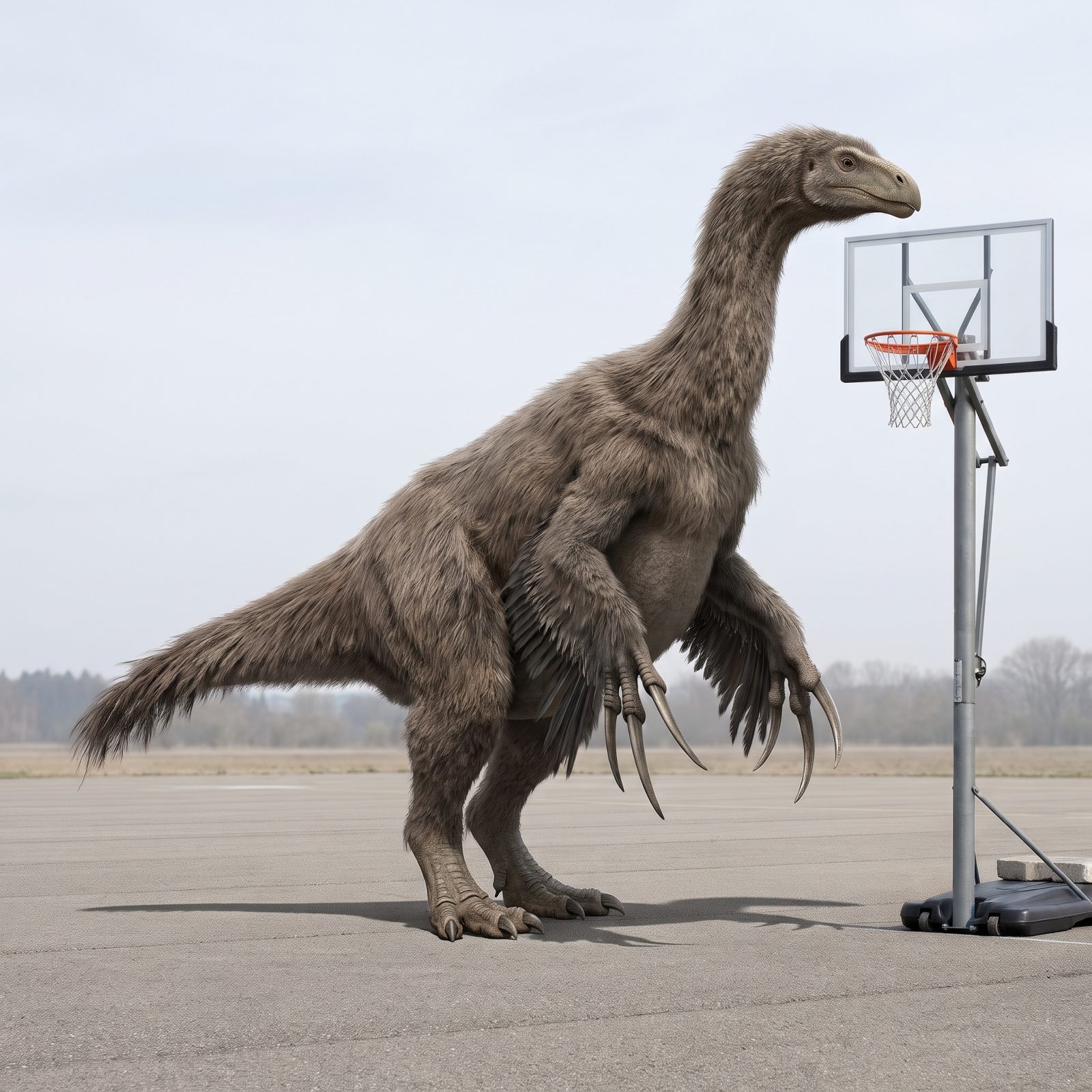
The claws are the whole story. Each one reached roughly a meter, the longest claws of any animal that ever lived, and for years nobody could agree what they were for. A weapon? A fish hook? The best guess now is gloriously dull: raking in branches, the way a sloth hooks leaves toward its mouth.
Because this was a feathered plant-eater. Late Cretaceous Mongolia again, same Nemegt beds. Line it up with a basketball hoop and the head clears the rim. A gentle giant with switchblades for hands.
29. Utahraptor Beside a Grand Piano
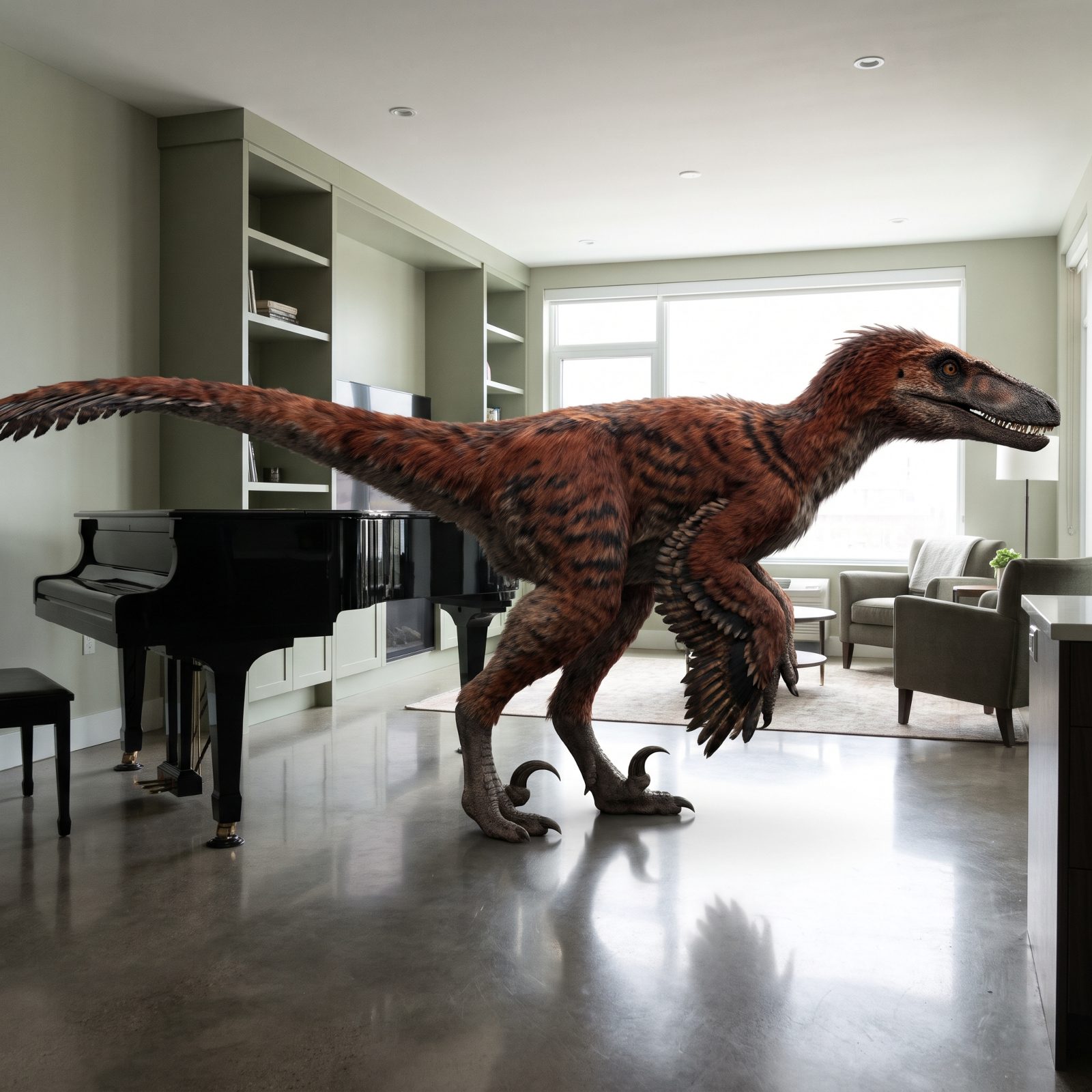
Forget the movie raptors. The real heavyweight of the family came out of Utah’s Cedar Mountain Formation, Early Cretaceous, and it was built like a linebacker with feathers.
More than twice the length of a grand piano, tail included, and considerably heavier, Utahraptor carried a sickle claw the size of your hand on each foot. It wasn’t fast the way the little ones were. It was a grappler, using that claw to pin prey while its mass did the rest. The feathers aren’t a guess, by the way. Close relatives preserved them, so this one had them too.
28. Deinonychus Beside a Refrigerator
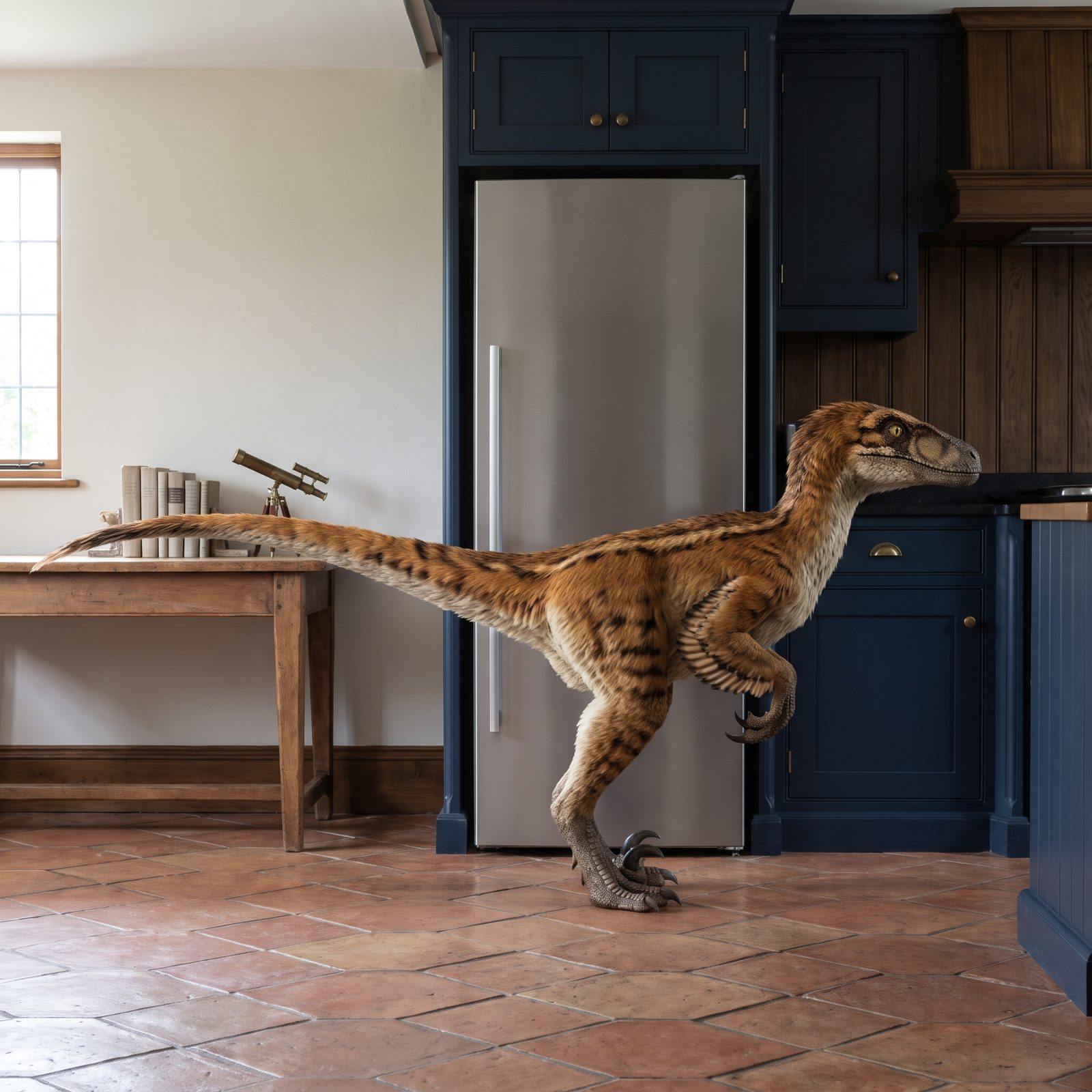
This is the animal the famous raptors were really based on. Not Velociraptor. Deinonychus. When John Ostrom dug it out of Montana’s Cloverly Formation in the 1960s, Early Cretaceous, it overturned how we picture dinosaurs: here was something sleek, warm-blooded, built to move.
And it stands only about half fridge height at the hip, its head still below the top of the fridge. Shorter than you’d expect. The hype gave it the body of a lion, but the real thing weighed maybe 160 pounds, with feathered arms it couldn’t fly with and a wicked second-toe claw it held up off the ground while it ran.
27. Velociraptor Beside a Shopping Cart
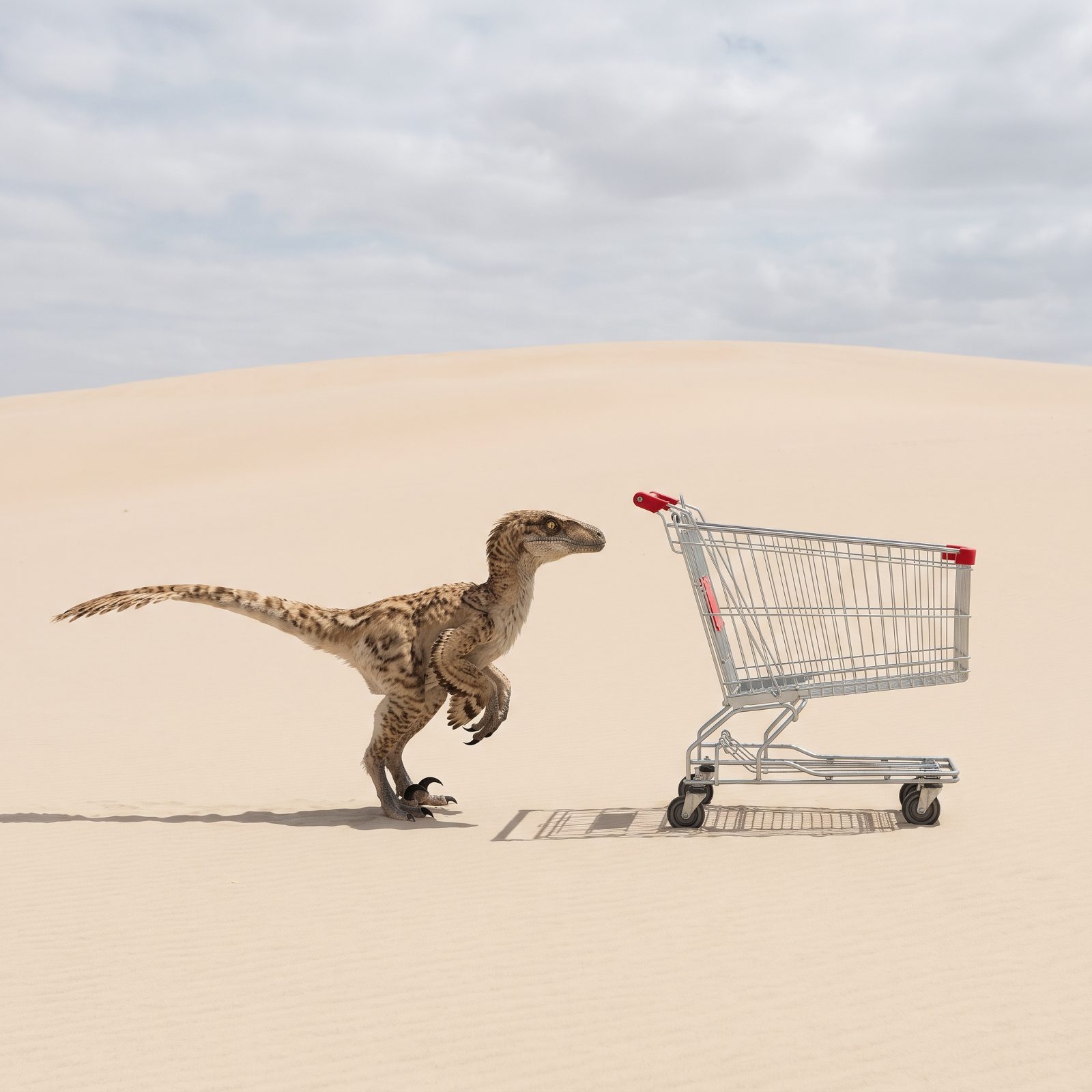
Now the one that wrecks everyone. The real Velociraptor, found in Mongolia’s Djadokhta Formation, Late Cretaceous, is shown here beside a shopping cart. A feathered, snuffling predator whose head sits roughly level with the cart’s handle and whose body, tail tip to snout, is only about one and a half times the cart’s length.
We know it had feathers for certain. Quill knobs, the little bumps where wing feathers anchor, were found on a fossilized forearm in 2007. So the hairless scaly monster of the movies is pure fiction. Picture something closer to an angry roadrunner with a knife on each foot, and you’re much nearer the truth.
26. Oviraptor Beside a Vending Machine
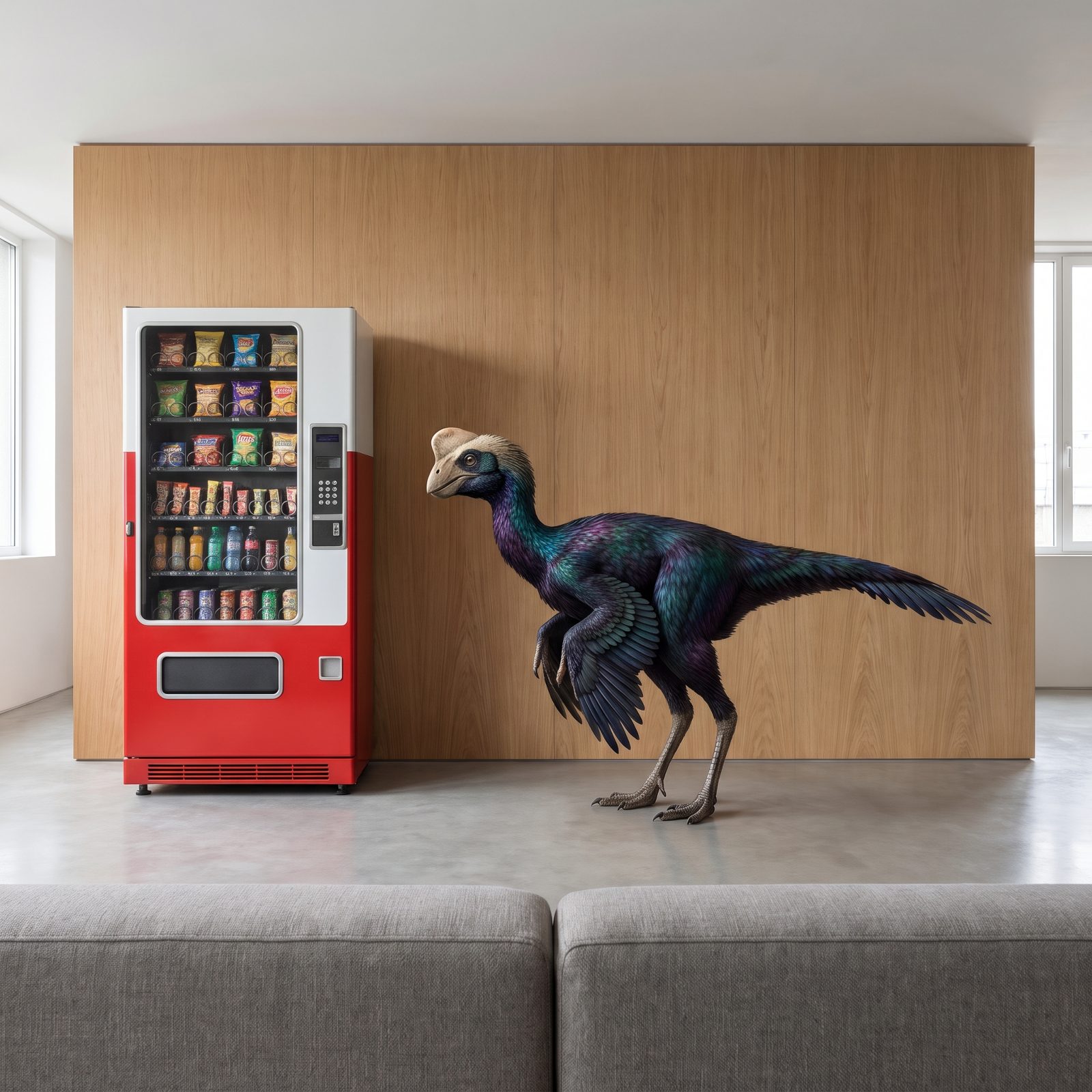
The name means “egg thief,” and it’s one of paleontology’s great libels. The first specimen, dug from Mongolia’s Djadokhta Formation in the 1920s, Late Cretaceous, was found sprawled over a nest of eggs. Case closed, everyone decided. It raided nests.
Then, decades later, an embryo in one of those eggs turned out to be Oviraptor itself. The “thief” was a devoted parent, brooding its own clutch like a hen when it died. Roughly vending-machine height, crested, feathered, and badly misnamed.
25. Gallimimus Beside a Motorcycle
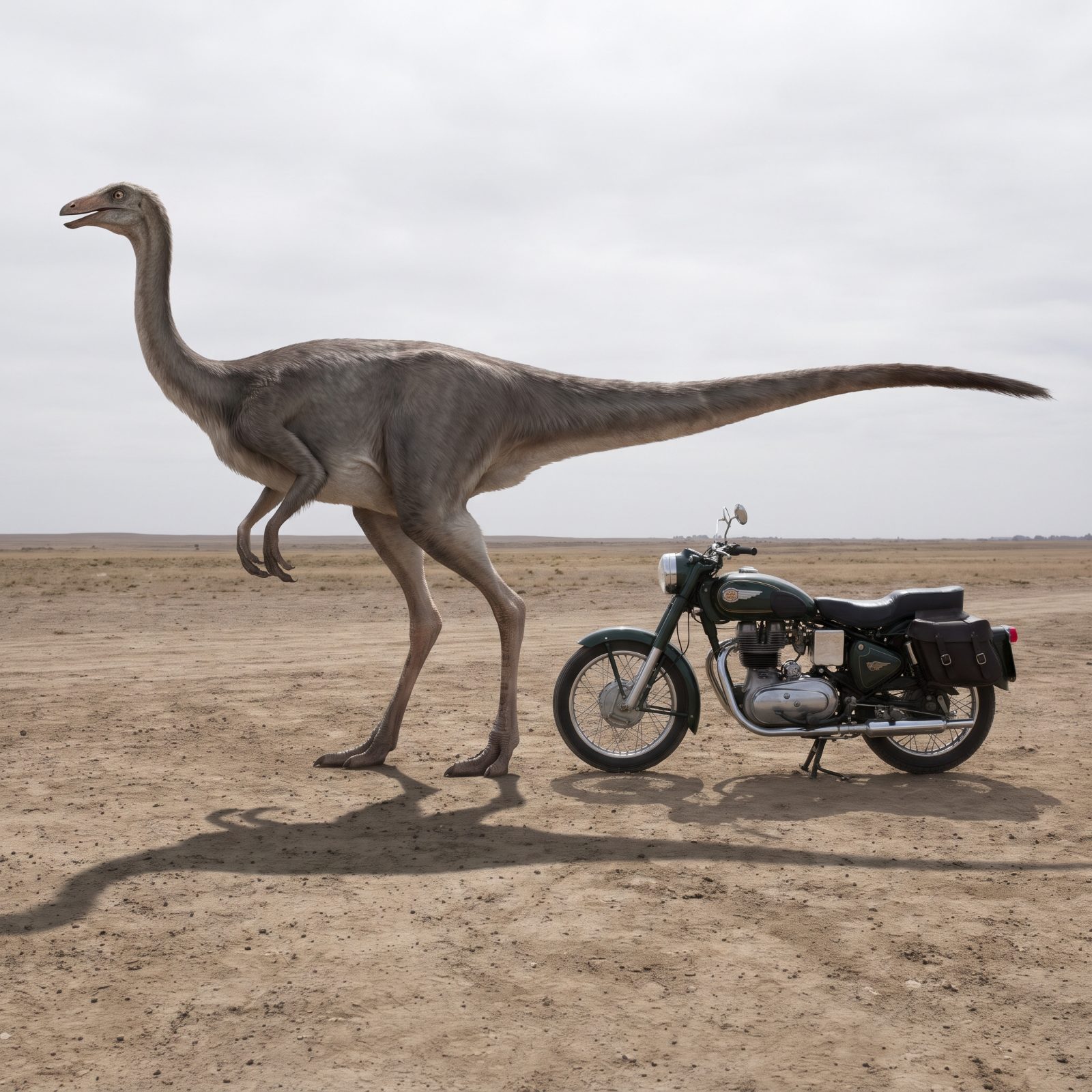
Picture the fastest thing on the Cretaceous plains and you’re picturing something like this. Gallimimus, the “chicken mimic,” came out of Mongolia’s Nemegt Formation, Late Cretaceous, and it was put together the way an ostrich is: long legs, light frame, toothless beak, all engine.
About twenty feet long but barely heavier than a large horse. Beside a motorcycle the proportions make sense, because speed was the whole design brief. Estimates vary, but it may have cruised in the range of a galloping horse.
24. Dilophosaurus Beside a Canoe
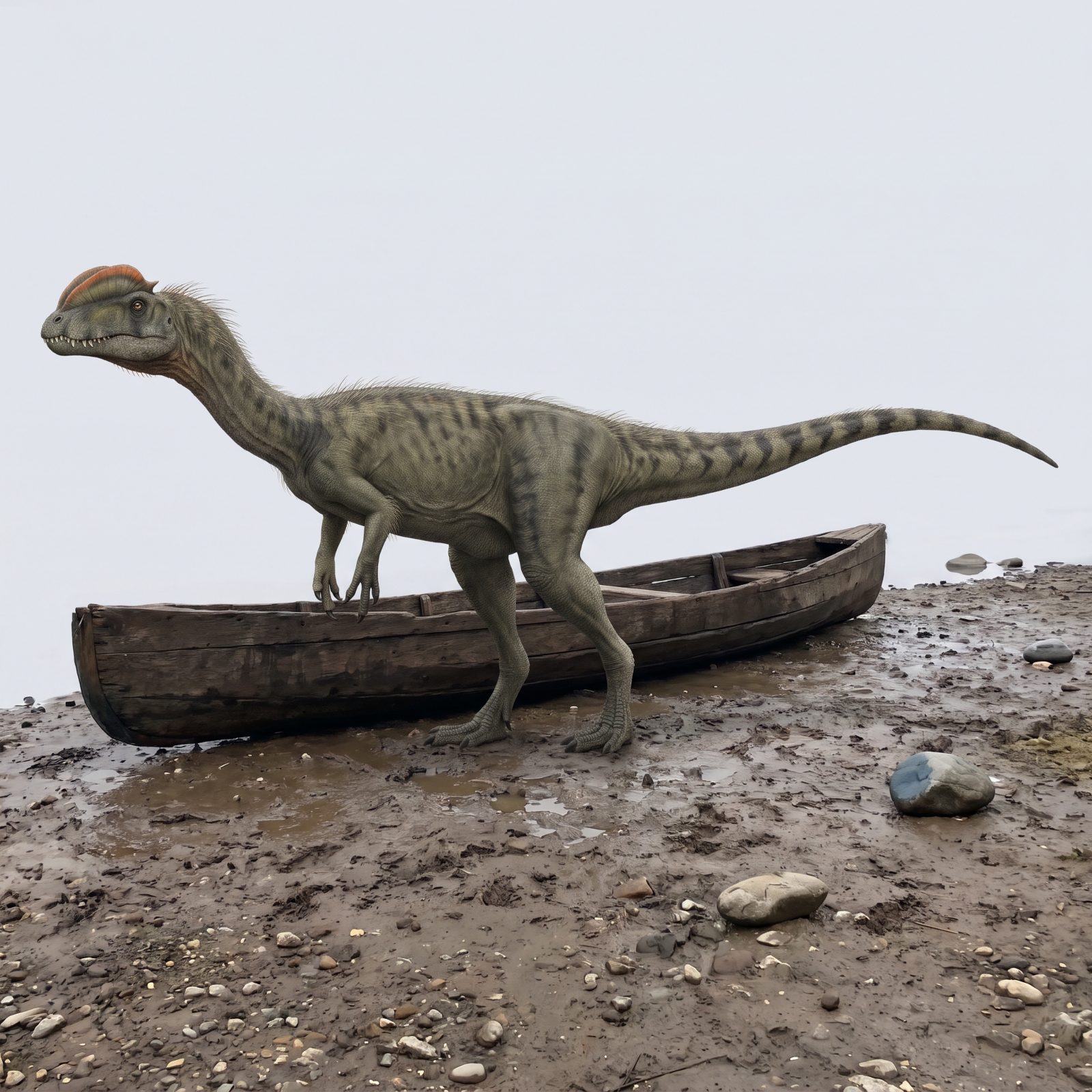
The movie did this one dirty. No neck frill. No venom spit. Both invented. The real Dilophosaurus, found in Arizona’s Kayenta Formation, Early Jurassic, measured a canoe plus a bit, and it was a genuine predator at a time when big predators were still rare.
Its signature is the pair of thin crests on its skull, too fragile for fighting and almost certainly for display. And it dwarfed the knee-high creature from the screen. Twenty feet of lean, crested hunter, stretching about as long as the canoe beside it.
23. Herrerasaurus Beside a Pool Table
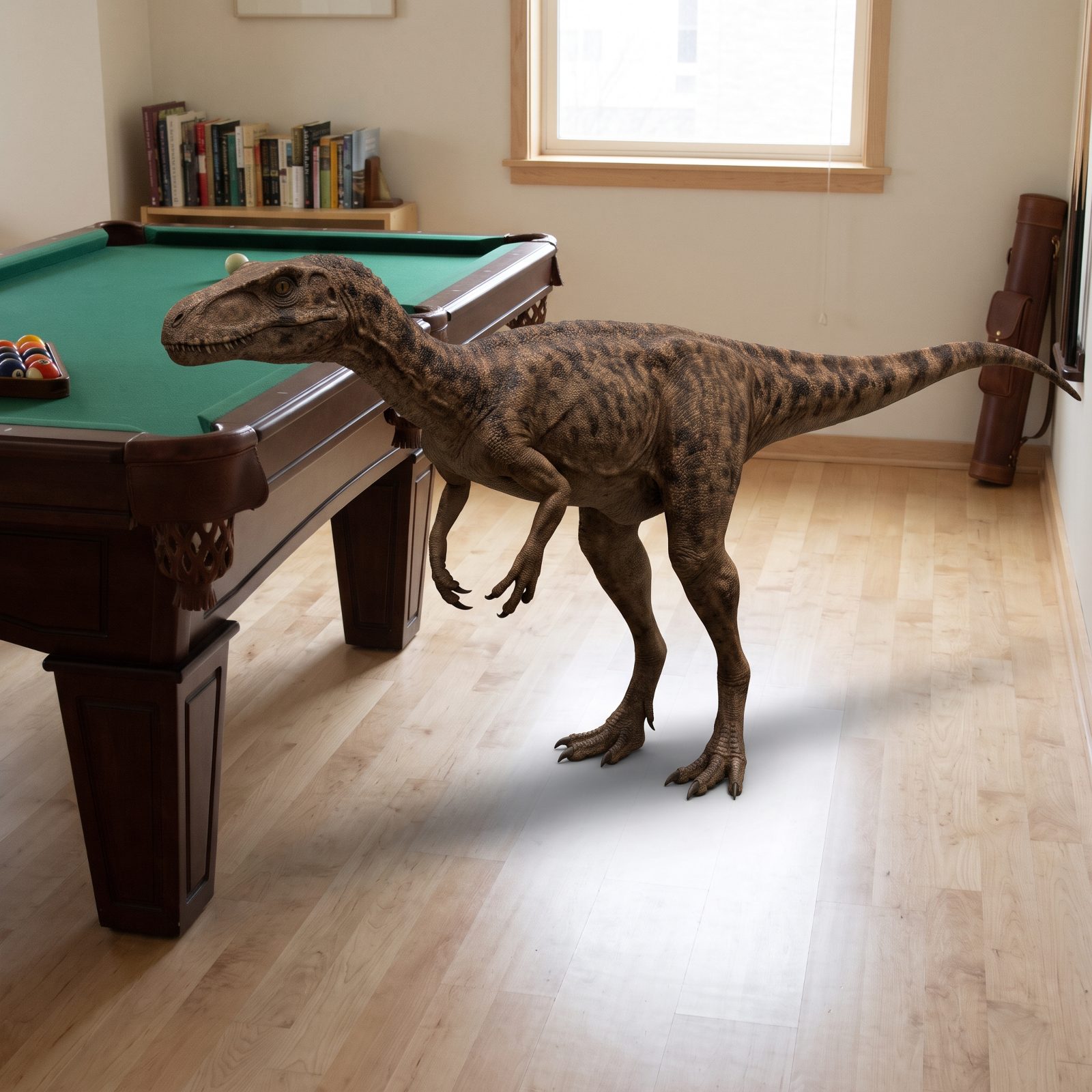
This is one of the oldest dinosaurs we know of, and it looks the part. Found in Argentina’s Ischigualasto Formation, Late Triassic, Herrerasaurus prowled around 230 million years ago, back when dinosaurs were still a bit player in a world run by other reptiles.
Roughly the length of a pool table, maybe a touch more, with grasping hands and a mouth built for meat. What gets me is how finished it looks for something so early. The basic predator blueprint that Tyrannosaurus would inherit more than 150 million years later was already here, mostly worked out.
22. Eoraptor Beside an Acoustic Guitar
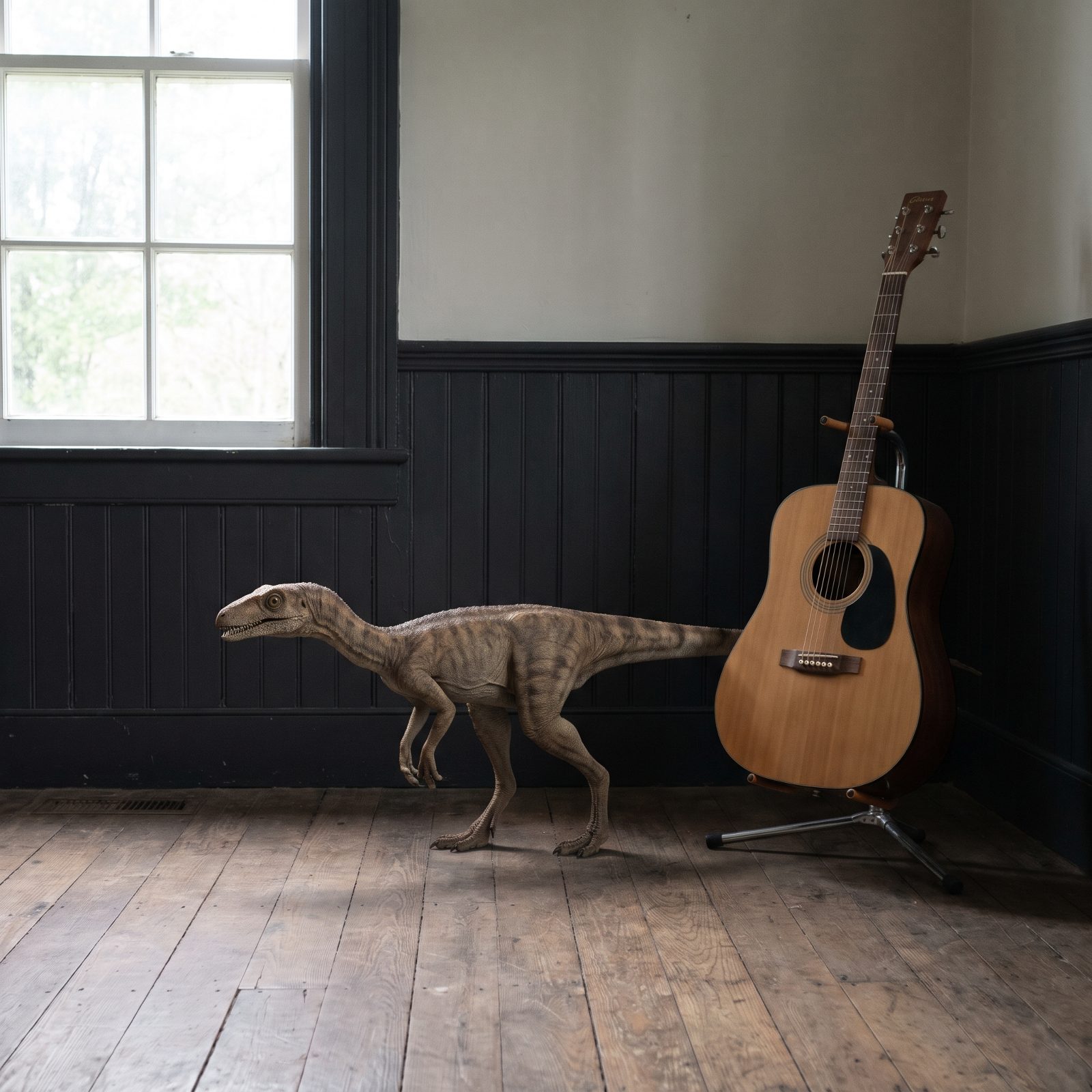
Now go small. Eoraptor, from those same Ischigualasto beds in Argentina, Late Triassic, ran about the length of an acoustic guitar, and it’s one of the earliest dinosaurs ever described.
Its mouth couldn’t decide what it was: some teeth shaped for meat, some for plants, a snapshot of a lineage still figuring out dinner. And here’s what to sit with. Everything on this list, the meter-long claws and the multi-ton waders, descended from something roughly this size. The giants all started as creatures you could’ve cradled in two hands. Go look at a sparrow and think about where it came from.
21. Compsognathus Beside a Skateboard
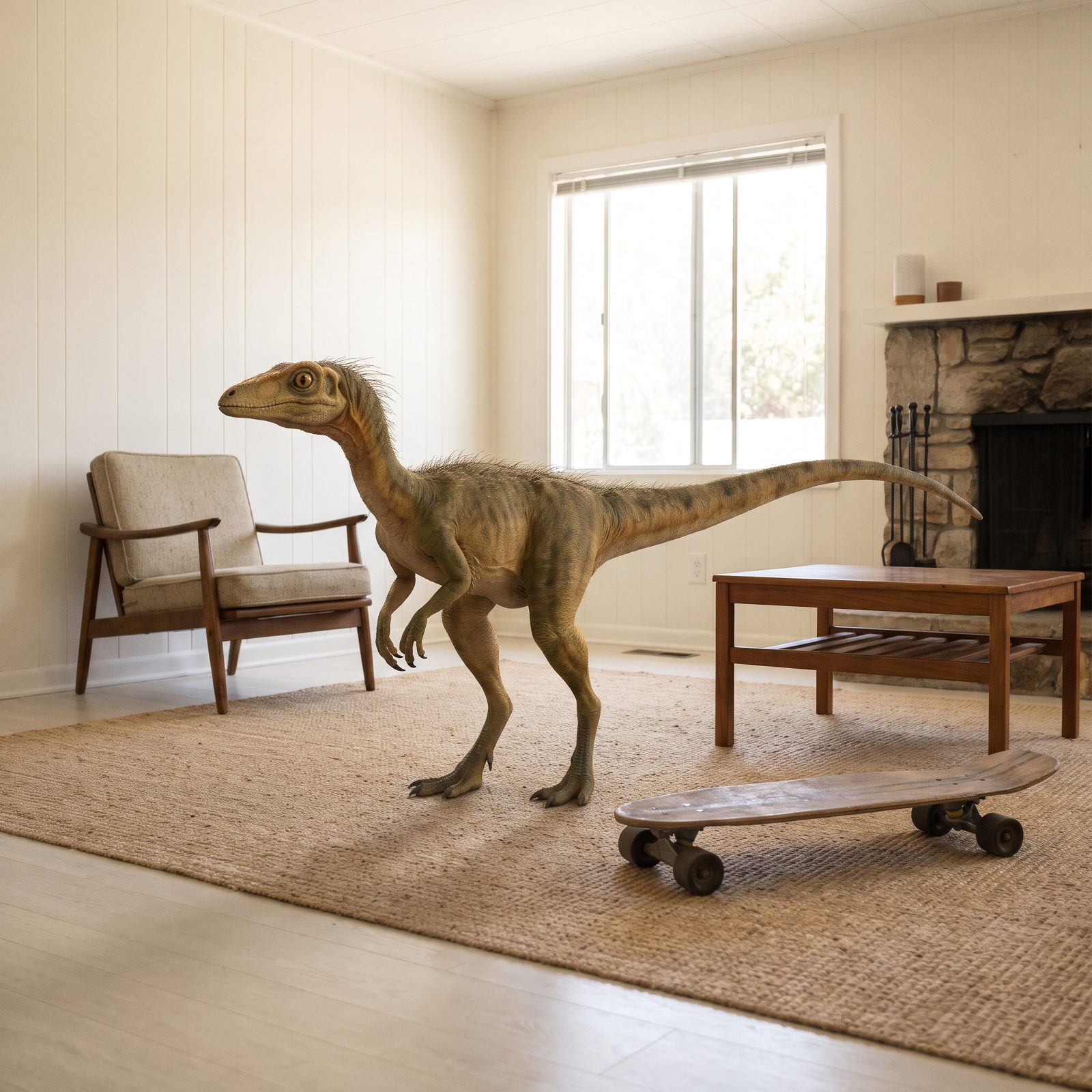
Forget anything you could ride into battle. Nose to tail tip it runs only a little longer than the skateboard beside it, and most of that is tail. Weigh one and you’d get something closer to a housecat than a large dog.
Found in the fine limestone of Solnhofen, this Late Jurassic hunter chased lizards, not horses. One famous specimen died with a small reptile still sitting in its gut — which is exactly how we know what was on the menu.
20. Microraptor Beside an Open Umbrella
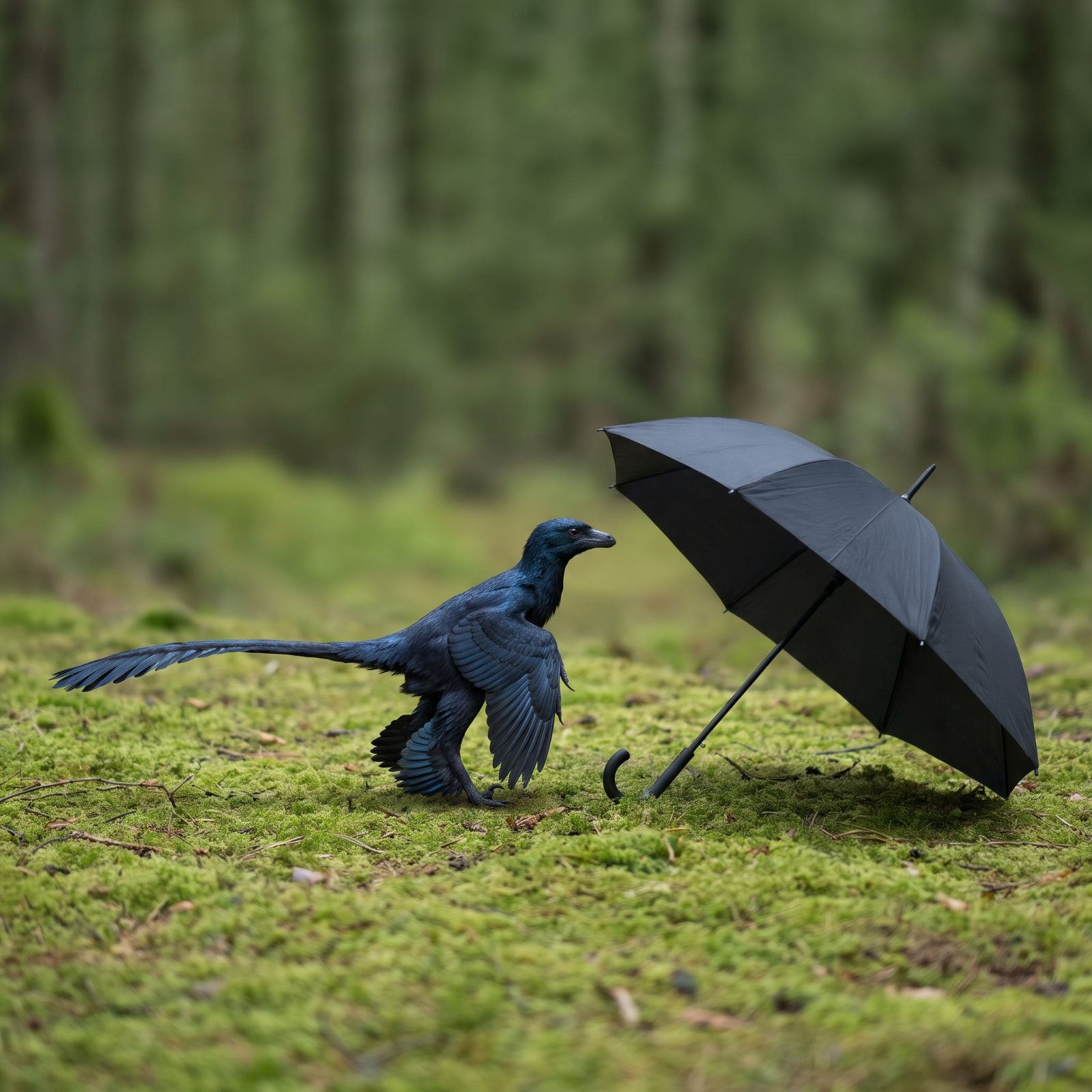
Four wings. Not two. Microraptor grew long flight feathers on its hind legs as well as its arms, a body plan nothing alive today bothers to repeat. Here, from snout to tail tip, it stretches only a little wider than that open umbrella, looking far bulkier than any pigeon.
And the glossy black plumage isn’t a guess. Fossils from Liaoning preserved the microscopic melanosomes that once held pigment, and their shape tells us the feathers shone iridescent blue-black, like a grackle caught in sun.
A gliding dinosaur with shimmering feathers on all four limbs. If you’d described it in 1990, nobody would have believed you.
19. Archaeopteryx Beside a Laptop
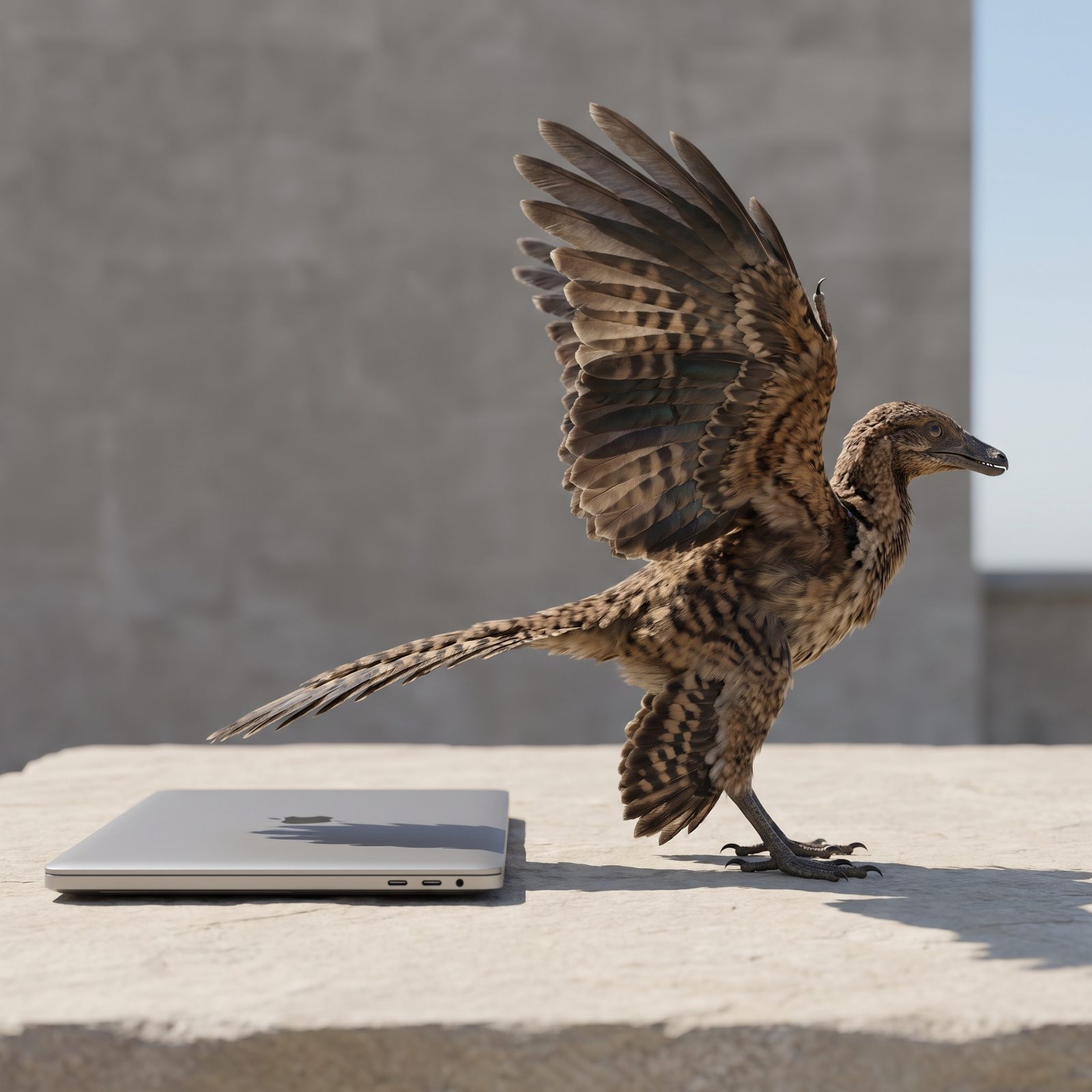
The size always surprises people. Archaeopteryx, the creature textbooks crown as the first bird, ran well over a laptop’s length from beak to tail tip and stood nearly as tall as one is long. No eagle. Picture a toothy, clawed raven that could probably flap but likely wasn’t much of a flier.
Twelve main skeletons have turned up, every one from the same Bavarian limestone laid down roughly 150 million years ago, a quarry that fossilized feathers finely enough to count individual barbs.
It’s the mix that matters. A long bony tail and wing claws from the dinosaur side; feathers and wings from the bird side. One animal, straddling a line we only drew later.
18. Yi Qi Beside an Unfolded Newspaper
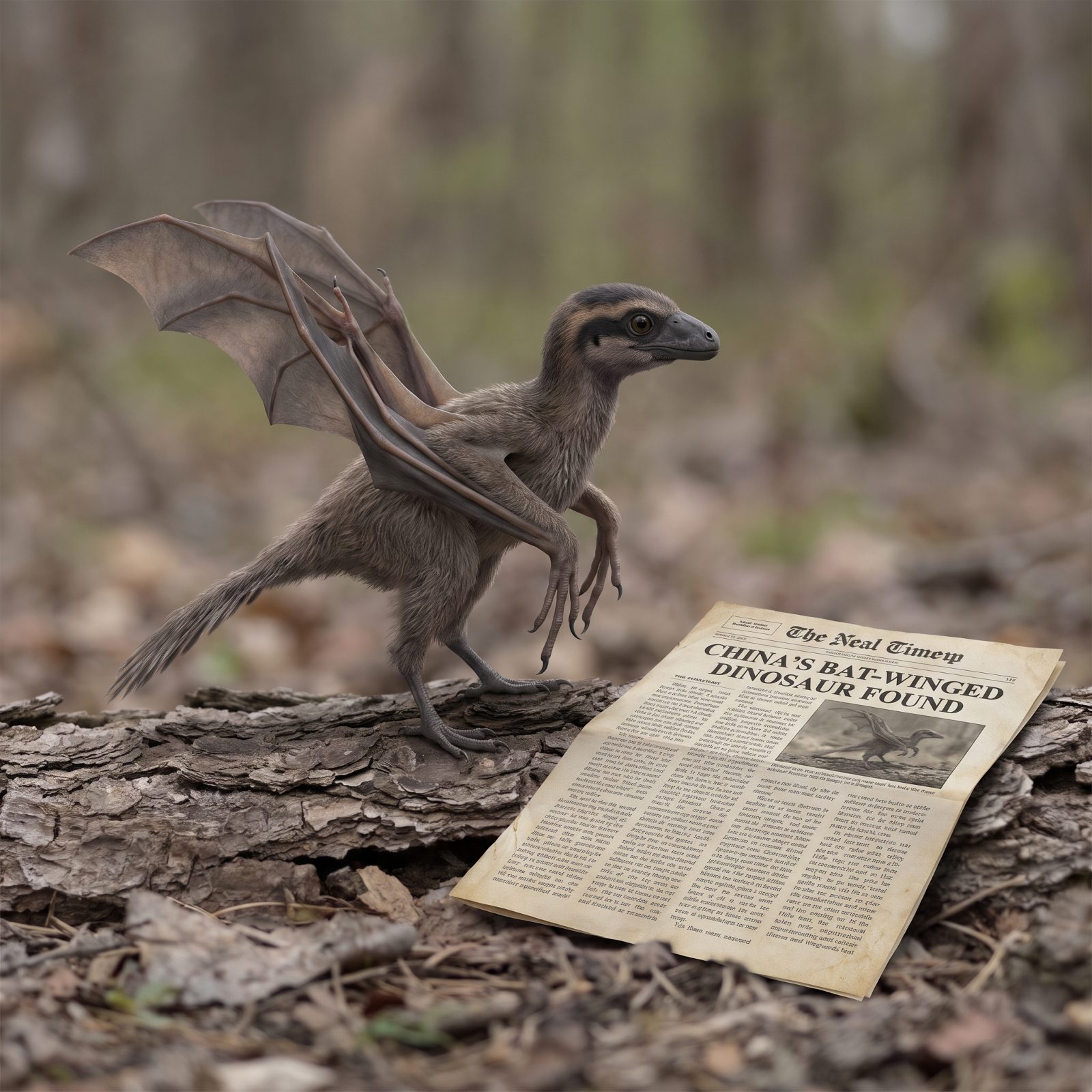
Of every animal on this list, Yi qi is the strangest — and here it stands about the same size as the newspaper beside it. Say it “ee chee,” meaning “strange wing.” A dinosaur that flew on membranes rather than feathers, measuring from beak to tail roughly the width of the unfolded sheet.
From each forearm hung a loose flap of skin, a wing closer to a bat or flying squirrel than to any bird. The single known fossil came from Hebei, in rocks around 160 million years old.
17. Mononykus Beside a Vacuum Cleaner
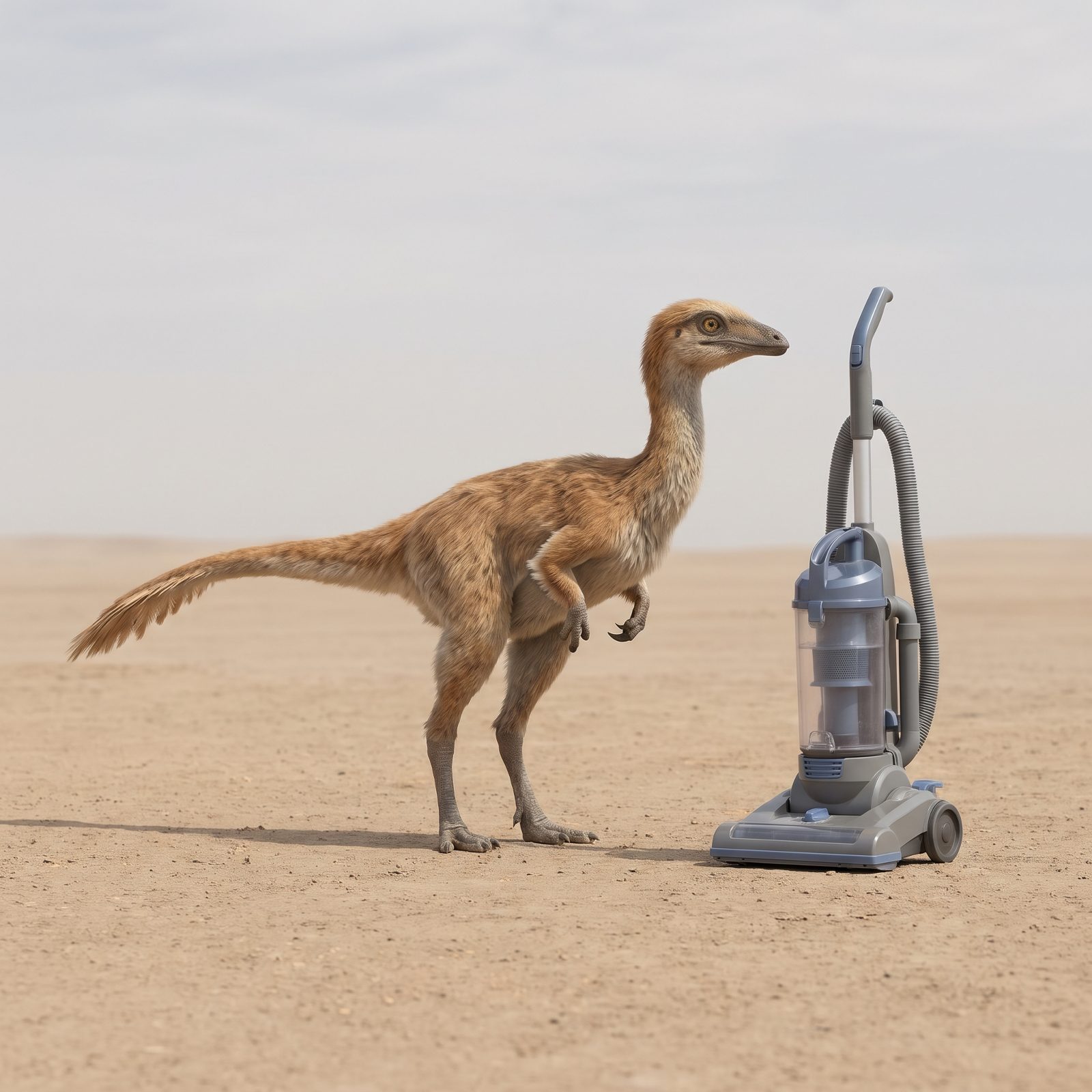
Standing about hip-high next to a vacuum, Mononykus had the running build of a roadrunner and the weirdest arms in the business — stubby little things, each ending in a single massive claw.
The leading idea? It cracked into insect nests, ripping open rotten logs or termite mounds like a prehistoric can opener. Those long legs say it ran fast across the Gobi, where its bones eventually surfaced.
Specialized doesn’t mean big. This one bet everything on one finger.
16. Plateosaurus Beside a Food Truck
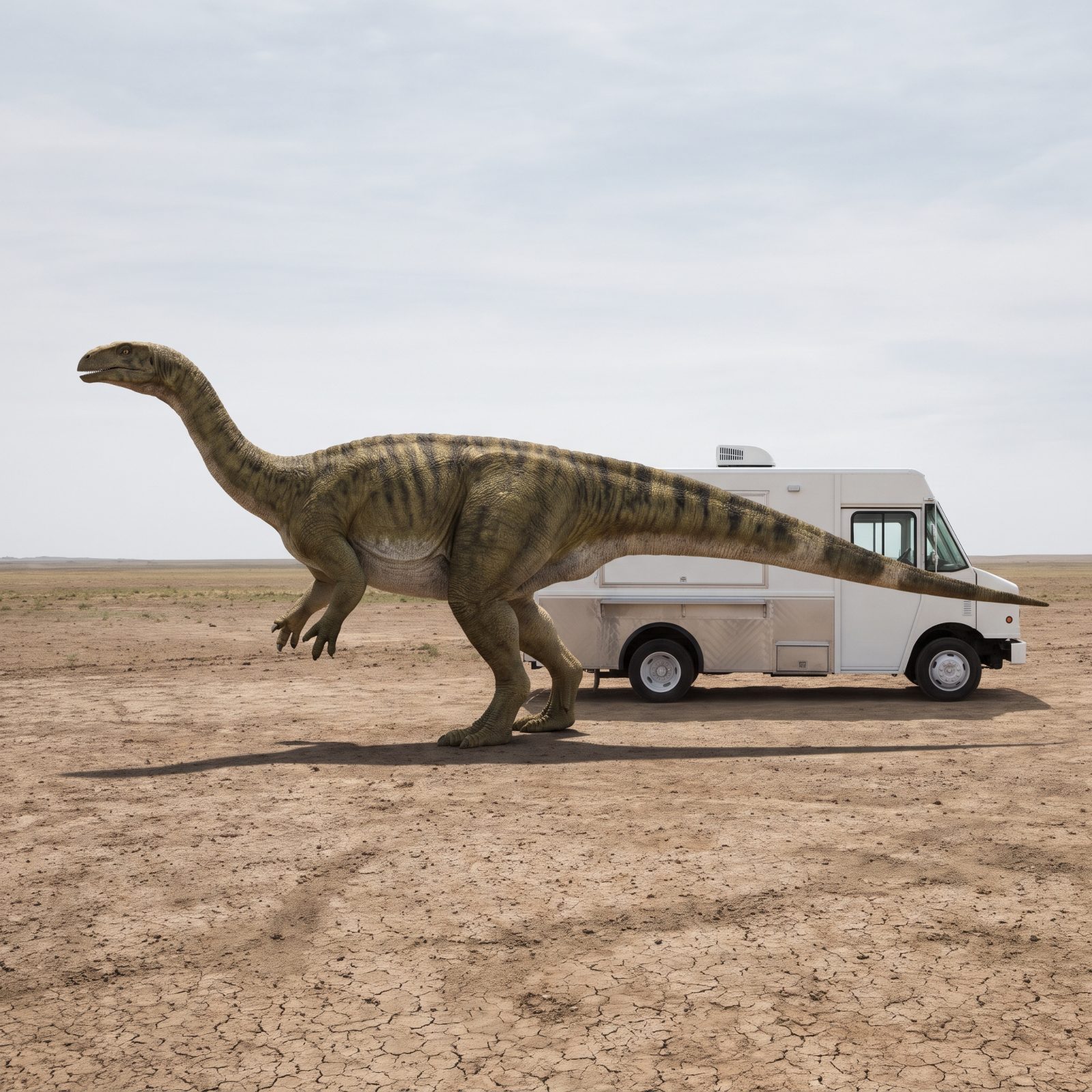
Here the scale tips hard. Plateosaurus ran the length of a food truck, pushing toward 26 feet and a couple of tons — and this was a Triassic animal, living long before the giant sauropods ever showed up. It walked on two legs, reached up with grasping hands and a long neck, and ate plants.
Dozens of skeletons came out of a single site at Trossingen, Germany, which tells us these animals piled up together, possibly trapped in mud during droughts.
15. Triceratops Beside an SUV
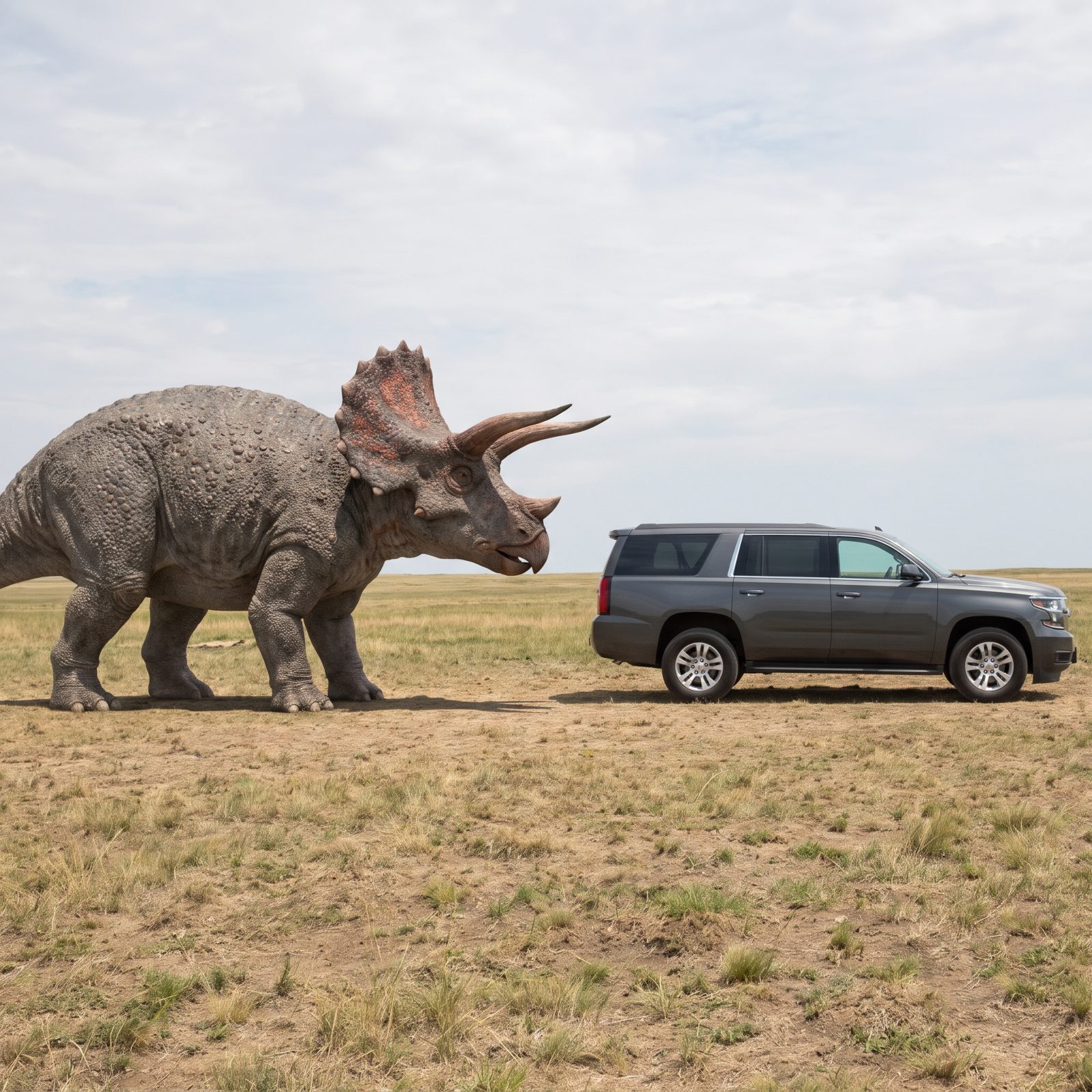
Park a Triceratops next to your SUV and it would run nearly twice the length. Something like 26 to 30 feet long, several tons, with a skull that could stretch past six feet — one of the largest heads any land animal has ever carried.
Those three horns and the broad frill came out of Hell Creek rock in Montana and the Dakotas, laid down in the last stretch before the asteroid hit. Triceratops was one of the final dinosaurs standing, grazing the same ground as T. rex.
And the frill wasn’t just armor. Many researchers think it doubled as display — a billboard for recognizing your own kind, or sorting out mates.
14. Styracosaurus Beside a Golf Cart
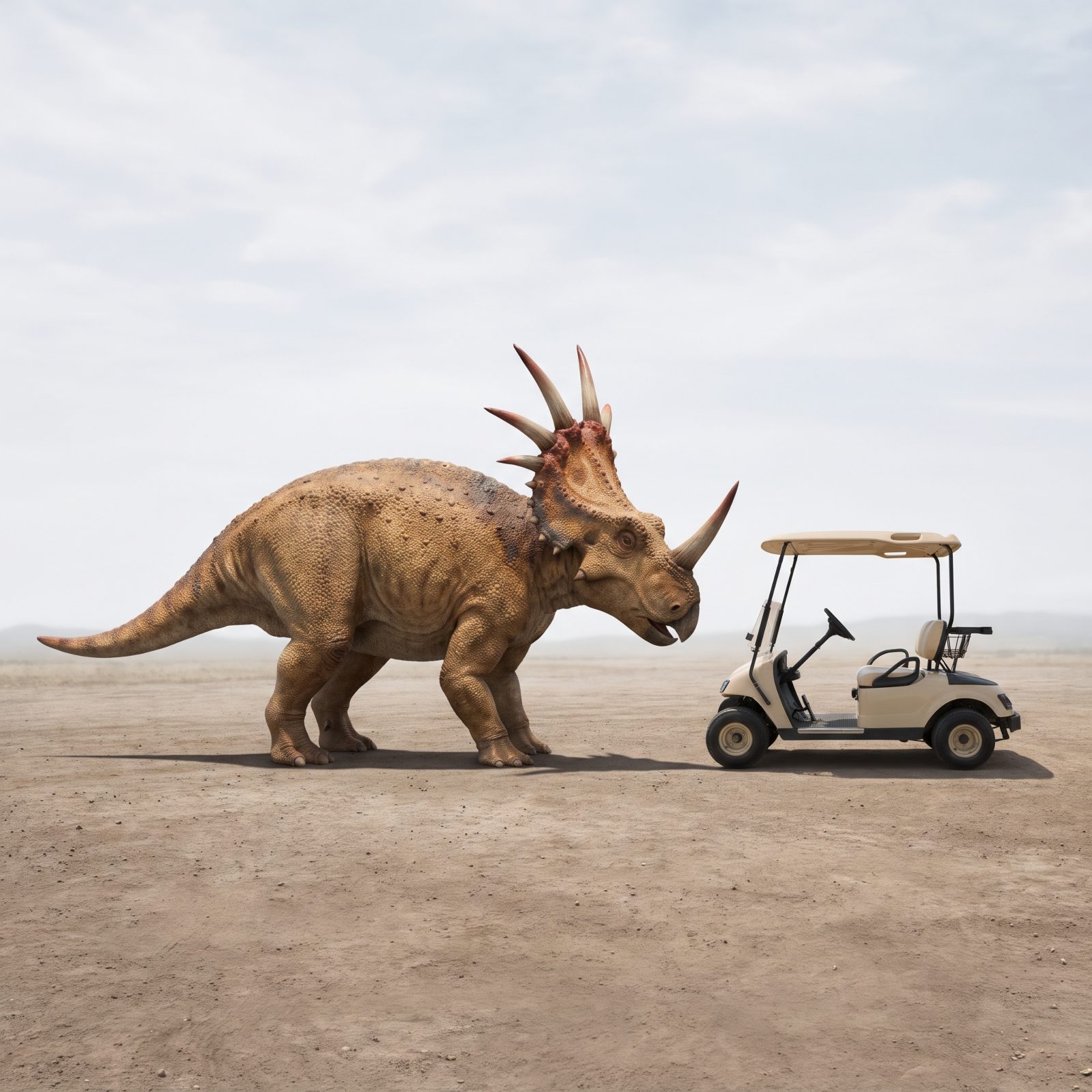
The spikes do all the talking. Styracosaurus wore a crown of long horns around its frill, plus a single nose horn that could reach a couple of feet. Set it beside a golf cart and it would loom larger and far nastier, somewhere around 18 feet long and a few tons.
Its bones come from Alberta’s Dinosaur Park Formation, some of the richest ceratopsian ground on Earth. A bonebed there hints that whole herds died together, maybe while crossing a flooded river.
All those spikes probably impressed other Styracosaurus more than they scared predators. Fashion, not just armor.
13. Protoceratops Beside a Wheelbarrow
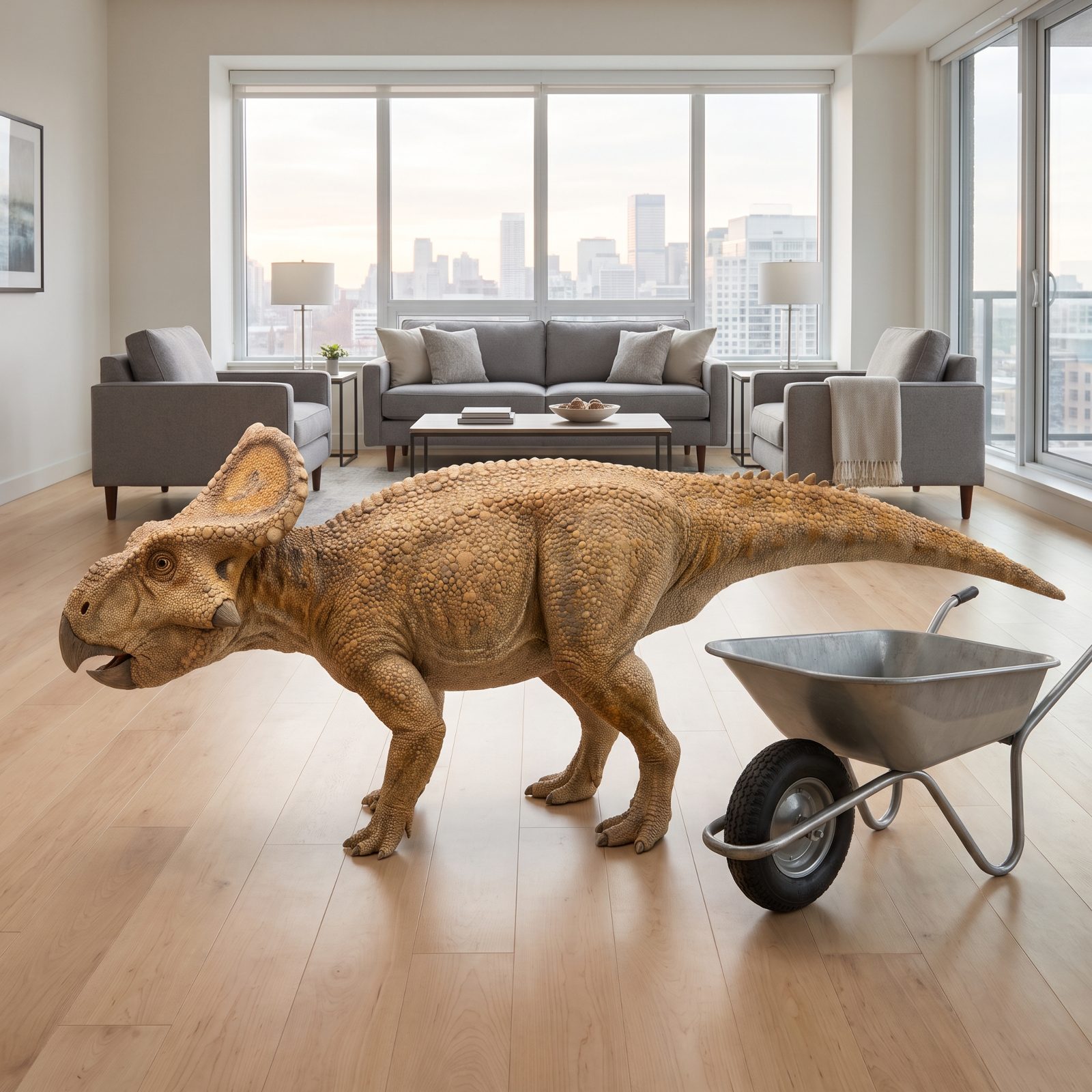
No horns, just a bony frill and a plant-eater’s beak — shown here at roughly its real sheep size, standing about as tall as the wheelbarrow beside it, its head well below the sofa back. Protoceratops was a small, early cousin of Triceratops, and it might be the most historically loaded dinosaur here.
Its skulls, parrot beak and bony frill and all, pour out of the red sands of Mongolia’s Gobi. Some researchers suspect that ancient people stumbling onto these very bones may have sparked the griffin legend — a beaked, four-legged guardian of gold.
12. Psittacosaurus Beside an Office Chair
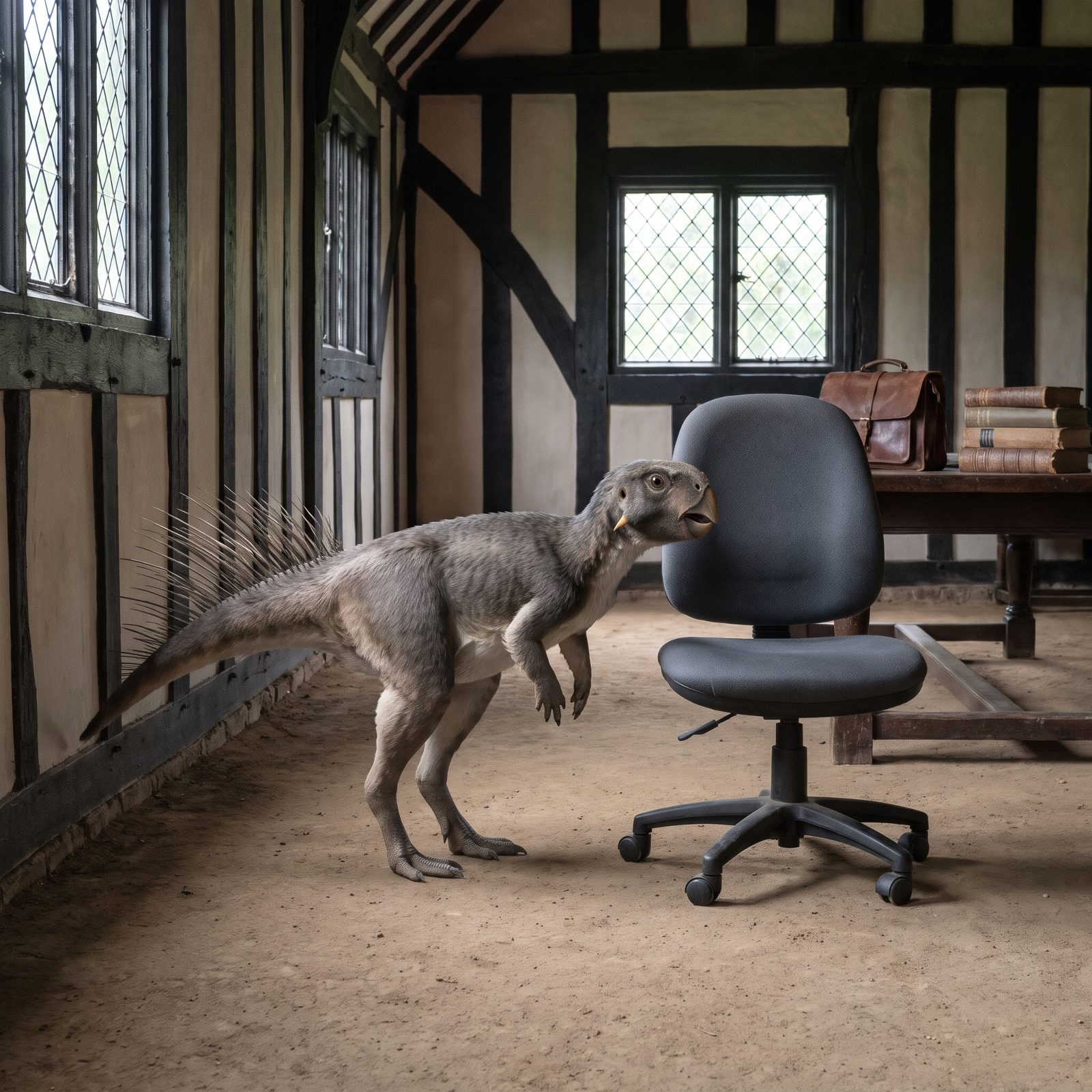
Dog-sized and strangely well understood, Psittacosaurus stood about chest-high to an office chair. The name means “parrot lizard,” after a short, deep beak built to shear tough plants.
One fossil from Liaoning is good enough that it rewrote what we knew about dinosaur color. Preserved pigment shows classic countershading — dark above, pale below, the exact camouflage of a forest-floor animal hiding from sharp eyes overhead. Odder still, a cluster of long bristle-like quills ran along its tail, structures with no obvious job except, perhaps, showing off.
11. Stegosaurus Standing Beside a Double-Decker Bus
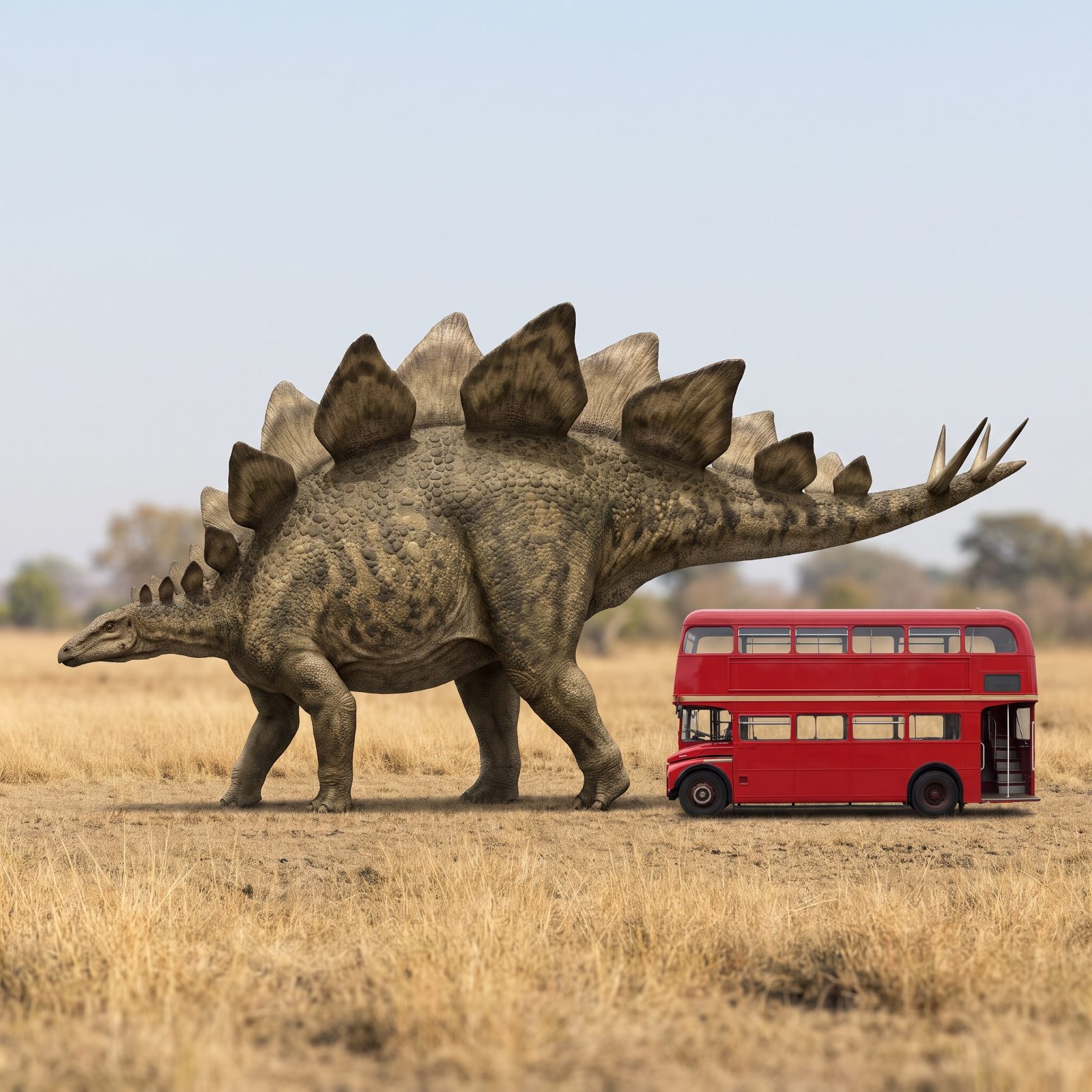
The plates are the part everyone gets wrong. Hollywood loves them as armor, and they almost certainly weren’t. Blood vessel channels suggest they ran warm with circulation, which points to display or temperature control rather than defense. A predator could have walked right between them.
Length-wise it runs a little shorter than the double-decker bus beside it, roughly 9 meters, with its plates rising to around the bus’s height, Late Jurassic, with the richest finds coming out of the Morrison Formation in Colorado and Wyoming. The body dwarfs the bus. The brain is not — famously tiny, about the size of a lime, which fueled the old myth of a “second brain” in the hips. There wasn’t one. Just a normal nerve bundle, same as in living birds.
10. Ankylosaurus Lined Up Against an Armored Van
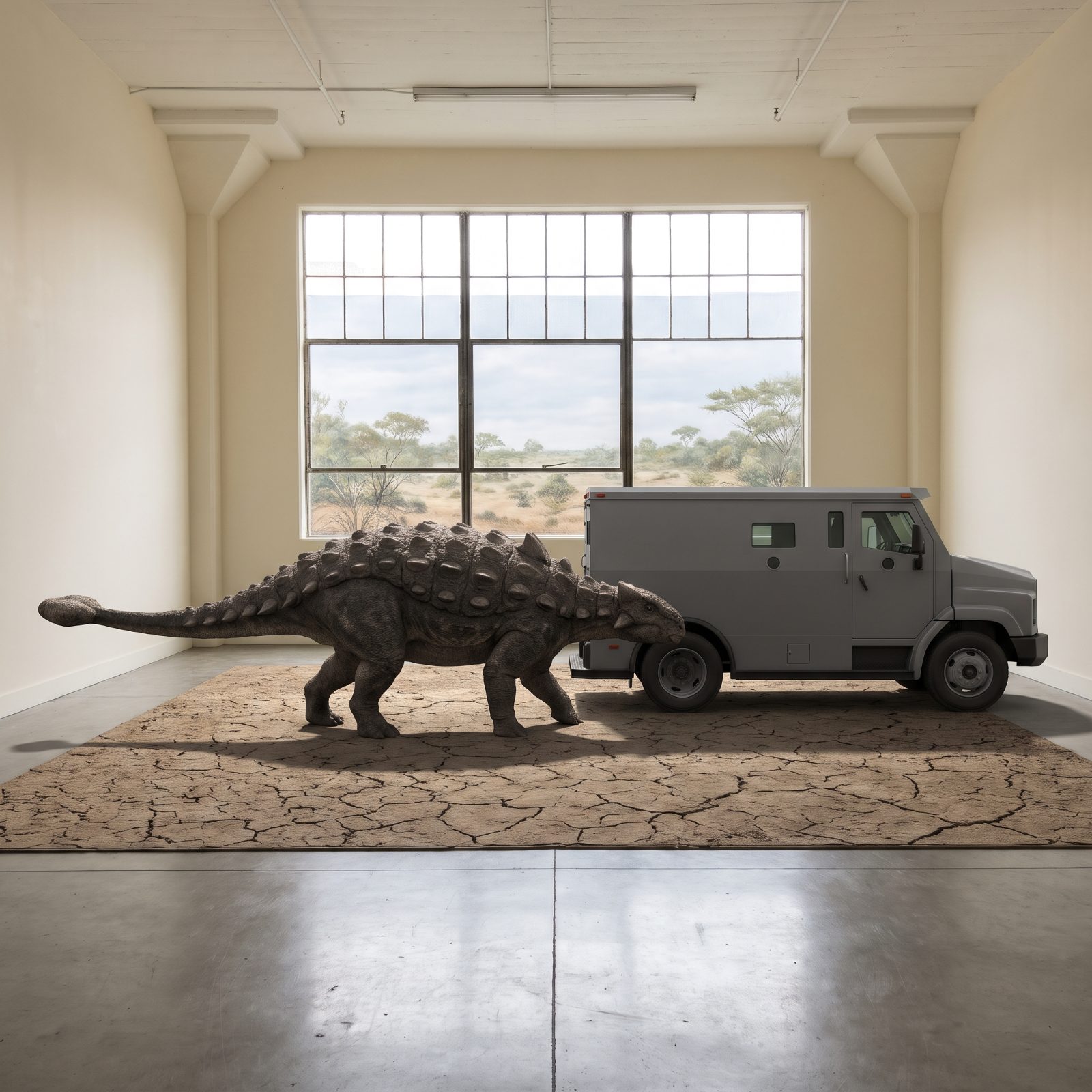
Built like something designed by a committee that only cared about not dying. Ankylosaurus was a walking fortress, roughly 7 meters long, Late Cretaceous, with fossils from Montana and Alberta.
The tail club is the headline, and it wasn’t decoration. Modeling of the fused bone and the tendons anchoring the swing suggests it could shatter bone, which means a frustrated T. rex could get its ankle broken mid-attack. Even the eyelids were armored — bone plates right over the eyes. When your blink needs a defense system, you know the neighborhood was rough.
9. Borealopelta Next to an Ordinary Garden Shed
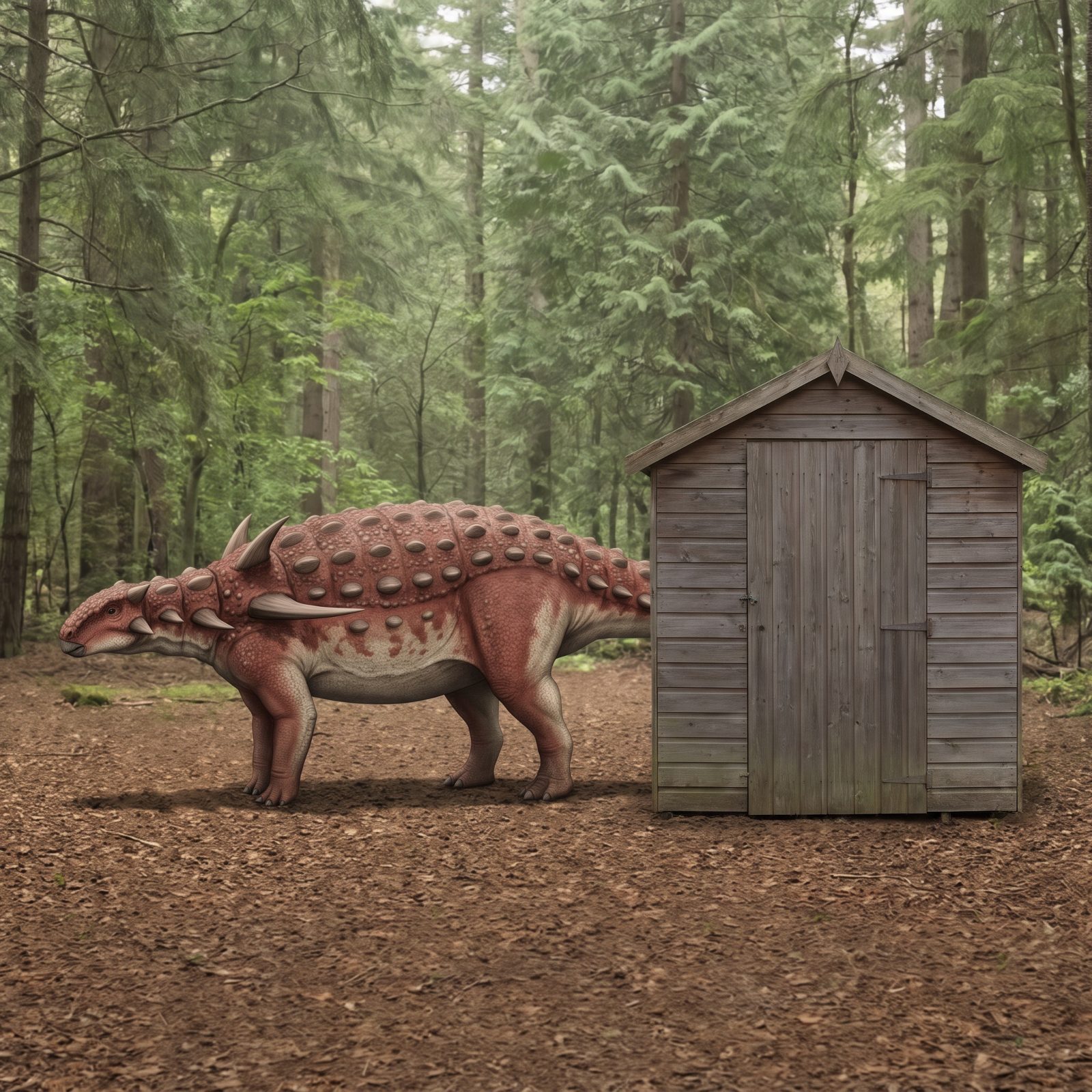
This one is a ghost that kept its skin. Borealopelta is the best-preserved armored dinosaur ever found, dug up by accident in 2011 at an oil sands mine near Fort McMurray, Alberta, Early Cretaceous. A miner’s shovel hit it. The fossil is so complete it looks less like bone and more like the animal fell asleep and turned to stone.
At around 5.5 meters, it’s shed-sized. The real jolt is the color. Chemical traces in the preserved skin revealed reddish-brown countershading — dark on top, pale below, the exact camouflage pattern of a hunted animal today. A two-ton tank still needed to hide. That tells you the predators of its world were no joke.
8. Parasaurolophus Beside a Wooden Utility Pole
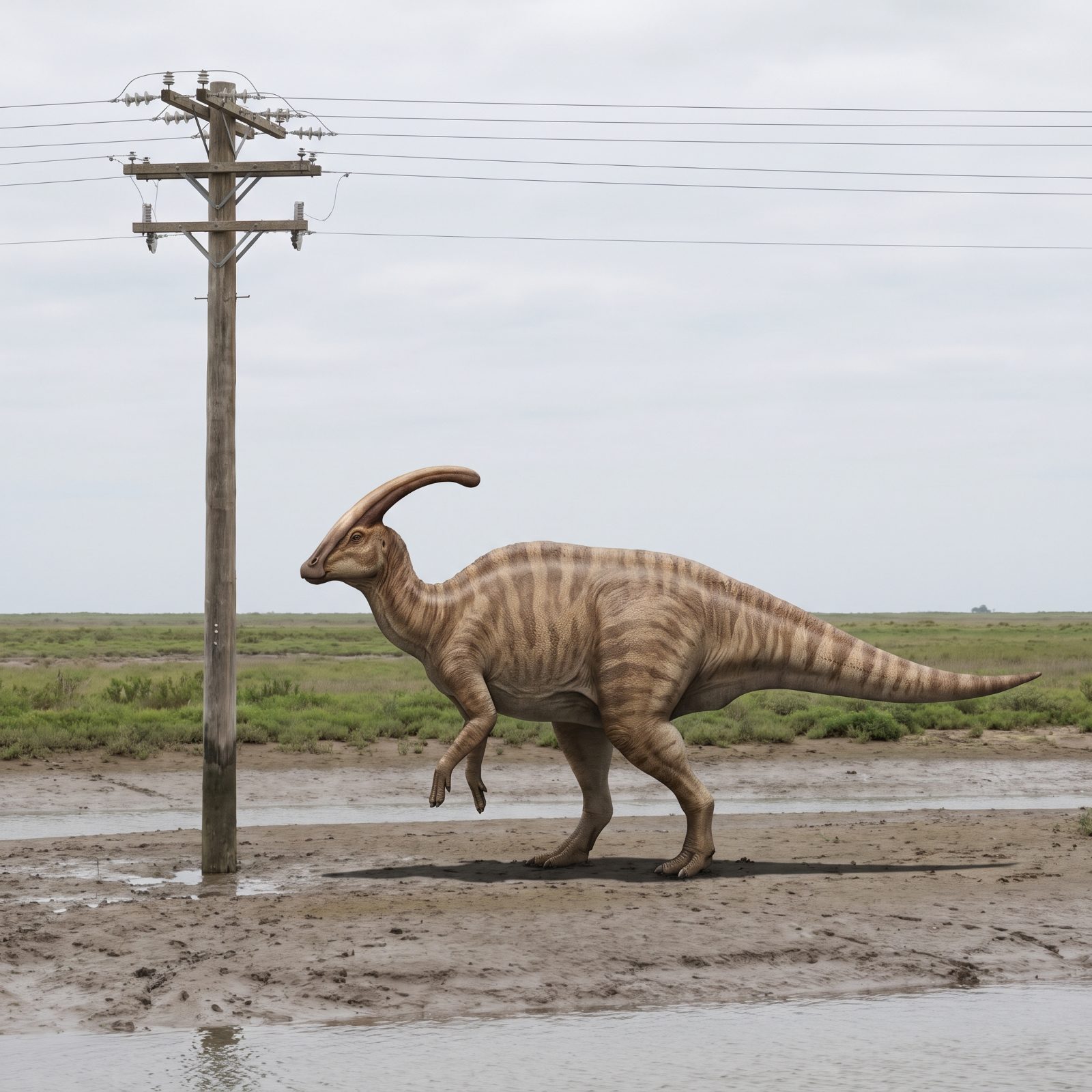
That crest launched a thousand bad theories. Snorkel for diving underwater? No — the tubes are sealed. Air tank? Also no.
The real answer turned out to be beautiful. The crest is hollow, a looping set of nasal passages, and when researchers modeled the airflow it worked like a resonating horn. Parasaurolophus could trumpet, a deep foghorn call that carried across the floodplains of Late Cretaceous Alberta and New Mexico. At roughly 9 to 10 meters long, it stood with its crest reaching well under halfway up a utility pole, far below the crossarms — and it may have sounded a little like one if the wind caught it right.
7. Edmontosaurus Parked Alongside a Family RV
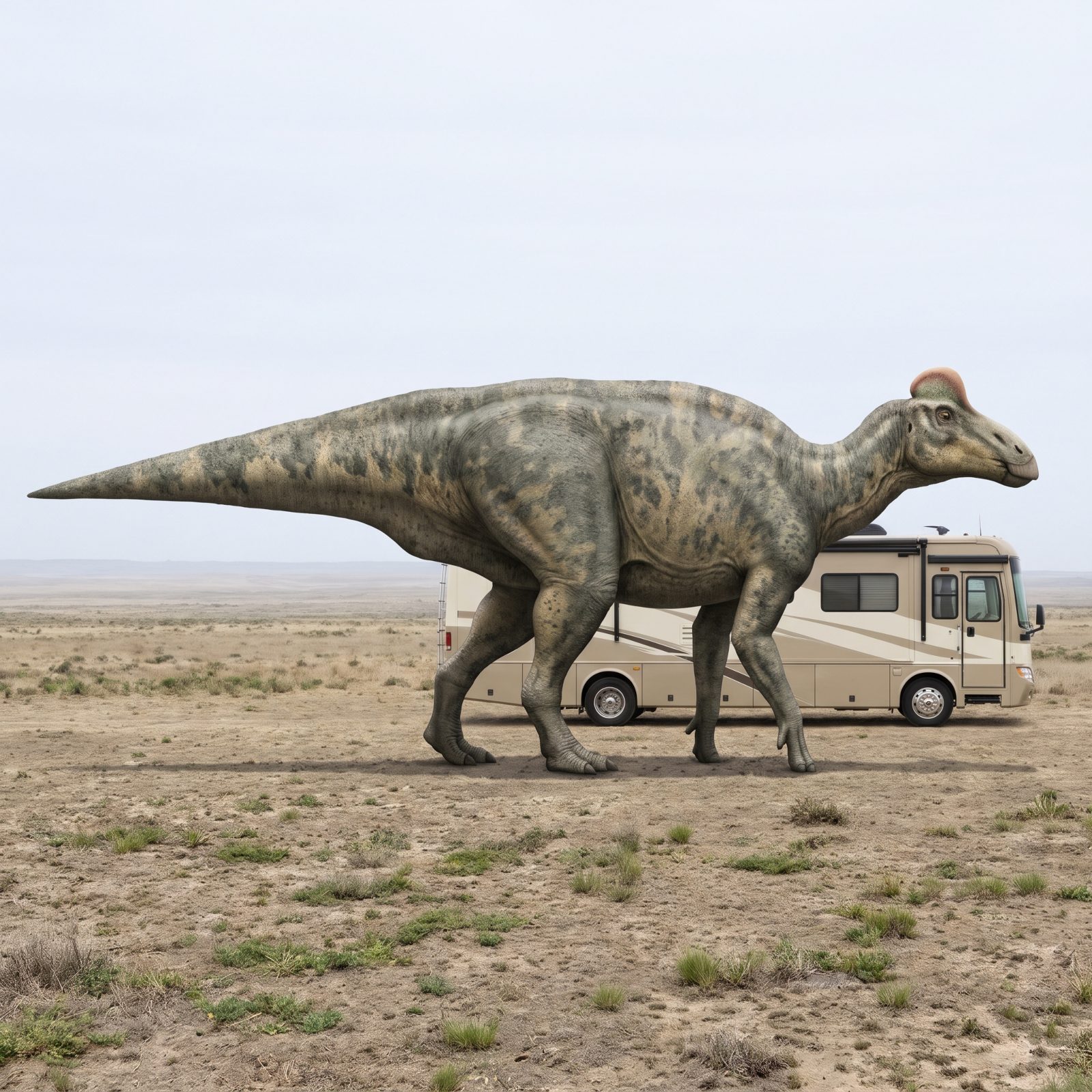
Roughly as long as a full-size RV, adults reached about 12 meters, Late Cretaceous, with abundant fossils across Alberta and the American West. Edmontosaurus traveled in herds and died in them too, which is why we have so many.
And here’s the mouth that rewrote what we thought dinosaurs could do. Edmontosaurus packed hundreds of teeth into grinding batteries, constantly replaced, capable of pulverizing tough plants like no reptile today. One specimen even preserved a fleshy comb on its head — a crest nobody expected, because soft tissue almost never survives. We’d been drawing it bald for a century. One lucky fossil gave it a crown.
6. Iguanodon Measured Against a Farm Tractor
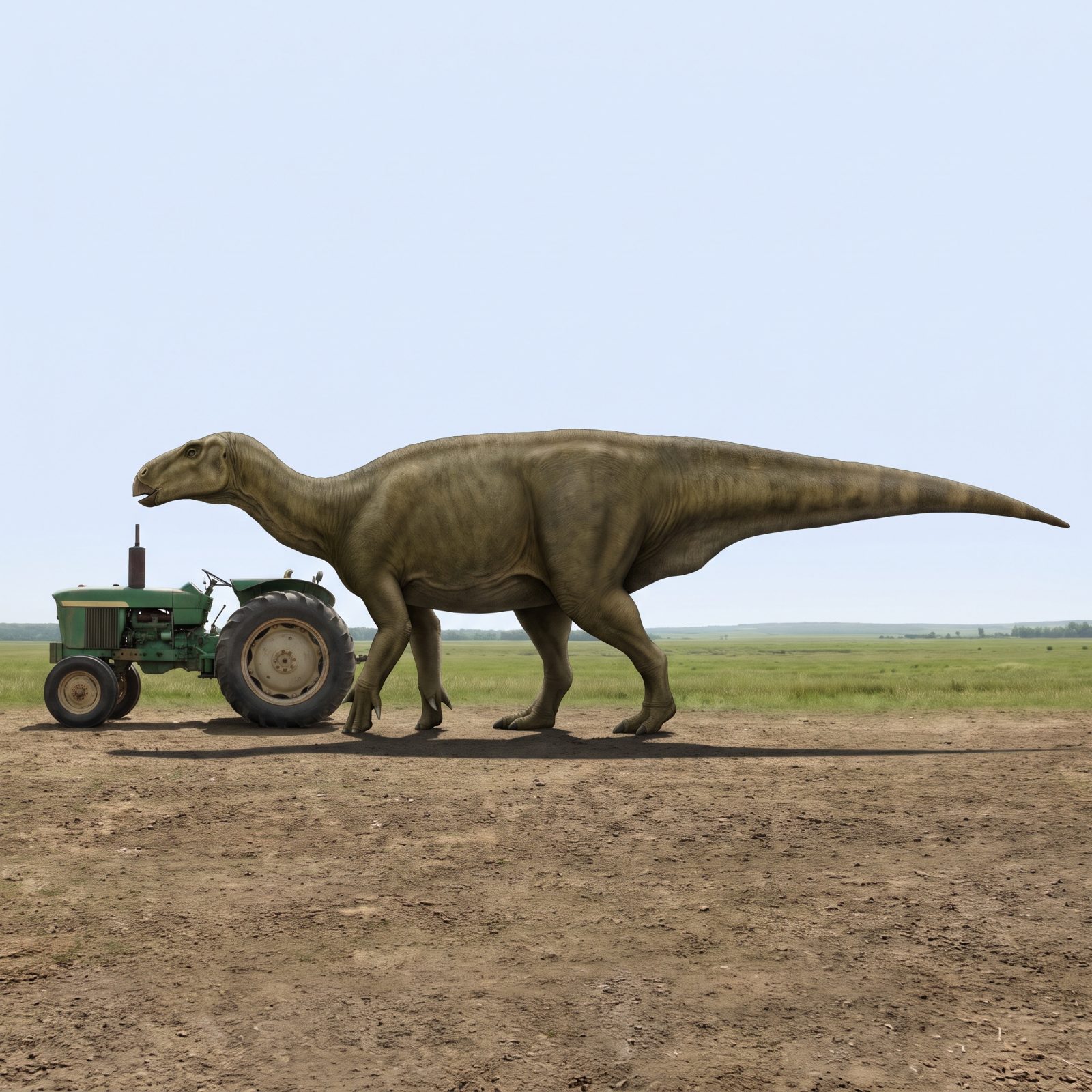
Iguanodon has the most charming case of mistaken identity in all of palaeontology. When the first bones turned up in England in the 1820s, Early Cretaceous, the thumb spike got stuck on the nose like a rhino horn. Early museum reconstructions proudly displayed it there, and for decades Iguanodon wore its thumb on its face.
We know better now. The spike was a weapon or a tool, jutting from the hand of an animal several times the length of a farm tractor, around 10 meters. The famous Belgian find at Bernissart in 1878 produced dozens of near-complete skeletons from a coal mine — still one of the great fossil hauls in history.
5. Dryosaurus Compared to a Longboard Surfboard
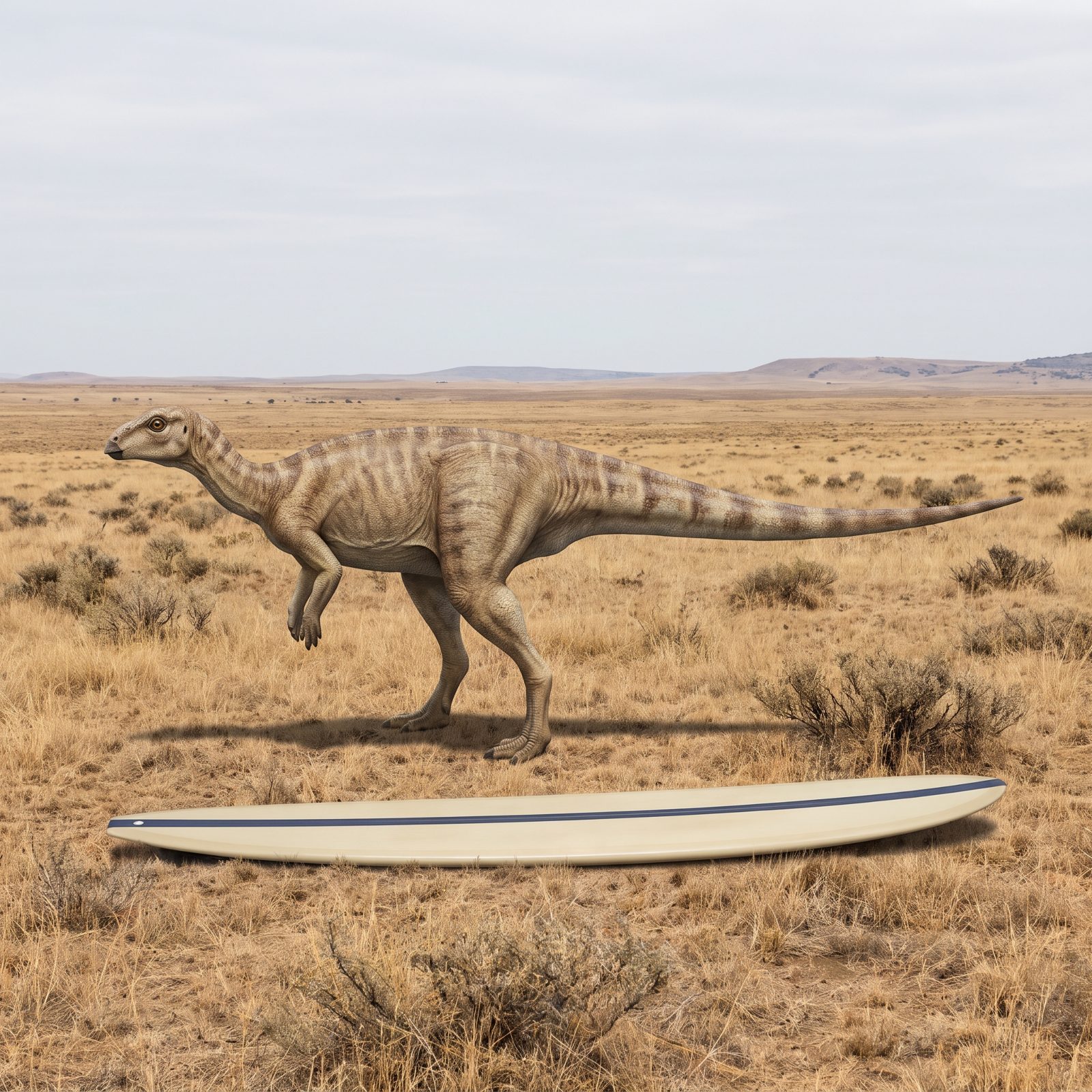
Finally, a dinosaur you could outrun a parking ticket with. Dryosaurus was small, about 3 meters, roughly the length of a longboard, and Late Jurassic, from the Morrison Formation in the American West.
No armor, no horns, no weapons at all. Its whole survival strategy was legs — long shins, light build, a stiff tail for balance at speed. Picture the gazelle of its world, the animal that ate quietly and sprinted the moment something large looked its way. Not every dinosaur was a tank. Some just planned to be somewhere else.
4. Leaellynasaura Set Beside a Kitchen Broom
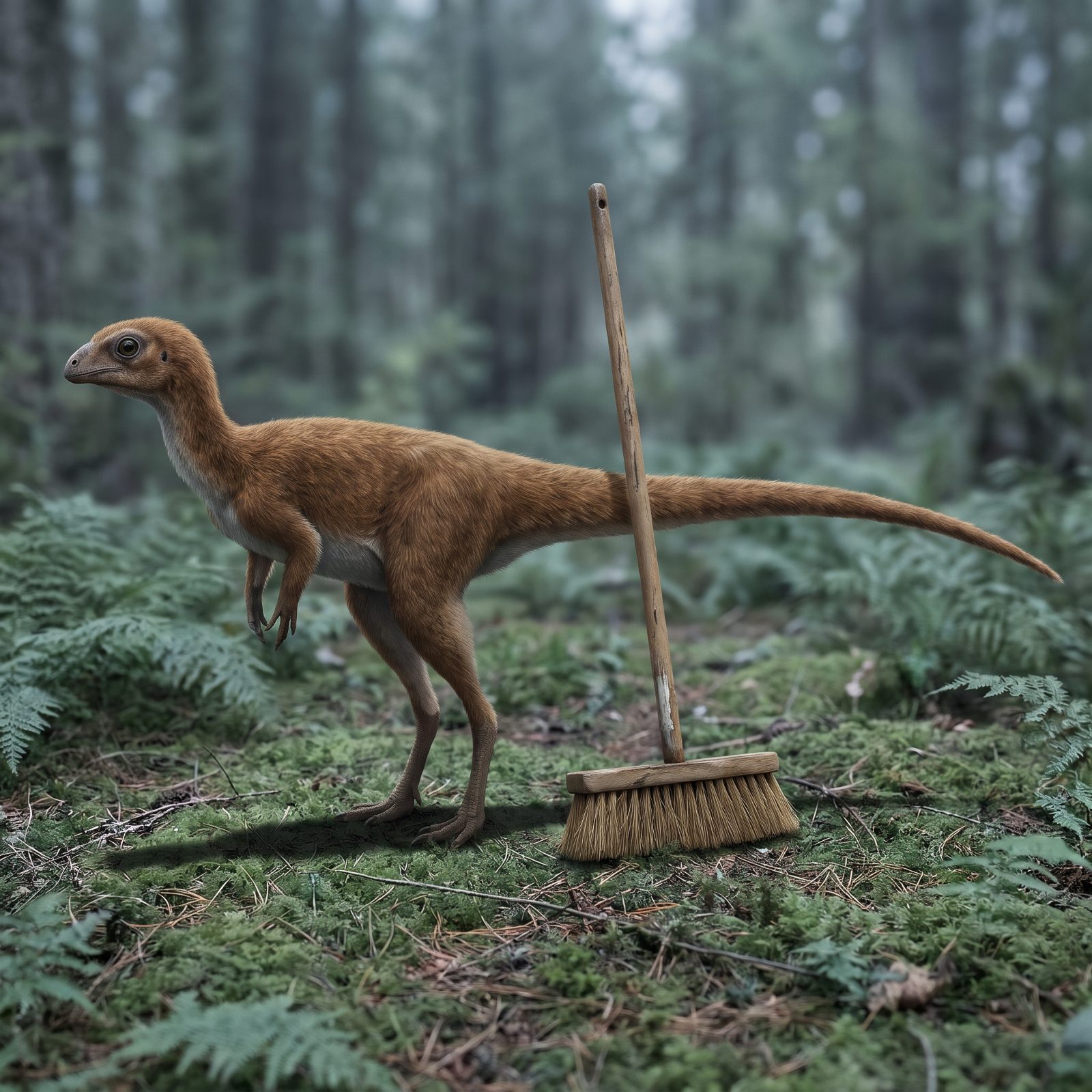
Tiny, feathered, and tougher than anything its size has a right to be. Leaellynasaura was a small ornithischian, broom-height, found in Victoria, Australia, Early Cretaceous. And here’s what makes it extraordinary: back then, the site sat inside the Antarctic Circle.
This little animal lived through polar winters — months of darkness, near-freezing cold, in an age everyone pictures as a steamy jungle. Its large eye sockets suggest it needed to see in that long dark, and the insulating body covering helped it hold heat. Living proof that dinosaurs weren’t all sun-loving swamp giants. Some of them handled conditions that would send a modern lizard into a coma.
3. Pachycephalosaurus Squared Up Against an Upright Piano
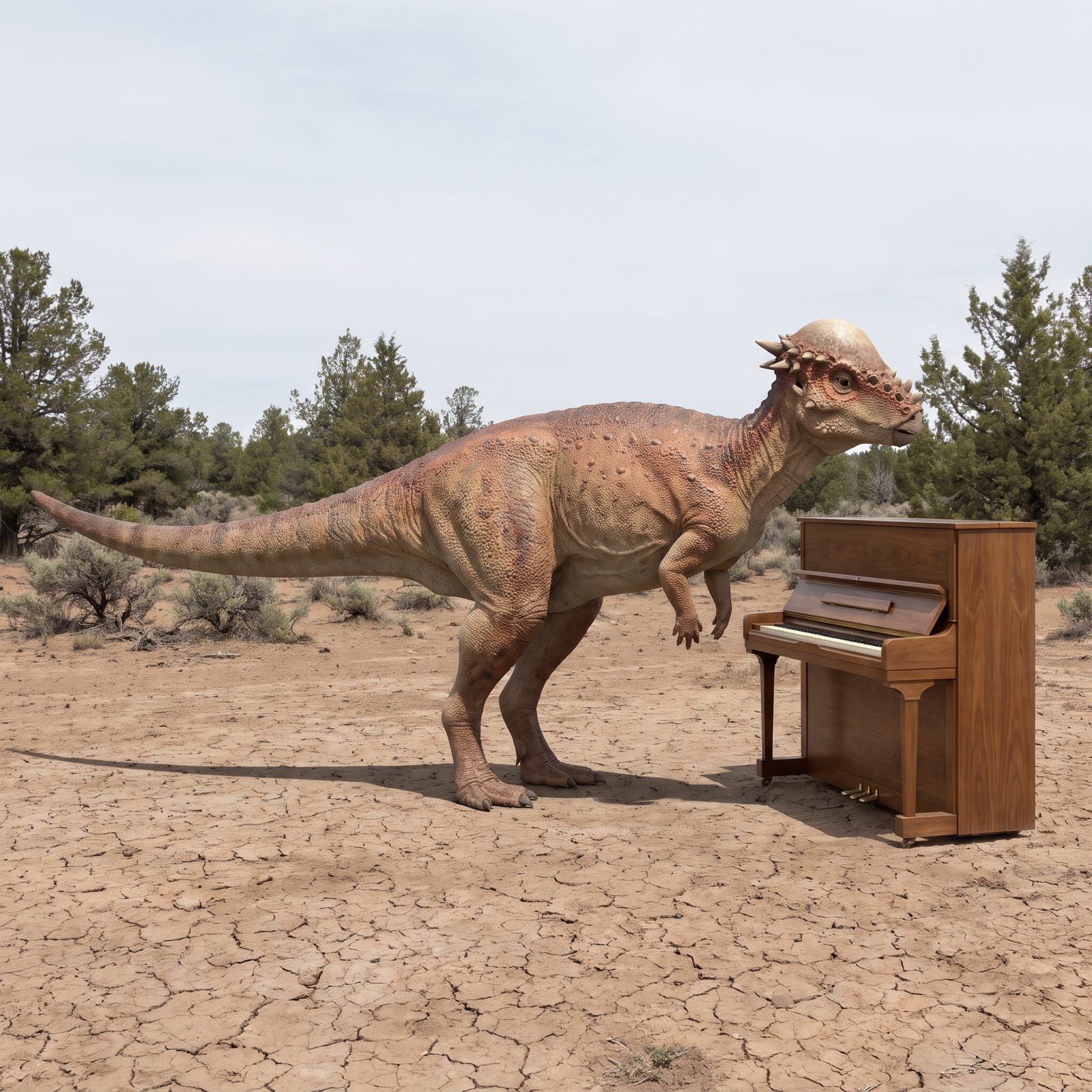
The dome is nine inches of solid bone sitting on top of its head, which is why everyone assumed these animals rammed each other like bighorn sheep. For years that was gospel.
Then came the doubts. Some studies argued the neck couldn’t take a head-on collision without snapping. Others found healed injuries on the domes that looked exactly like combat damage. The current read lands somewhere in the middle: flank-butting and shoving, more sparring than full charges. About piano height and a little longer, Late Cretaceous, from Montana, Wyoming and South Dakota. A thick-skulled animal walking around in a crash helmet it may or may not have been allowed to use.
2. Shantungosaurus Towering Over a Railroad Boxcar
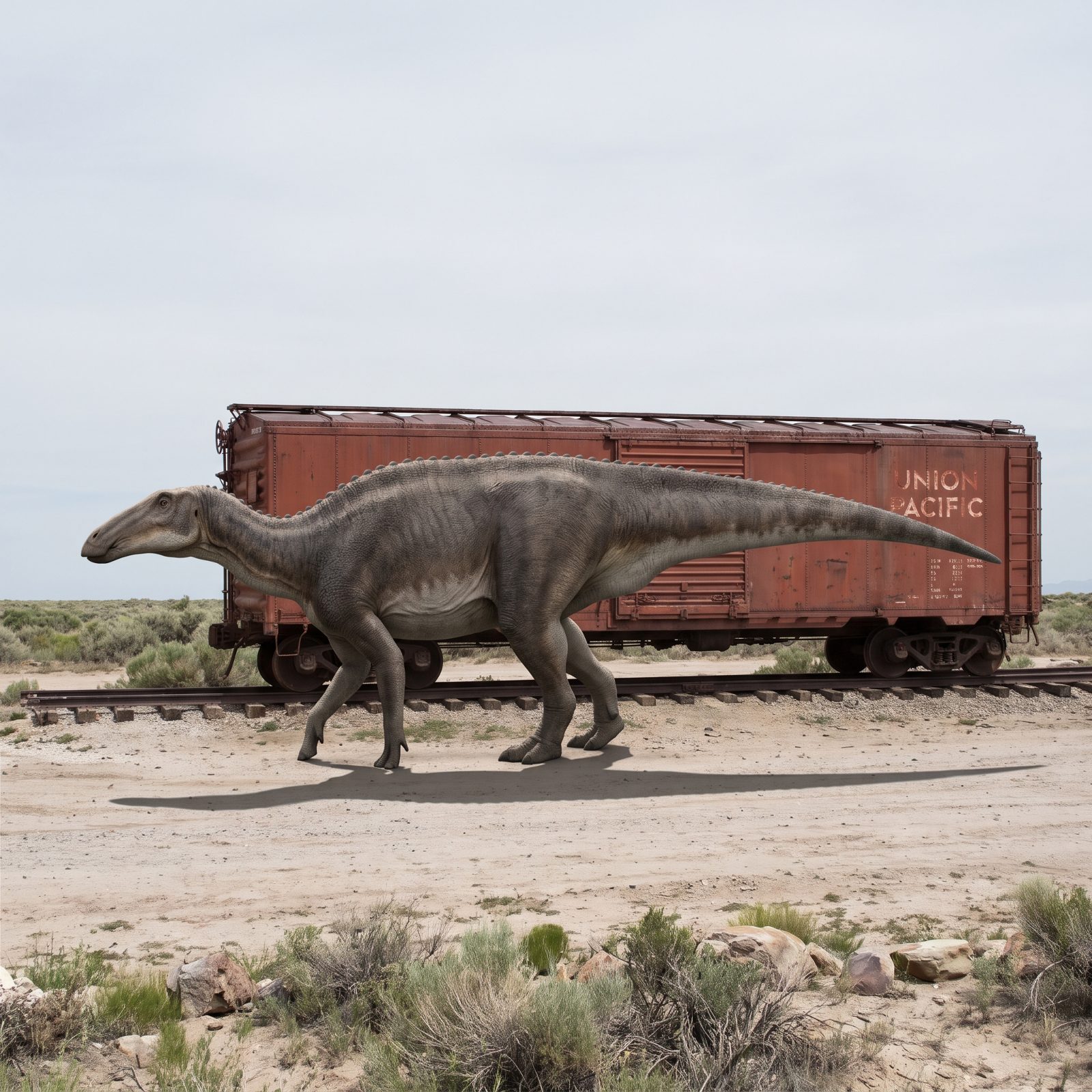
Now the giant of the duckbills. Shantungosaurus is one of the largest duck-billed dinosaurs ever found, running 15 to 16 meters, shown here at roughly the length of a railroad boxcar with its back reaching roughly the height of the car’s roof, Late Cretaceous, from Shandong Province in China.
What breaks the brain is that this wasn’t a long-necked sauropod built for size. It was a hadrosaur — the same basic design as the duck-billed grazers you picture nibbling plants, scaled up to monstrous proportions and carrying thousands of grinding teeth. No armor, no weapons. At that size, it didn’t need any. Standing as tall as a train car is its own kind of defense, and nothing in its world was big enough to make a serious go of it.
1. Tyrannosaurus Rex Beside a Single-Story Ranch House
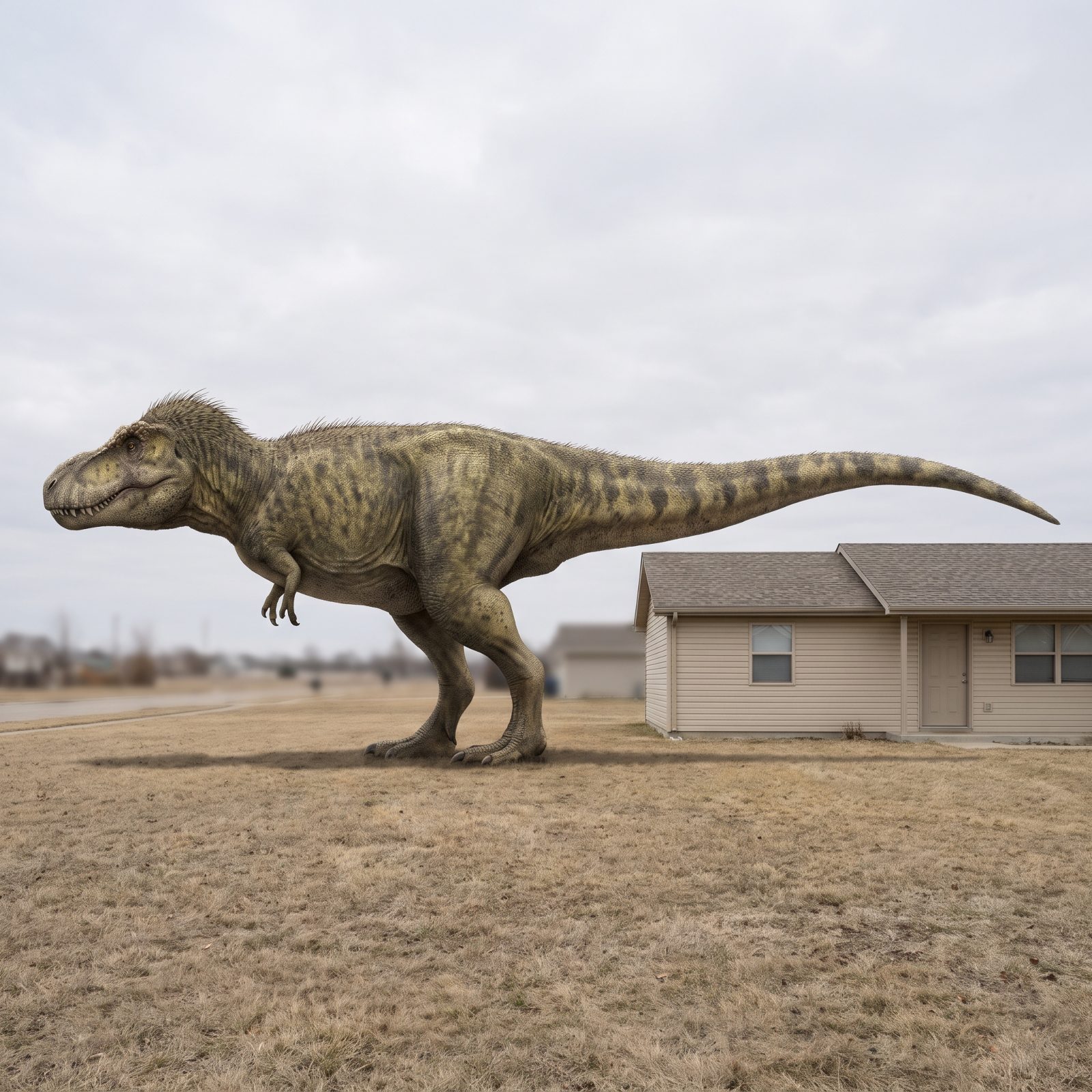
A full-grown T. rex would look your roofline in the eye and keep going. Take Sue, the famous specimen in Chicago and the best-preserved one we’ve got: about 40 feet long, standing roughly 12 to 13 feet tall at the hip. Park that animal next to a one-story ranch house and its back sails clean over the eaves.
Here’s where most people go sideways. They imagine a tail dragging through the dirt and a body hauled upright like a kangaroo at a bus stop. Both wrong. The spine ran flat and level, head and tail balanced over the hips like a seesaw mid-tilt. As for those arms everybody snickers at? Strong enough to curl a grown man without breaking a sweat.