
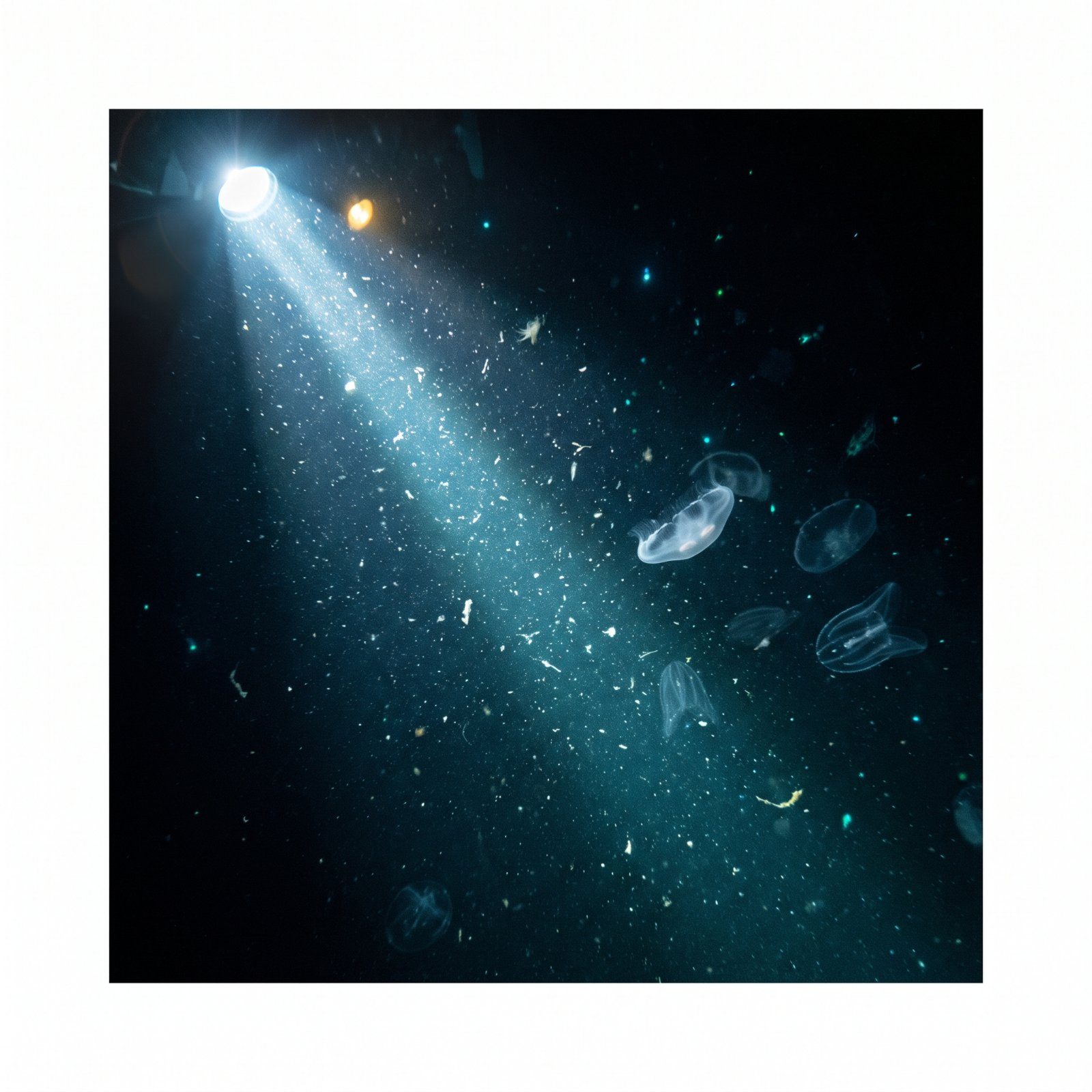
Sunlight gives up around 3,000 feet down. Below that sits the largest habitat on Earth, and nobody really lives there except animals that look like mistakes nature decided to keep. A fish with a see-through forehead. A shark whose jaw fires out of its face like a trap. A squid that would rather hug its prey than chase it. None of these are science fiction — every one has been filmed, hauled up, or logged by a submersible, and the real anatomy is stranger than anything an artist would dare invent. Come meet the ocean’s deepest residents, the ones that make the surface world look boring.
42. Barreleye Fish With a Transparent Dome for a Head
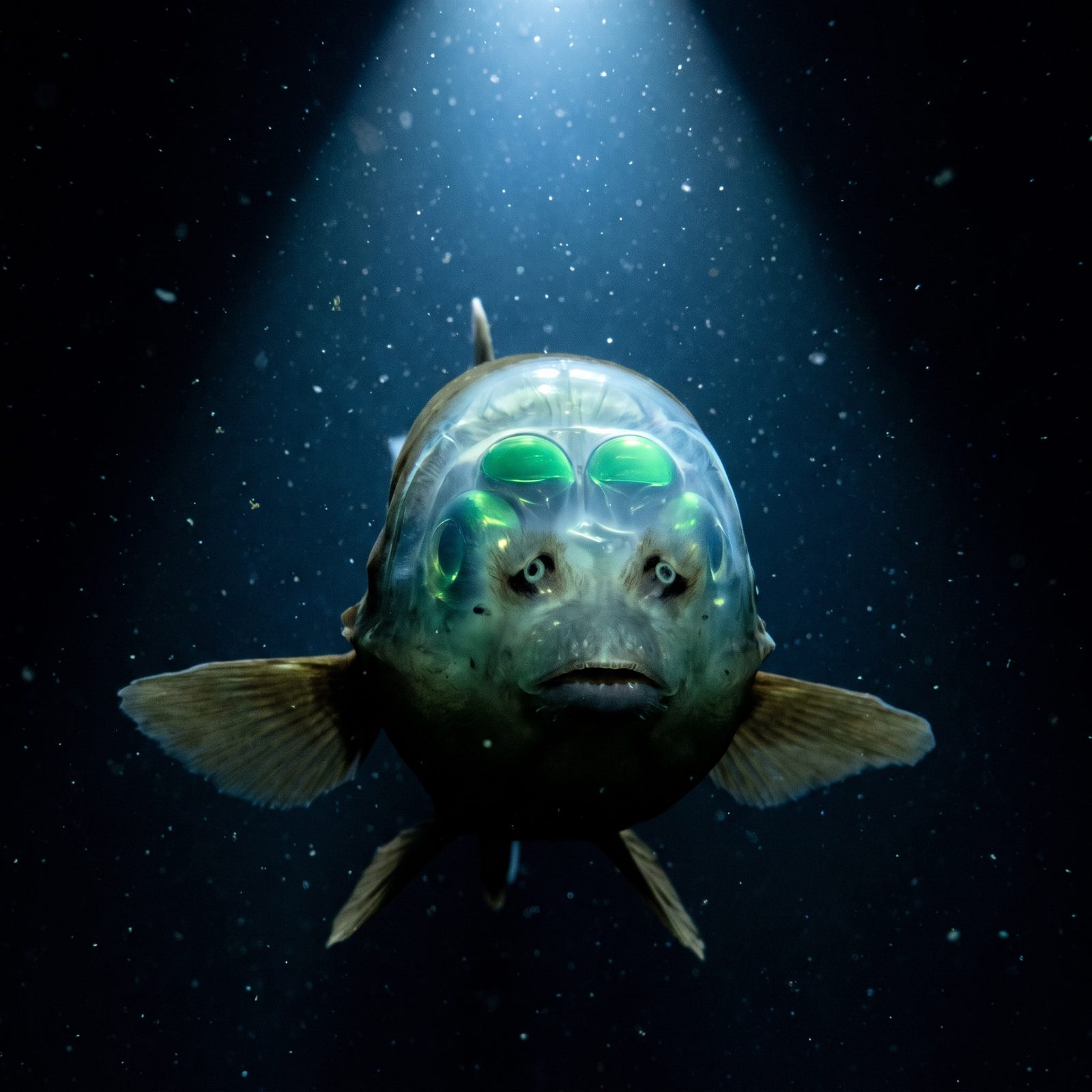
Those two staring eyes on its face are not the whole story. They aren’t eyes at all — they’re nostrils. The real eyes are two glowing green orbs sealed inside that transparent, fluid-filled dome. For a long time nobody saw them intact, because every barreleye hauled up in a net arrived with its delicate head bubble ruptured.
Monterey Bay Aquarium Research Institute finally filmed a living one hovering in place a couple thousand feet down. Its green orbs normally stare straight up, scanning for the faint silhouette of prey against the last trace of light, and when food appears they rotate forward inside the clear shield to track it. You’re looking at a fish that watches the world through a crash helmet.
41. Bigfin Squid With Arms Bent Like Alien Elbows
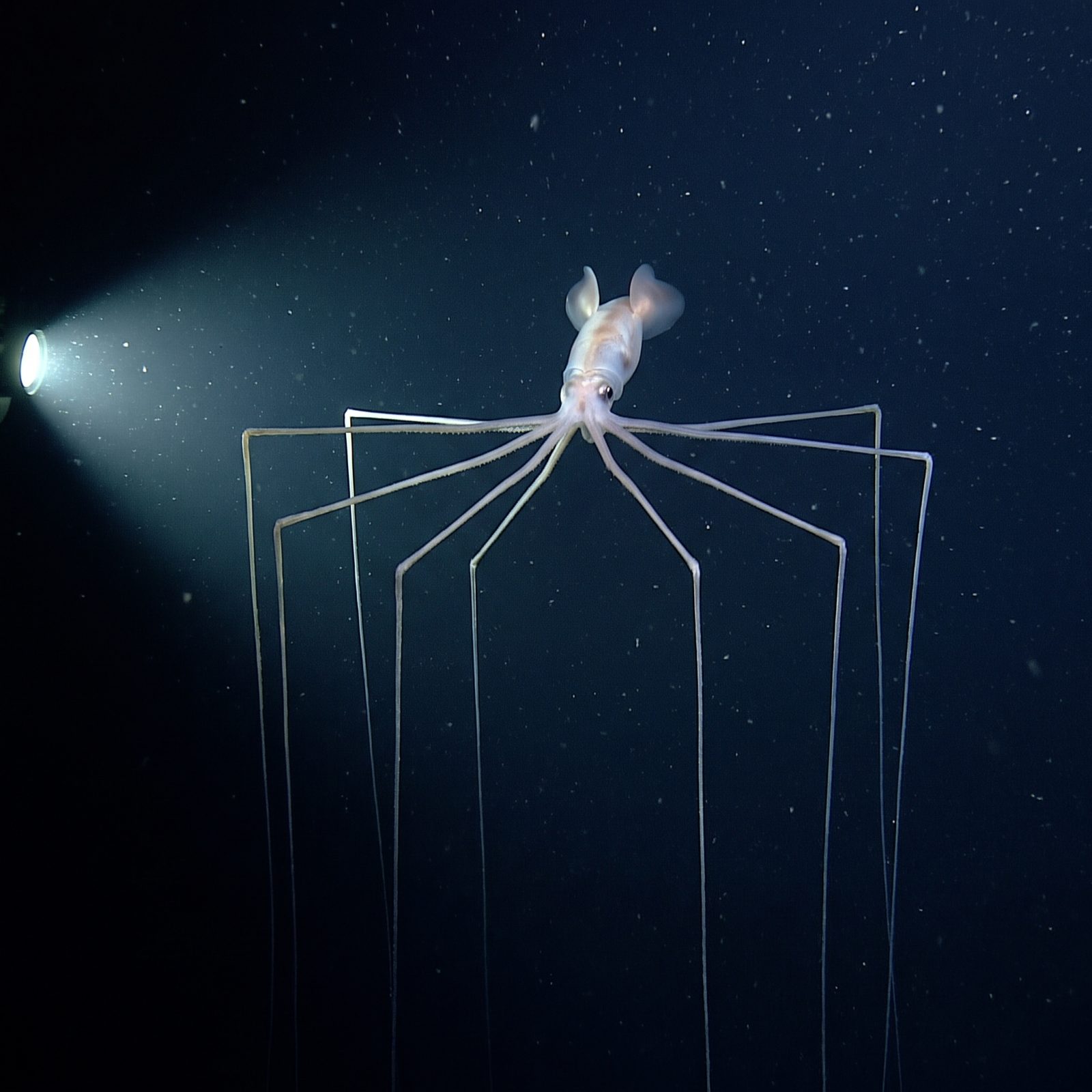
Imagine a squid with legs longer than a giraffe is tall, and all of them bent at the same weird elbow. That’s the bigfin squid, one of the least-seen large animals on the planet. Only a handful of confirmed sightings exist, nearly all from deep-diving submersibles and industrial oil-rig cameras thousands of feet down.
The arms and tentacles run the same length — strange on its own — and they kink out at right angles before dropping into fine trailing filaments many times the body length. Scientists think it drifts and drags those sticky threads to snag passing food. It doesn’t hunt. It fishes, with itself as the lure.
40. Goblin Shark With a Slingshot Jaw
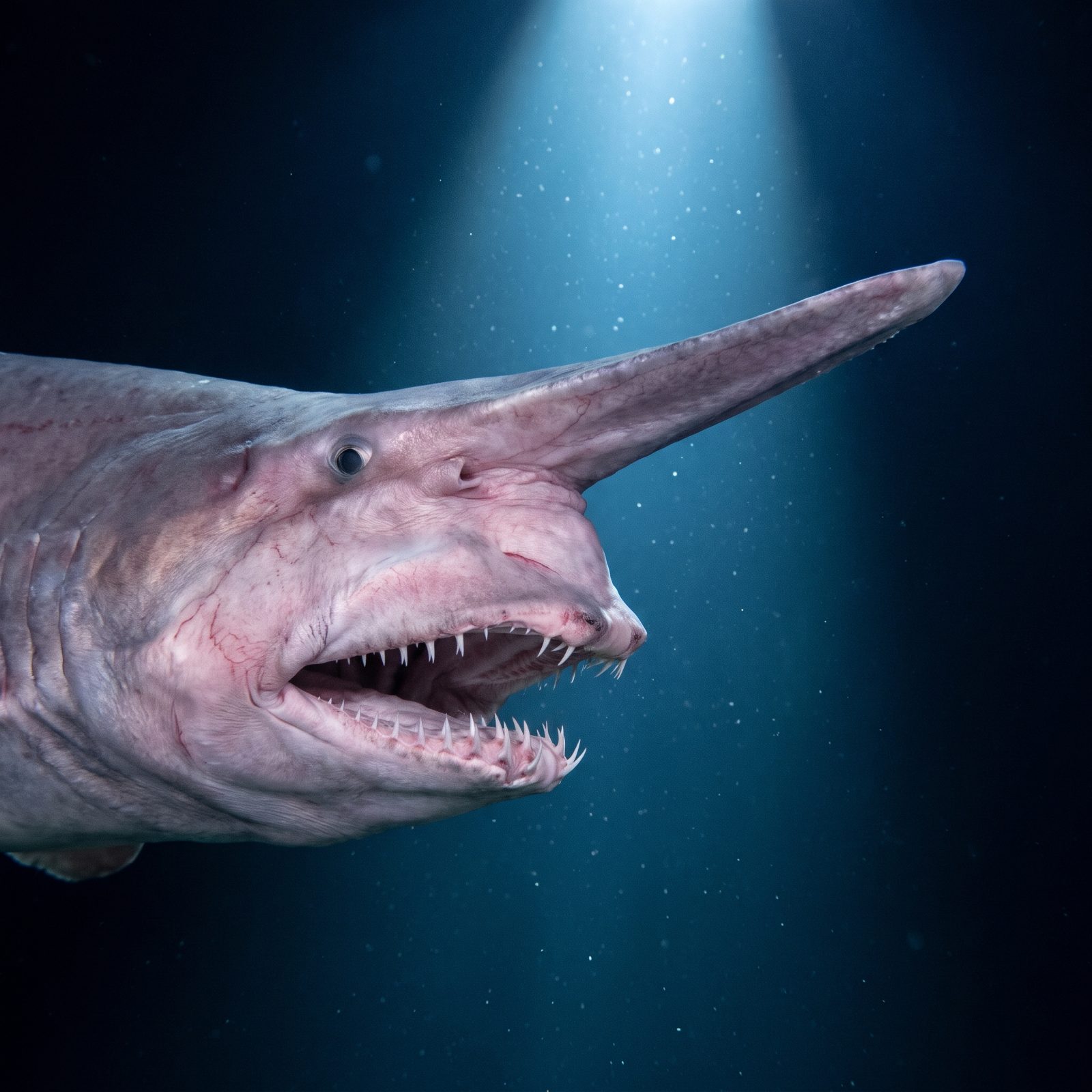
The goblin shark’s face comes apart when it eats. Its jaws hang from stretchy ligaments, so when prey drifts close, the whole mouth rockets forward off the face like a drawer flung open, snatches the meal, and snaps back. High-speed footage clocks it as one of the fastest jaw strikes of any fish.
That pink color isn’t pigment. The skin is so thin and pale you’re seeing the blood vessels underneath. Nicknamed a living fossil, its family line reaches back roughly 125 million years.
39. Giant Phantom Jelly With Ribbon-Like Mouth Arms
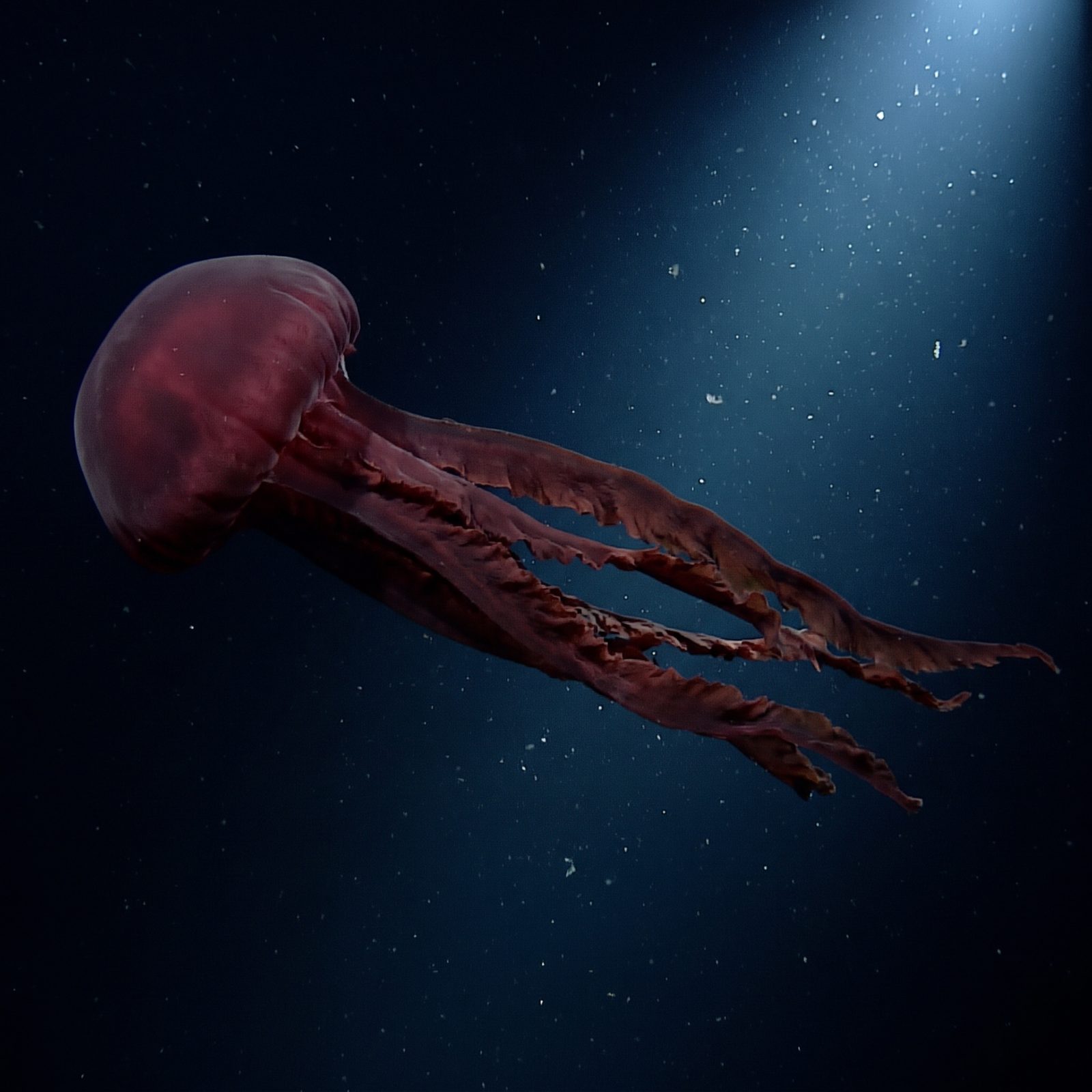
In more than a century of deep-sea exploration, this giant has turned up only around a hundred times. Its bell can span over three feet, and four mouth arms stream behind it like banners torn from a flag, some reaching 30 feet.
No stinging tentacles here. It uses those enormous arms to engulf prey and reel it in. The animal lives in cold, crushing darkness worldwide, yet somehow stayed nearly invisible to us until submersibles started lingering long enough to catch one drifting past.
38. Pelican Eel With a Mouth Bigger Than Its Body
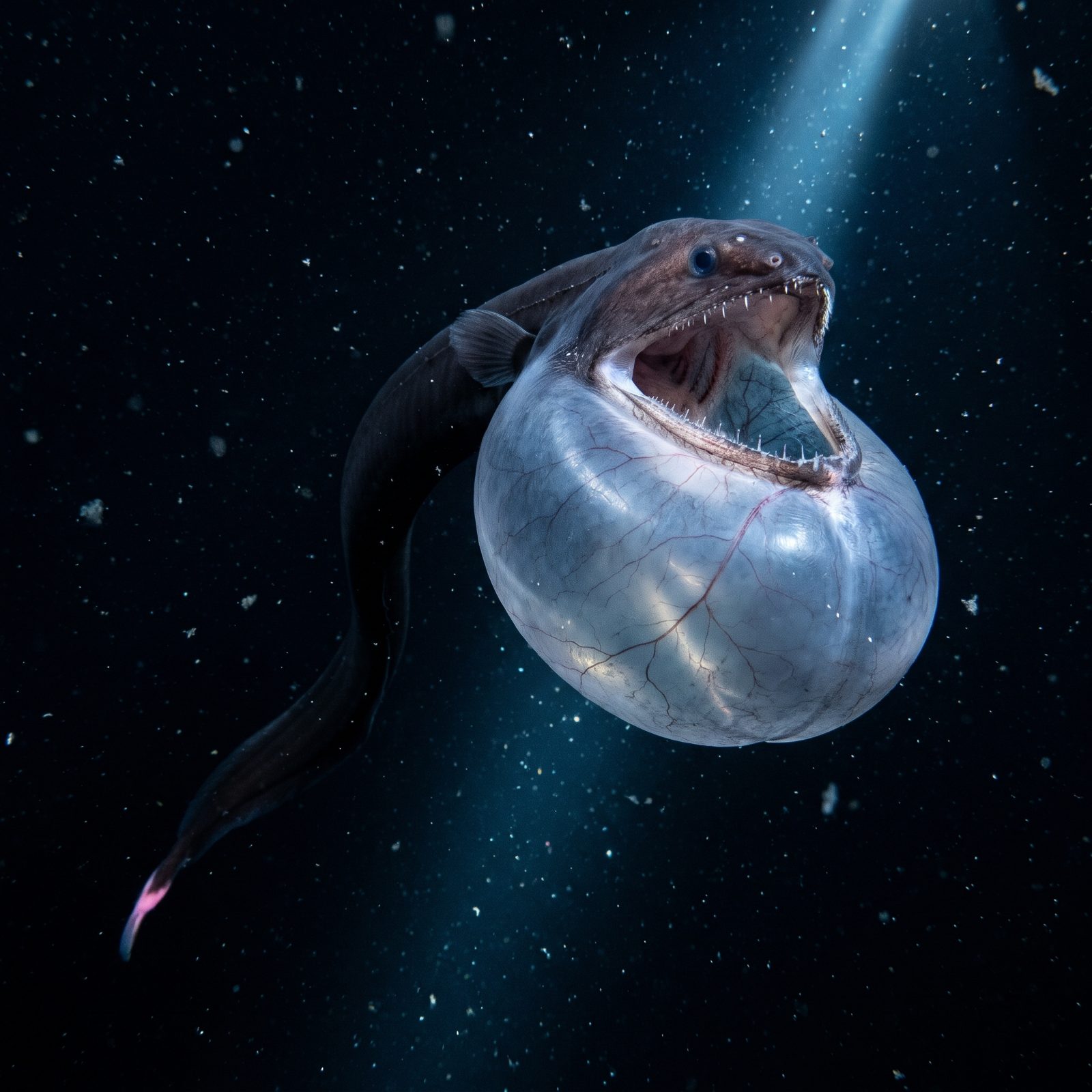
When an EV Nautilus expedition filmed a pelican eel in 2018, the crew’s audible gasp went viral. The animal had inflated its mouth into a pale, translucent grey-white balloon many times the width of its pencil-thin body, then deflated it back into a slim ribbon before swimming off. Plenty of people online swore the footage was faked.
That hinged, pouch-like jaw lets it gulp prey far larger than its throat would suggest, though it mostly eats small crustaceans. A tiny glowing lure sits at the tip of its long whip tail. Big mouth, small appetite, strange plan.
37. Frilled Shark Resembling a Prehistoric Sea Serpent
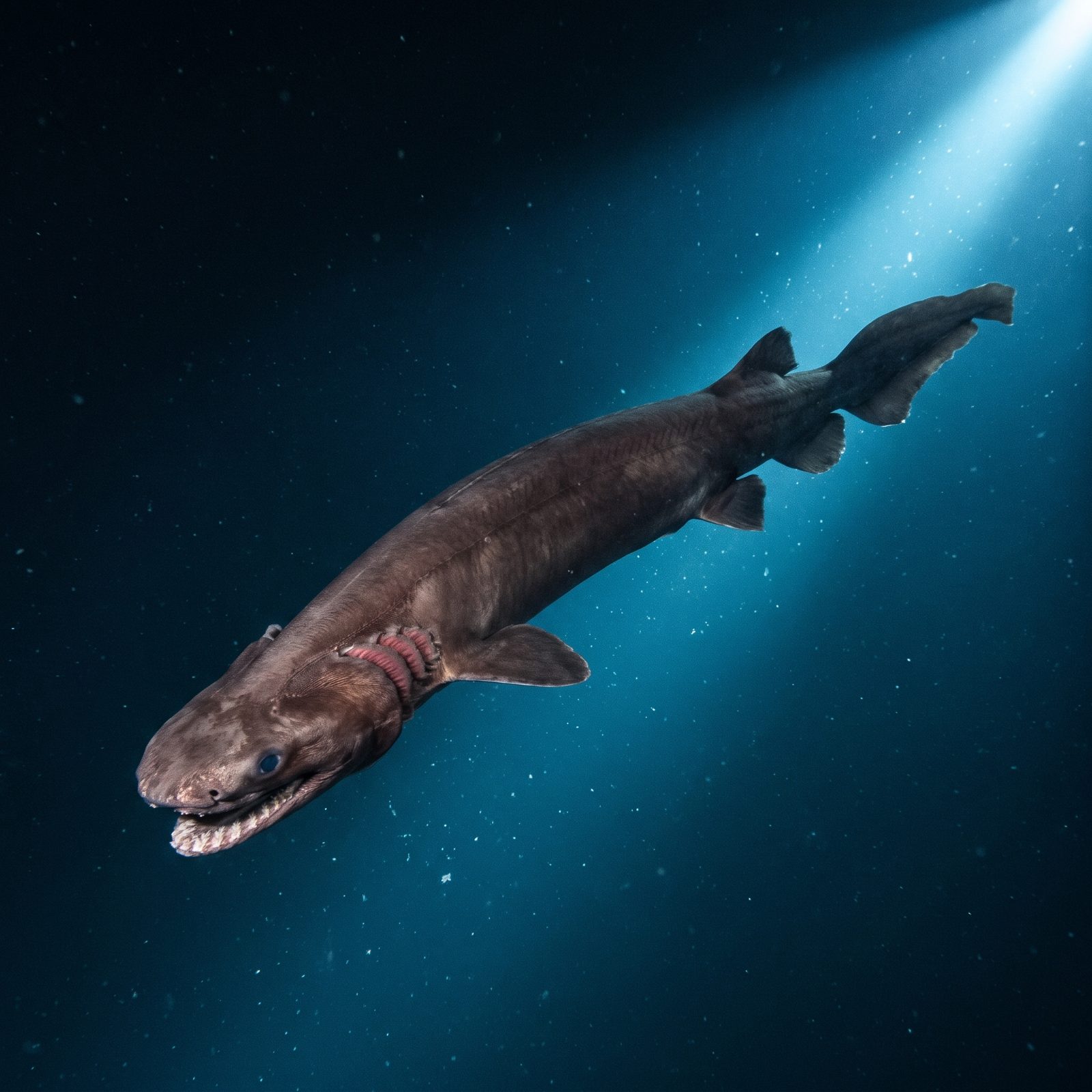
You could mistake this for a sea serpent, and sailors probably did. The frilled shark has a long, snaking body, six ruffled gill slits that look like frilly collars, and a mouth packed with roughly 300 teeth arranged in curved three-pronged rows — each one a tiny trident built to grip soft, slippery prey.
It swims by undulating like an eel and may strike by lunging forward like a snake. Rarely seen alive, it mostly turns up as an accidental catch. Its body plan has barely budged in millions of years, which is why people keep calling it a relic from the age of dinosaurs.
36. Deepstaria Jellyfish Shaped Like a Floating Plastic Bag
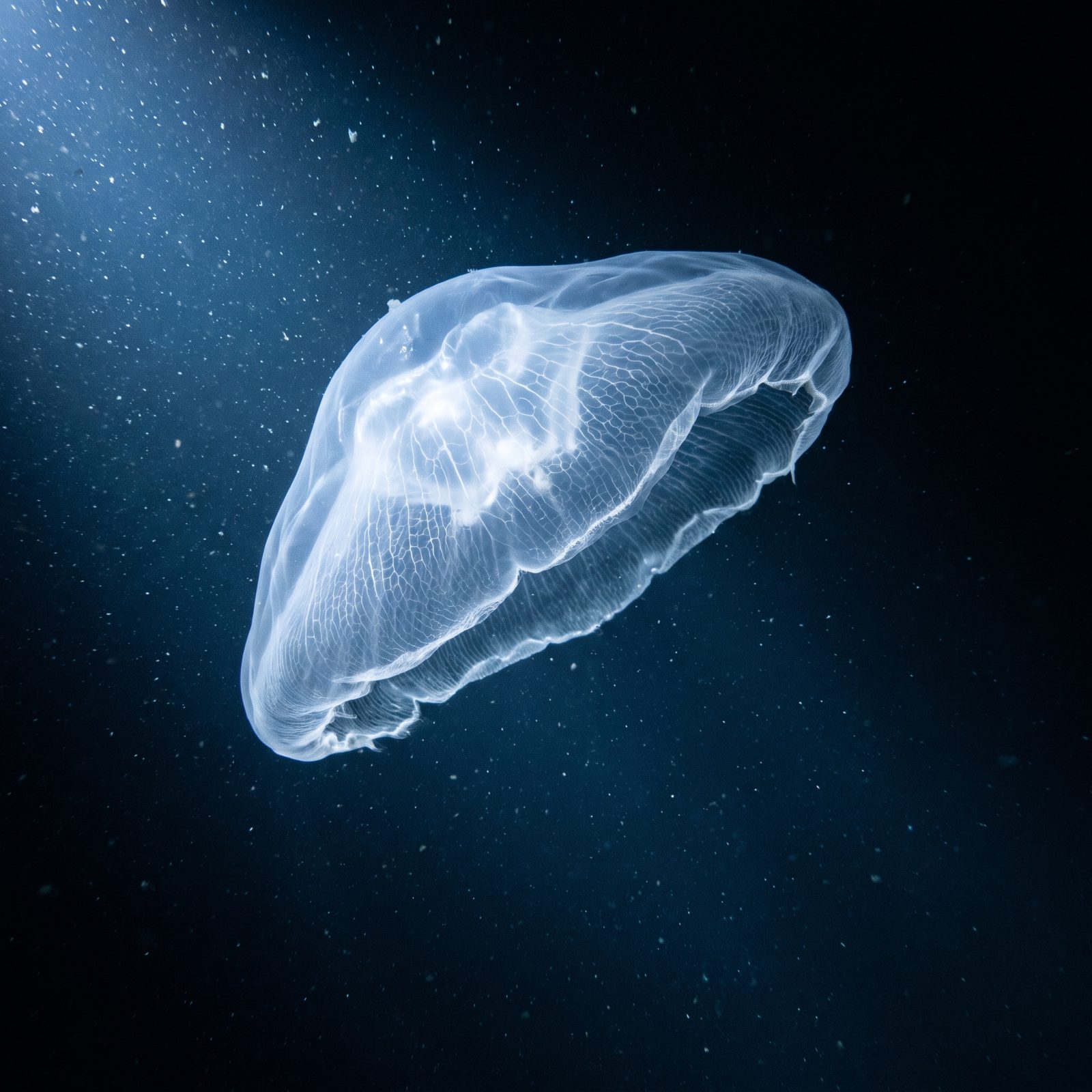
More than one submersible pilot has radioed up that they’d spotted a plastic bag in the deep sea, then watched it unfurl and swim. Meet Deepstaria. Its thin, sheet-like bell billows open and folds shut like laundry on a line, crossed by a branching web of canals that looks eerily like veins.
Instead of a fringe of stinging tentacles, it uses that broad membrane almost like a net, closing around whatever drifts inside. Harmless, slow, and deeply unsettling the first time you see one. The resemblance to our own trash is the part that sticks with people.
35. Vampire Squid Wrapped in a Spiny Black Cloak
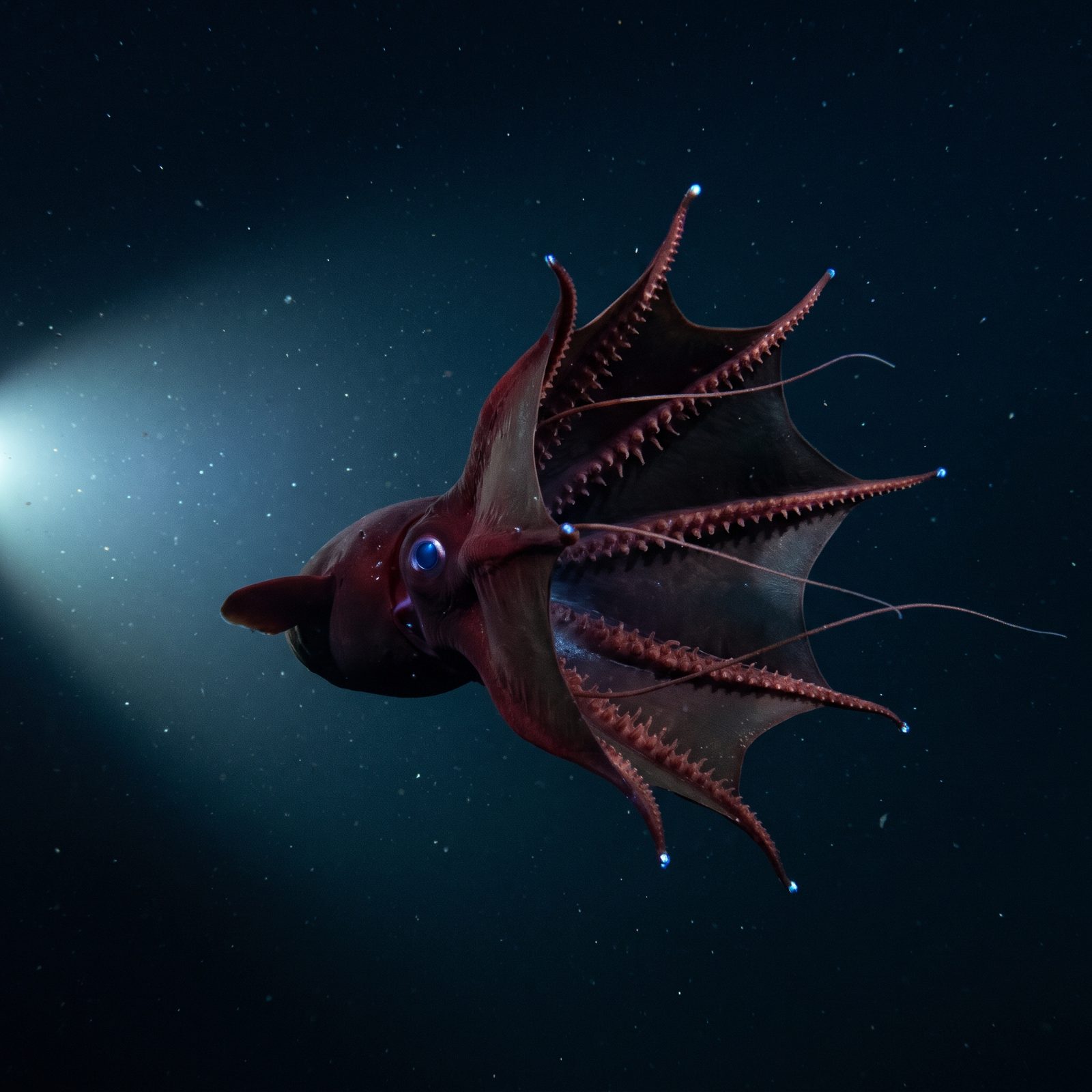
The name oversells the menace. A vampire squid eats marine snow — flakes of dead plankton and debris sifting down from above — which it collects on two sticky filaments. No blood-sucking anywhere in the job description.
When threatened it turns its webbed arms inside out and pulls them up over its body like a spiny cloak, hiding the soft parts behind a wall of harmless fleshy spines. It can’t squirt ink the way shallow squid do. Instead it releases a glowing cloud of bioluminescent mucus to dazzle attackers while it slips away. And it thrives in low-oxygen water that would suffocate almost anything else.
34. Giant Isopod Resembling an Armored Underwater Pill Bug
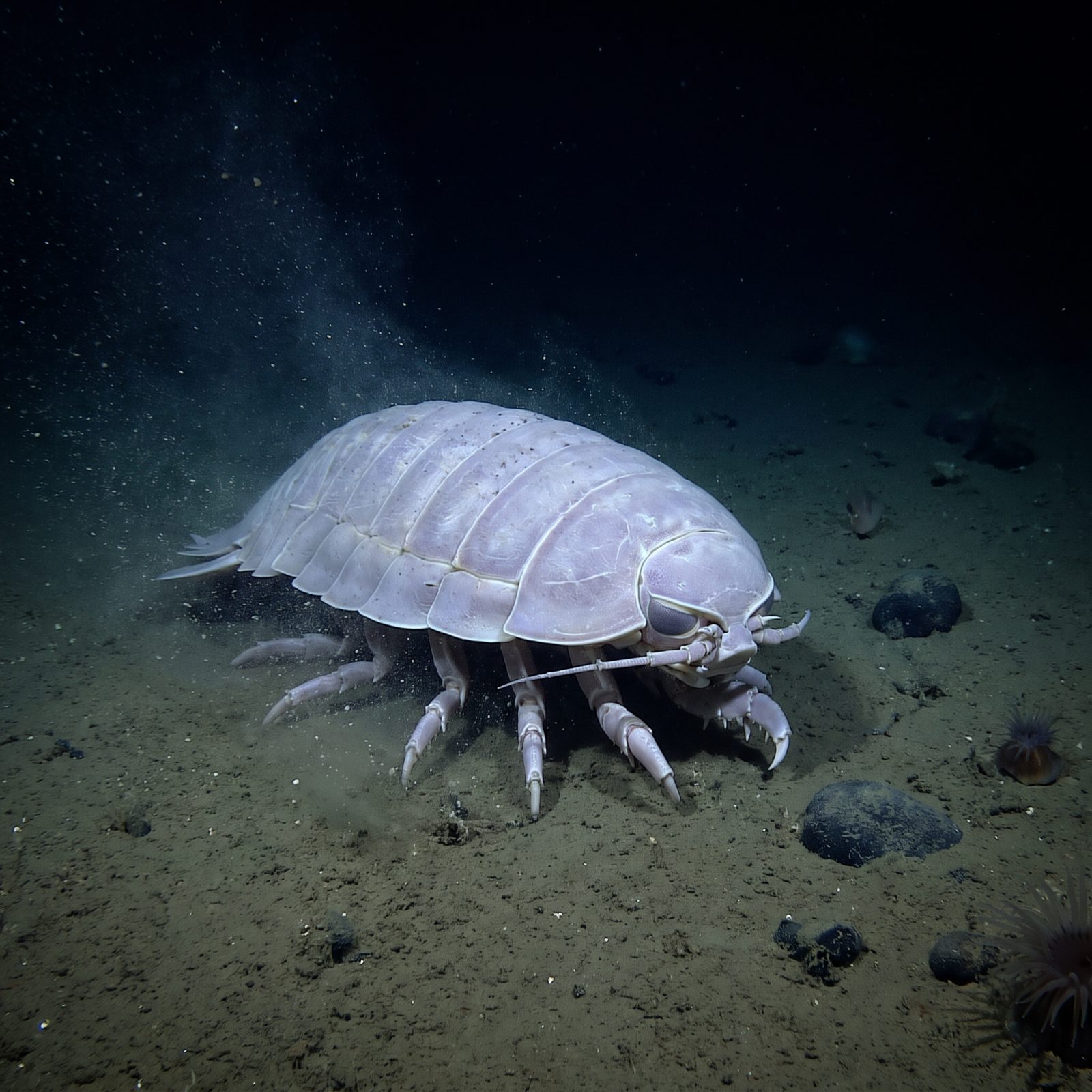
Picture a pill bug from your garden, then scale it up to roughly the size of a house cat. The giant isopod is a real crustacean, a distant cousin of shrimp and crabs, and the biggest stretch up to about a foot and a half long. They wear armor plating like tanks and curl into a ball when threatened, same trick as the backyard version.
Down on the abyssal plain, food is scarce, so these scavengers go remarkably long between meals. One kept in a Japanese aquarium reportedly refused food for over five years and survived. Then a whale carcass sinks, they swarm it, and they gorge until they can barely move.
33. Sea Pig Walking Across the Abyss on Tube Feet
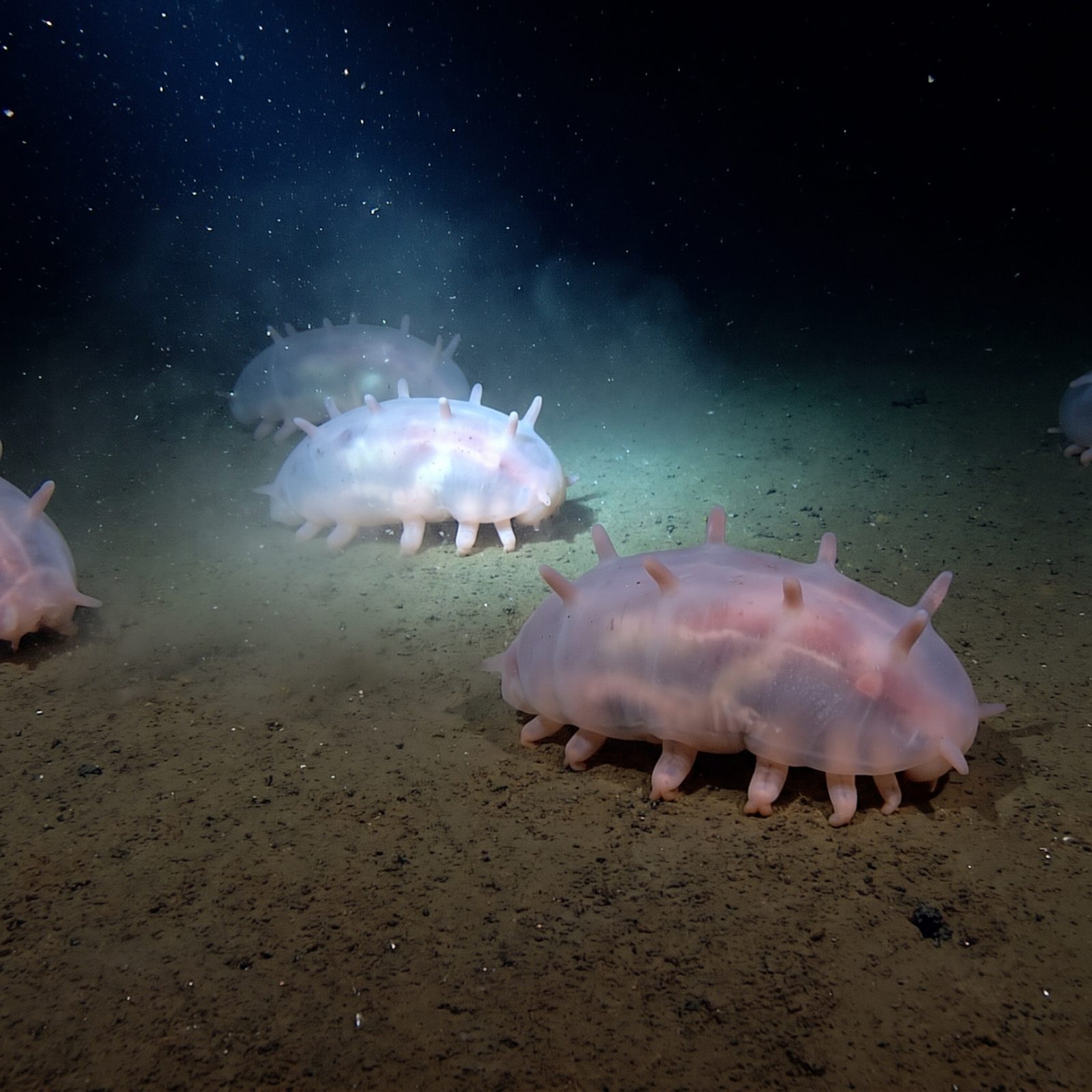
They look like pink balloon animals strolling across the mud, and that’s almost exactly what they are. Sea pigs are sea cucumbers, relatives of sea stars, standing up on enlarged tube feet to walk the deepest ocean floors in herds — sometimes hundreds marching the same direction into the current.
They do one thing beautifully. They eat mud, rooting through the top layer of sediment for the scraps of organic matter that rain down from far above, the cleanup crew of the abyss. Look closely at a captured one and you might spot tiny crabs hitching a ride on its belly for protection.
32. The Yeti Crab That Grows Its Own Dinner on Its Furry Claws
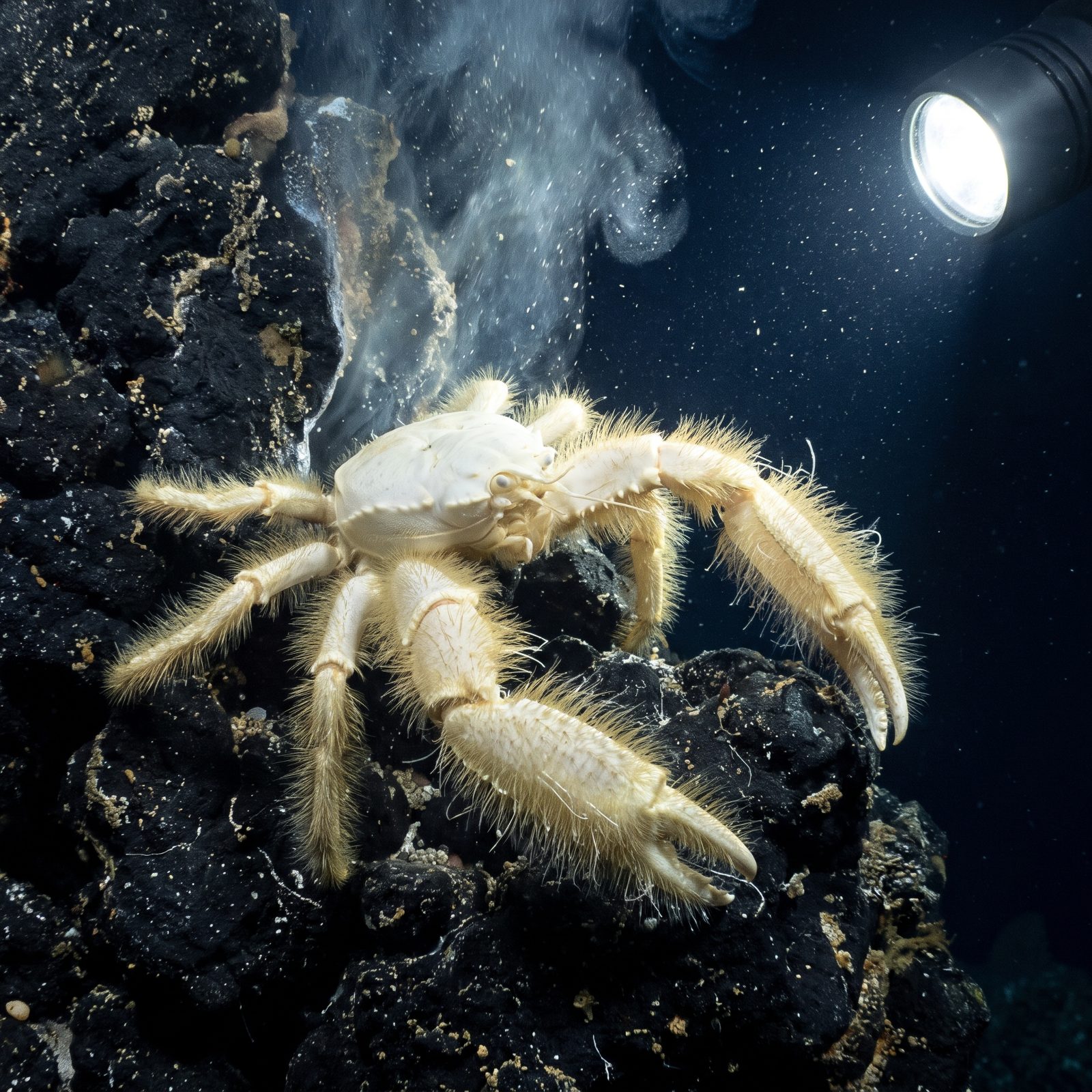
This crab doesn’t hunt. It gardens. Those blond bristles that earned it the Yeti name are living farms. Bacteria grow in the fur, and the crab waves its arms over the warm chemical-rich water pouring out of hydrothermal vents to feed them, then combs the crop off with comb-shaped mouthparts and eats it.
Nobody even described it until 2005, from a vent field near Easter Island nearly a mile and a half down. No working eyes down there, so why bother keeping them? Just a crab raising livestock on its own body, in near-freezing water sitting an inch from fluid hot enough to scald you.
31. The Scaly-Foot Snail Built Like a Tiny Suit of Armor
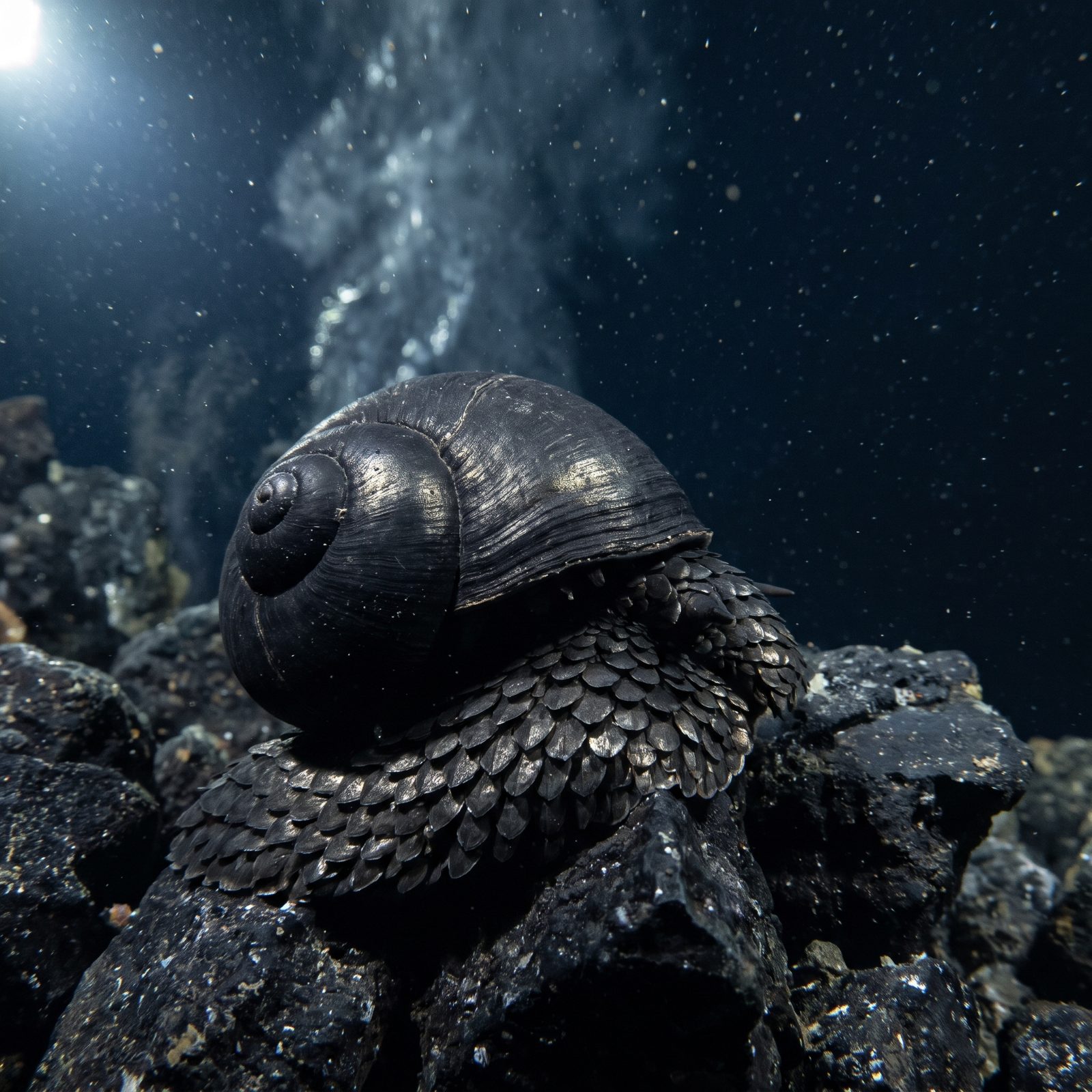
Nothing else on Earth builds a body out of iron. The scaly-foot snail does, out on the hydrothermal vents of the Indian Ocean more than a mile and a half down, armoring itself in iron sulfide. The shell runs three layers deep, and the outer one is magnetic enough to stick to a magnet. Hundreds of mineralized scales clad its soft foot like overlapping chainmail.
Why all the armor? Crabs keep trying to crack it, and the local vent snails hunt with venom. The iron coating absorbs the blow. Militaries have picked the shell structure apart for protective-materials research. And in 2019 the snail became the first deep-sea vent animal declared endangered — threatened by nothing more than the prospect of mining the very vents it calls home.
30. The Headless Chicken Monster Flapping Over the Deep
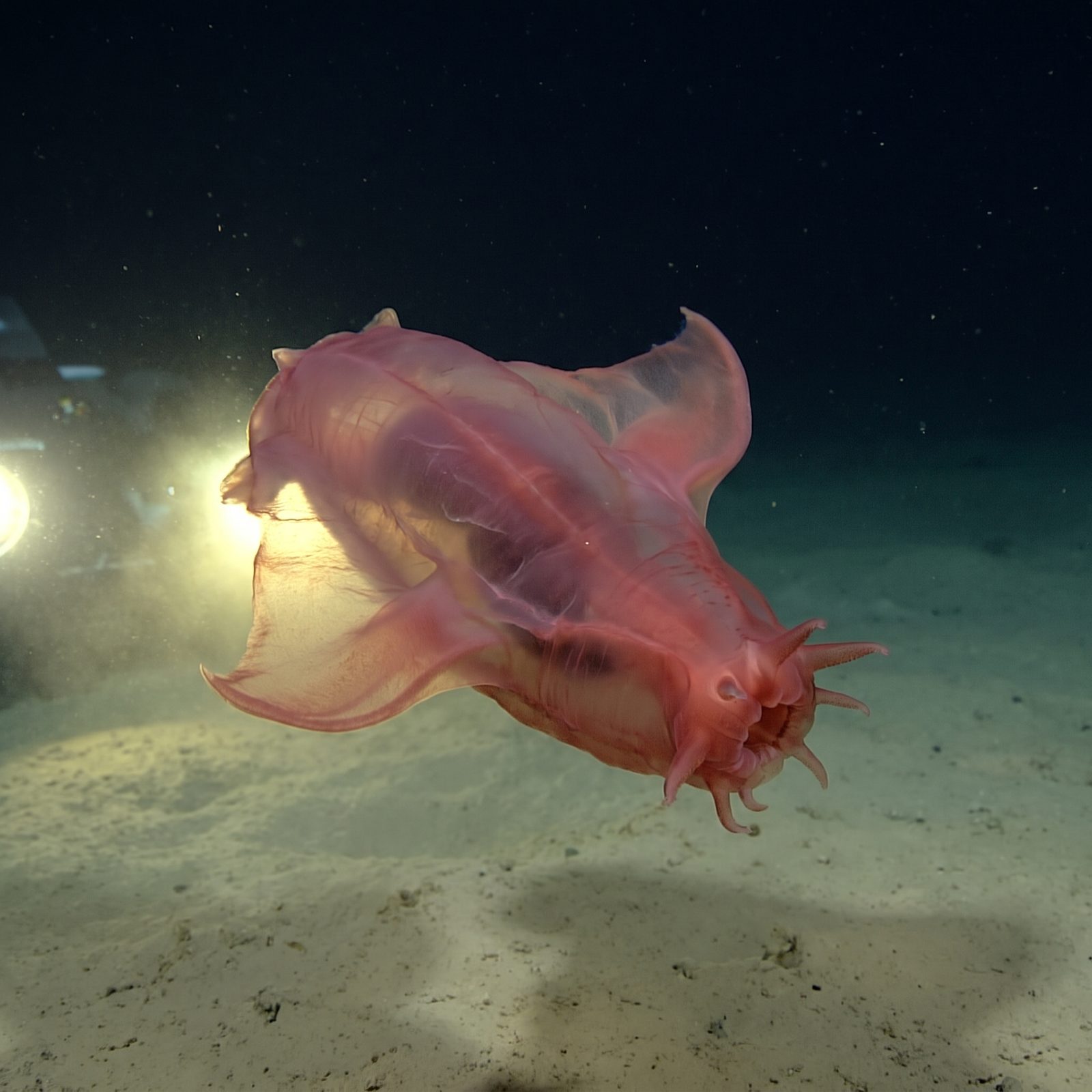
The name is doing a lot of work, and honestly, it fits. The Headless Chicken Monster is a swimming sea cucumber, Enypniastes eximia, and when it lifts off the seafloor and flaps away it looks exactly like a plucked bird with no head gliding through the dark. Cameras caught it near Antarctica in 2018 and the footage went everywhere.
Here’s the part nobody mentions: it’s see-through. Shine a light and you watch its gut glow a deep red, a last meal of mud visible straight through the skin. Threatened, it can shed a glowing cloud of luminous skin — a decoy smeared onto whatever’s chasing it, so the predator lights up and gets eaten instead.
29. The Blobfish That Only Looks Like a Sad Puddle at the Surface
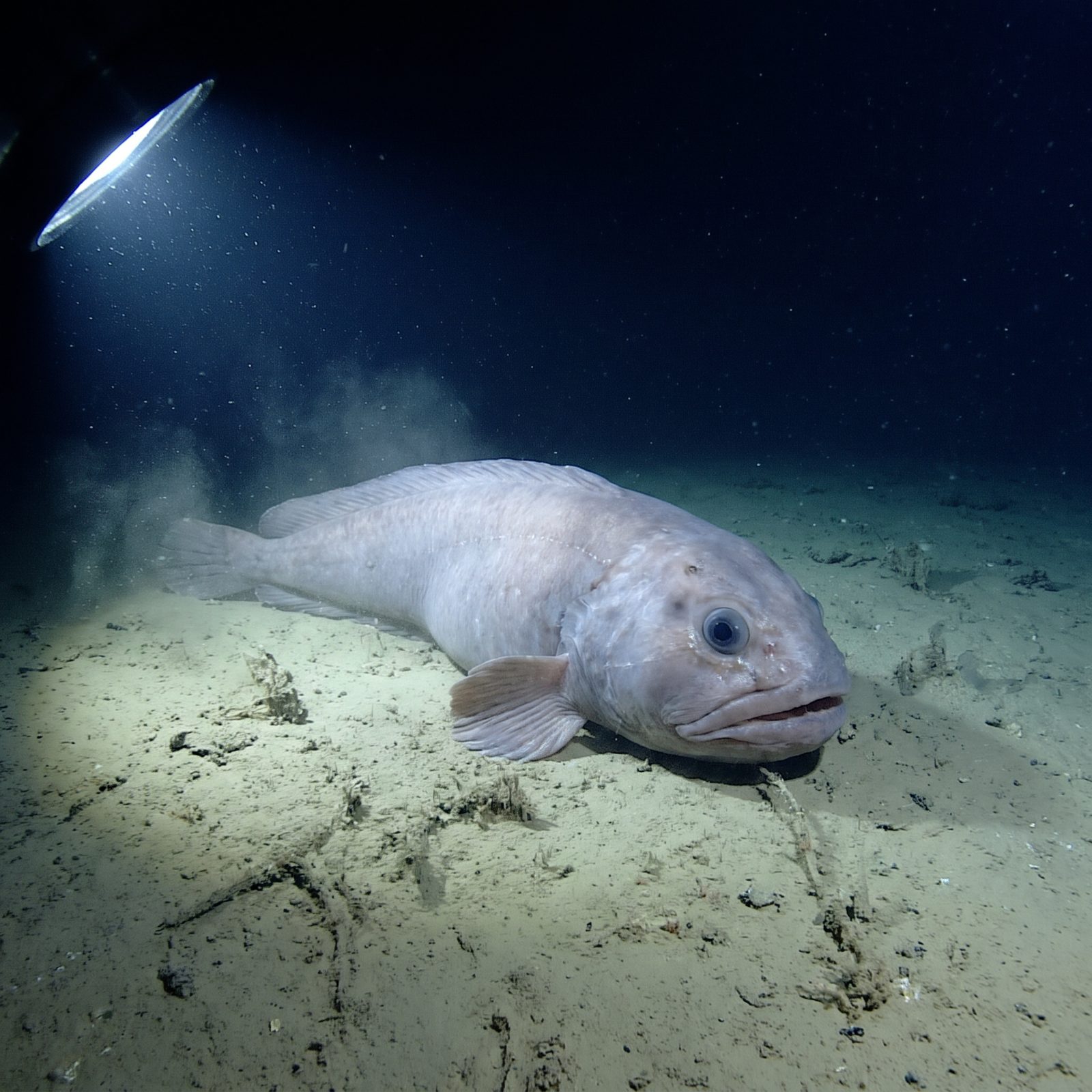
Everyone has seen the photo — the droopy, frowning pink blob voted the world’s ugliest animal back in 2013. Here’s what that contest got wrong. The blobfish doesn’t actually look like that.
Down where it lives off Australia, a couple thousand feet deep, the pressure is many times what you feel standing on a beach, and at that depth the blobfish is a fairly ordinary fish, its soft, nearly boneless flesh held in proper shape by the water squeezing it from every direction. Haul it up fast and that pressure vanishes, so the body deflates into the famous sad puddle. You’ve been laughing at a corpse that decompressed, basically. Down in the deep, it’s just a fish doing fine.
28. The Tripod Fish That Stands on Stilts Made of Its Own Fins
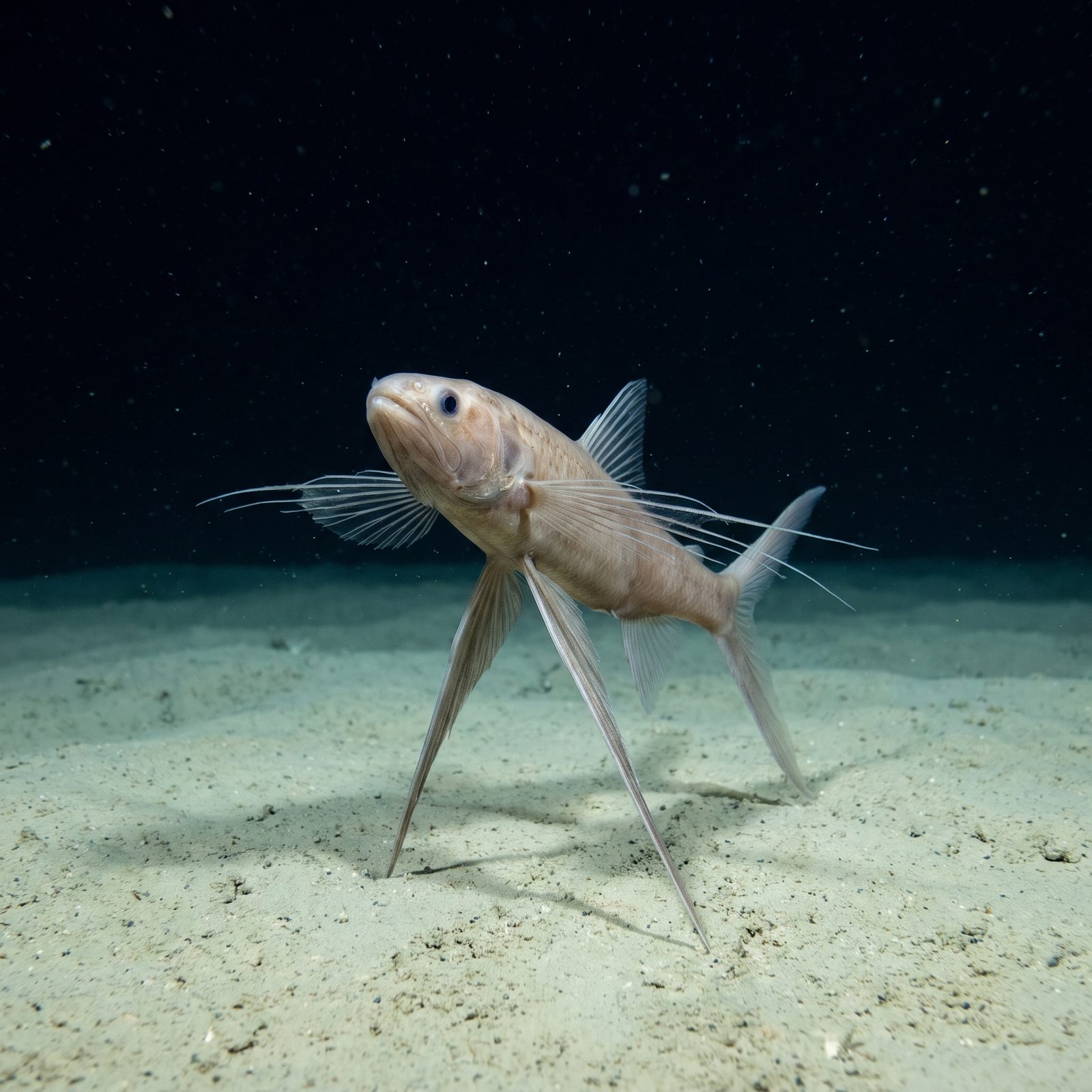
Picture a fish that got tired of swimming and decided to stand instead. That’s the tripod fish. It props itself up on three stiffened fin rays — two from the pelvic fins, one from the tail — and perches dead still above the seafloor, waiting for something to drift by.
Facing into the current, it spreads its long front fins like feelers — one fanned forward, the other swept back with filaments trailing past its tail — and snatches small prey straight out of the passing water. Its eyes are nearly useless, so it mostly feels its food coming. And those stilts? Sometimes longer than the fish itself.
27. The Black Swallower That Eats Fish Twice Its Own Size
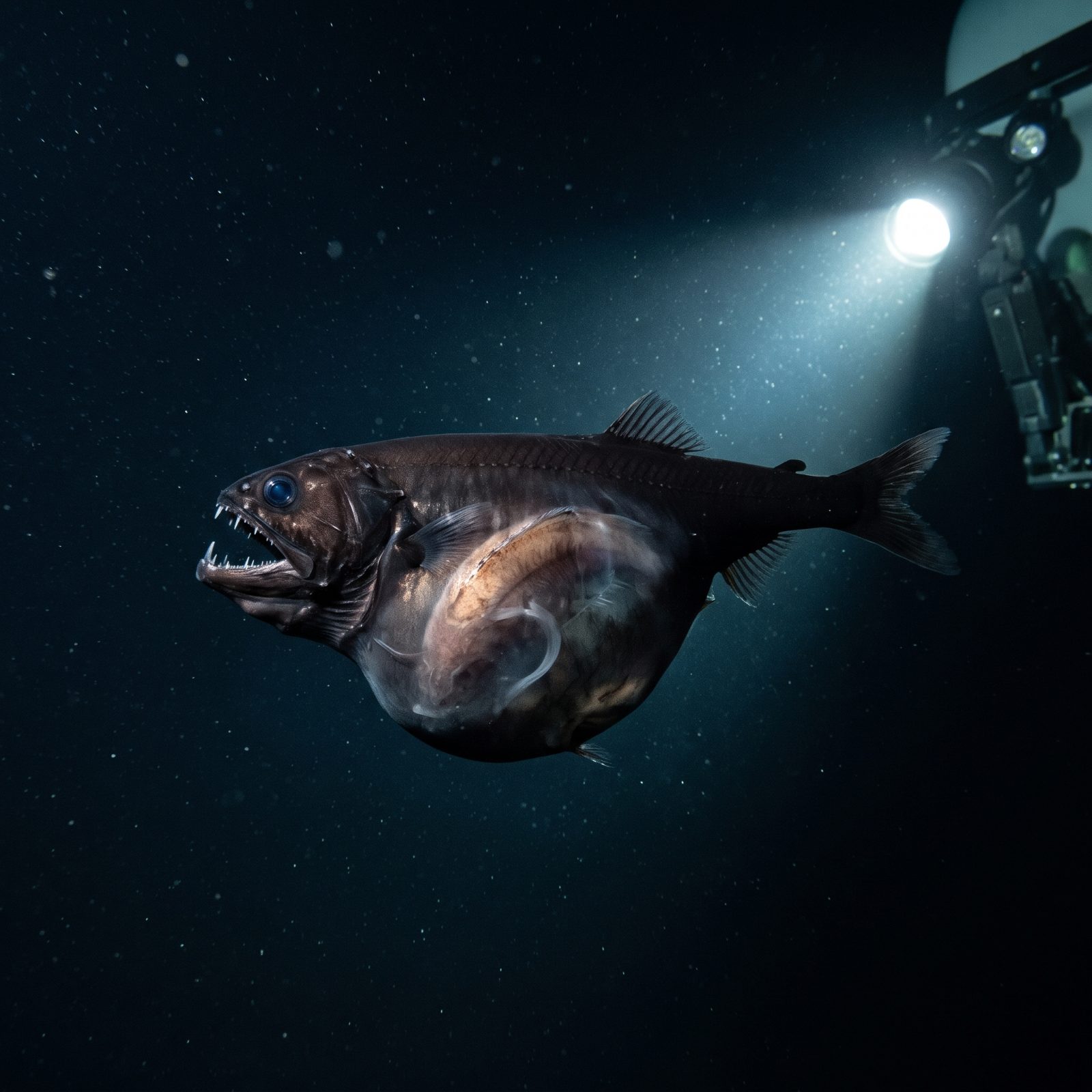
Food is scarce in the deep, so when a meal comes along you don’t pass. The black swallower takes this to an absurd extreme. Usually under ten inches long, it can swallow prey more than twice its length and ten times its weight.
Its stomach stretches like a balloon until the swallowed fish is visible right through the distended belly. The problem is timing. Sometimes the prey is so big it begins to rot and produce gas before the swallower can digest it, and the gas floats the whole bloated package up toward the surface. That’s how most black swallowers come to science: dead, drifting up, a meal they couldn’t finish still inside them. Ambition, fatal.
26. The Pacific Viperfish and Its Cage of Needle Teeth
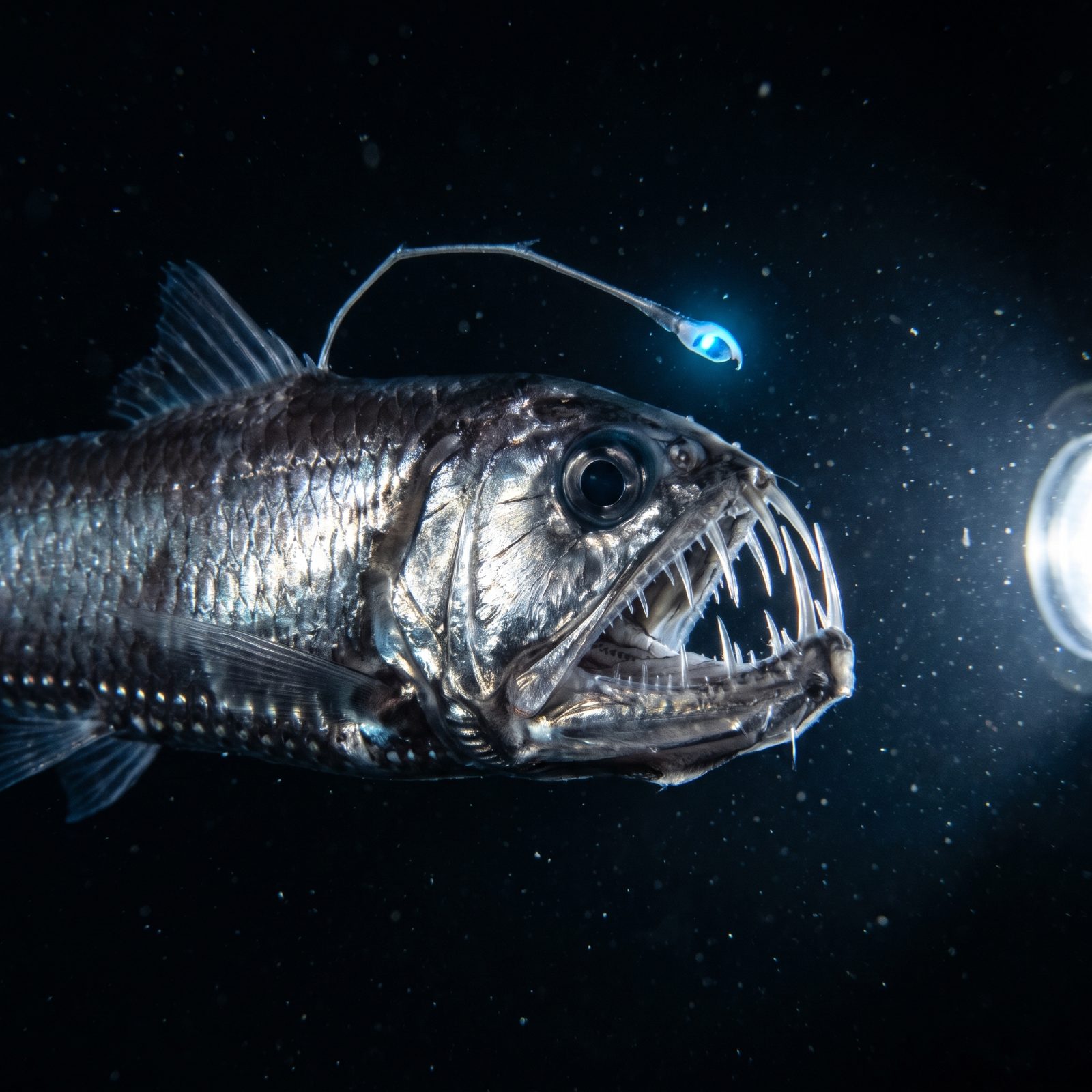
The teeth are the whole story. The Pacific viperfish carries fangs so long they fill its wide-open gape — glassy needles crowding the upper and lower jaws, forming a transparent cage inside its mouth, and the fish opens at a wild angle to bring them to bear.
At the tip of a long dorsal fin ray rising from mid-back glows a lure, a dot of blue light dangled out in front, above its snout, to draw curious prey close in the pitch dark. Something comes to inspect the glow, the viperfish lunges, and those needle teeth make sure nothing escapes. Barely a foot long. Fishing in the void with its own built-in lantern and a bear trap bolted to its face.
25. The Stoplight Loosejaw That Hunts With Invisible Red Light
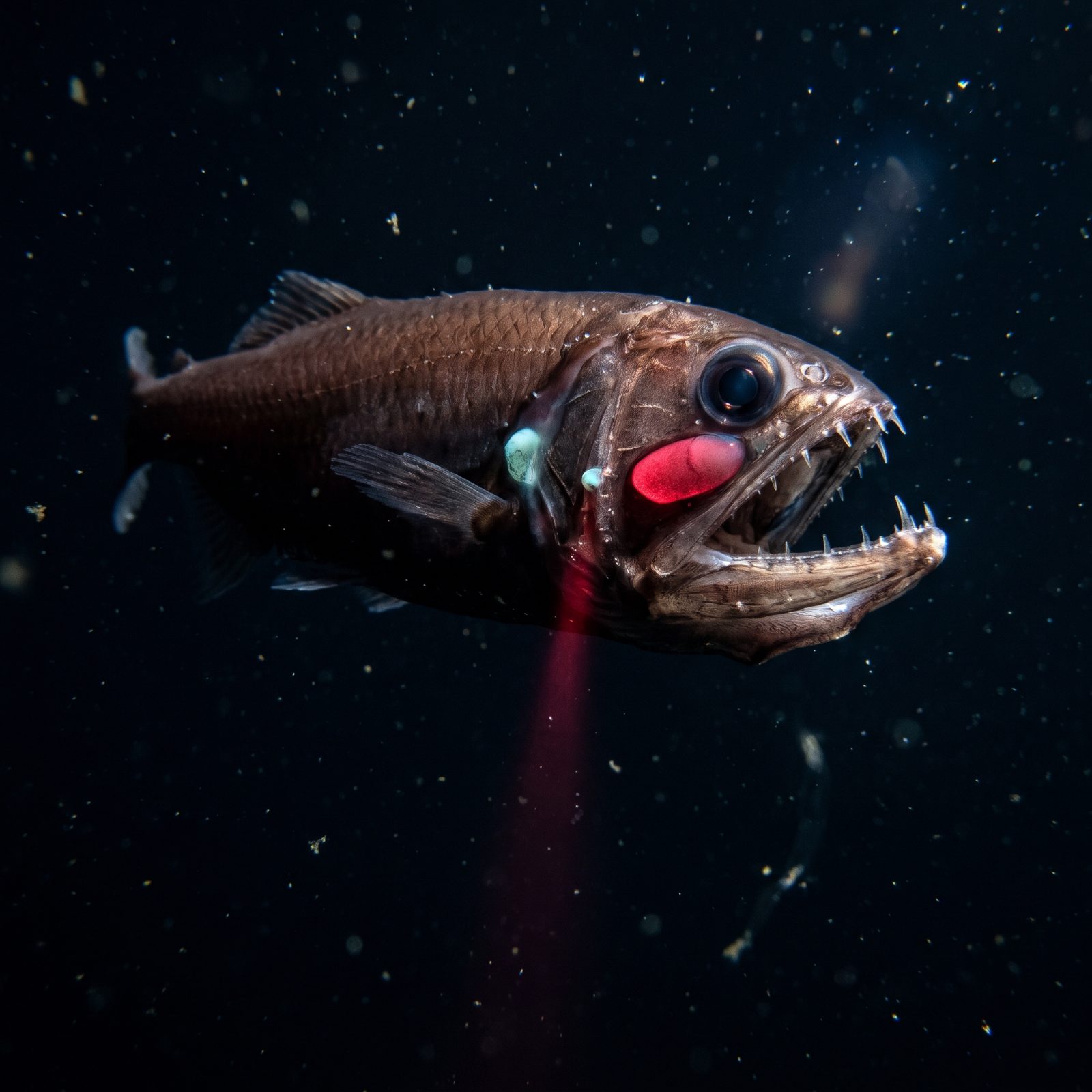
Nearly every animal in the deep sees only blue light. Red doesn’t travel far in water, so most deep-sea creatures lost the ability to see it at all. The stoplight loosejaw turned that blind spot into a weapon.
It carries a red light organ just under its eye, while a blue-green glow sits much farther back near the base of its pectoral fin, with a second small blue spot on its gill cover. That red beam is a searchlight only the loosejaw can see — a private channel its prey is utterly blind to, so it lights up its victims without ever tipping them off. Weirder still, the red pigment it uses to detect its own glow appears to be borrowed from the chlorophyll in the copepods it eats, a sniper’s scope assembled out of lunch.
The jaw gapes wide, lined with needle-like fangs around a pink, fleshy mouth floor, ready to snap shut on anything its red beam finds.
24. The Hatchetfish With a Body Thin as a Coin and Lights on Its Belly
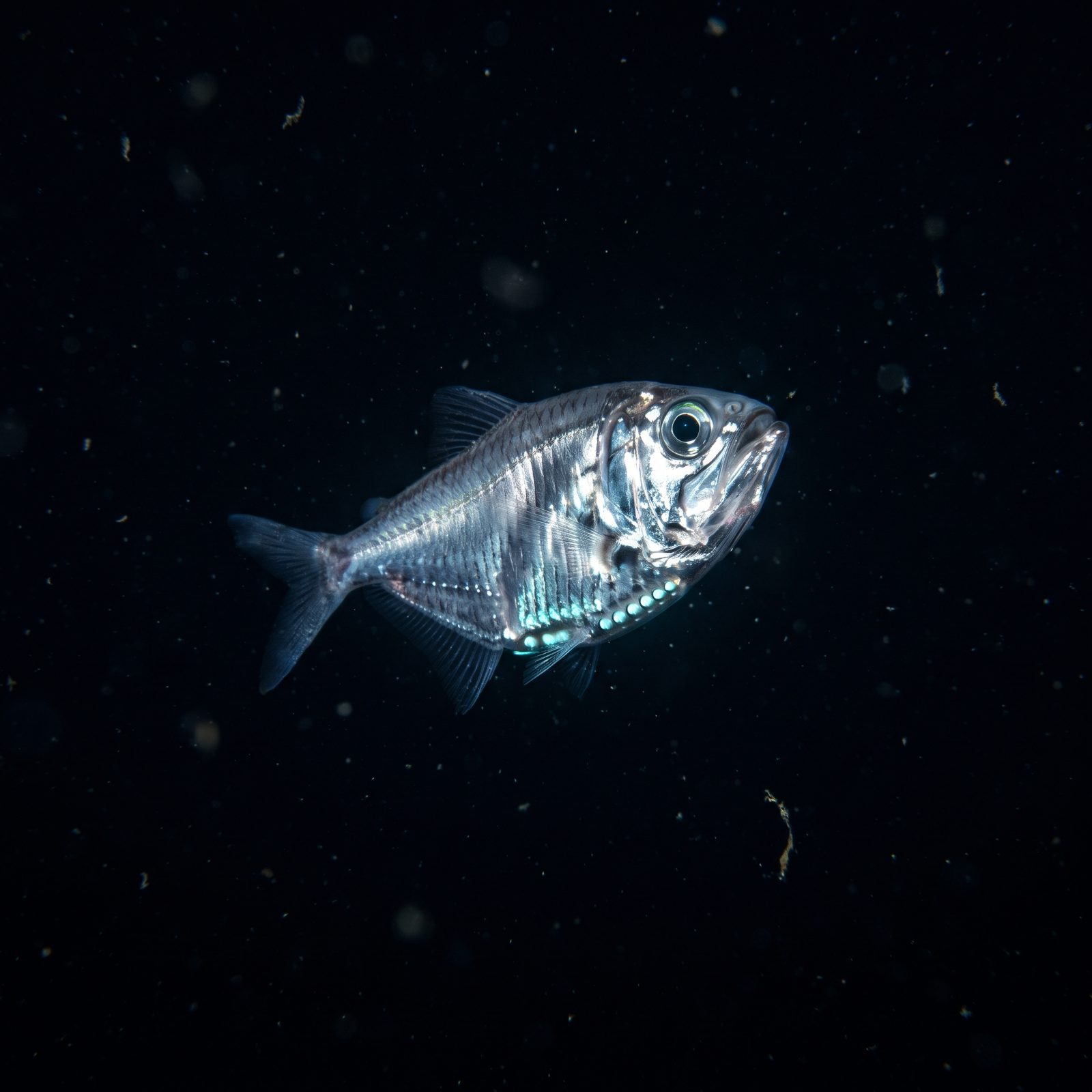
Turn a hatchetfish sideways and it nearly disappears. Its body is squeezed into a thin silvery blade, the flanks so mirror-bright they reflect the surrounding water and erase the fish’s own outline.
The real trick is on its belly. A row of light organs points straight down, glowing just enough to match the faint daylight leaking from above, so a predator looking up from below sees no silhouette against the dim surface — only even light. The hatchetfish erases its own shadow. Biologists call it counterillumination, and it’s one of the most common survival tricks in the twilight zone. Meanwhile that huge, round, mirror-rimmed eye keeps watch on the gloom around it for its own prey, which may be pulling the exact same con.
23. The Long-Nosed Chimaera and Its Blade of a Snout
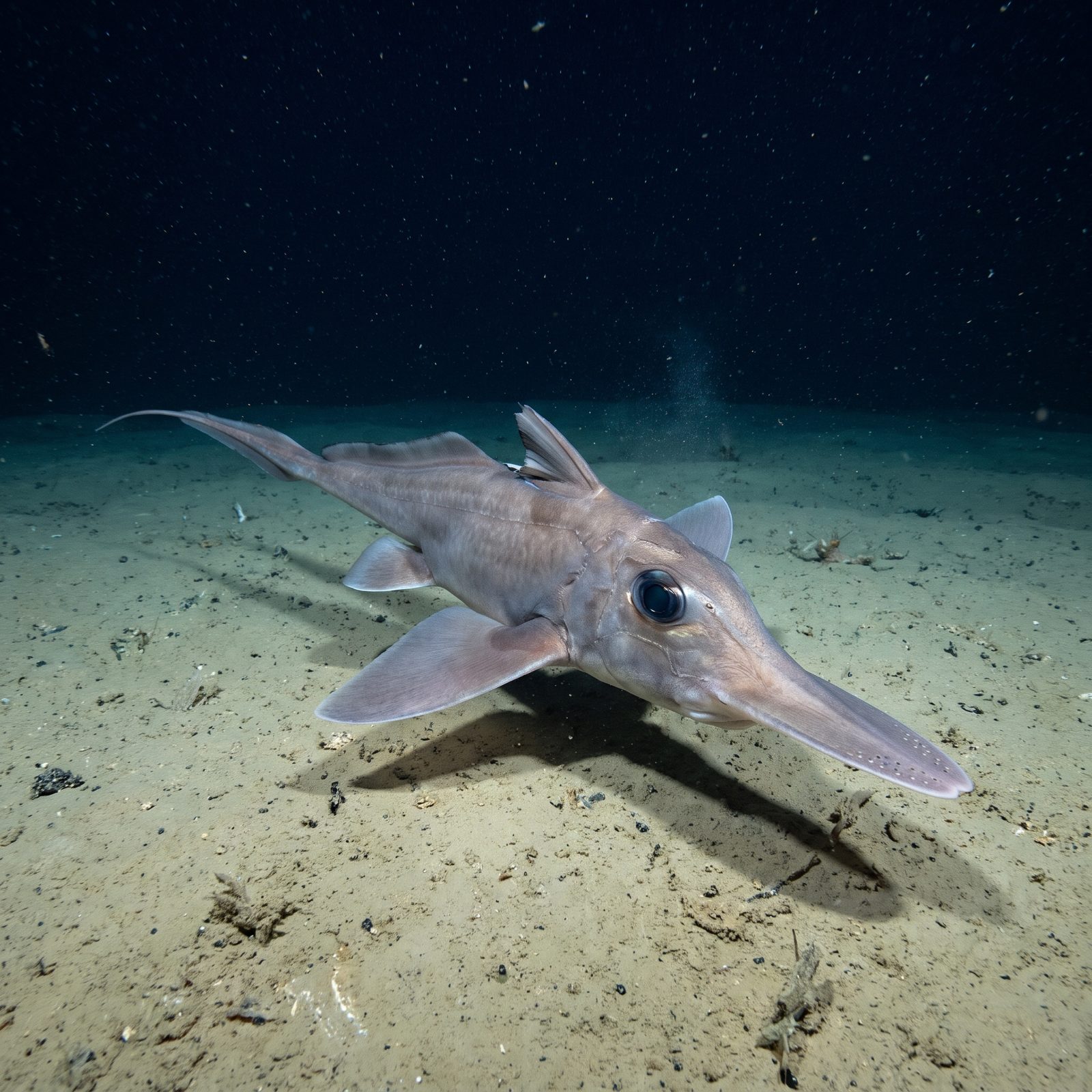
Chimaeras split off from sharks around 400 million years ago, which makes the long-nosed chimaera one of the oldest lineages of fish still swimming. That long, pointed snout isn’t for show. It’s packed with sensory pores that pick up the faint electrical fields of prey buried in the mud, so the fish can hunt by feel in total darkness.
No bony skeleton, just cartilage like its shark cousins, plus a mildly venomous spine standing guard in front of the dorsal fin. Its smooth, scaleless body and oversized eyes give it a ghostly drift along the bottom. Fishermen call them ratfish. The deep has kept this blueprint around for 400 million years for one reason — down here, it still works.
22. The Coffinfish That Gulps Water and Puffs Up Like a Balloon
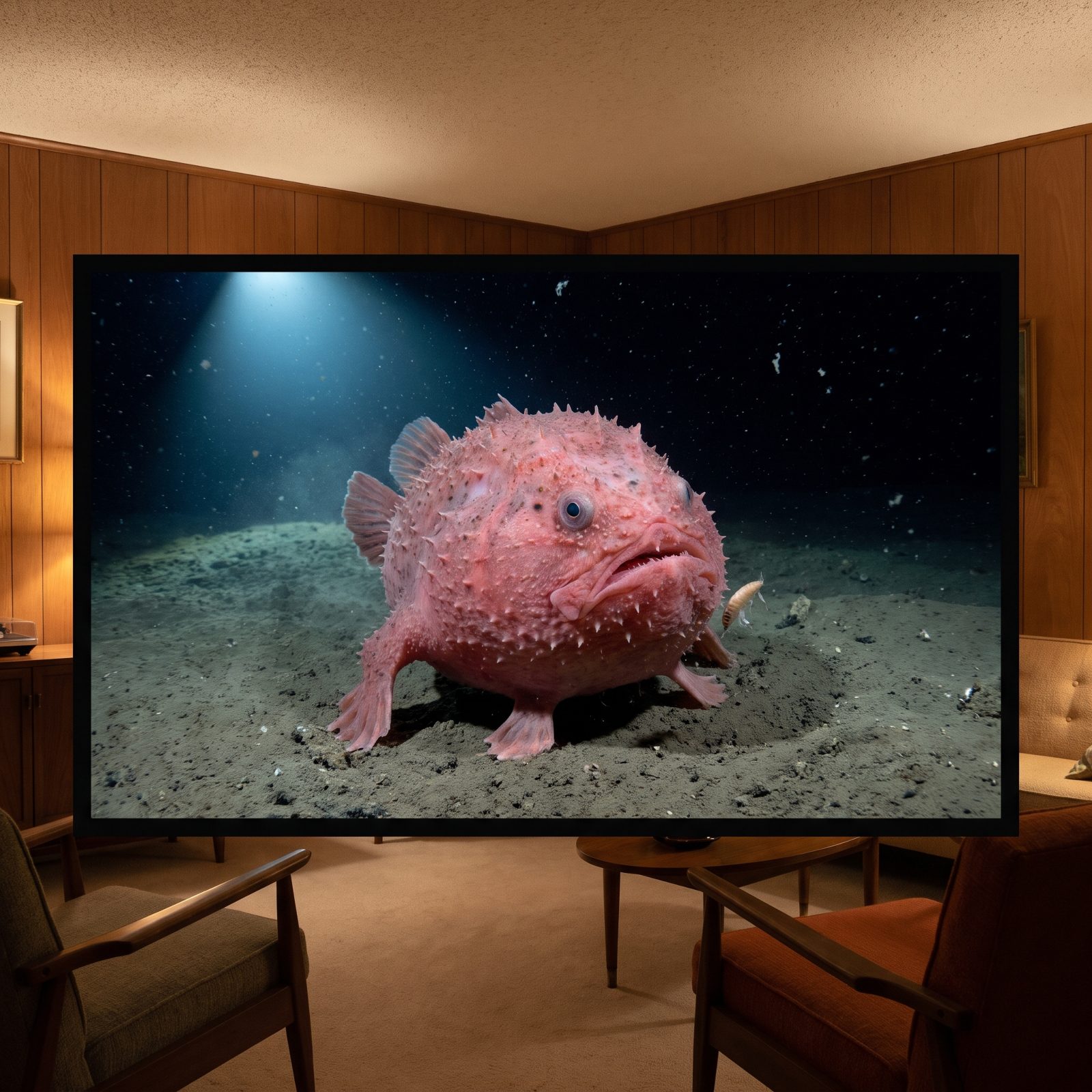
It holds its breath, but not for the reason you’d think. The coffinfish gulps seawater into its gill chambers and swells up like a water balloon, sometimes holding a single breath for minutes at a time. Down where oxygen is thin and food barely passes by, breathing less often saves energy.
Puffing up has a second job. A sudden balloon of a fish is harder to swallow and looks a lot bigger than the floppy, loose-skinned blob it actually is. And that baggy skin is the giveaway — this is an anglerfish relative that gave up chasing anything, and now it just sits on the mud waving a tiny lure, waiting.
21. The Colossal Squid and Its Rotating, Swiveling Hooks
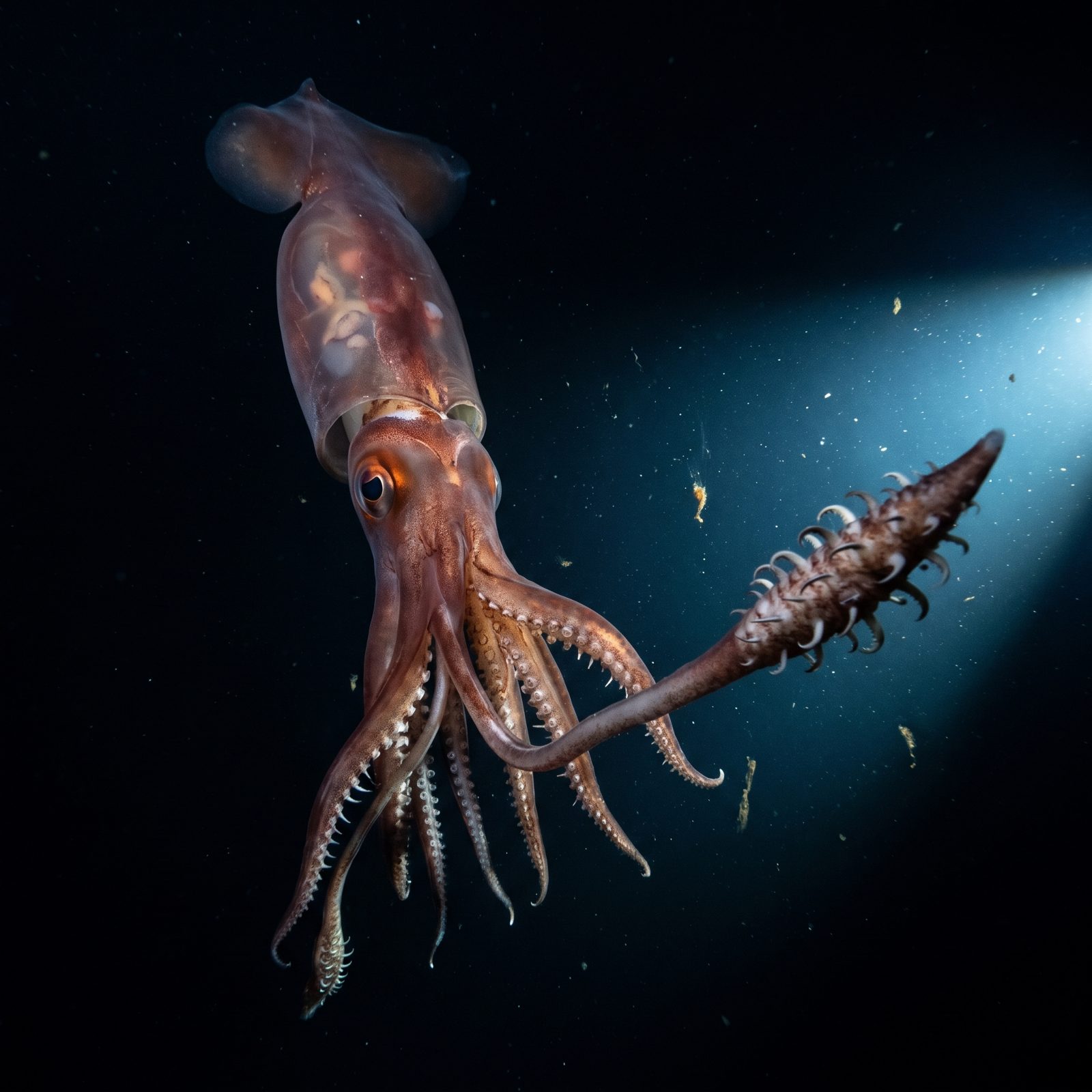
Forget the giant squid. The colossal squid is heavier, bulkier, built like a tank — and nobody had ever filmed a live one down there until early 2025, when a research team caught a small juvenile on camera near the South Sandwich Islands.
The weapons are the strange part. Instead of simple suckers, its arms and tentacle clubs carry sharp hooks, and some of them rotate on their base, swiveling to lock onto slippery prey. Grab a fish, the hooks turn, the fish stops leaving. Sperm whales carry the scars to prove how that fight usually ends.
The eye of a full-grown colossal squid is the largest in the animal kingdom, about the size of a soccer ball.
20. The Strawberry Squid With One Huge Eye and One Tiny Eye
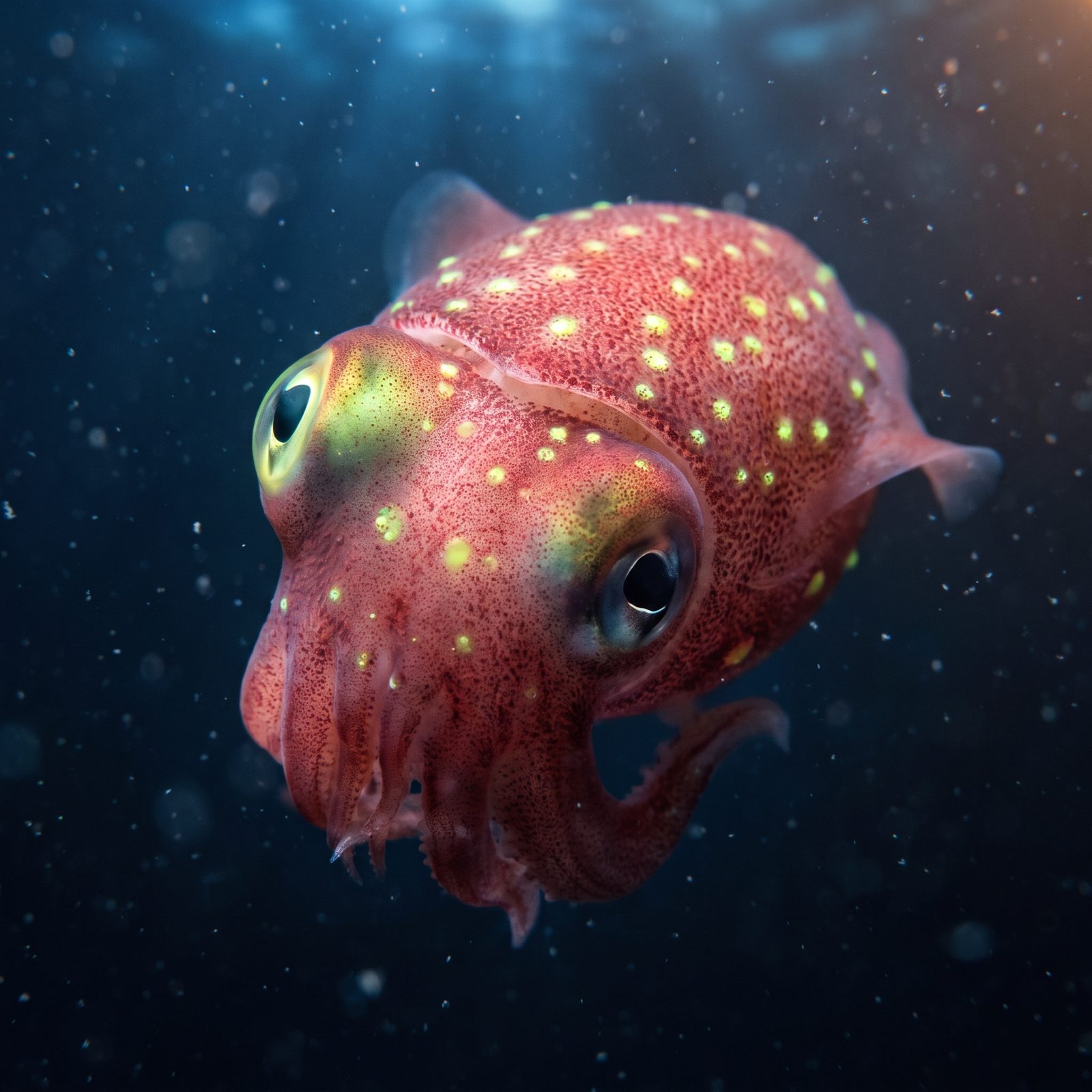
One eye ringed in glowing yellow. The other dark and glassy, a fraction of the size. The strawberry squid isn’t deformed — it’s optimized.
Home is the twilight zone, that dim band where faint sunlight filters down from above and almost nothing comes from below. So the yellow-ringed eye points up, scanning for the shadows of prey against the last of the light, its yellow tint cutting through the natural glow of counter-illuminating animals. Meanwhile the dark eye points down, hunting for sparks of bioluminescence in the black water underneath. Two completely different lighting problems, two differently tuned eyes, riding around on the same little body.
19. The Dumbo Octopus That Flaps Fins Like an Elephant’s Ears
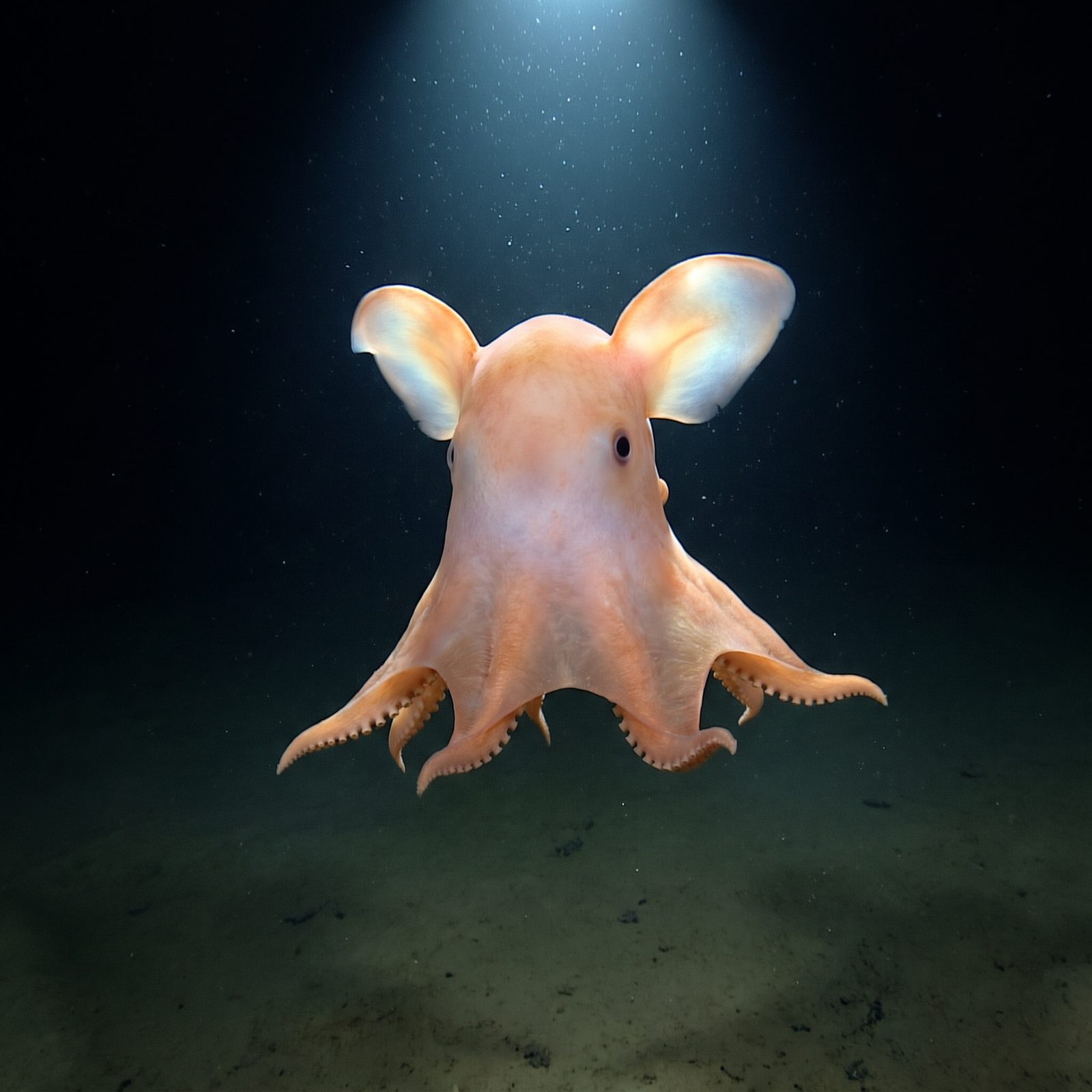
The cutest animal in the deep ocean also lives deeper than almost anything else with a face. Dumbo octopuses have been recorded below 4,000 meters, and the sightings hint they go deeper still, which makes them the deepest-living octopuses we know of.
Those adorable ears aren’t ears. They’re fins, and the octopus flaps them to hover and steer while its webbed arms form a little umbrella underneath. Most octopuses jet around by squirting water. This one flies — slow, gentle, through water so cold and dark that rushing anywhere would just burn calories it can’t spare.
18. The Ram’s Horn Squid and Its Secret Spiral Shell
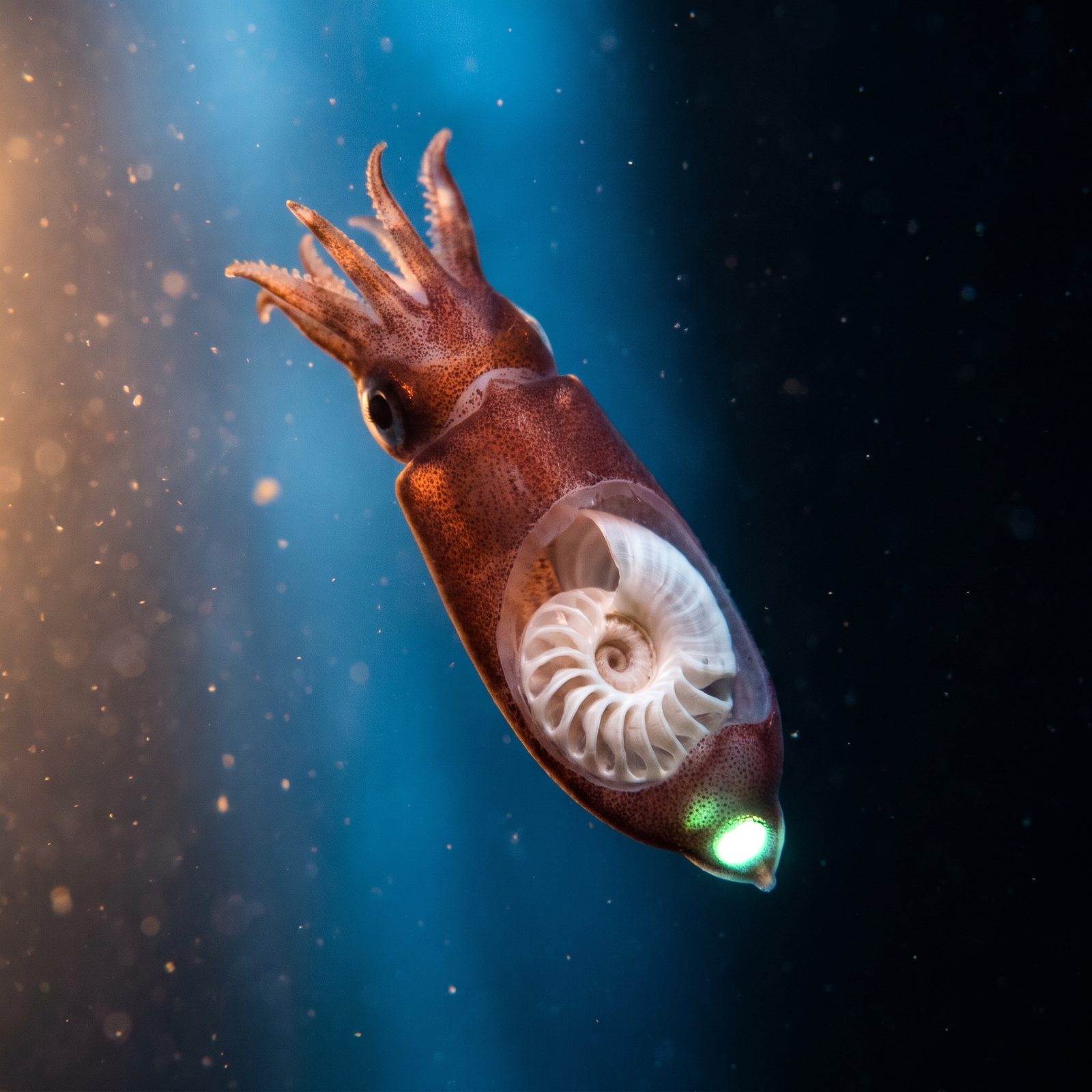
You’ve probably held this animal and never knew it. That delicate white spiral you find washed up on tropical beaches, coiled like a tiny ram’s horn? It belonged to a living squid that carried it coiled at the end of its body.
Spirula uses the chambered shell for buoyancy, pumping gas between the compartments the way a nautilus does, which lets it hang motionless in the water. At that same end, right beside the shell, glows a single green light that burns almost without pause — one of the only steady bioluminescent organs in the whole sea. Nobody is completely sure what it’s for.
17. The Giant Larvacean That Builds a Disposable Mucus Mansion
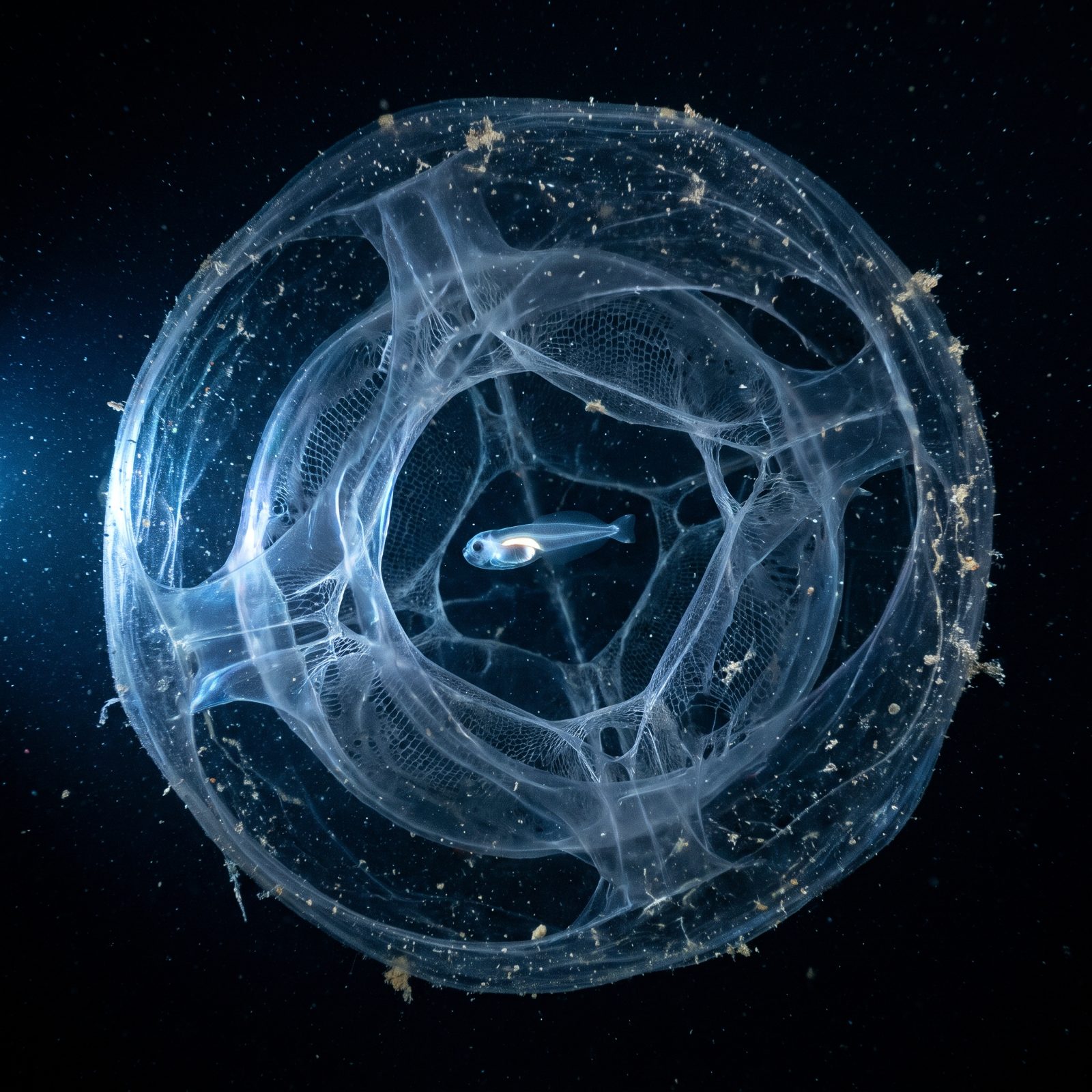
Picture a tadpole the size of your thumb living inside a balloon of snot the size of a beach ball. That’s a giant larvacean, and the snot palace is the clever part.
The animal secretes an elaborate mucus house wrapped around two nested filters. It beats its tail to pump water through, the mesh traps tiny crumbs of food, and when everything clogs it simply abandons the whole thing and builds a fresh one — sometimes daily. The discards sink, hauling carbon down to the deep seafloor. One tiny animal doing silent work on the planet’s climate, one mucus mansion at a time.
16. The Bloody-Belly Comb Jelly That Hides Its Glowing Dinner
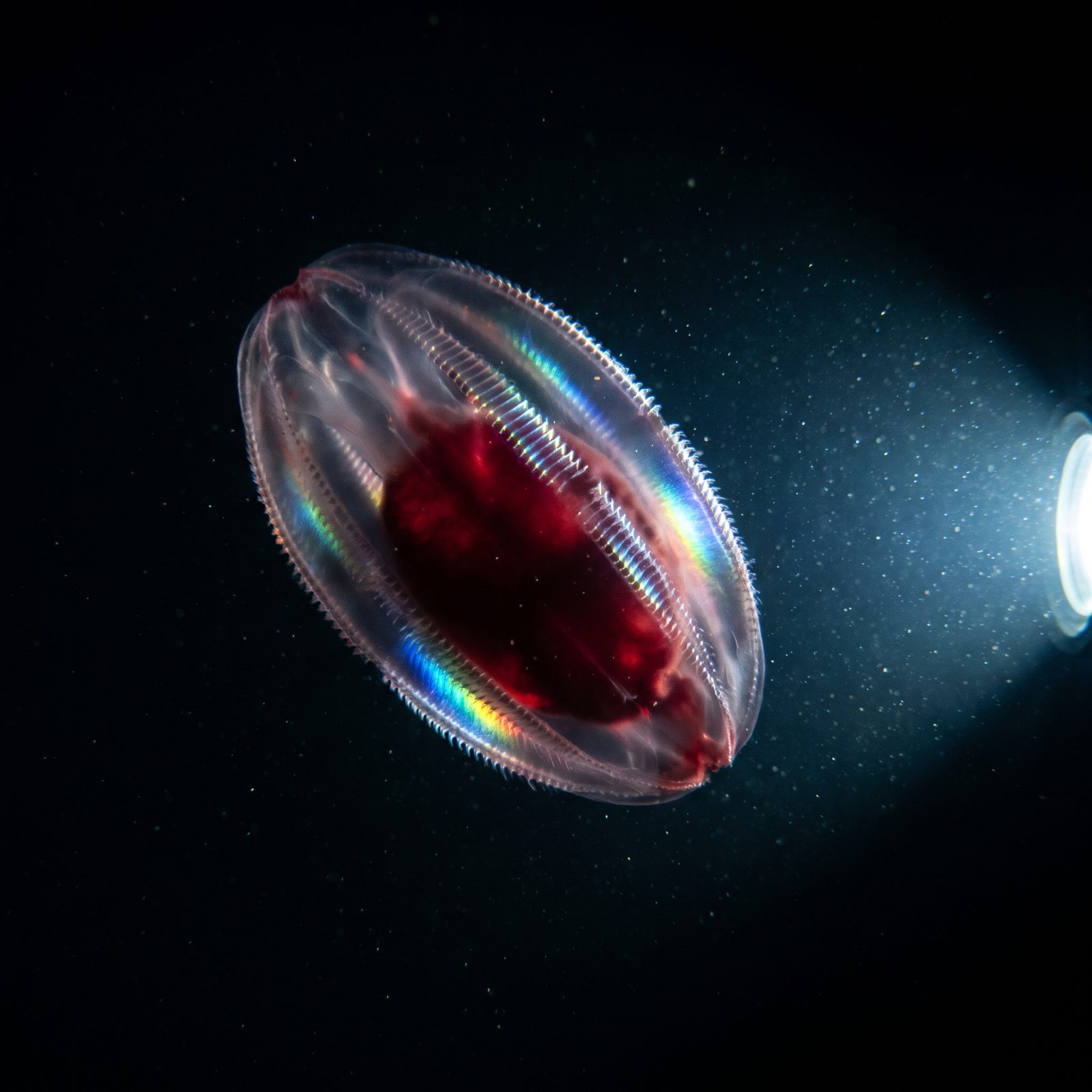
In the deep sea, red is the new black. Almost no red light reaches those depths, so a red animal reads as pitch black and vanishes. The bloody-belly comb jelly runs that trick in reverse.
Its stomach is a deep blood red, and that’s no accident. Many of the glowing creatures it swallows keep right on glowing inside its gut, and a bright snack lighting up your belly is a billboard for bigger predators. The red tissue soaks up that light and buries the evidence. Meanwhile its comb rows scatter passing light into shimmering rainbows that, in the pitch dark, are effectively invisible anyway. Gorgeous to us. Pure camouflage to everything down there.
15. The Atolla Jellyfish That Screams With Light
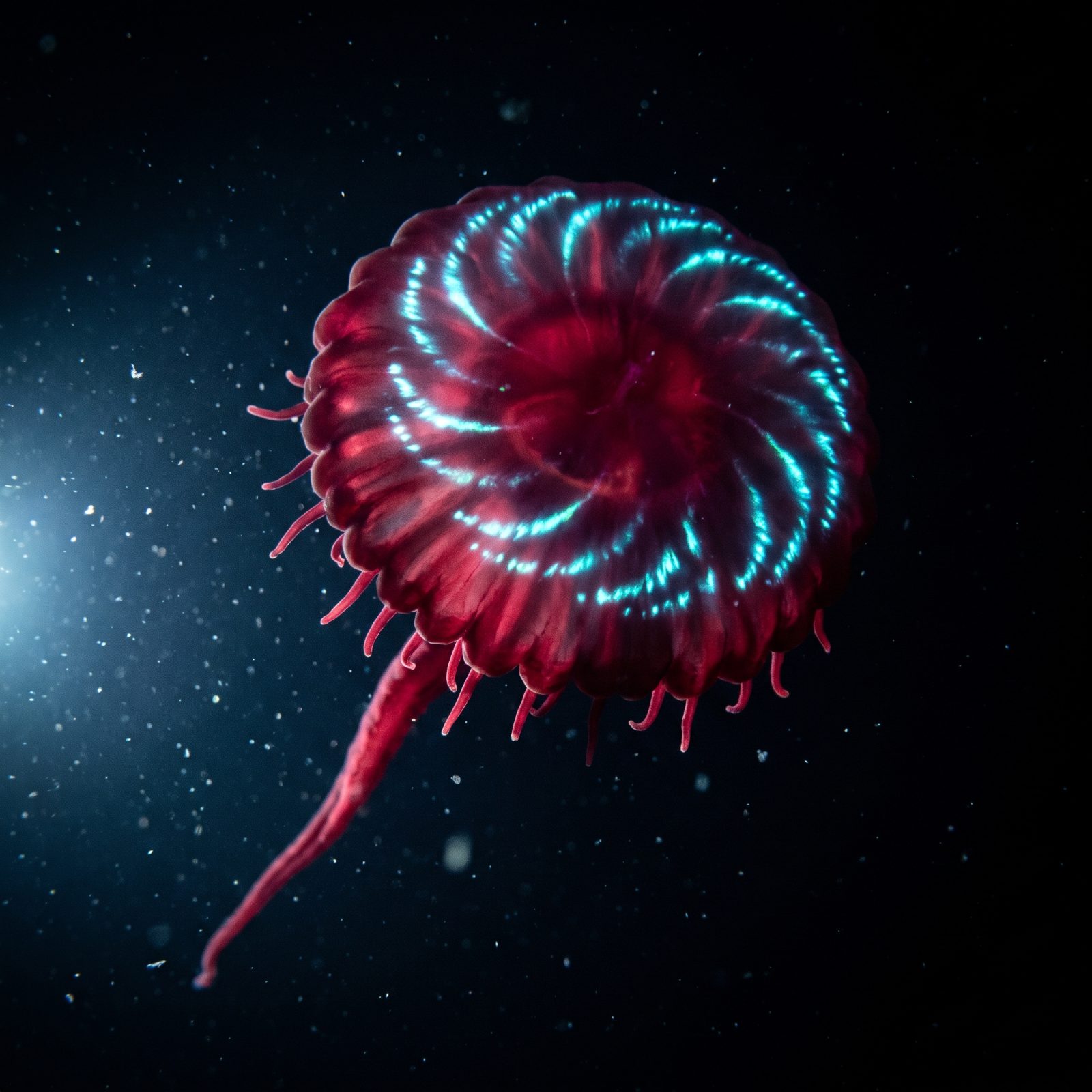
When this jellyfish gets grabbed, it calls for help by lighting up the dark.
Attack an Atolla and it fires a spinning pinwheel of blue light around its rim, flash after flash spiraling outward. The show isn’t meant to scare off whatever caught it. It’s bait for something bigger — a predator that will hopefully turn around and eat the first attacker. Scientists call it the burglar alarm, because it works like a siren that pulls in the police.
The idea was clever enough that researchers built a glowing lure to mimic it. That electronic jelly helped film the first-ever footage of a live giant squid in its own deep home.
14. The Pyrosome, a Glowing Hollow Tube Made of Thousands of Animals
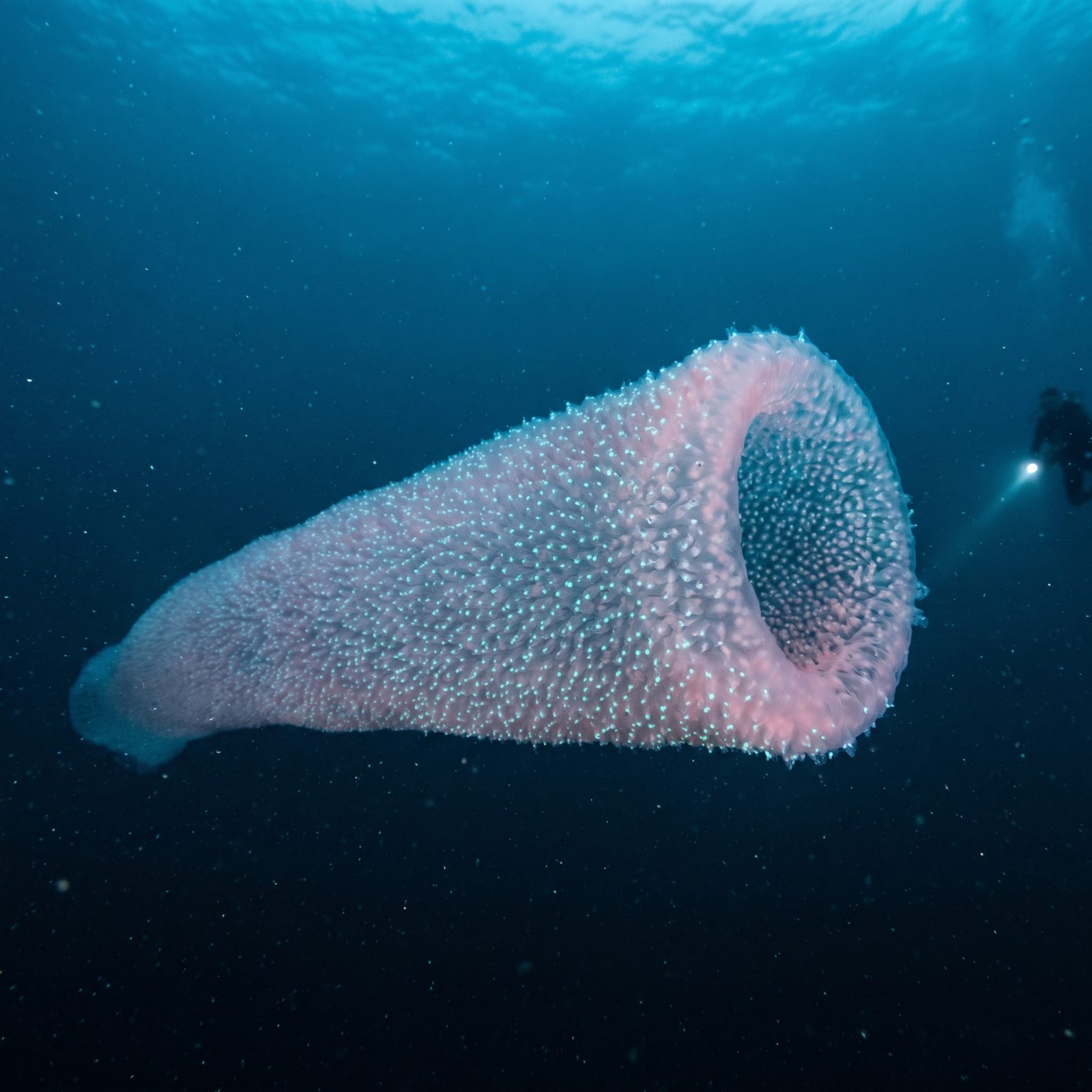
It looks like a see-through sock the size of your leg, drifting open-ended through the ocean and glowing. And it’s not one animal. It’s thousands.
A pyrosome is a colony of tiny creatures called zooids, each one filtering water, all of them locked together into a single hollow tube. They draw water in through their bodies and jet it out the open end, which quietly nudges the whole tube forward. Then there’s the glow — so bright and so contagious that one flash can ripple across the entire colony and even trigger neighboring pyrosomes. The name means fire body. It earns it.
13. The Venus Flytrap Anemone That Snaps Its Disc Shut
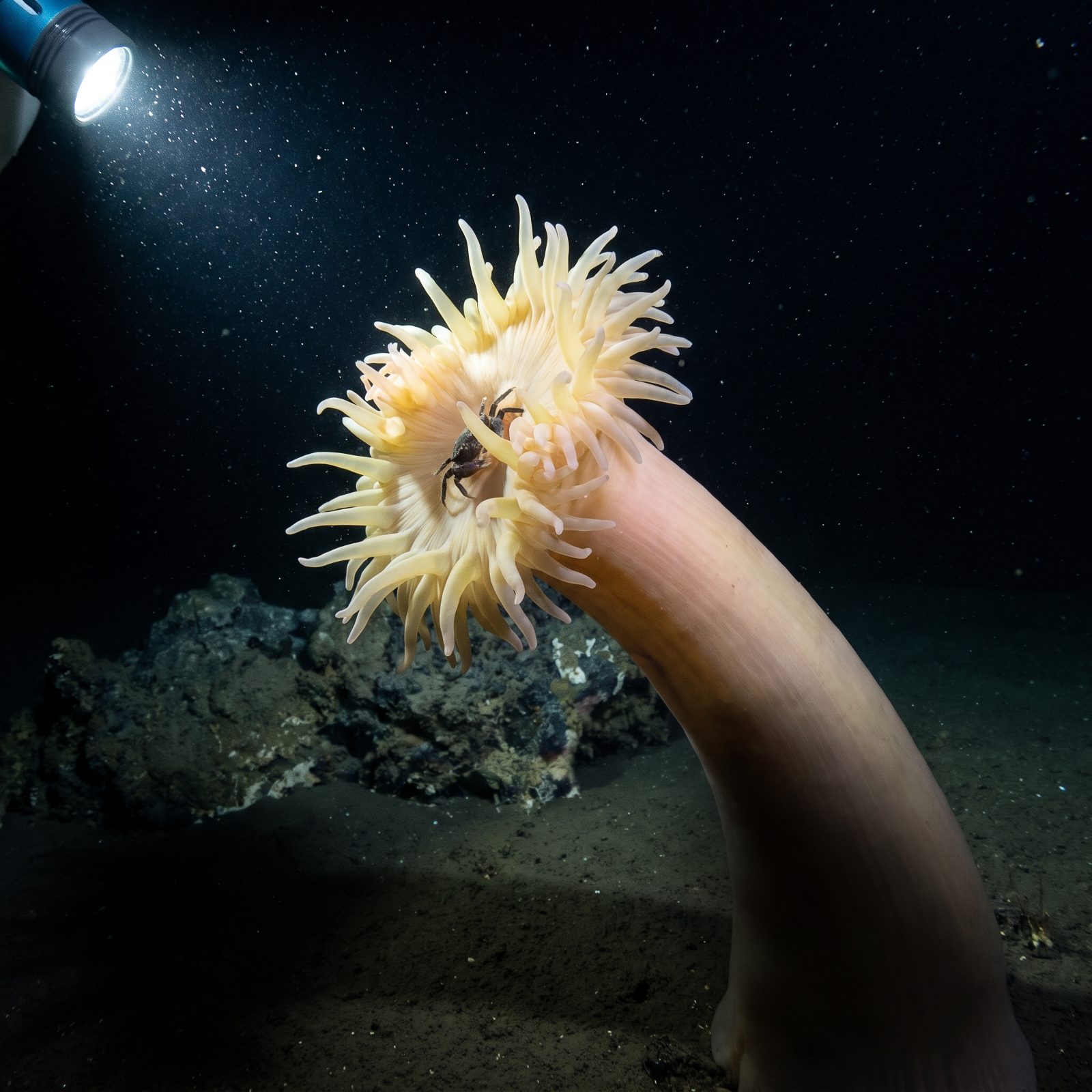
Share a name with a famous carnivorous plant and people expect a snapping trap. This one actually delivers, sort of.
The Venus flytrap anemone perches on a stalk in the deep sea, its wide disc fringed with tentacles and angled into the current to catch drifting food and marine snow. When something lands — or when it feels threatened — the two halves of that disc can fold together like a pair of closing hands. No fast, spring-loaded snap like the plant’s, and the resemblance is pure coincidence. Two unrelated life forms, one on land and one three kilometers down, arriving at the same shape for the same job.
12. The Harp Sponge That Hunts Like an Underwater Candelabra
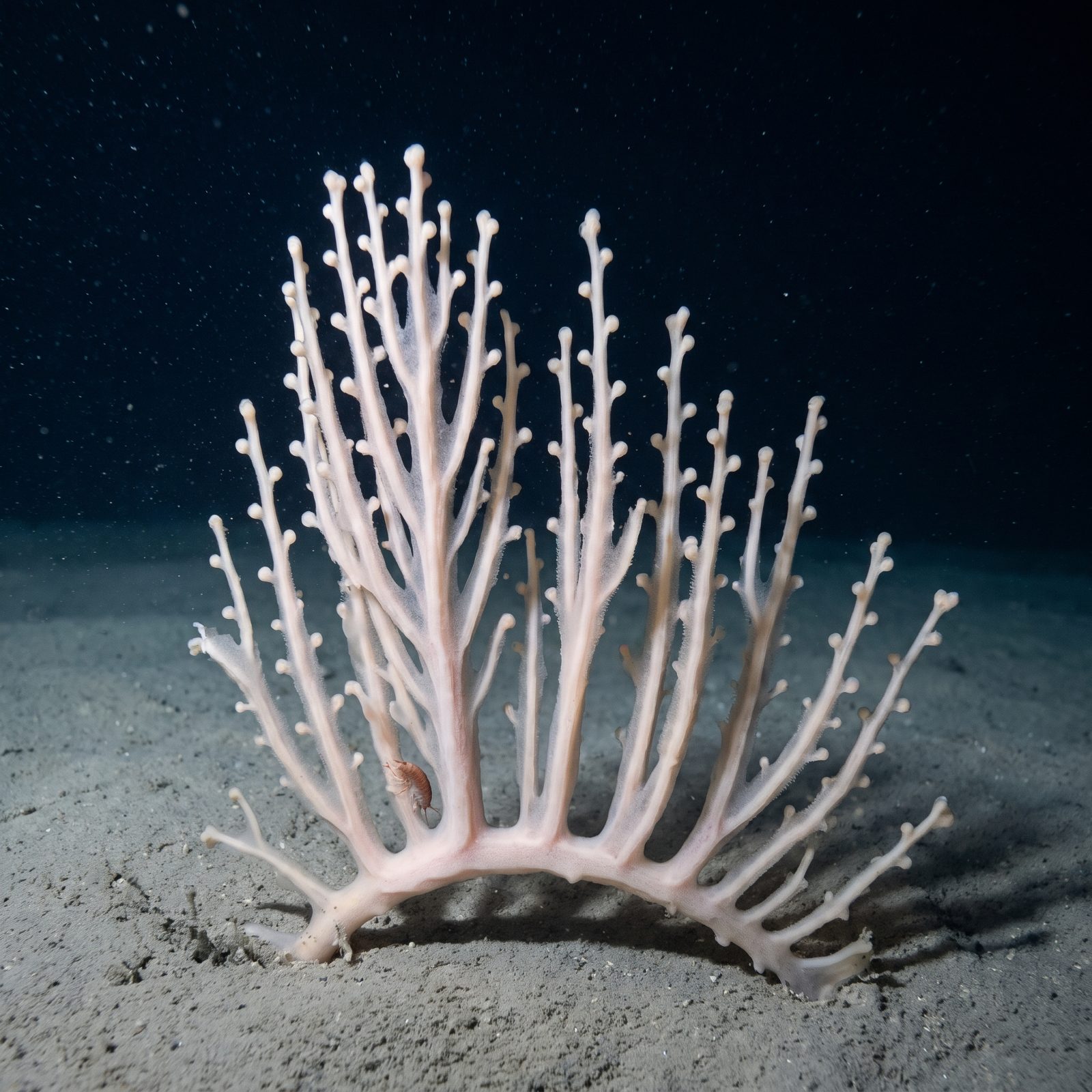
Sponges are supposed to filter water and mind their own business. This one hunts. Found almost two miles down off California and described in 2012, the harp sponge spreads its branches like a candelabra and snags tiny crustaceans on surfaces studded with microscopic hooks — the same grabbing trick as velcro.
Once dinner is stuck, the sponge slowly grows a membrane over it and digests it alive. And those little balls studding every branch from base to tip? Packets of sperm, released to drift toward neighbors. A predator and a romantic, all in one pale skeleton.
11. The Giant Tube Worm With a Plume the Color of Fresh Blood
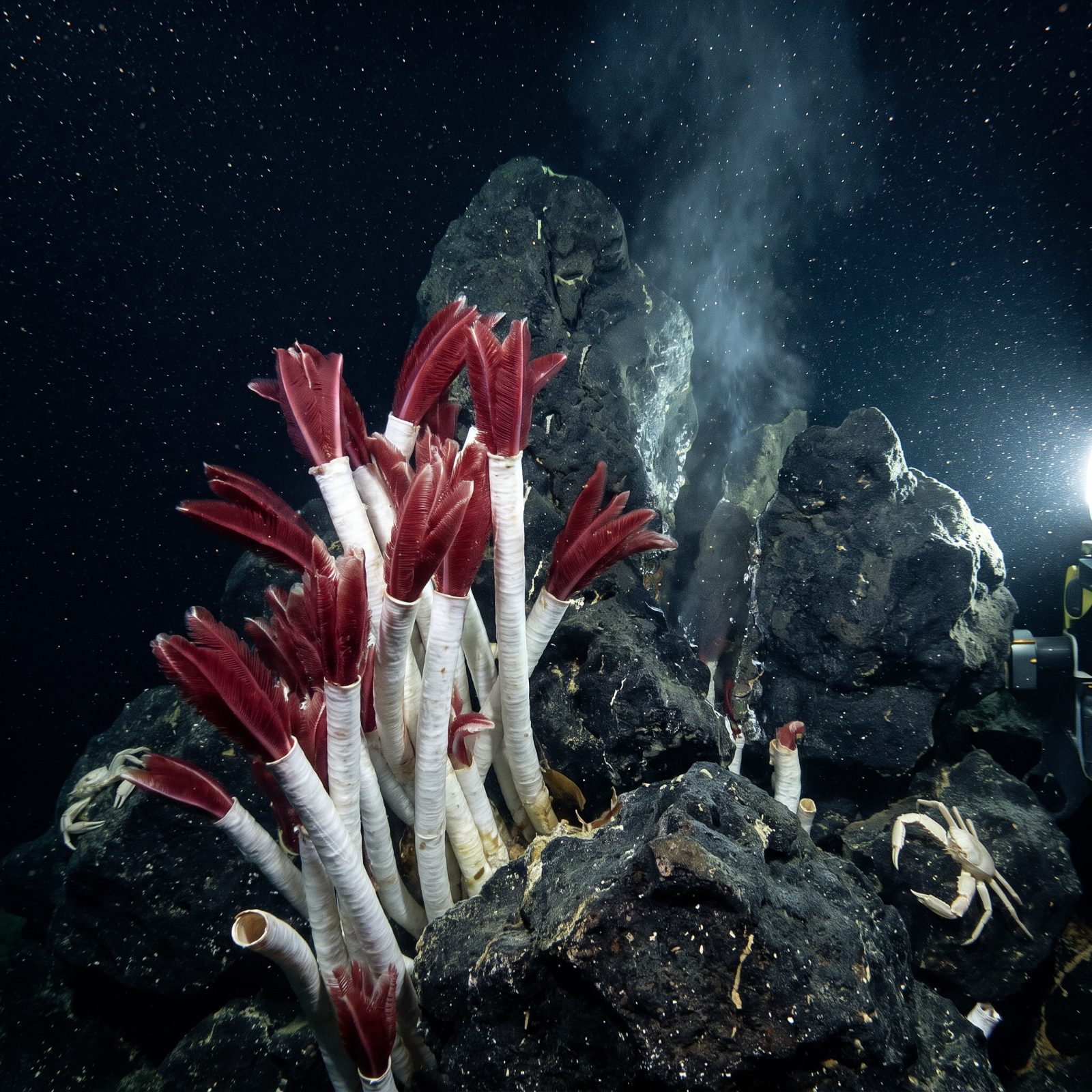
Picture a worm taller than you, growing in total darkness, with no mouth, no gut, and no way to eat. Discovered around Galápagos vents in 1977, the giant tube worm cracks every rule you learned about life.
That blood-red plume is packed with a special hemoglobin that grabs both oxygen and toxic hydrogen sulfide from the vent water, which the worm pumps down to billions of bacteria living inside its body. The bacteria turn chemicals into food. The worm just provides room and board. It survives on volcanic poison, delivered by a plume that looks exactly like it sounds.
10. The Pompeii Worm That Sunbathes in Scalding Vent Water
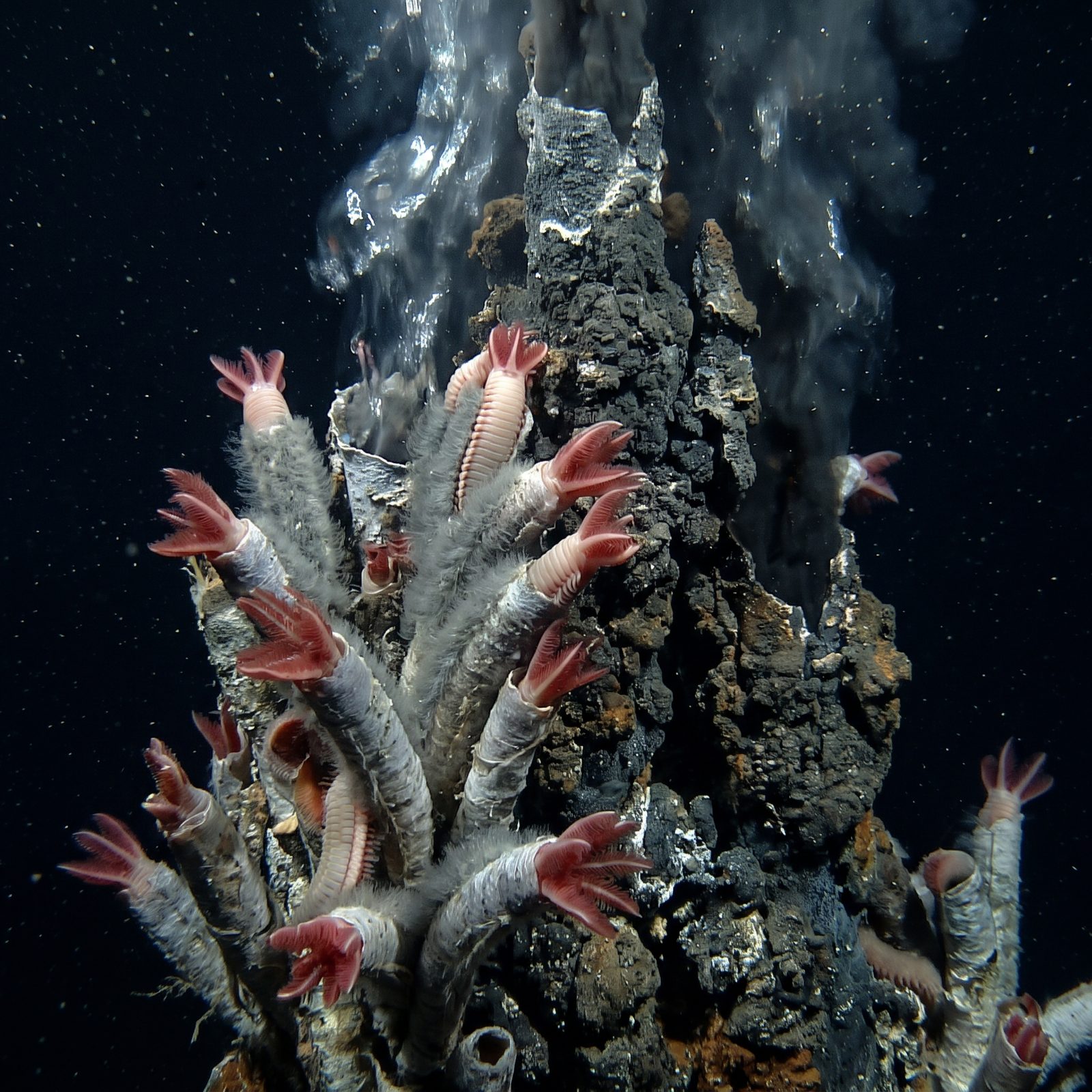
This worm lives where almost nothing should. It plants its tail end against hydrothermal chimney walls that can hit scalding temperatures while its gilled head sits in cooler water just a few inches away — one of the hottest temperature swings any animal tolerates across its own body.
Its secret is the fringe of pale bristles lining its bare, pink, segmented body, home to colonies of bacteria, which may help insulate the worm and clean up vent toxins. May. We’re still arguing about exactly how it pulls this off. The deep sea keeps handing us animals that make our thermometers look optimistic.
9. The Bone-Eating Zombie Worm With No Mouth and No Stomach
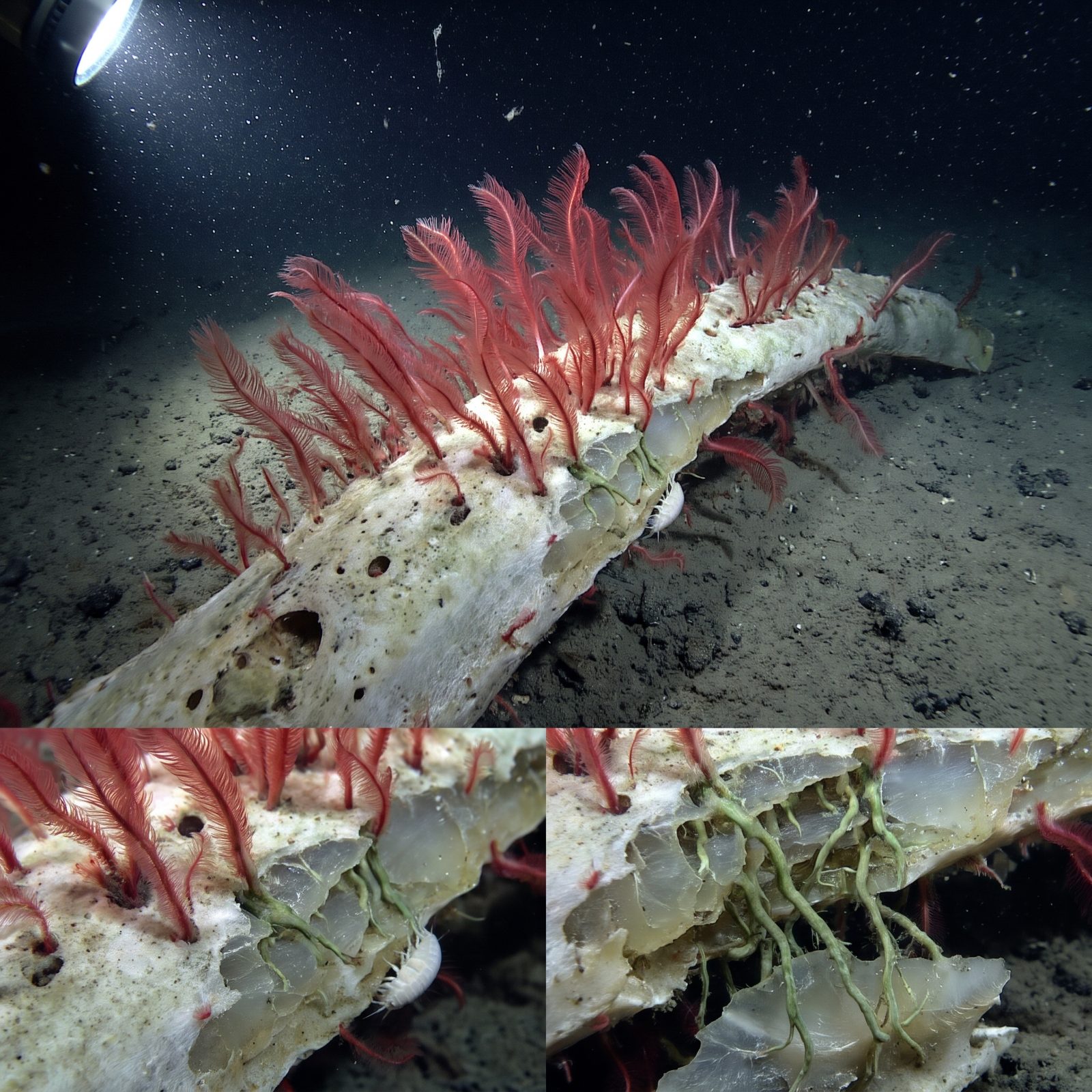
When a whale dies and sinks, it becomes an entire ecosystem, and the star of the late shift is Osedax, the bone-eating worm, first found on a gray whale skeleton off California in 2002. No mouth. No stomach. No anus. Nothing you’d call a digestive system at all.
Instead it drills green root-like tendrils into whale bone and farms bacteria that dissolve the fat and protein locked inside. And here’s the genuinely strange part: the visible worms are all female. The males are microscopic, dozens of them living harem-style inside each female’s tube. One worm you can see, paired with mates too small to notice.
8. The Xenophyophore: A Single Cell the Size of Your Fist
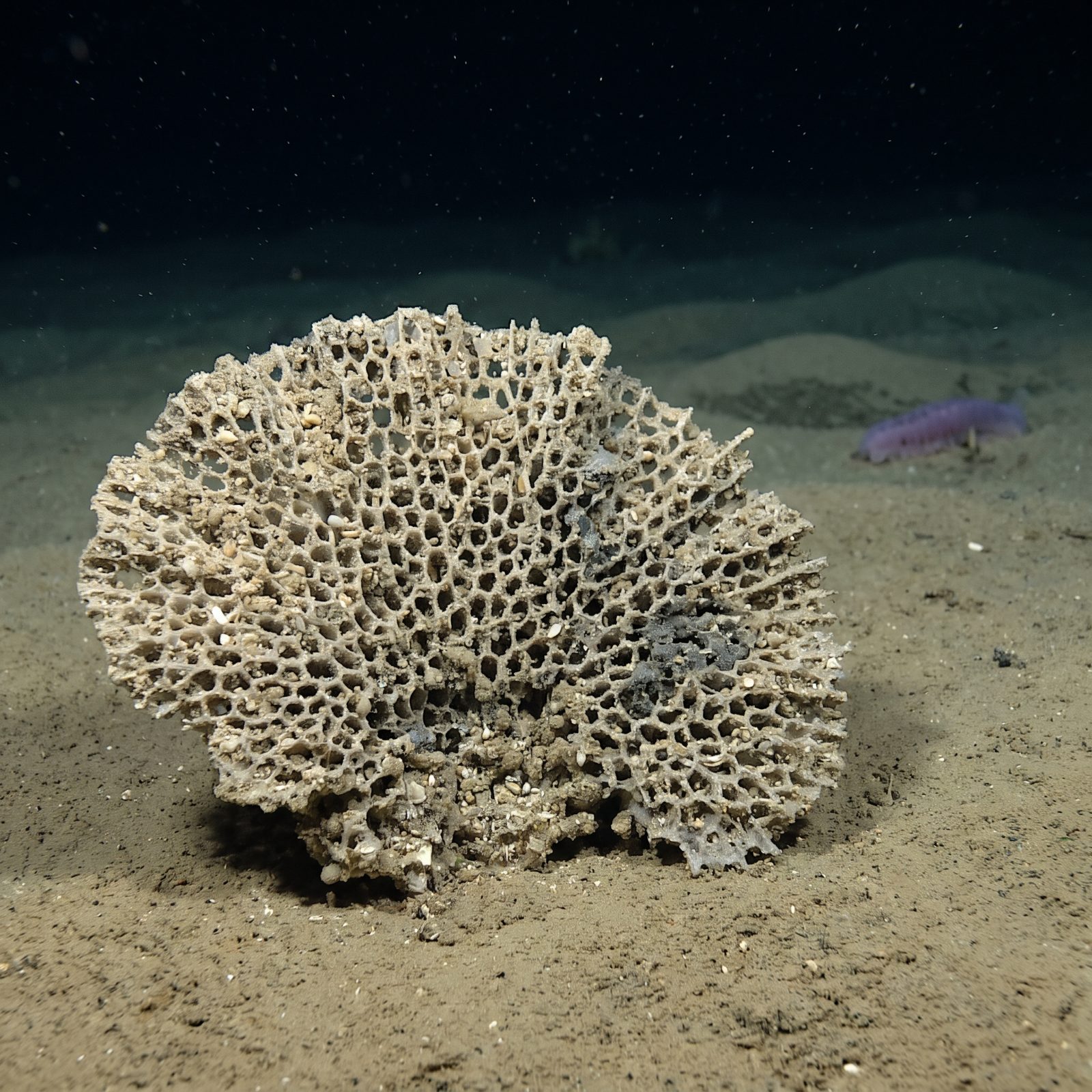
Everything you know about single cells says they’re microscopic. Xenophyophores never got the memo. These deep-sea giants are a single cell that can grow as large as your fist — among the biggest single-celled organisms on Earth.
They build elaborate shells by gluing together sand grains, sponge needles and mineral bits scavenged from the seafloor, and thousands of them can carpet the abyssal plains, quietly creating homes for shrimp, worms and brittle stars. A living apartment complex with no neighbors inside. Just one enormous cell doing all the work.
7. The Predatory Tunicate That Swallows Whatever Swims Into Its Hood
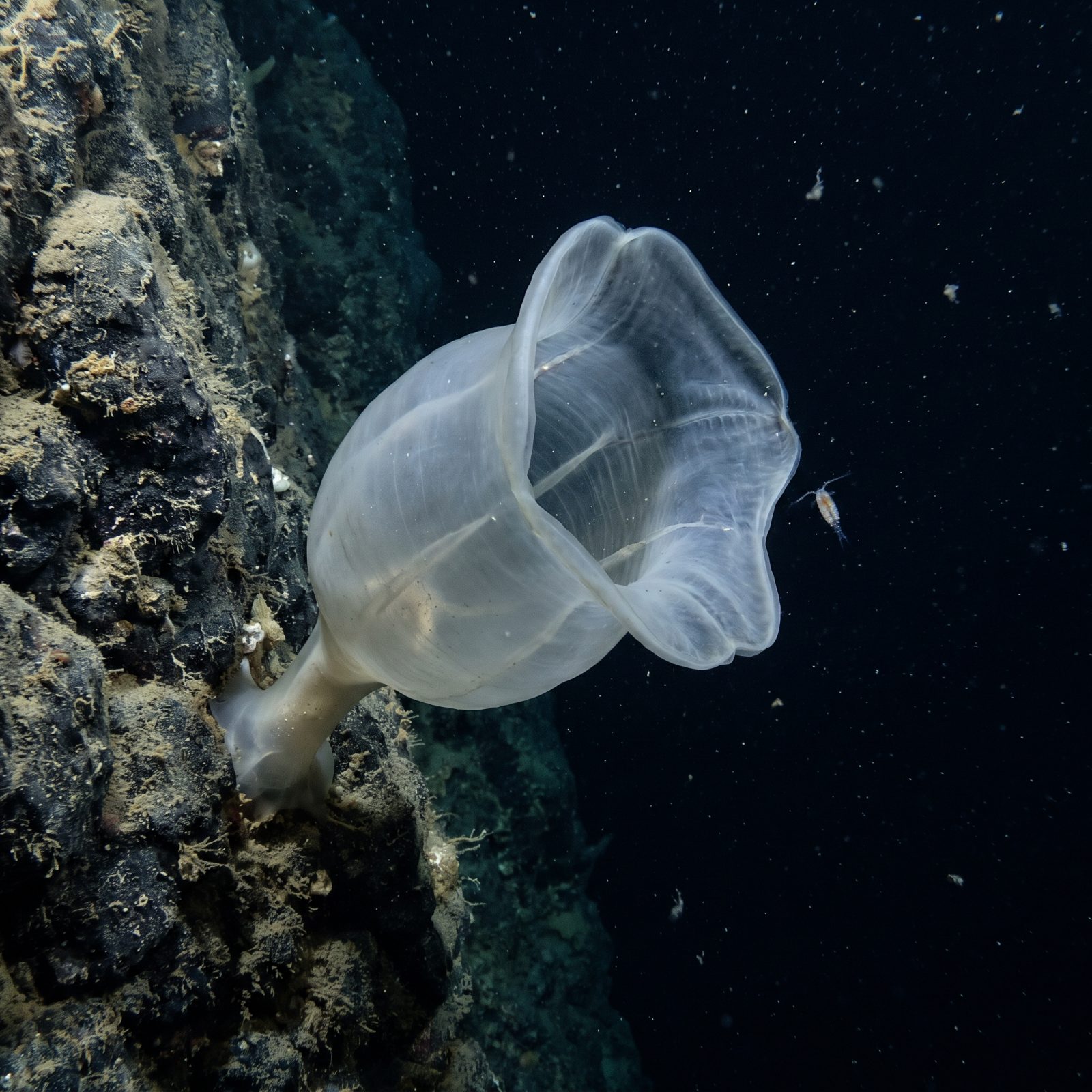
Most sea squirts are peaceful filter feeders, pumping water through their bodies all day. This one turned predator. The hooded tunicate found in Monterey Canyon holds open a wide, translucent mouth like a Venus flytrap and waits.
When a small crustacean drifts inside, the hood snaps shut and the prey is trapped — a sit-and-wait ambush from an animal most people assume couldn’t catch a cold. A body that looks like blown glass, doing the work of a jaw.
In the deep sea, patience isn’t a virtue. It’s a hunting strategy.
6. The Giant Sea Spider With Legs Longer Than Your Hand and Almost No Body
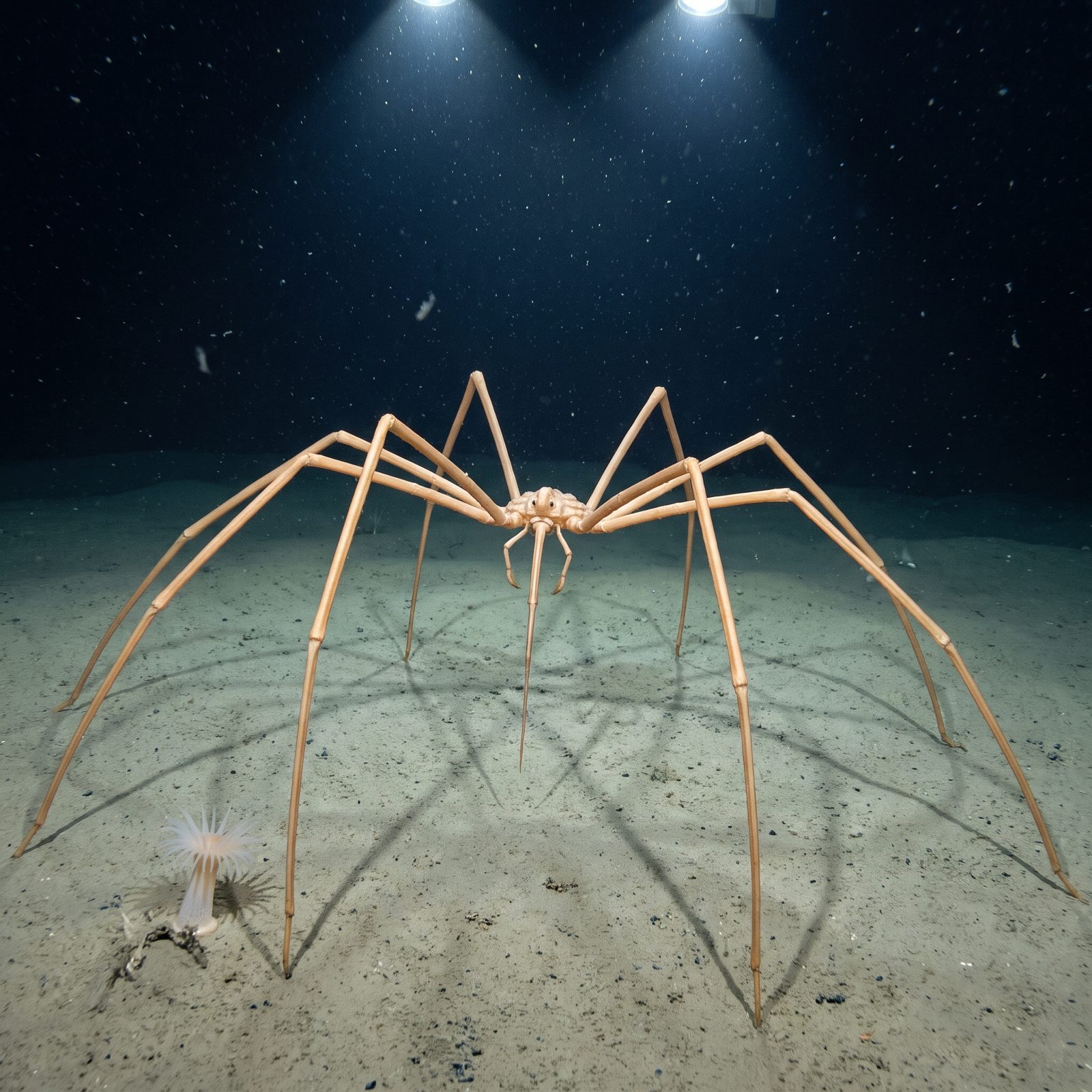
Imagine a spider with legs spanning a dinner plate and a body so small it can barely hold its own guts. That’s the giant sea spider, a real animal that haunts cold deep waters, especially around Antarctica.
Its body is so tiny that its organs — digestive bits included — spill out into its legs. Stranger still, it has no proper lungs or gills, so oxygen just seeps straight through the surface of its skin. Scientists suspect the frigid, oxygen-rich polar water is part of why these creatures balloon so big, a pattern called polar gigantism. All leg, almost no middle, breathing through its body like a rumor.
5. The Phronima Amphipod That Hollows Out a Living Barrel to Raise Its Young
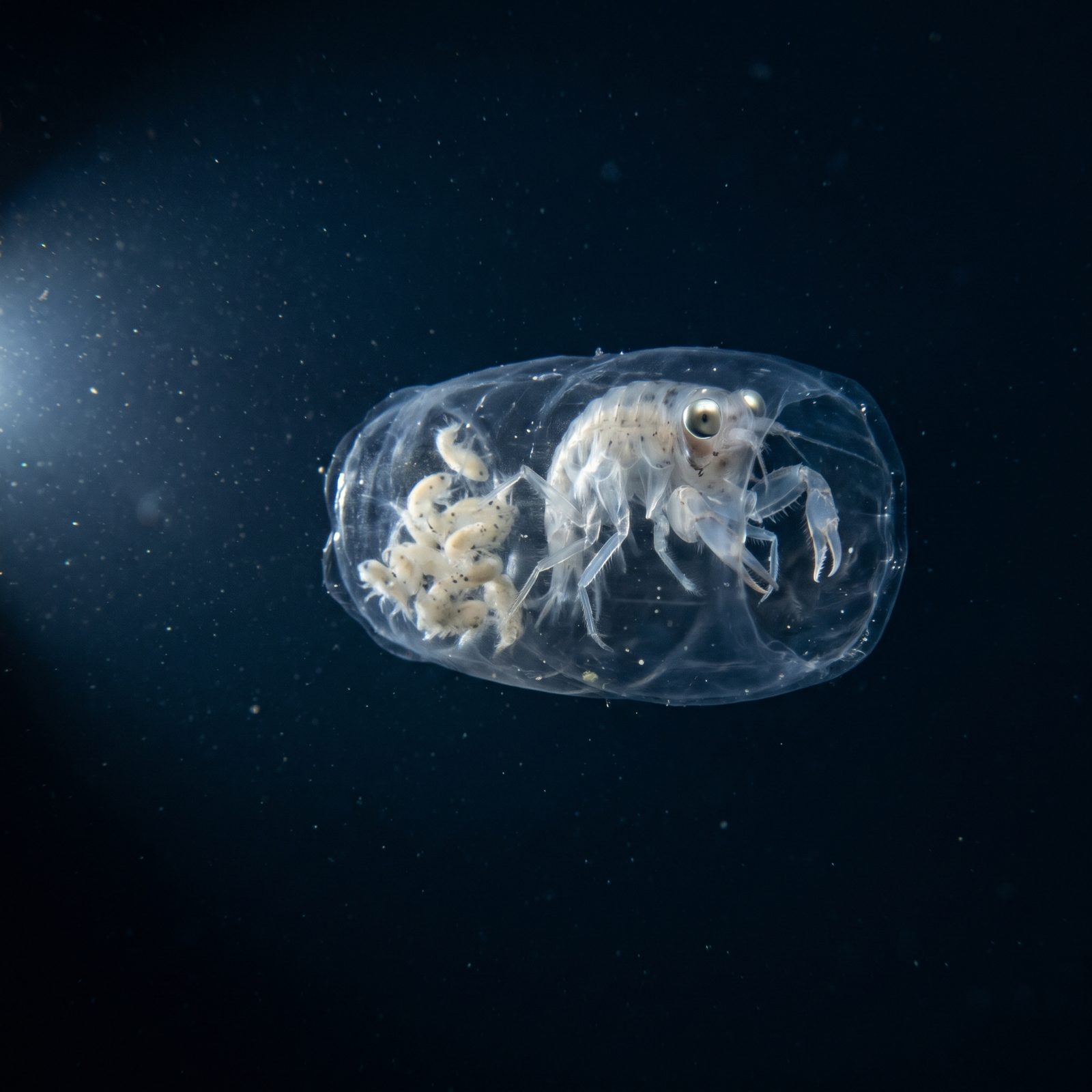
Here’s an animal that reportedly inspired the creature from Alien. Phronima is a small, transparent amphipod that hunts gelatinous animals called salps, then hollows out the victim’s body to make a see-through barrel.
Inside that barrel it lays its eggs and raises its babies, pushing the whole thing through the water like a glassy baby carriage. It drifts through the twilight zone, nearly invisible — a mother and her brood riding inside a stolen house of jelly. Horror movie writers didn’t have to invent much. The ocean got there first.
4. The Basket Star That Unfurls a Fractal Net of Thousands of Branching Arms
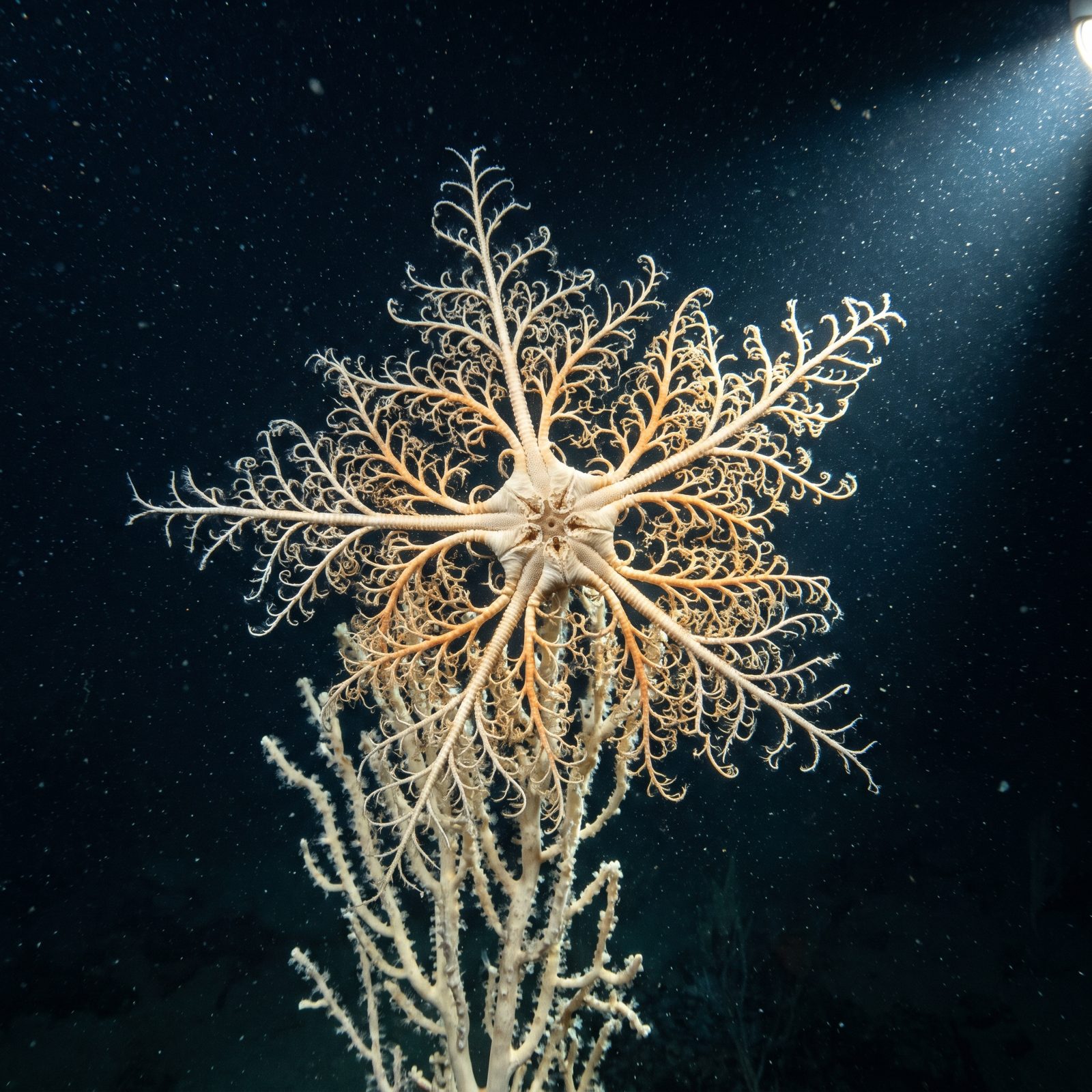
A basket star looks less like an animal and more like living mathematics. Start with five arms. Each arm splits in two. Those split again, and again, until the creature becomes a net of thousands of curling branches — a fractal come to life.
At night it climbs to a high perch, spreads its arms into the current, and catches drifting plankton on the tiny hooks lining each branch. Come morning it rolls the entire tangle back into a tight ball. Relative of the sea star, built like a snowflake, hungry like a net.
3. The Sea Dandelion That’s Actually a Colony of Hundreds of Tiny Animals
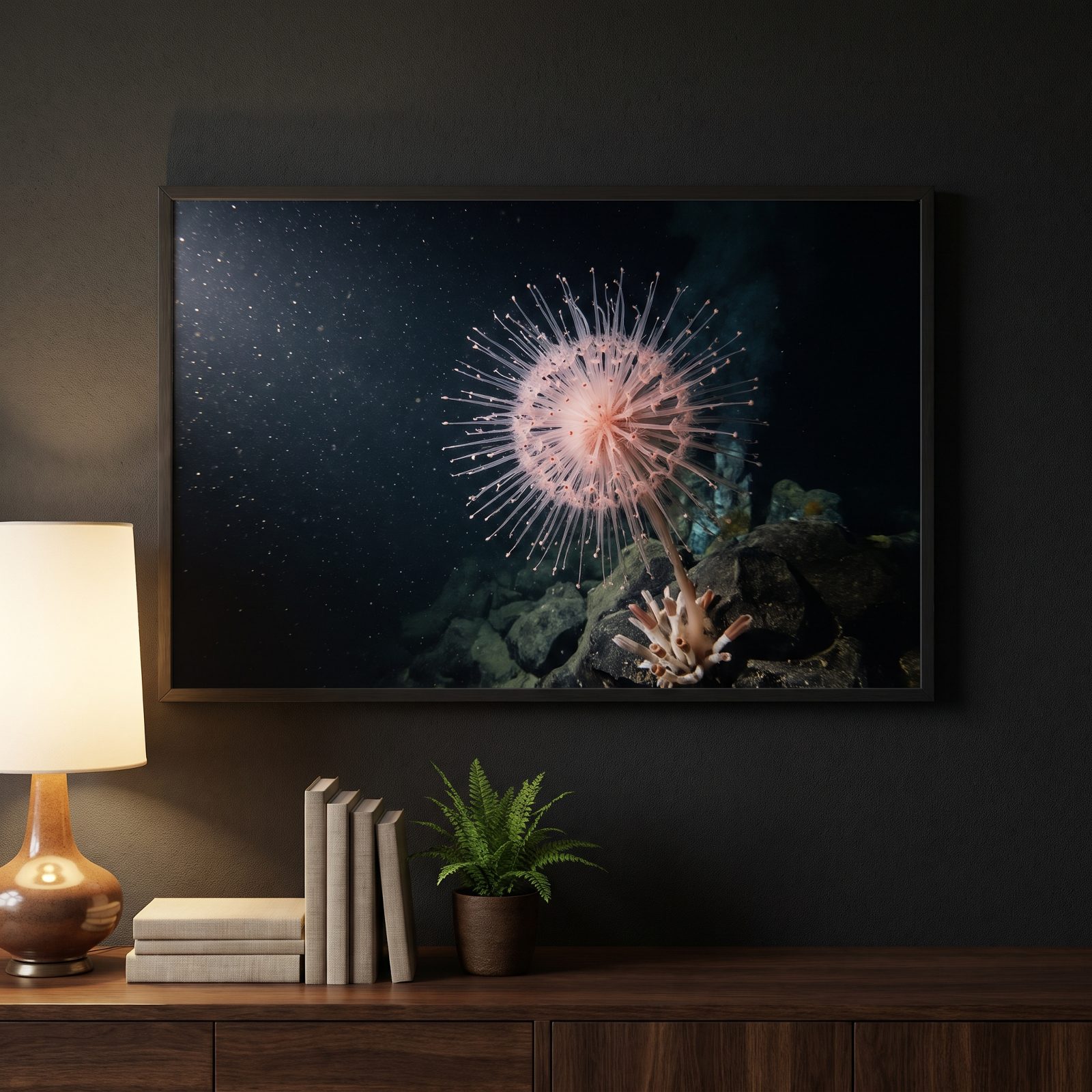
You’d swear you were looking at a dandelion gone to seed, floating on the seafloor near a vent. You’re not. The sea dandelion isn’t one animal at all — it’s a siphonophore, a colony of hundreds of tiny specialized animals living and working as a single body.
Some members catch food. Some digest it. Some handle reproduction. None could survive alone. Together they anchor to the rock and spread their feeding tentacles like a bloom. Its most famous cousin is the Portuguese man o’ war, which fools everyone into thinking it’s a jellyfish. The deep sea’s version just happens to look like a weed in a lawn nobody will ever mow.
2. The Halitrephes Jellyfish That Glows Like an Underwater Firework
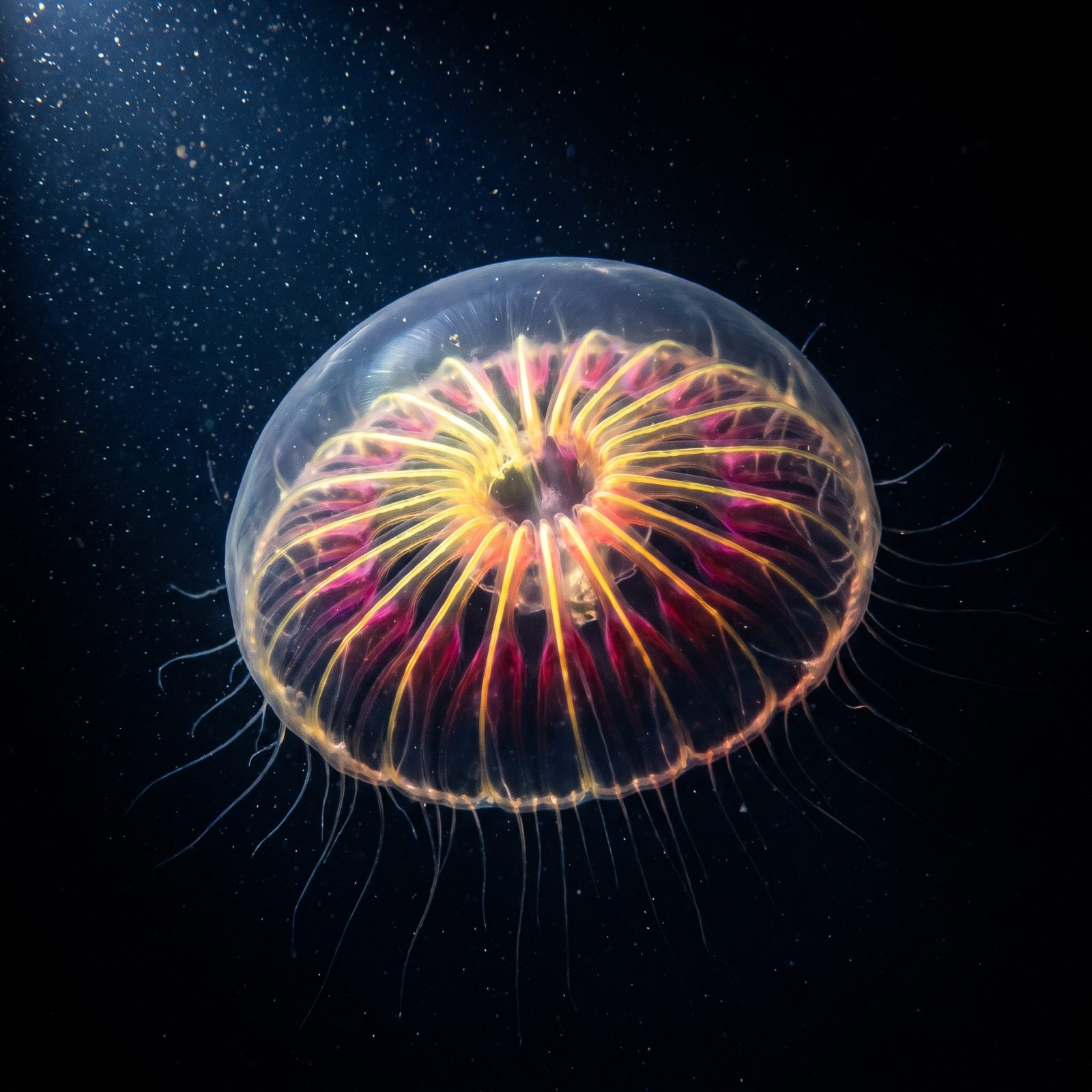
The colors aren’t bioluminescence, and that’s the trick almost everyone gets wrong. The firework effect you see on Halitrephes maxima comes from the submersible’s own lights bouncing off the jelly’s internal canals. Down in the natural dark of its home, 4,000 feet below the surface, this animal is practically invisible — a pane of living glass you’d swim right past.
Those radiating spokes are the gastrovascular system, the plumbing that moves nutrients around a body with no heart and no brain. Switch off the ROV lamp and the whole display vanishes. The jelly goes back to being a clear, ghostly disc drifting through water colder than your refrigerator.
1. The Giant Siphonophore That Stretches Longer Than a Blue Whale
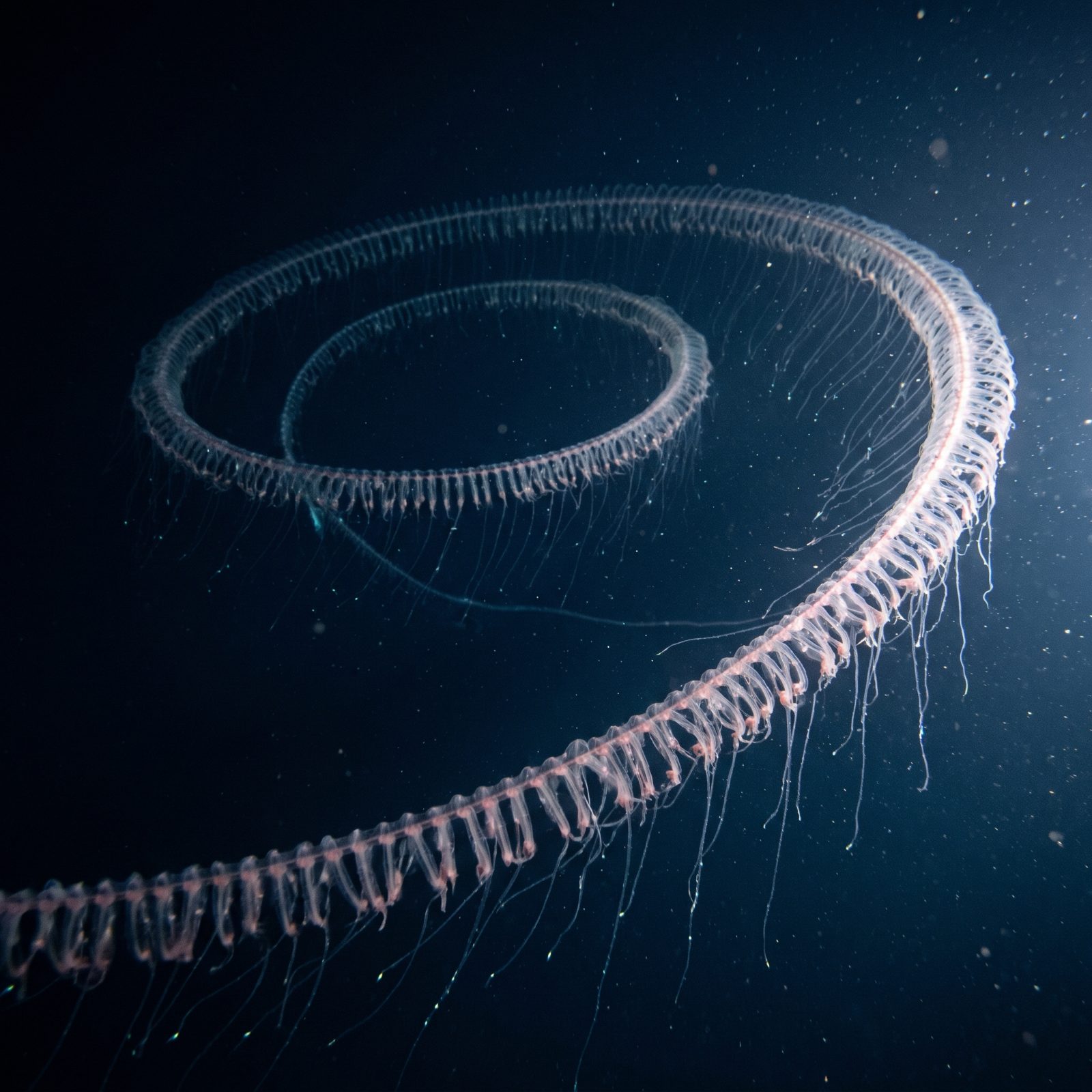
It isn’t one animal. It’s thousands. A siphonophore is a colony of tiny clones called zooids, and each one is specialized for a single job — swimming, feeding, stinging, reproducing. Stitched together, they behave as one organism, and one of them may be the longest living thing ever recorded.
In 2020, a Schmidt Ocean Institute expedition off Western Australia filmed an Apolemia siphonophore coiled in a feeding spiral estimated at roughly 150 feet along its outer ring. That edges past a blue whale, the heaviest animal ever to exist. Length and weight aren’t the same thing, mind you — this creature has the mass of a wet shoelace.
What really gets me is the hunting. The colony drifts a curtain of stinging tentacles and waits for small fish and crustaceans to blunder in. No chase, no effort, just patience stretched across half a football field.
The longest animal on the planet weighs almost nothing and hunts by doing nothing at all.