
Light without heat. No battery, no flame, just chemistry a firefly worked out while dinosaurs still roamed. Most of it happens in the deep ocean, far from any eye that will ever see it, but some of that glow washes right up onto shorelines you can actually visit. Here are organisms that make their own light, and the real places you can watch them do it.
39. Pyrodinium bahamense: The Turquoise Bays of Vieques, Puerto Rico
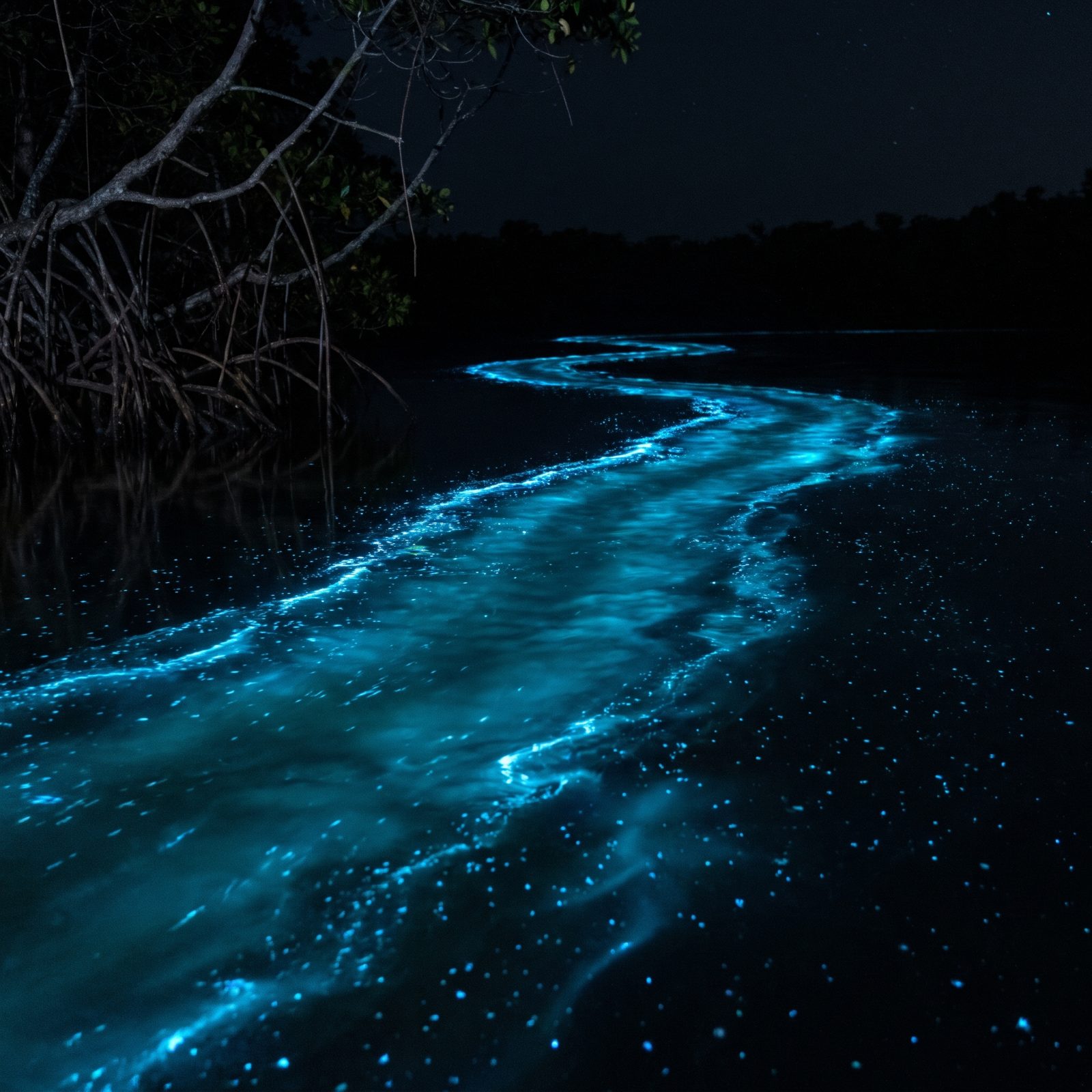
Drag your hand through the water in Mosquito Bay and it lights up like you broke something electric. You didn’t. You squeezed a few thousand single-celled dinoflagellates called Pyrodinium bahamense, and each one fired off a tiny flash of blue-green light in protest.
This is the brightest bioluminescent bay on Earth, and it stays that way because the mangrove-ringed lagoon traps the organisms and feeds them. The glow is a startle response. When water moves against them the plankton flash, probably to spook the tiny animals trying to eat them.
One detail most people miss: it only works in the dark. A full moon drowns the whole show. Book a new-moon night or you’ll paddle across black water wondering what the fuss was about.
38. Firefly Squid: Electric-Blue Spawning in Toyama Bay, Japan
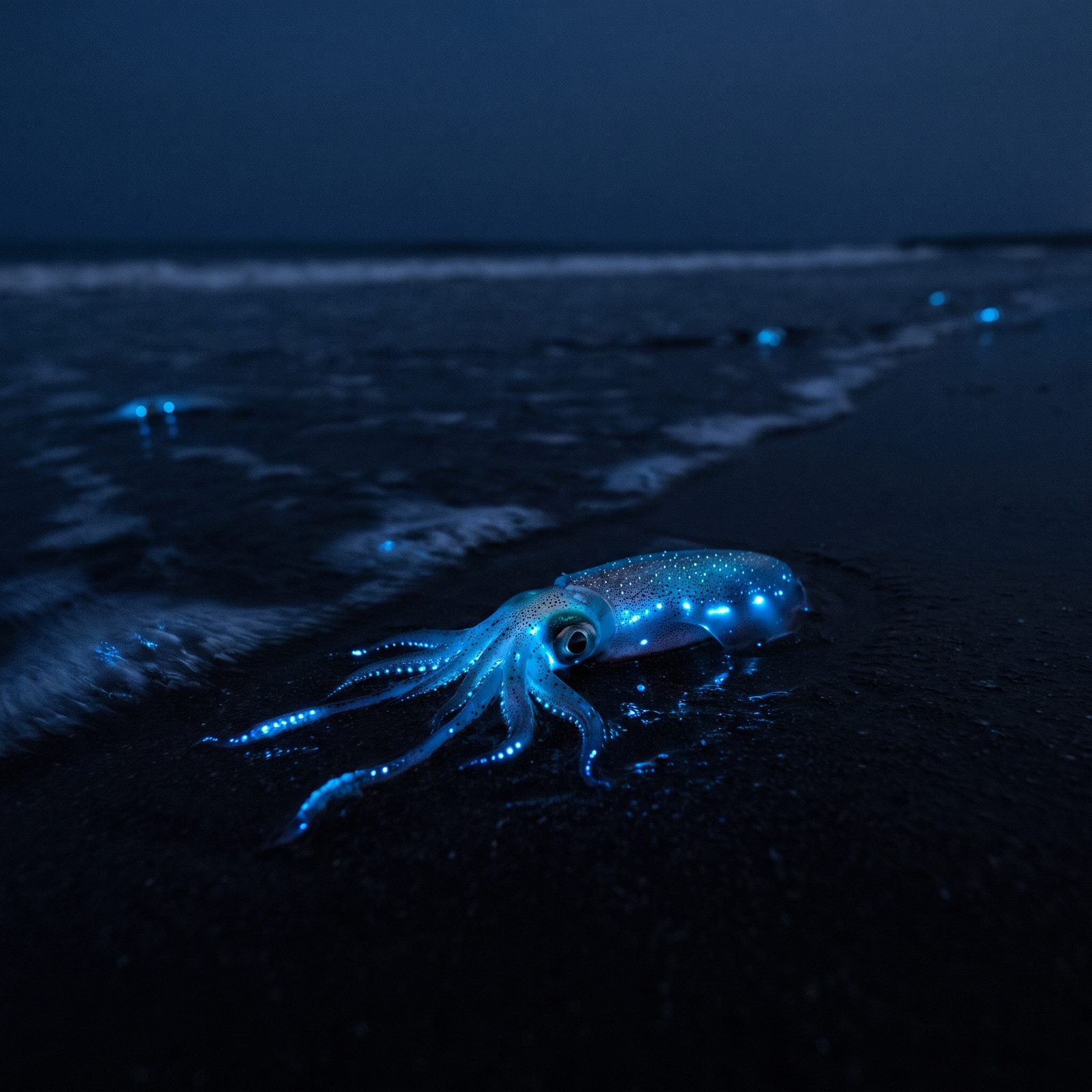
Every spring, Toyama Bay turns its tideline blue. Millions of firefly squid, each barely longer than your thumb, rise from deep water to spawn and wash into the shallows glowing cobalt.
Watasenia scintillans carries light organs called photophores scattered across its body, with the biggest clusters on the tips of two arms. Down deep it uses them for counter-illumination, matching the faint light filtering from above so predators lurking below can’t make out its silhouette. At the surface during the spawning run, the whole species lights up at once — millions of them, all going off together.
Locals have scooped these up for food for centuries, and the spawning grounds were declared a natural monument back in the 1920s. Go in March or April, after midnight, when the fishing boats haul nets shimmering with living light.
37. Hawaiian Bobtail Squid: Borrowed Moonlight Off Oahu
This squid doesn’t make its own light. It rents it.
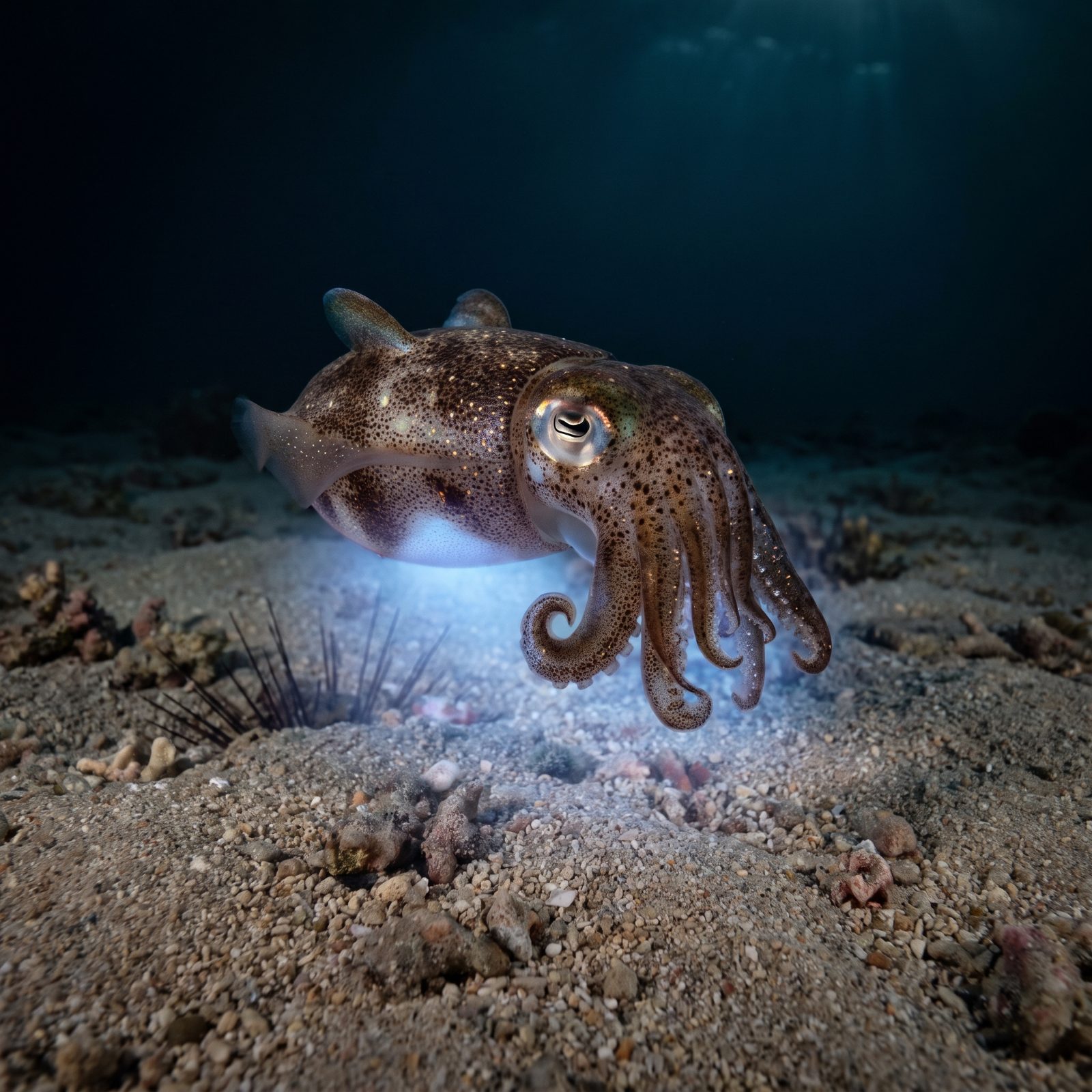
The Hawaiian bobtail squid, a thumbnail-sized creature living in the shallow sandy flats off Oahu, hosts a colony of glowing bacteria called Vibrio fischeri inside a special organ in its belly. The bacteria do the glowing. The squid provides room and board.
Now the clever part. On moonlit nights, a predator swimming below would normally spot the squid as a dark shape against the brighter surface, so the squid points its bacterial glow downward and dials it to match the moonlight exactly, erasing its own shadow. Every dawn it vents out most of the bacteria and lets the colony rebuild over the course of the day.
Scientists love this animal. The partnership is so clean and reliable that it became one of the most studied examples of how animals and bacteria learn to live together.
36. Atolla Jellyfish: The Burglar Alarm of Monterey Canyon
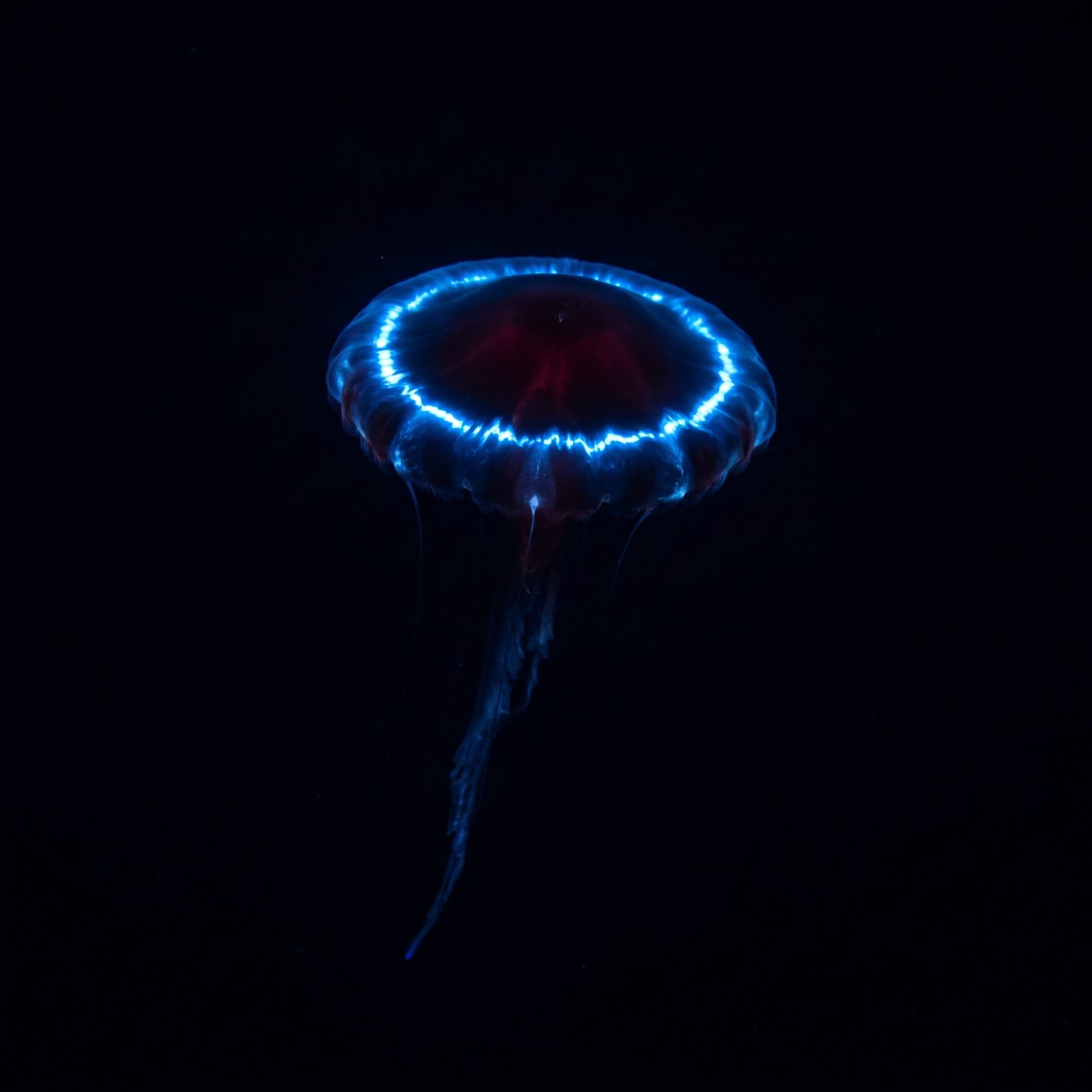
Corner an Atolla jelly in the deep dark of Monterey Canyon and it screams. Not with sound. With light.
When something attacks this deep-red jellyfish, it fires a spinning ring of blue flashes around its bell, a pulsing wave that researchers nicknamed the burglar alarm. The logic is brutal and smart: by lighting itself up, the jelly draws in a bigger predator to go after whatever is attacking it. The flash is a call for backup.
Why red? Down past a few hundred meters red light simply doesn’t exist, so a red animal is invisible — the Atolla stays hidden until it chooses to blaze. That same trick inspired an underwater camera system called the Eye-in-the-Sea, which used a ring of fake blue lights to lure in a giant squid for the first time ever on film.
35. Crystal Jelly: The Green Light Behind a Nobel Prize, San Juan Islands
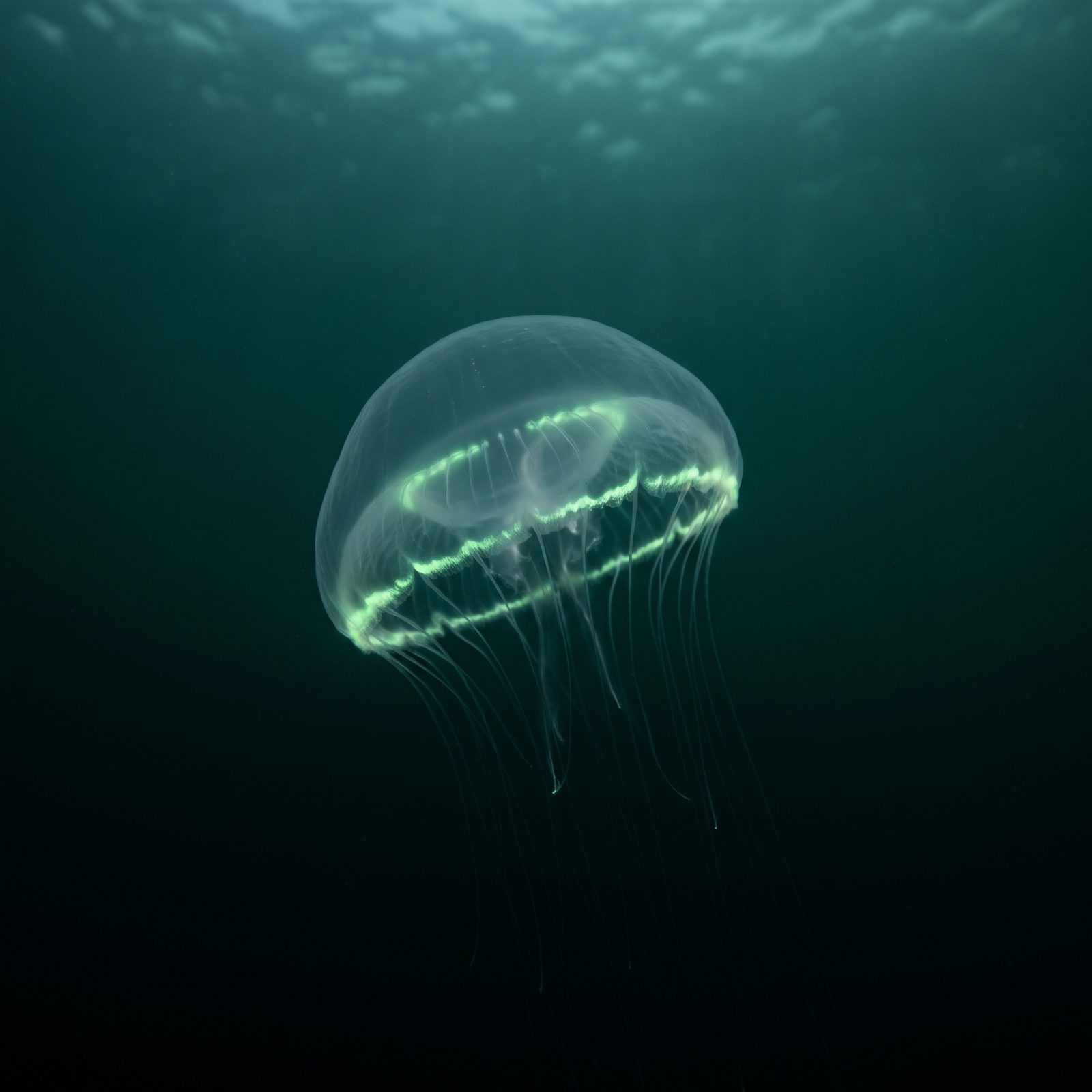
You’ve benefited from this jellyfish even if you never saw one. The crystal jelly — a glassy, nearly invisible bell that drifts through the cold green water around Washington’s San Juan Islands — changed modern biology.
It glows green at the edge of its bell, and the chemistry runs in two steps. A protein called aequorin flashes blue, and a second molecule, green fluorescent protein, catches that blue and re-emits it as green. That second protein, GFP, turned out to be the most useful glow in science.
Researchers learned to splice the GFP gene into other living things, lighting up cancer cells, neurons, and bacteria so they could watch them work inside living tissue. It won the Nobel Prize in Chemistry in 2008. A see-through jelly you’d barely notice in a tidepool became the flashlight that let biology see itself.
34. Bathocyroe Comb Jelly: Blue-Green Fire in the Midwater
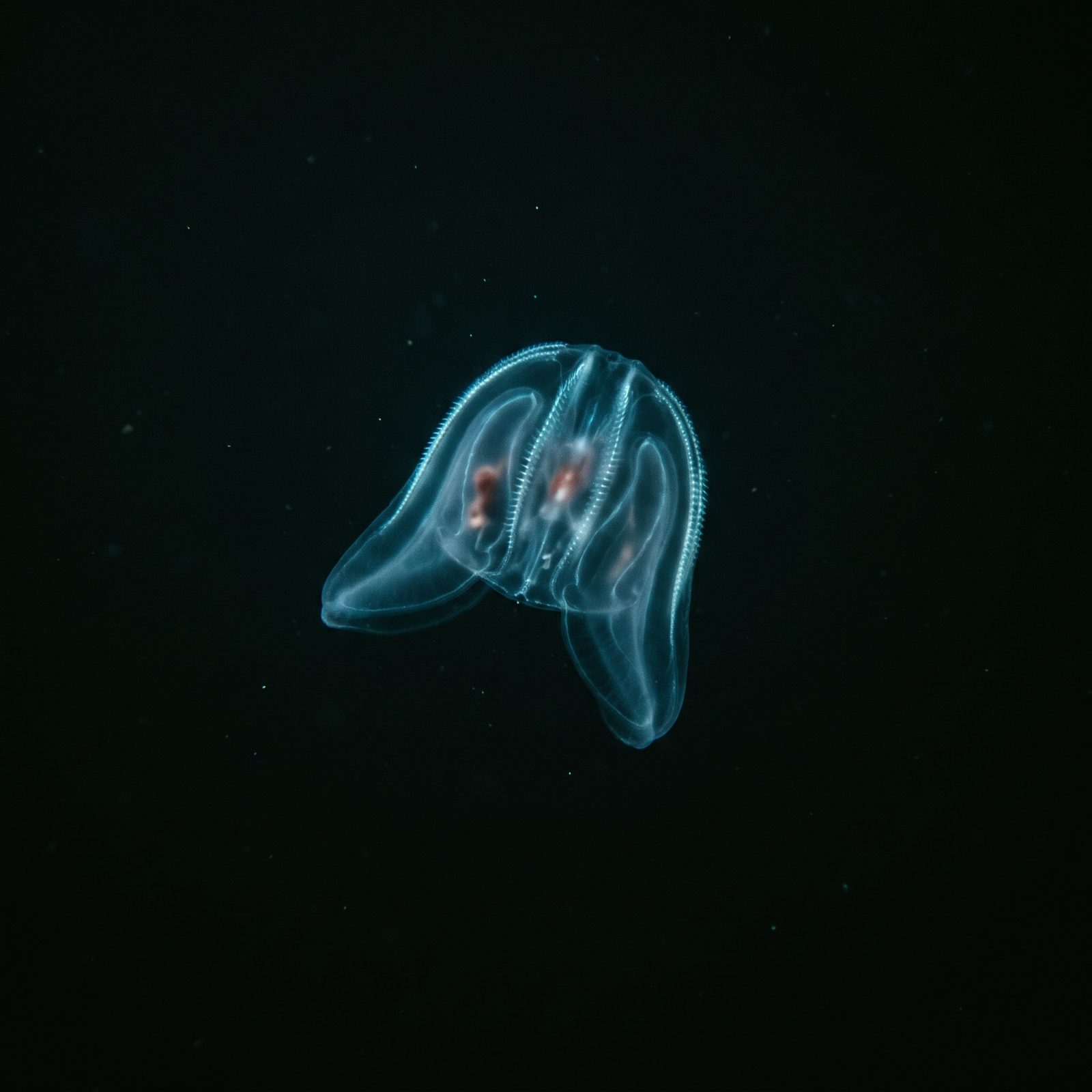
There are two lights on a comb jelly, and only one is real. The shimmer that runs down its body as it swims is just sunlight scattering off beating rows of tiny hairs. Pretty, but a trick of physics.
The actual bioluminescence is something else. Bathocyroe fosteri, a small, wing-lobed comb jelly common in the deep water of Monterey Canyon, glows a soft blue-green when disturbed — light produced inside its own tissues, not borrowed from the sun.
It’s one of the most abundant animals in the deep midwater, yet for years nobody had described it properly because it falls apart the moment you try to net it. The species finally got a name in 1978, once remote submersibles could film it intact. Fragile as a soap bubble, glowing in water that never sees the sun, and so common it may be one of the most numerous luminous animals on the planet.
33. Giant Pyrosome: The Glowing Living Tube Off New Zealand
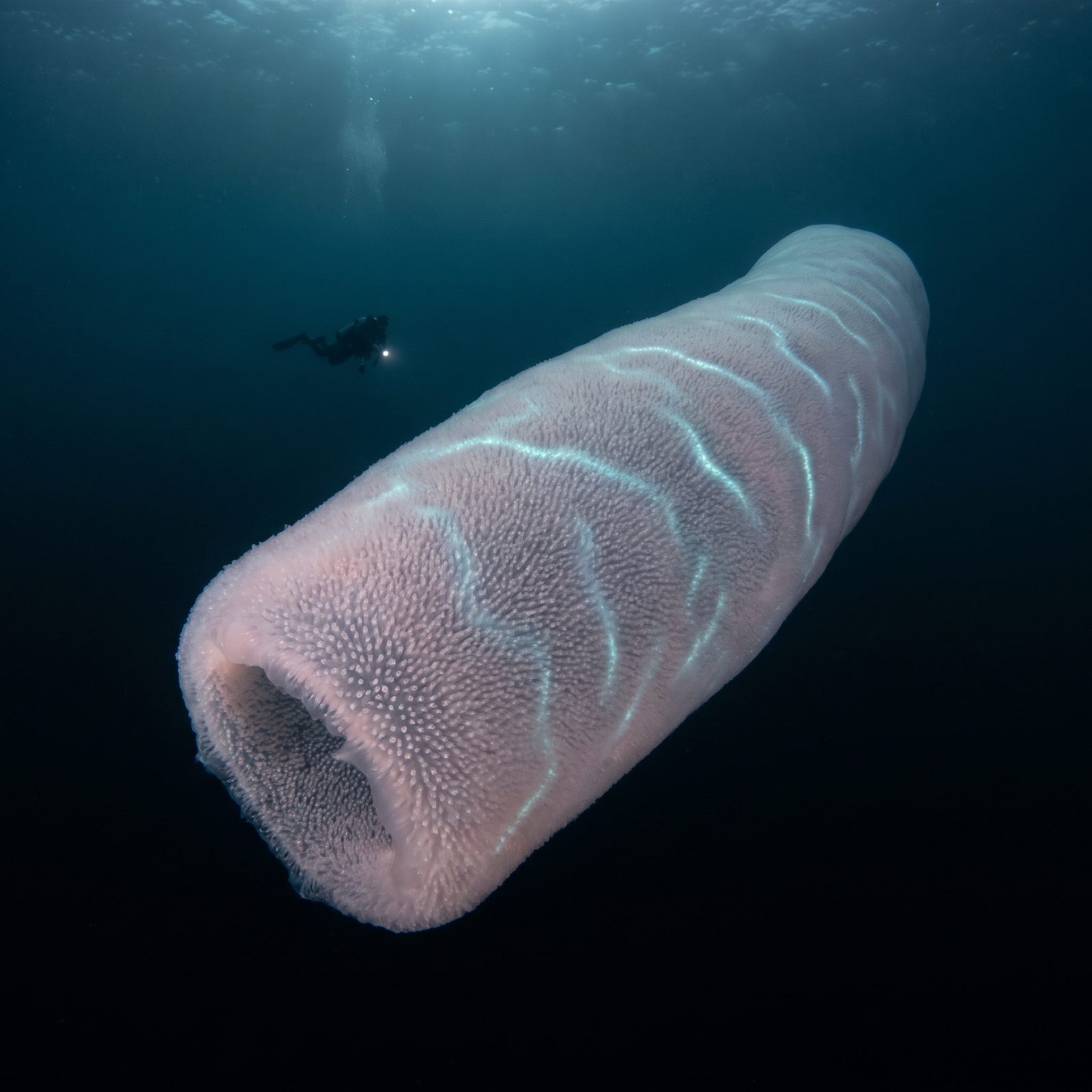
It looks like someone dropped a translucent fire hose into the sea, and then the thing started to glow. A pyrosome isn’t one animal. It’s a colony of thousands of tiny creatures called zooids, all fused into a single hollow tube that can stretch longer than a person.
Off New Zealand, divers sometimes meet these drifting giants in open water. Each zooid filters seawater and lights up, and because they’re wired together, a touch at one end sends a wave of blue-green light rolling down the whole length of the colony. The name comes from Greek: fire body.
The hollow tube works like a slow jet engine — water pumped through by every zooid pushes the whole colony gently forward. A creature made of thousands of lives, moving and glowing as one thing. That’s harder to wrap your head around than almost anything else in the ocean.
32. Vampire Squid: Defensive Light From the Oxygen Desert
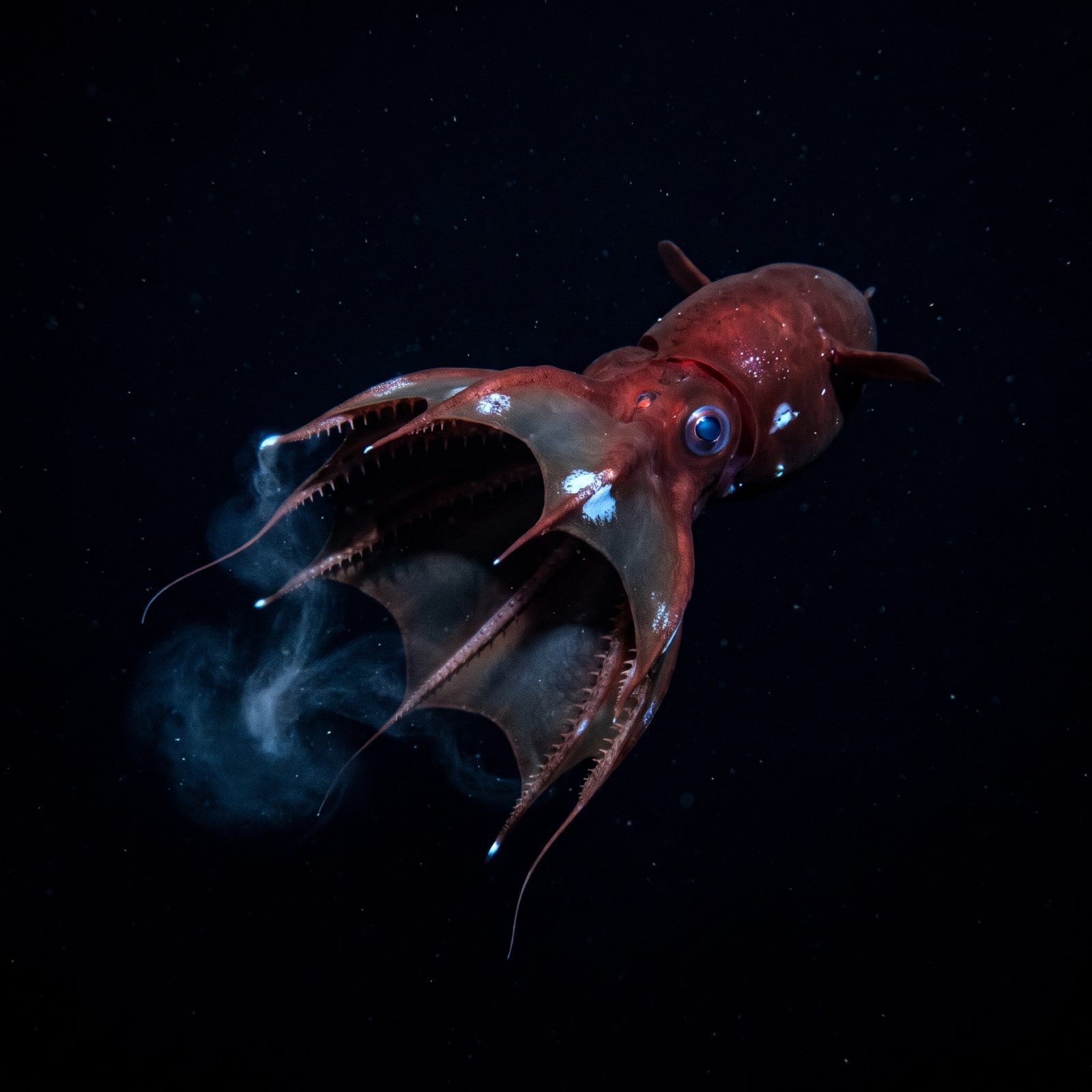
It can’t squirt ink. There’s nowhere for ink to go when the whole ocean around you is already black.
The vampire squid lives in the oxygen-minimum zone, a band of deep water so starved of oxygen that almost nothing else can survive there. That near-empty desert is its refuge, and it has traded speed and ink for a slower life and a stranger defense.
When threatened, it doesn’t flee. It throws light. It releases a cloud of glowing mucus studded with sparkling blue particles from the tips of its arms, a shining smokescreen that confuses a predator while the squid drifts quietly away in the dark. Light-emitting organs across its body can also flash and pulse.
Its scientific name translates to vampire squid from hell, a label it does not deserve. It eats mostly marine snow, the gentle drift of dead particles sinking from above. A cloak-wearing drifter that fights with glitter instead of ink.
31. Dana Octopus Squid: Blinding Flashbulbs in the Deep Off Hawaii
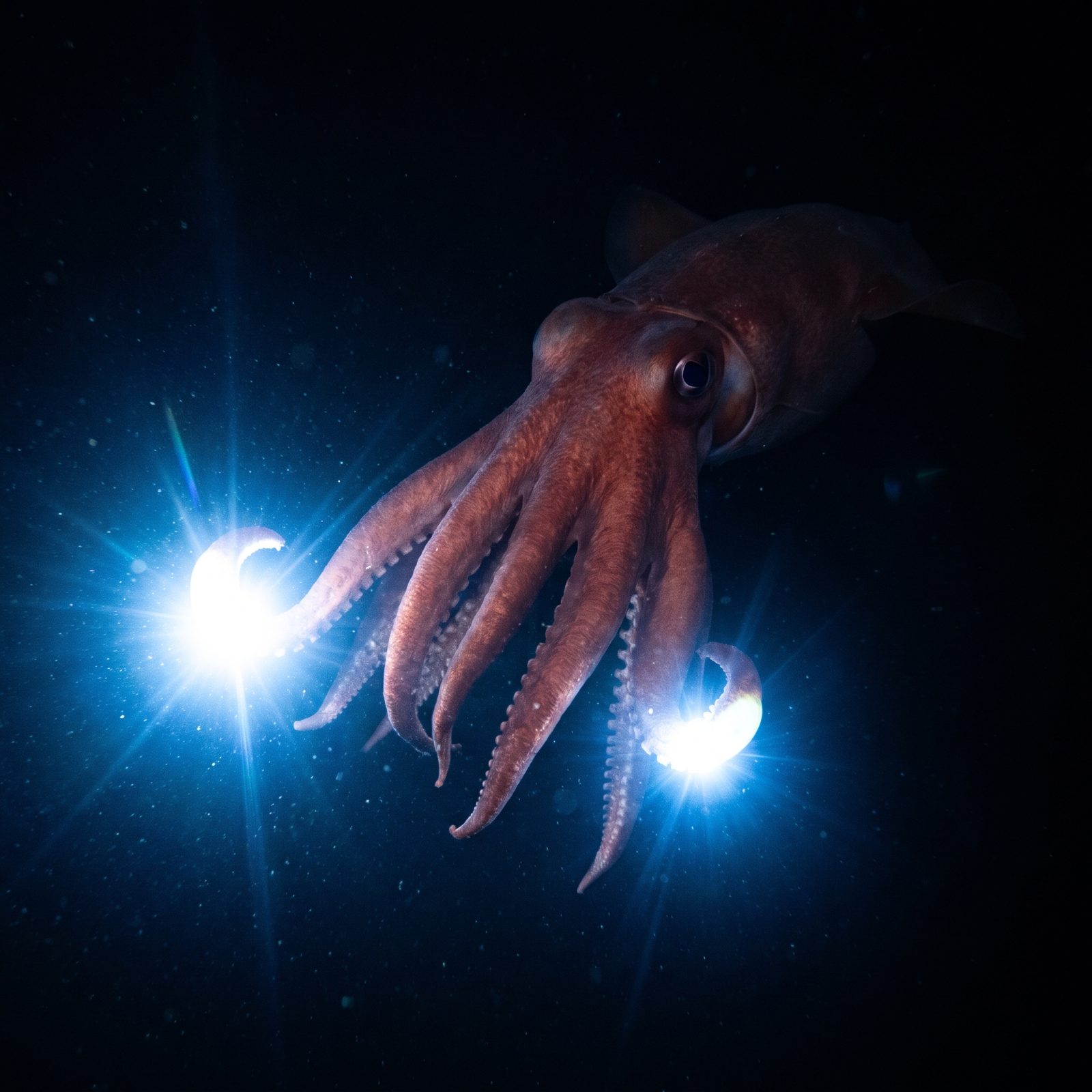
This squid carries the largest light organs of any animal on Earth — two of them, each the size of a lemon, mounted on the tips of its arms. And it uses them like a photographer’s flash.
The Dana octopus squid hunts in deep water off Hawaii, a powerful predator about as long as a tall person. When it attacks, it fires blinding blue-white bursts from those arm-tip organs, flashes bright enough to startle and disorient prey in the pitch black. Some researchers think the flash also helps it judge distance in the dark, lighting its target for a fraction of a second before the strike.
Deep-sea cameras have caught it doing something else: long and short pulses before it closes in, almost like a signal. Communication, a threat, or just a hunting technique? Nobody’s sure. A predator that brings its own lightning to a fight.
30. Stauroteuthis Octopus: The Glowing Suckers of the Gulf of Maine
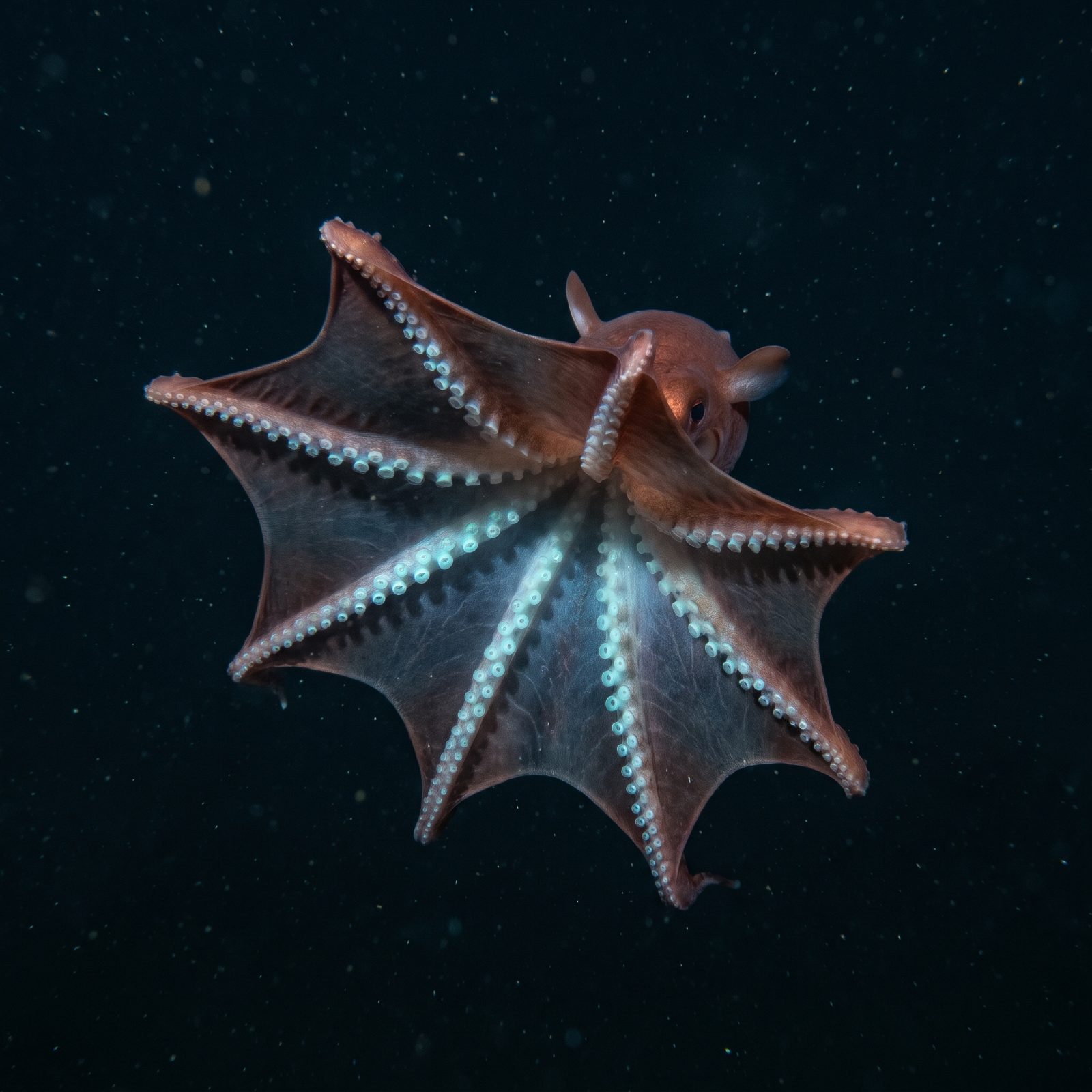
An octopus sucker is for gripping. Except on this one, where it’s for glowing.
The Stauroteuthis octopus lives in the cold deep of the Gulf of Maine, a soft, webbed little creature that opens its arms like an umbrella. Along those arms, many of its suckers have given up holding onto anything and become light organs instead, producing a soft blue-green glow in neat rows.
This caught scientists off guard. Octopus suckers that light up were essentially unknown until this animal was studied closely in the late 1990s. Why? Nobody’s certain. The glowing rows may lure in the tiny crustaceans it feeds on, drawing prey straight toward its mouth like runway lights guiding a plane to the gate.
It’s one of the only octopuses known to glow at all — a creature that turned its own hands into lamps, out in water so deep no sunlight has ever reached it.
29. Humpback Anglerfish: A Bacterial Lure in the Deep Atlantic
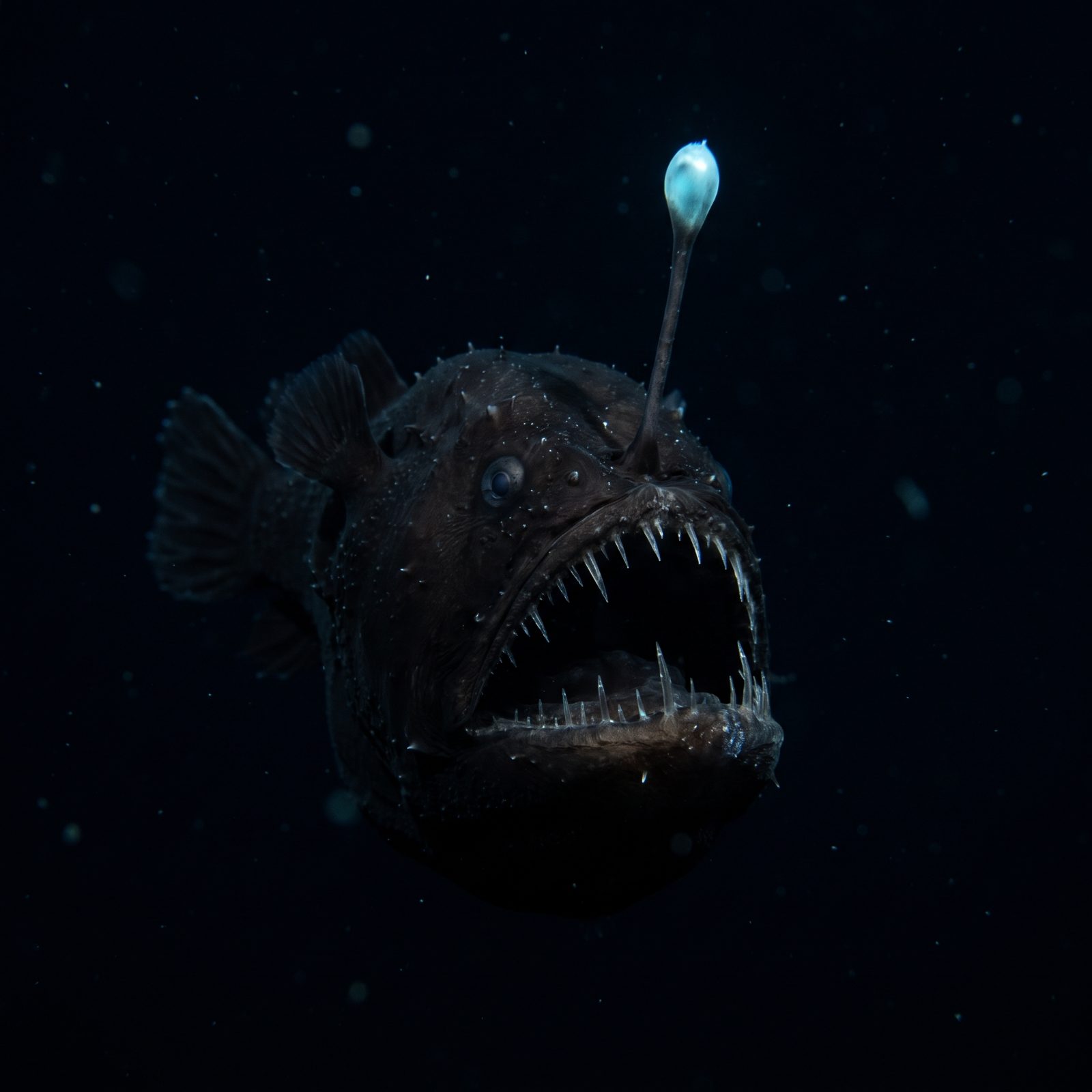
She doesn’t make her own light, and that part surprises people. The glow at the end of that fishing-pole lure comes from colonies of bioluminescent bacteria the anglerfish farms inside a little pouch called the esca. Strike a deal with microbes, get a porch light for life.
The bacteria produce a steady blue-green shine, and smaller fish drift toward it the way moths drift toward a bulb — straight into a mouth that opens wider than the rest of the body. Only females carry the lure. Males are tiny, and in some related anglerfish they fuse permanently to the female, shrinking into little more than a pair of gonads glued to her flank.
You won’t see this one from a dock. It lives in the lightless Atlantic midwater, thousands of feet down, filmed only by submersibles and ROVs.
28. Stoplight Loosejaw: Secret Red Searchlights in Tropical Deep Water
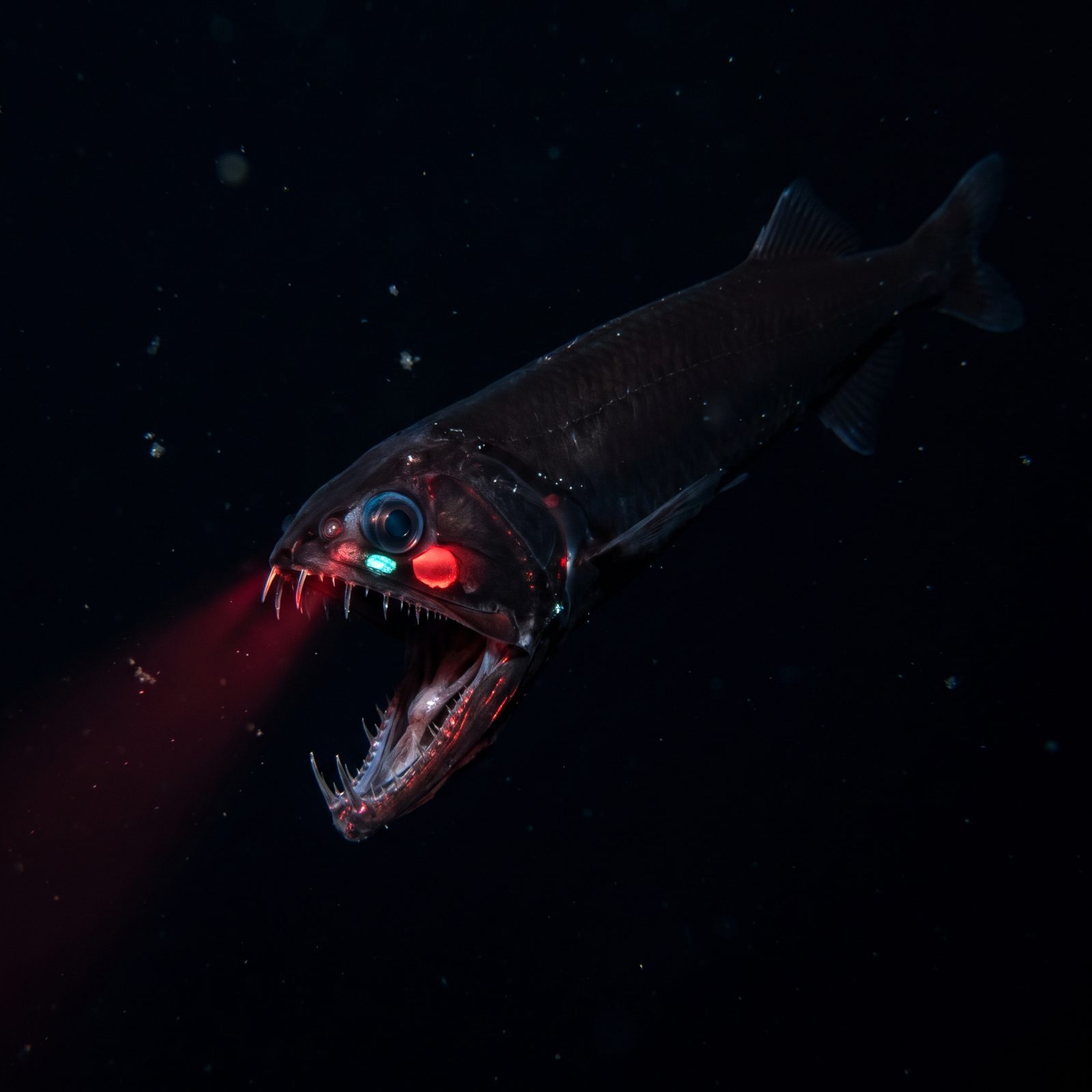
Red light is nearly impossible to find in the deep sea. Water swallows it long before it reaches those depths, which means almost every deep-sea animal is simply blind to red. The stoplight loosejaw turns that blindness into a weapon.
It carries a scatter of glowing organs across its cheek and gill area. Several small patches flash the usual blue-green. Two others, one under the eye and one behind the gill cover, pump out red — a beam its prey can’t detect. So the loosejaw lights up a shrimp like a sniper scope while the shrimp has no clue it’s been spotted. A flashlight only you can see.
Pulling this off takes some chemistry theft. The worm — sorry, the fish — borrows a pigment related to chlorophyll, likely scavenged from the copepods it eats, retooling plant chemistry so it can perceive its own red glow. It haunts tropical and subtropical deep water around the globe, caught mostly by research trawls and the occasional deep camera.
27. Flashlight Fish: Blinking Bacterial Organs Around the Cayman Islands
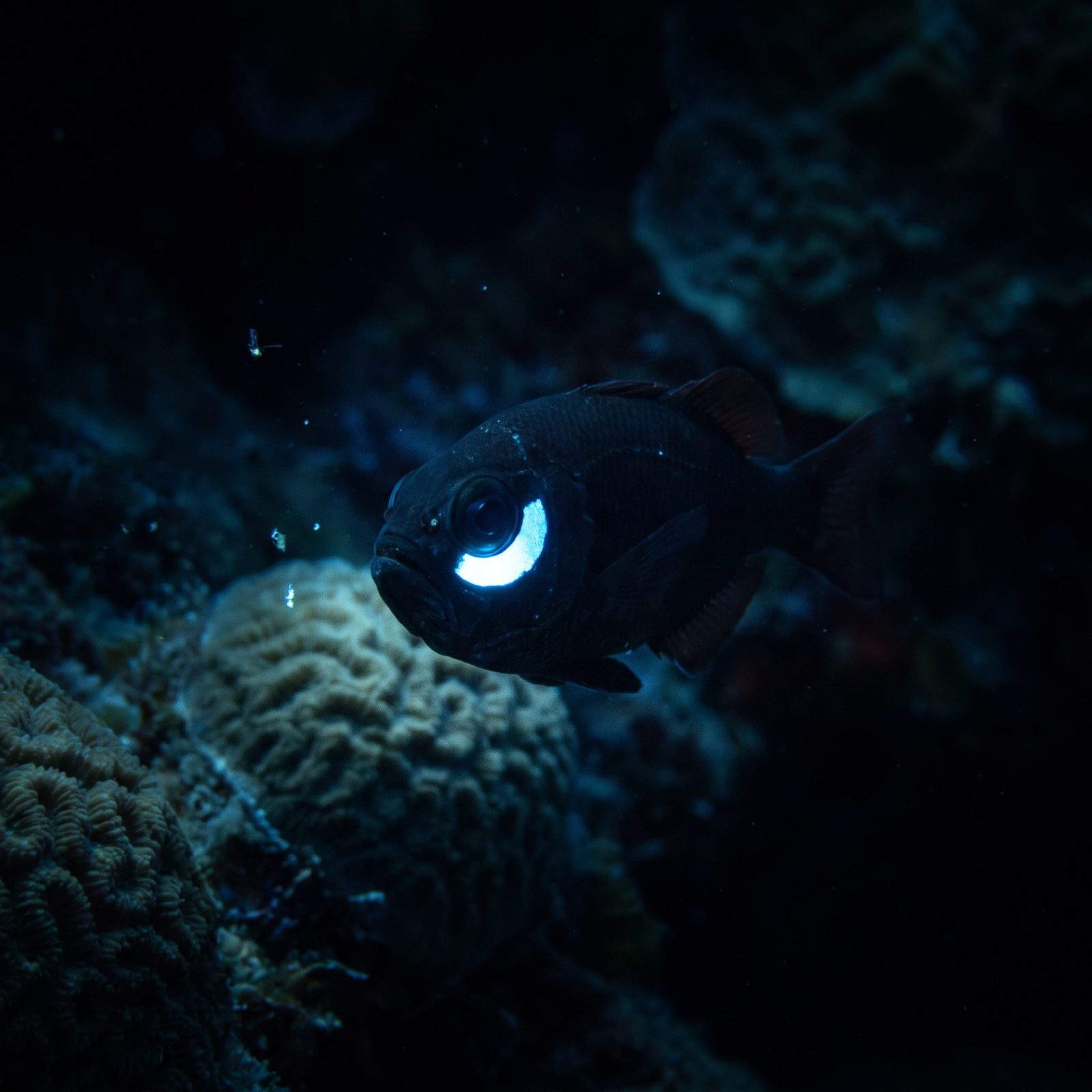
These are the headlights of the reef.
Under each eye sits a bean-shaped organ packed with glowing bacteria, among the brightest biological lights known, visible to divers from over a hundred feet away. And here’s the good part: the fish can blink it, rolling a dark lid over the organ or rotating it inward, flashing on and off as it swims.
That blinking earns its keep. It confuses predators, signals other flashlight fish, and lights up plankton to eat. A quick on-off dash — the fish darting sideways in the dark gap it just created — is a classic escape trick.
Around the Cayman Islands and other Caribbean deep reefs, night divers on moonless nights sometimes catch them rising from below, little blue lanterns winking along the wall.
26. Kitefin Shark: The World’s Largest Glowing Vertebrate off New Zealand
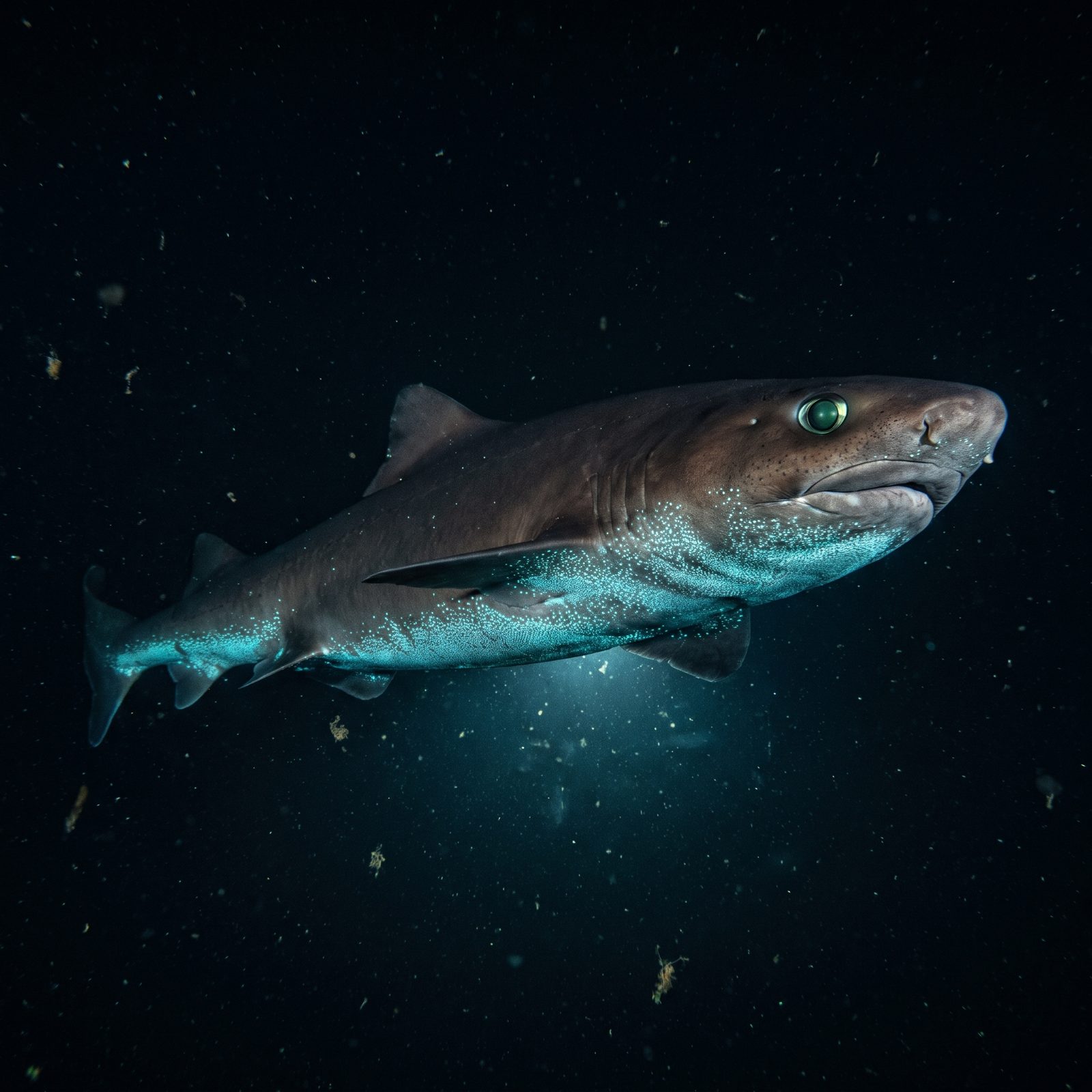
Until recently nobody had proven a shark this big could glow. Then researchers hauled kitefin sharks up from the deep water off New Zealand and confirmed it. At nearly six feet, it now holds the title of largest known luminous vertebrate on Earth.
The light pours from its underside, a trick called counterillumination. Picture the shark from below: against the faint glow filtering down from the surface, a dark body shows up as a crisp silhouette. A glowing belly erases that shadow, and the shark melts into the dim light above. Invisible by light, not by hiding.
Hormones run the display rather than nerves, so the glow fades up and down slowly, like a dimmer switch on a timer. It lives on continental slopes around the world, though the New Zealand population gave science its first clear look.
25. Cookiecutter Shark: A Glowing Disguise Around Hawaii
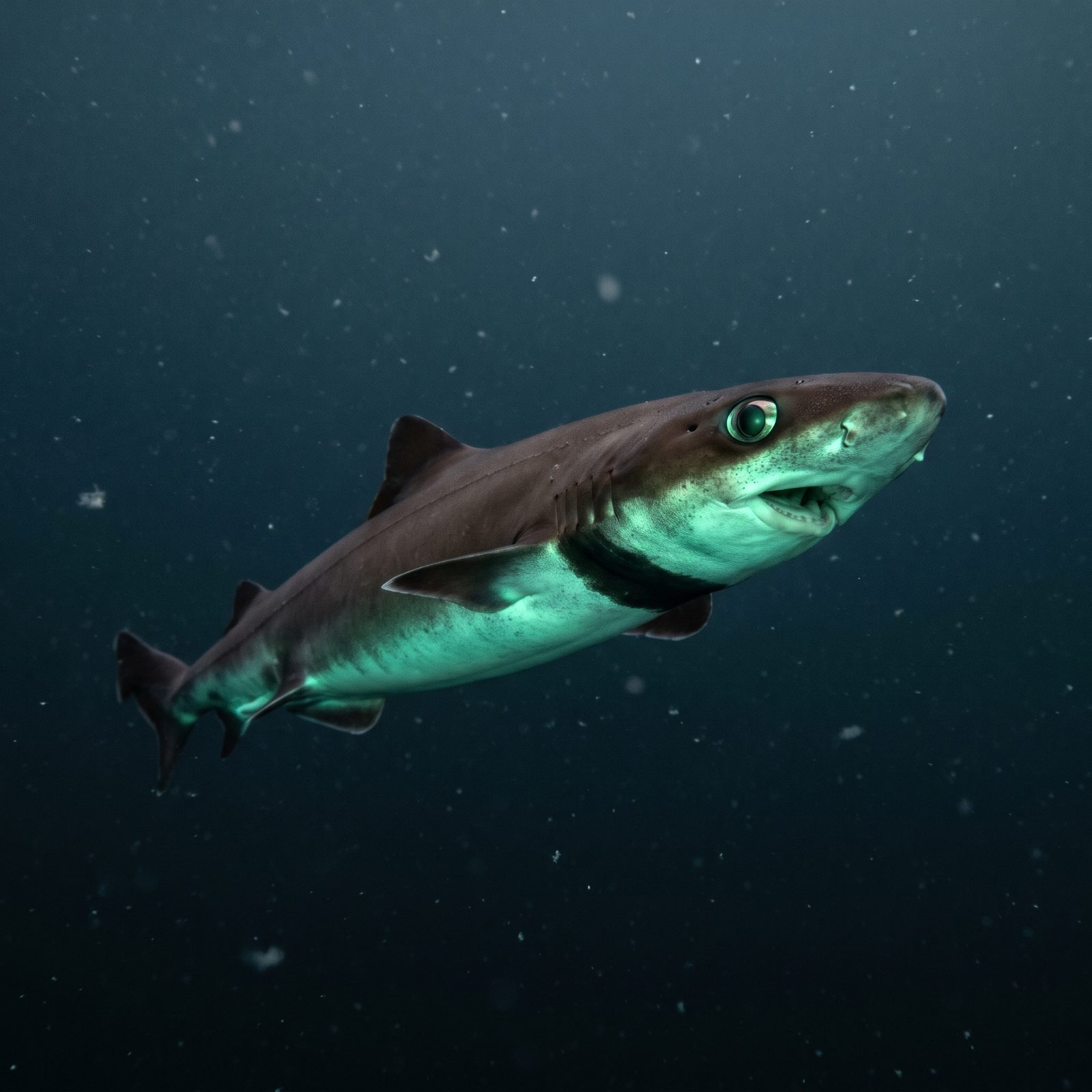
Small, strange, and one of the ocean’s best con artists. The cookiecutter shark glows green across its whole belly to disappear — the same counterillumination the kitefin uses — but it deliberately leaves one spot dark: a band around its throat.
Against that softly lit underside, the unlit collar reads like a small fish swimming alone. Tuna, seals, even great whites rise up to grab the fake snack. Then the shark clamps its round suctioning mouth onto them, spins, and twists out a perfect plug of flesh. That’s where the name comes from. It bites, and it leaves a cookie-shaped crater.
Around Hawaii it climbs toward the surface at night to hunt, then sinks back into the deep by day. Divers almost never see it. The evidence turns up later, as neat round wounds on much bigger animals.
A fish that turns its own glow into bait, then uses the one dark patch on its body as the hook.
24. Lanternfish: Vast Nightly Light Shows in Every Major Ocean
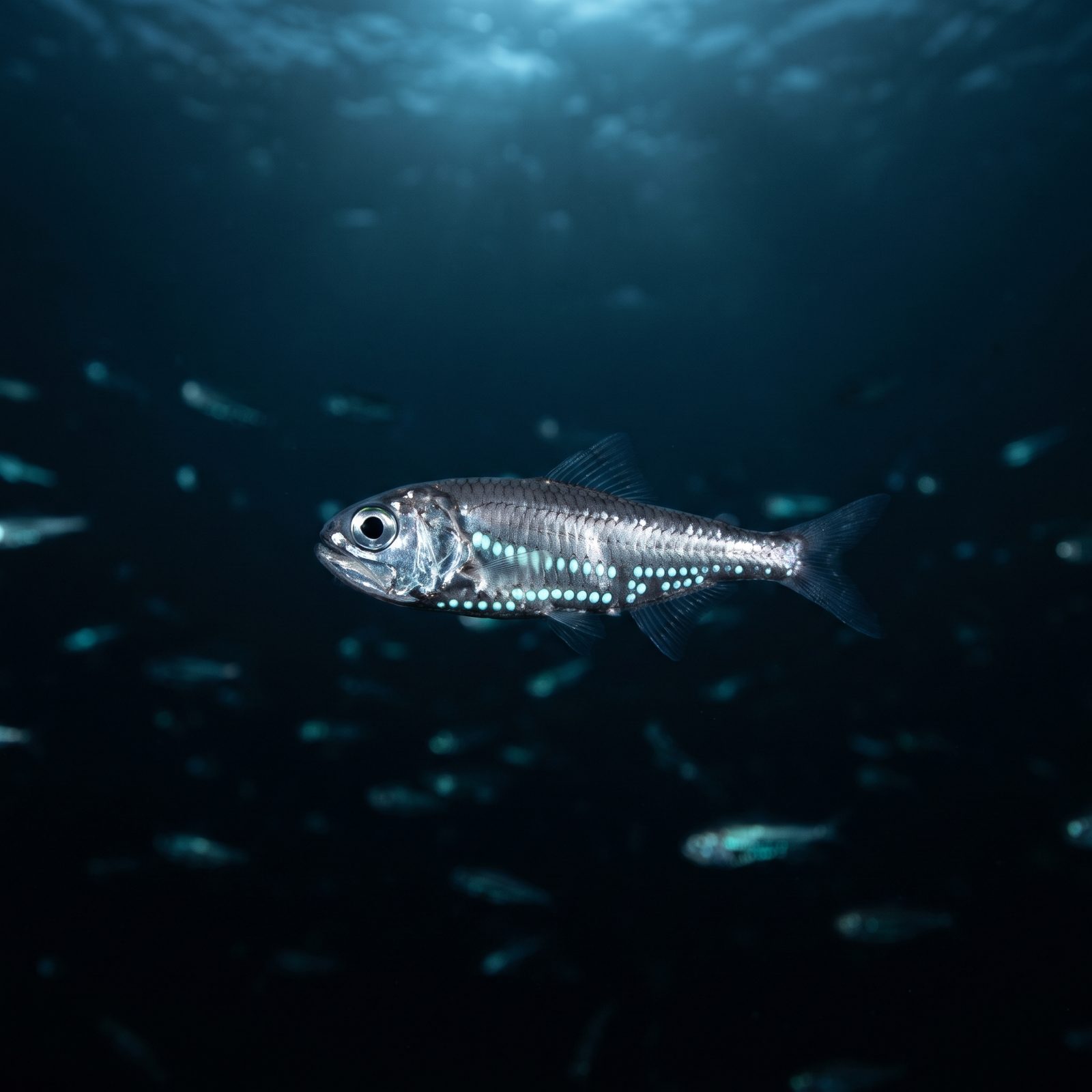
The most abundant vertebrates on the planet, and almost nobody has heard of them.
Lanternfish make up a staggering share of all the fish in the open ocean by weight. Most are no longer than your finger. Each one carries rows of light organs along its body, arranged in patterns unique to its species — think of a license plate written in light.
Those patterns let them recognize their own kind in the dark and smudge out their silhouette from below. And every night, by the billions, they rise from the deep toward the surface to feed, then sink again by dawn. It’s the biggest animal migration on Earth, and it runs twice a day in every ocean, a tide of fish you never see.
23. Ponyfish: Bacterial Light Shining Through the Belly in Southeast Asia
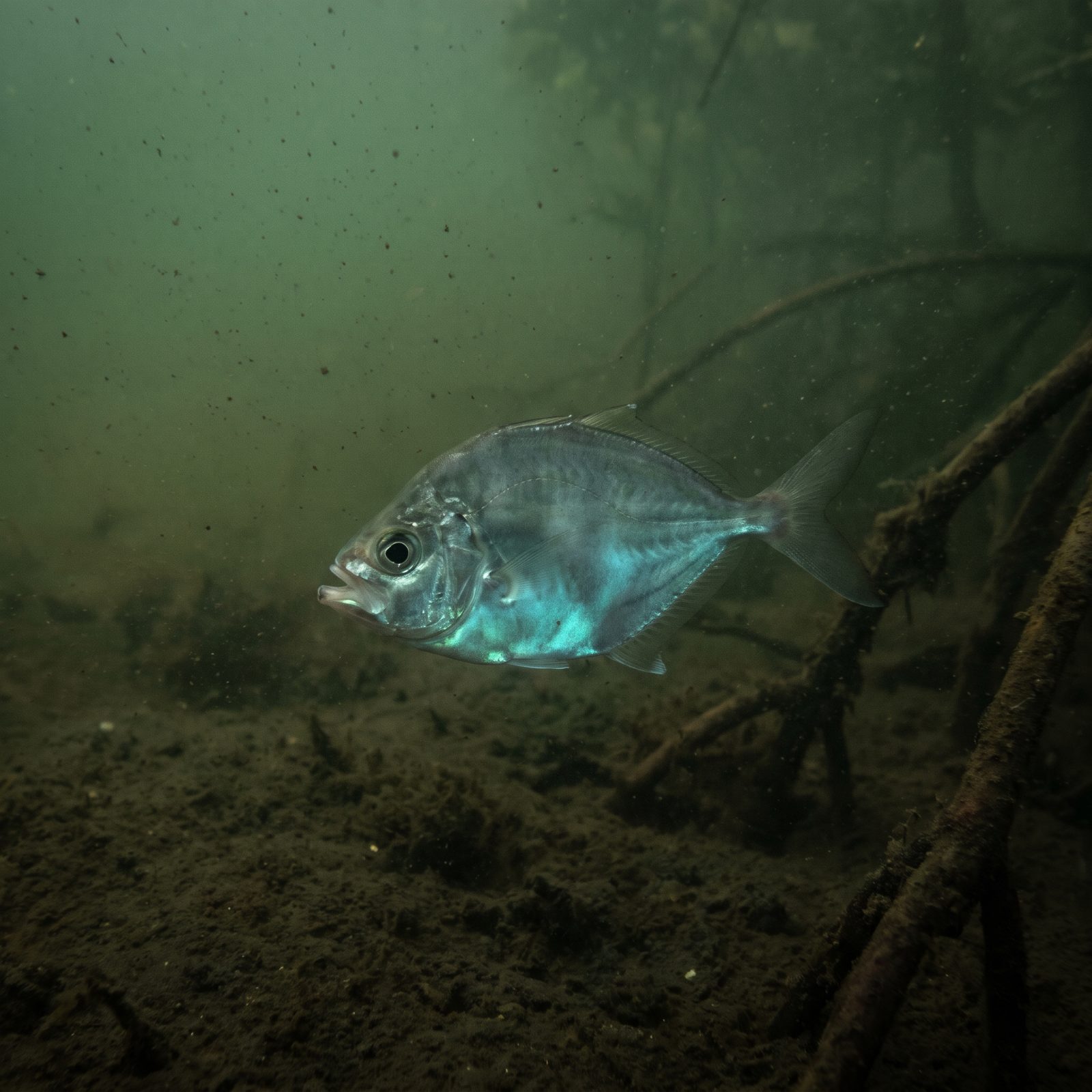
Here’s a neat bit of plumbing in a palm-sized fish. The ponyfish houses a ring of glowing bacteria around its gut, then uses its own silvery, mirror-like internal tissue to spread that single light source evenly across its belly. One bulb, a whole lightbox.
Males and females glow differently, and males can flash courtship signals through transparent patches, basically blinking their bellies at each other in the murk. It’s counterillumination too, wiping out the shadow a predator below would otherwise catch.
Ponyfish swarm the warm coastal waters and muddy estuaries of Southeast Asia, often netted by the ton for food and fish paste. The glow fades fast once they leave the water, so you’d never guess the living fish were quietly lit from inside.
22. Green-Bomber Worm: Detachable Glowing Bombs off California
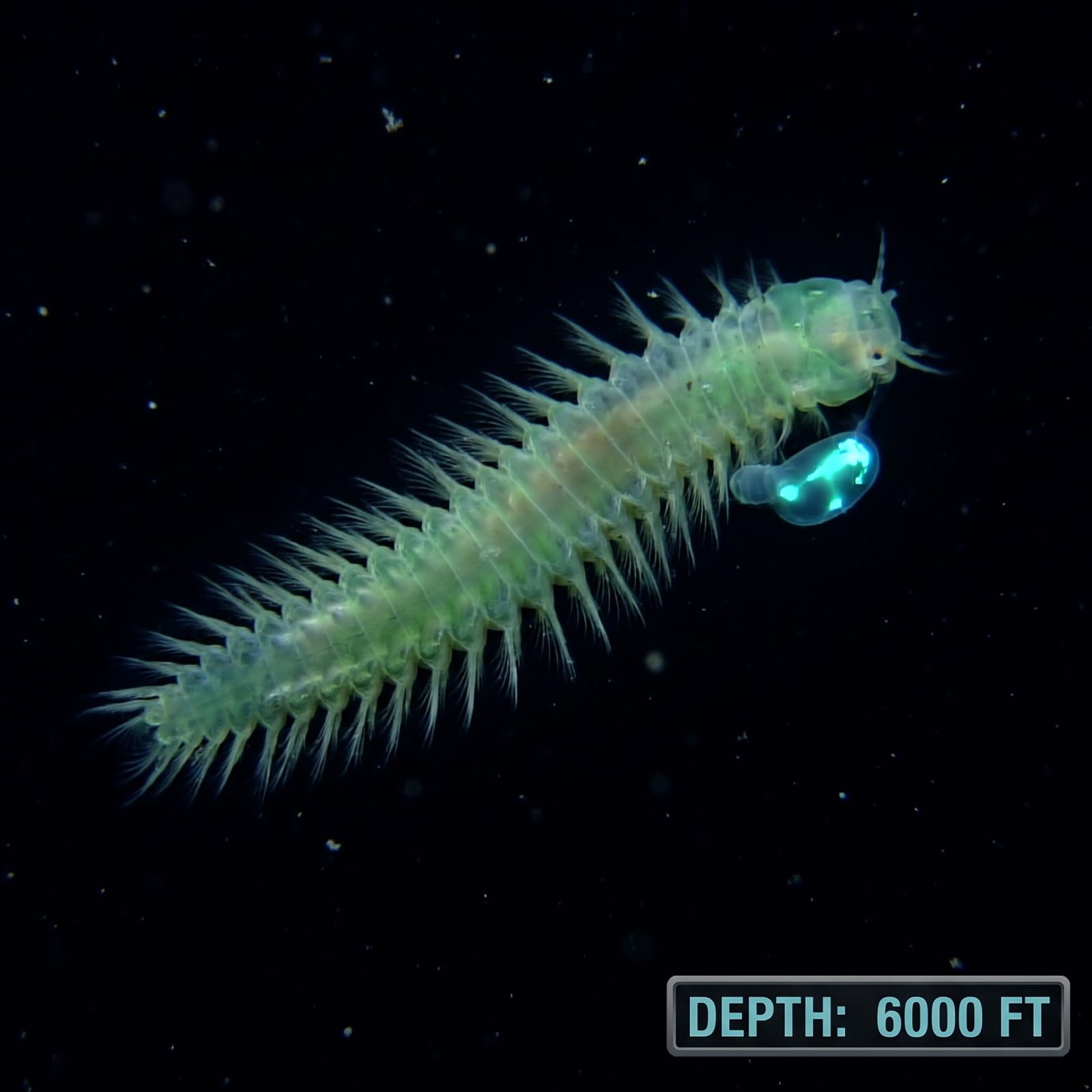
This worm throws flash grenades. Discovered in the deep water off California, it carries small fluid-filled sacs near its head that it can detach on demand. Once released, each one flares bright green-blue for several seconds and drifts away.
The point is distraction. A predator closing in gets a bright decoy flung in its face while the worm — now dark and quick — bolts off the other way. Lose the bomb, keep your life.
Scientists named the species for this trick. The worms live in the cold midwater column thousands of feet down, filmed by ROVs working the submarine canyons off the West Coast. You will not stumble on this one on a beach walk. It took deep-sea robots to find it at all.
21. Tomopteris Worm: Rare Yellow Bioluminescence in the Mediterranean
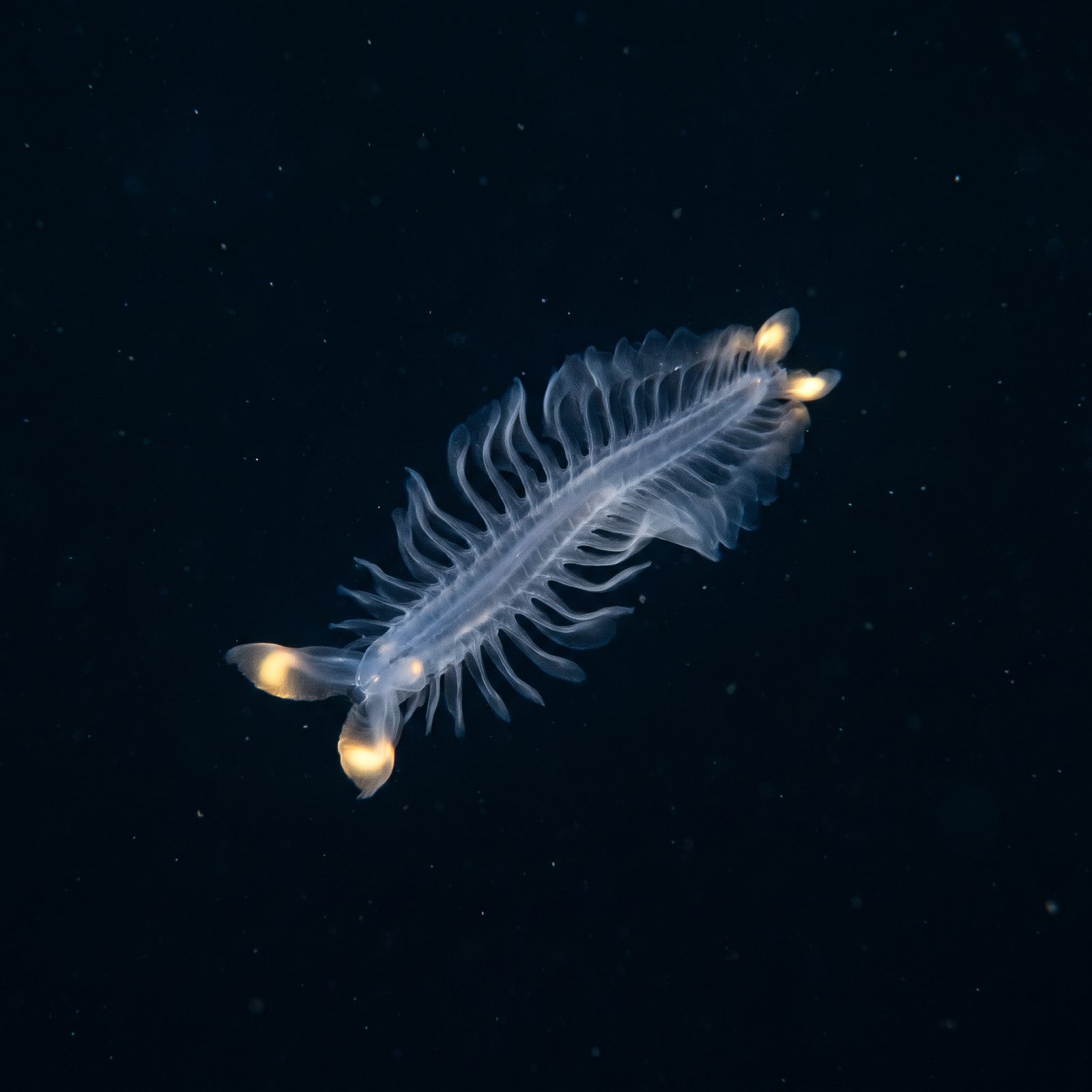
Almost everything in the ocean glows blue. This worm glows yellow, and that makes it a genuine oddball.
Blue travels best through seawater, so nearly every luminous marine animal settled on it. Tomopteris went its own way. When disturbed, it sheds a soft yellow light from the tips of its swimming paddles — one of the very few animals on Earth known to produce yellow bioluminescence.
Why yellow? Honestly, nobody’s nailed it down yet. One idea: the light sticks to an attacker like a glowing tag, turning the predator itself into a target for something bigger. Mug the worm, wear the stain.
It drifts through the open water of the Mediterranean and other seas, nearly invisible by day, a transparent ribbon of a creature — until something bumps it in the dark and the light spills out.
20. Parchment Tube Worm: Clouds of Blue Mucus on the U.S. Atlantic Coast
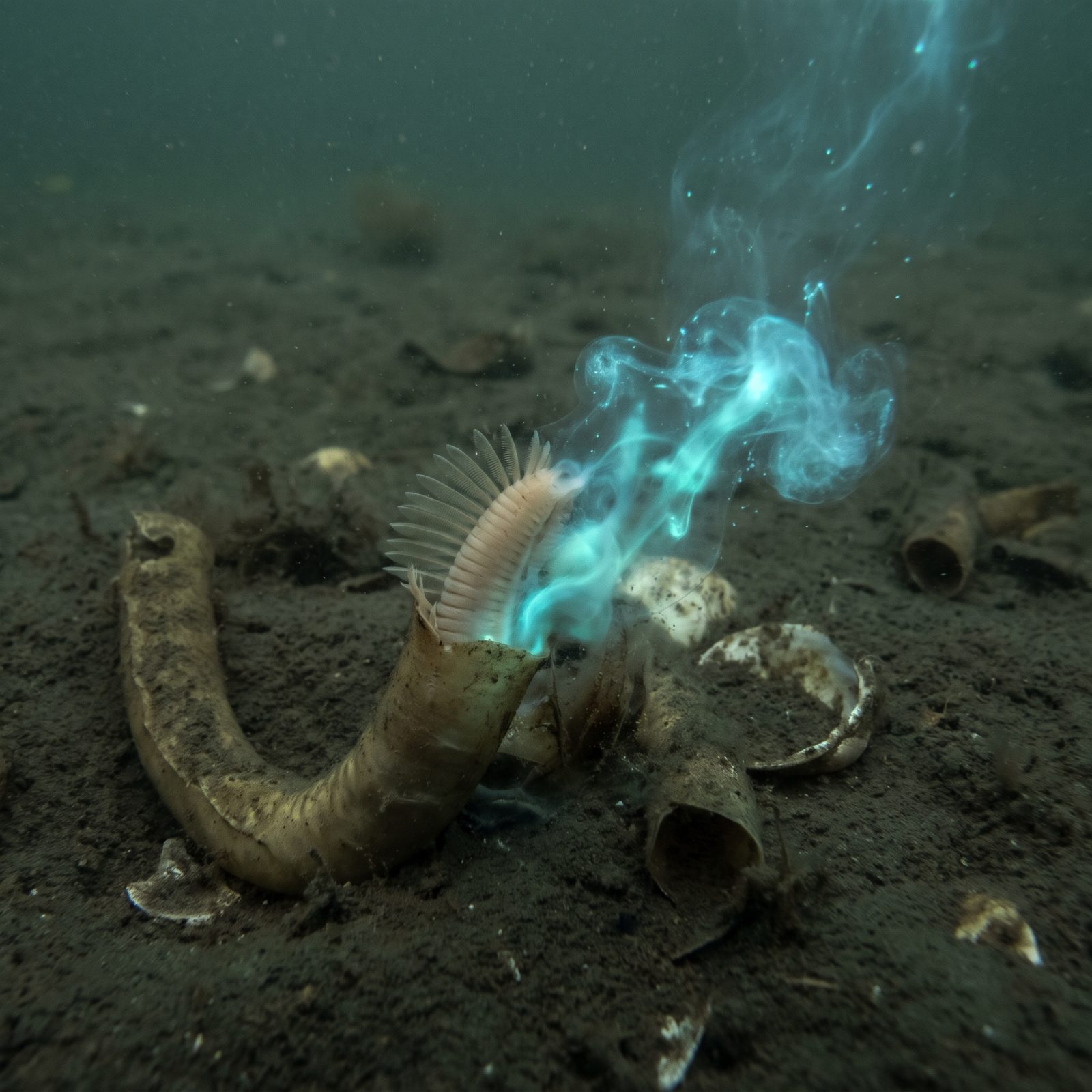
A worm that spends its entire life in a tube and still manages one of the stranger light shows on the Atlantic coast. The parchment tube worm builds a tough papery U-shaped home buried in the mud and almost never leaves it. Poke it, though, and it oozes a glowing blue mucus that can keep shining for hours.
That’s unusual. Most bioluminescence is a quick flash and done. This slime glows long and slow, and researchers are still untangling exactly how — which is a big part of why the worm keeps turning up in lab studies on living light.
It lives along muddy and sandy bottoms from New England down the eastern seaboard. Its tubes can lie right out on the seafloor in plain view, and you could swim right past one and never guess it holds something that glows.
19. Bermuda Fireworm: Green Mating Displays After the Full Moon
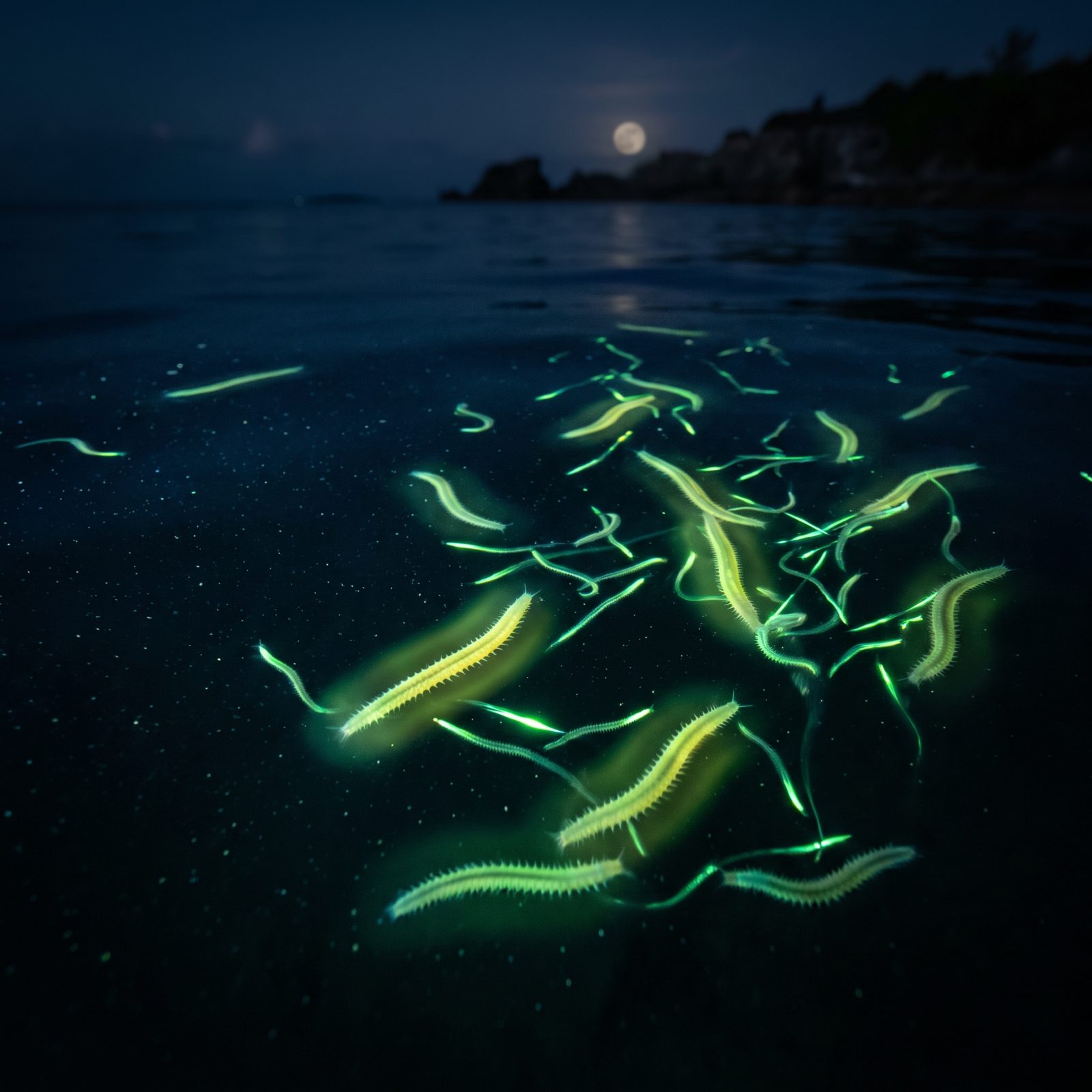
A few nights after the summer full moon, not long after sunset, the water off Bermuda starts to glow. And the timing isn’t loose. The Bermuda fireworm keeps a schedule tighter than most dentist appointments, and marine biologists have predicted the display to the minute for decades.
Females rise from the seabed and spin in tight circles, leaking a green glowing slime to broadcast that they’re ready to spawn, while males dart up from below and flash their own light like tiny signal lamps answering a call. The whole thing lasts minutes. Then it’s over, and the sea goes black again.
Christopher Columbus’s crew may have seen this in 1492, logging a strange light in the water near the New World. If so, it’s one of the oldest written bioluminescence sightings in the Atlantic.
18. Sea Pansy: Waves of Green Light Along Florida’s Coast
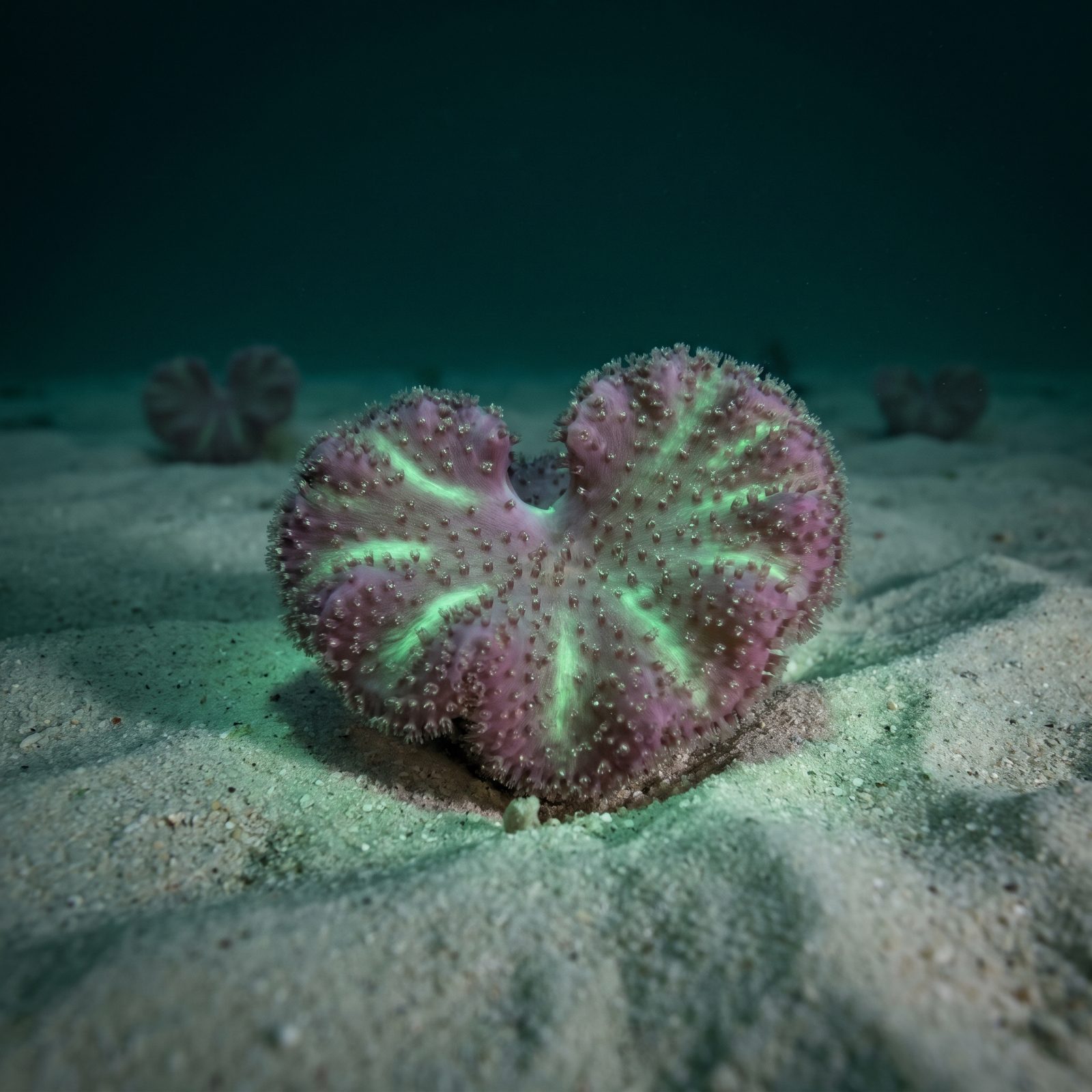
Step on something soft in the dark Gulf shallows and it might light up under your foot. The sea pansy looks like a little purple flower pressed into the sand, but it’s a colony of hundreds of tiny animals working as one.
Touch it, and a green glow rolls across the surface in a visible wave, each polyp firing in sequence. Scientists suspect the ripple startles or confuses whatever bumped into it. You’ll find them washed into tide pools along Florida’s Gulf coast and scattered across sandy bottoms from the Carolinas south.
What gets me about the sea pansy is how little it needs to live. No brain, no heart, no eyes. Just a shared chemistry and a trick of light that’s older than anything with a spine.
17. Bioluminescent Brittle Star: Flashing Arms in Caribbean Reefs
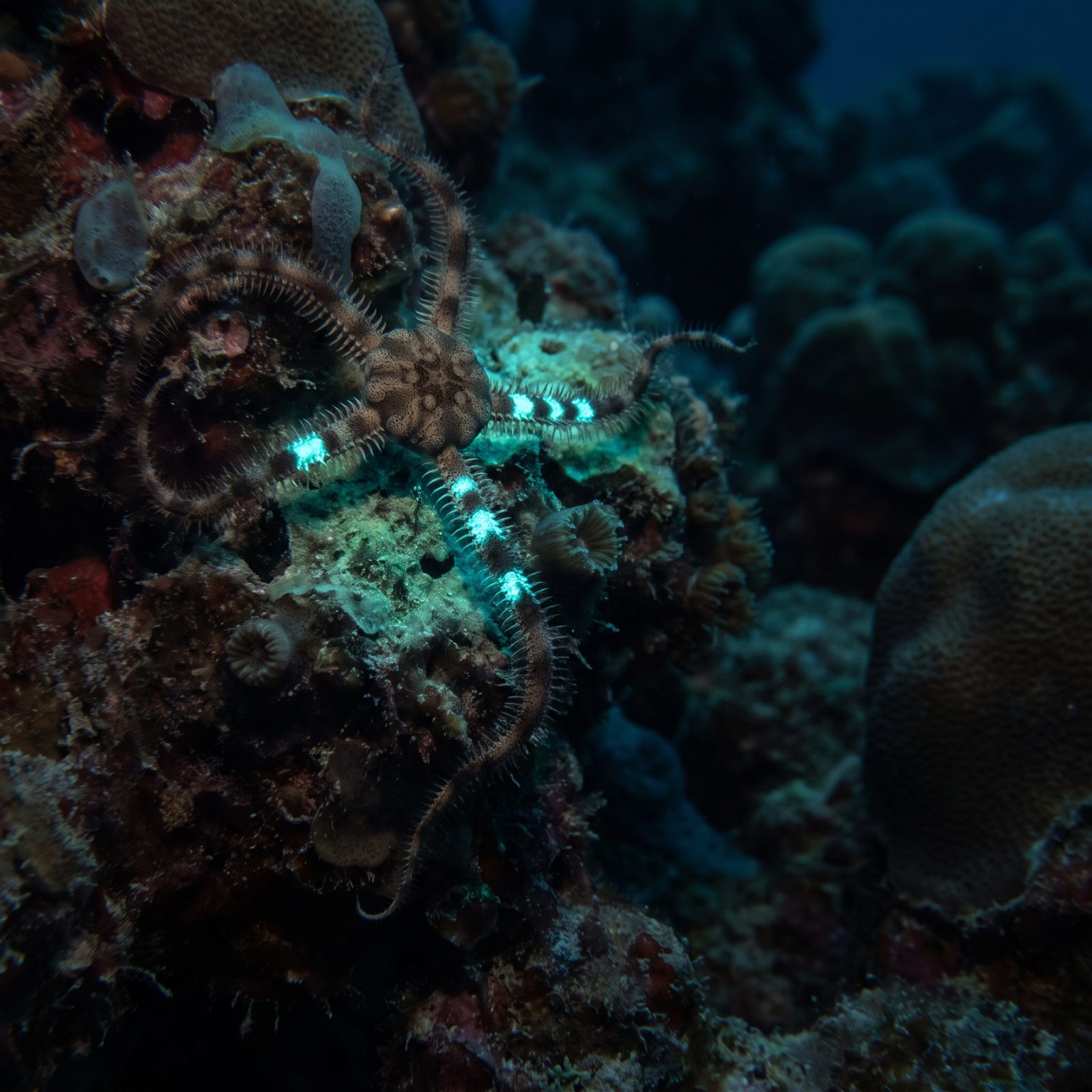
Grab a brittle star by the arm and it will do something unsettling: light up along that arm, drop the limb entirely, and crawl off into the dark. The glowing cast-off wriggles and flashes while the real animal slips away. Cheap trick. Very effective.
These spindly cousins of starfish live tucked under rocks and inside coral crevices across Caribbean reefs. The light travels down the arm segment by segment, like a string of runway lights. Predators chase the glow, the brittle star keeps its life, and it regrows the arm later.
16. Sea Firefly Ostracod: Blue Courtship Signals in the Caribbean
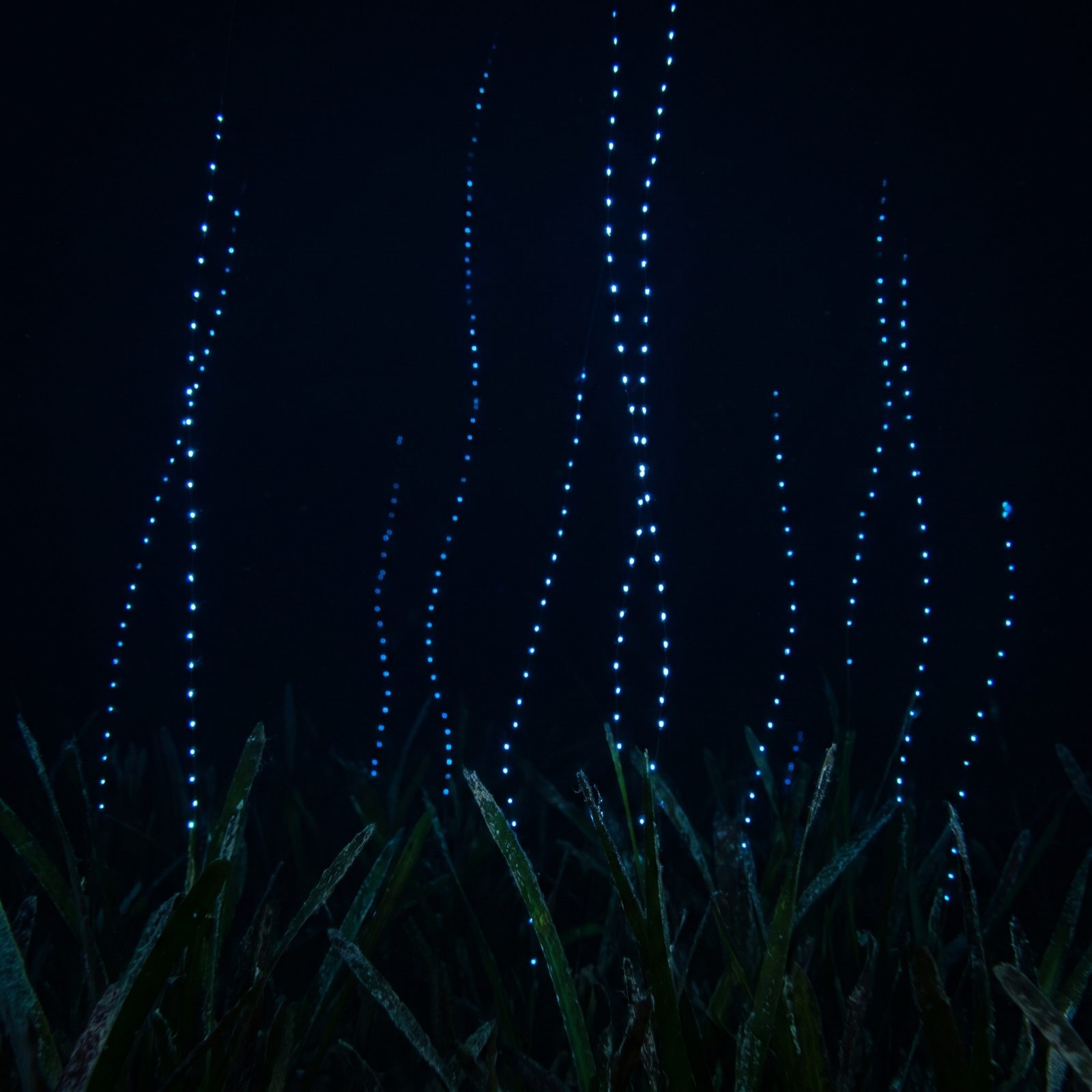
The males write in light. Each tiny sea firefly squirts a precise sequence of glowing blue dots as it swims, spacing and timing them to spell out a signal only females of its own species can read. Different species, different patterns. A language made of luminous spit.
These are ostracods, seed-shrimp barely bigger than a sand grain, and the courtship plays out over Caribbean seagrass beds on dark nights after sunset. A single male leaves a ladder of blue dots climbing through the water. Dozens of males together turn the shallows into a slow-motion starfield.
Japanese soldiers in World War II reportedly dried a related species, called umi-hotaru, and crushed it in water to read maps by the faint glow without giving away their position. Living light as a field tool.
15. Acanthephyra Shrimp: Spewed Clouds of Light in Monterey Canyon
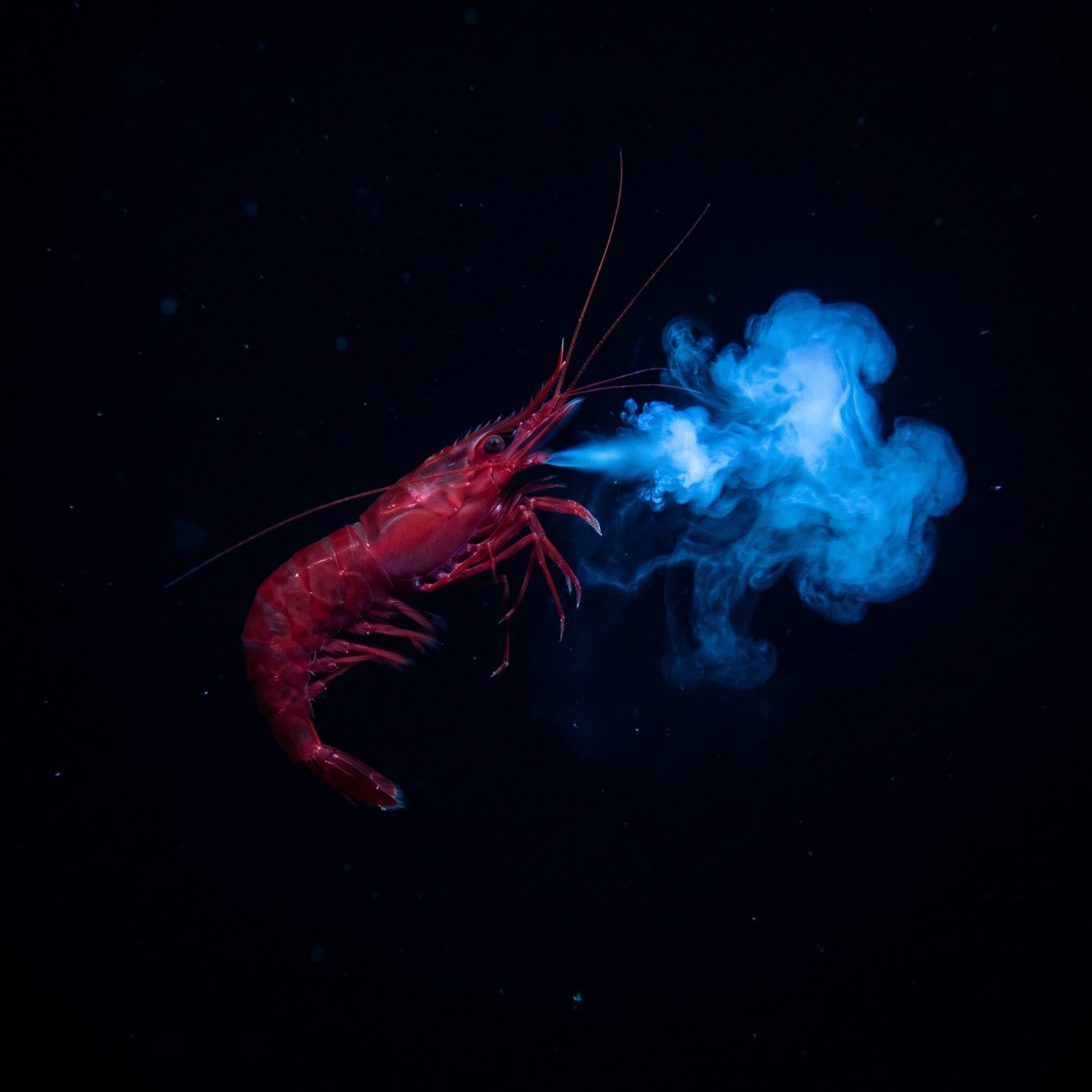
Most animals run when attacked. This shrimp vomits light, then runs.
Acanthephyra lives in the deep midwater of places like Monterey Submarine Canyon off California, a drowned gorge deeper than the Grand Canyon. When something grabs for it, the shrimp spews a bright blue cloud of glowing fluid straight at the attacker’s face and jets backward into the dark, leaving the predator staring at a luminous smokescreen while its meal vanishes.
Down there, blood-red bodies are a disguise. Red wavelengths don’t reach the deep sea, so a crimson shrimp reads as pure black to most eyes. The animal is bright red precisely so it can be invisible.
14. Headless Chicken Monster Sea Cucumber: Luminous Skin in the Deep Pacific
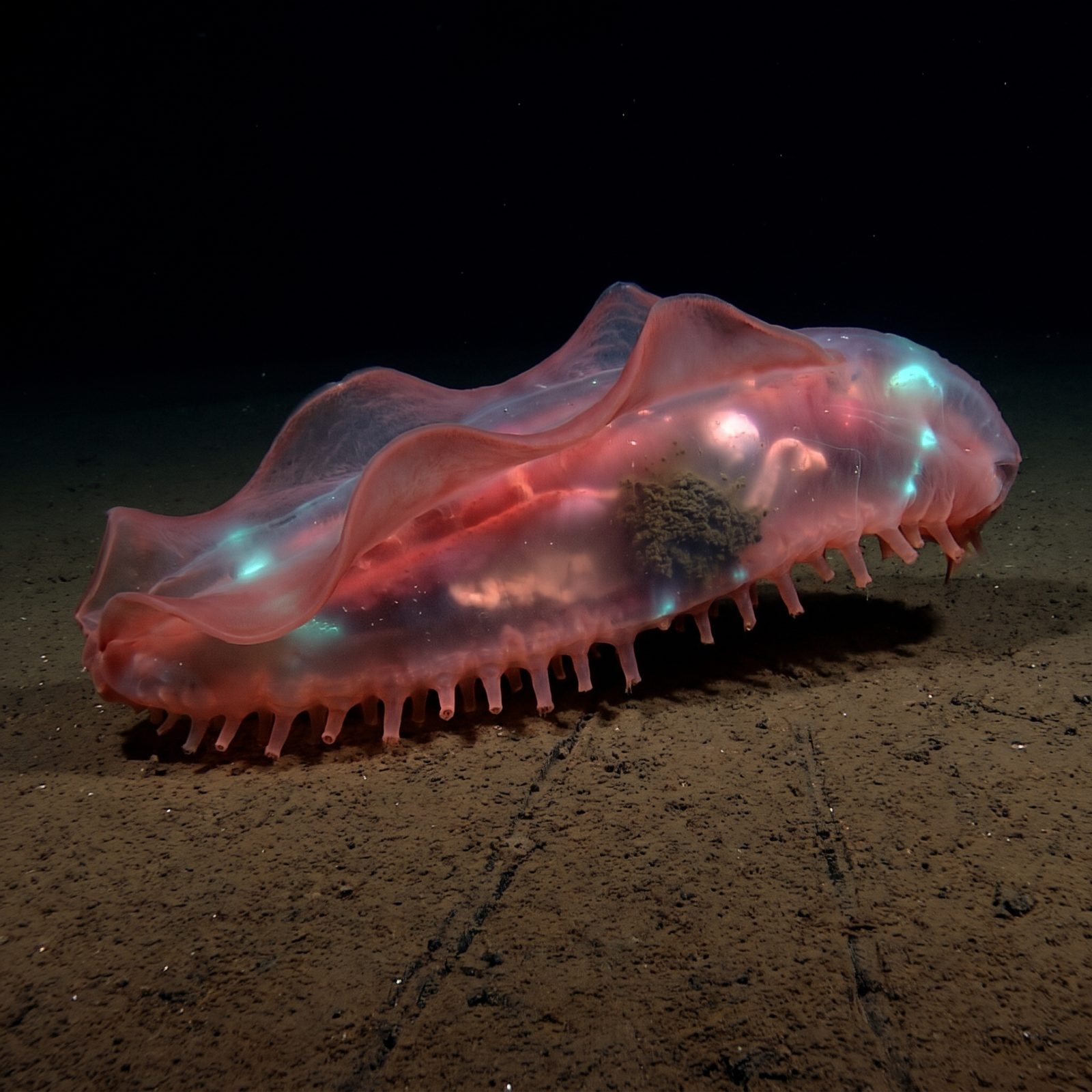
The name tells you everything. It swims, it’s pink, it looks exactly like a chicken that has had a very bad day, and it glows.
Enypniastes eximia is a swimming sea cucumber that patrols the deep Pacific seafloor, vacuuming up mud and digesting whatever organic bits it finds. Bump it, and patches of its translucent skin flare with cold light. Some researchers think it can even shed glowing skin to stick to an attacker, tagging the predator so other hunters come for it. A luminous ransom note.
You won’t see this one on a dive trip. It lives thousands of feet down, and nearly every clear image we have comes from a robot submarine. Which is its own kind of wonder: there are glowing animals down there we’ve only ever met through a camera.
13. Erenna Siphonophore: Red Lures in the Deep Atlantic
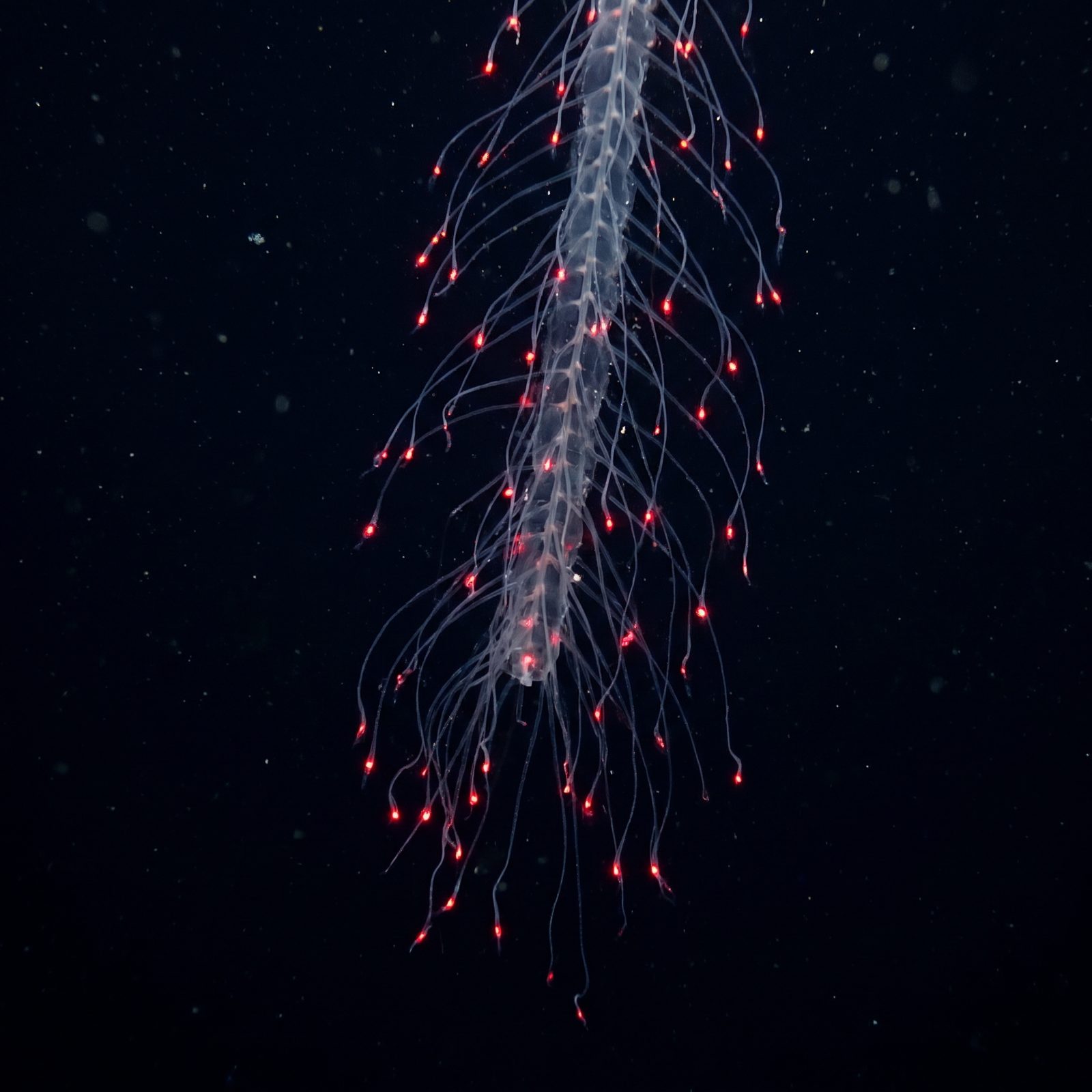
Red light in the deep sea is a near-impossible trick, and this animal pulls it off to fish for its dinner.
Erenna is a siphonophore, not a single creature but a floating colony of specialized bodies strung together, cousin to the Portuguese man o’ war. Along its tentacles hang tiny lures that glow red and twitch, mimicking the wiggle of small swimming prey. Fish that think they’re chasing a snack become the meal.
The clever part is the color. Almost nothing in the deep sea can even see red, so for a long time scientists assumed red light was useless down there. Erenna proves at least one hunter learned to use the forbidden wavelength as bait. The prey it targets, it turns out, can see red just fine.
A colony of hundreds of bodies, flashing a color almost nothing else can read, to catch the few things that can.
12. Mycena chlorophos: Glowing Mushroom Caps in Japan’s Rainy Forests
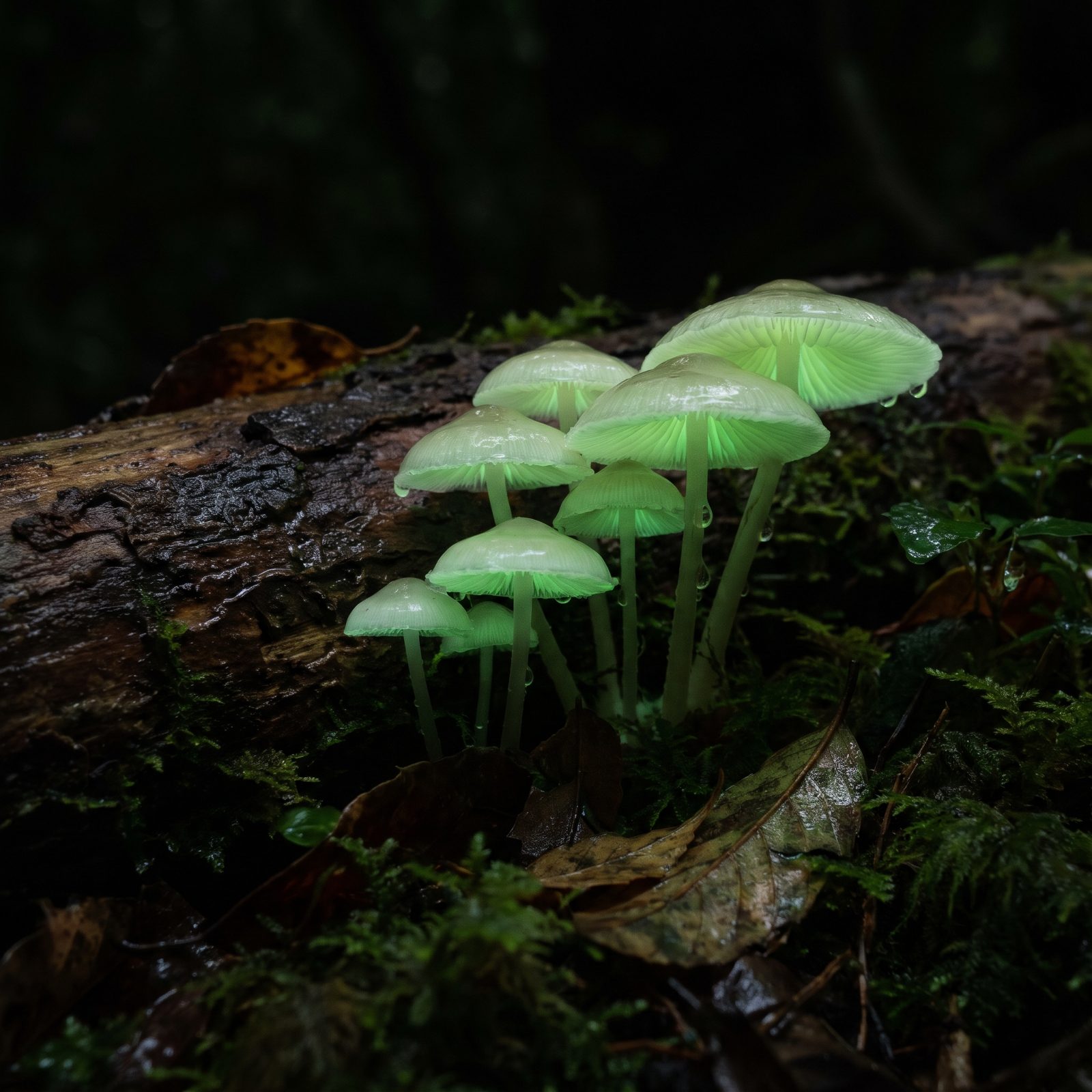
In the warm wet forests of Japan’s Bonin Islands and parts of Southeast Asia, the ground glows after a summer rain. The source is Mycena chlorophos, a mushroom with a cap so thin it’s nearly see-through, giving off a steady green light from its gills.
That glow burns strongest in the first night or two after the cap opens, then fades. And nobody is fully certain why the fungus bothers. The leading guess is that the light draws insects, which then carry spores off to new ground. A mushroom using a lantern to hitch a ride.
11. Armillaria Foxfire: Glowing Wood in Temperate Forests Worldwide
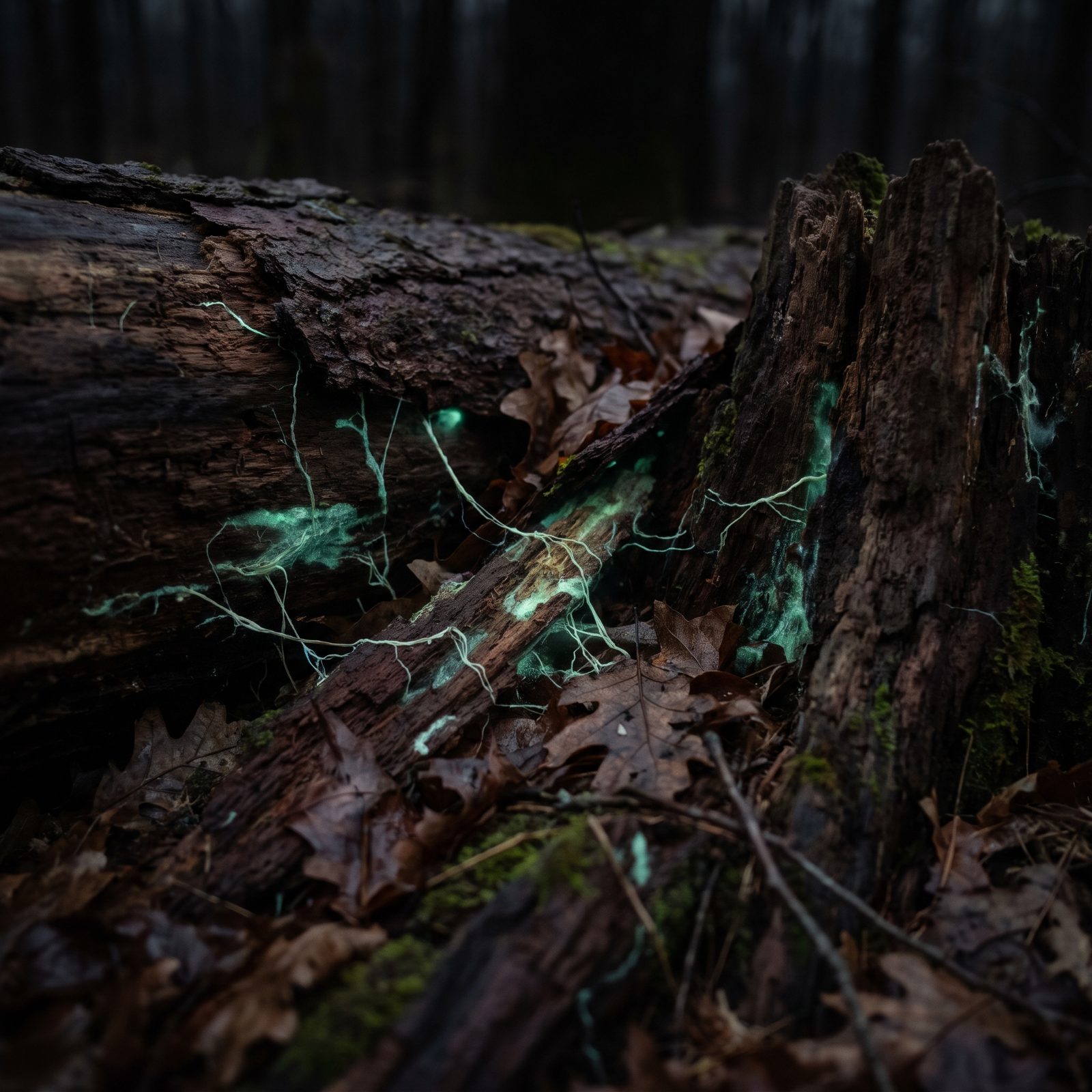
Soldiers in the trenches of World War I noticed it. So did Civil War field surgeons, and sailors on old wooden ships. A cold green light seeping from rotting wood in the dark, with no flame and no heat. They called it foxfire.
The glow comes from Armillaria, the honey fungus, whose threads run through decaying logs and quietly shine as they feed. Aristotle wrote about it over two thousand years ago, and for most of that stretch nobody had the faintest idea what caused it.
Now for the staggering part. One Armillaria colony in Oregon’s Malheur National Forest sprawls across several square miles and is thought to be thousands of years old, among the largest living organisms on Earth. Most of it sits underground and invisible. But on the right damp night, you can find a patch of its glow on a dead branch at your feet.
10. Synchronous Fireflies: Waves of Light in Great Smoky Mountains National Park
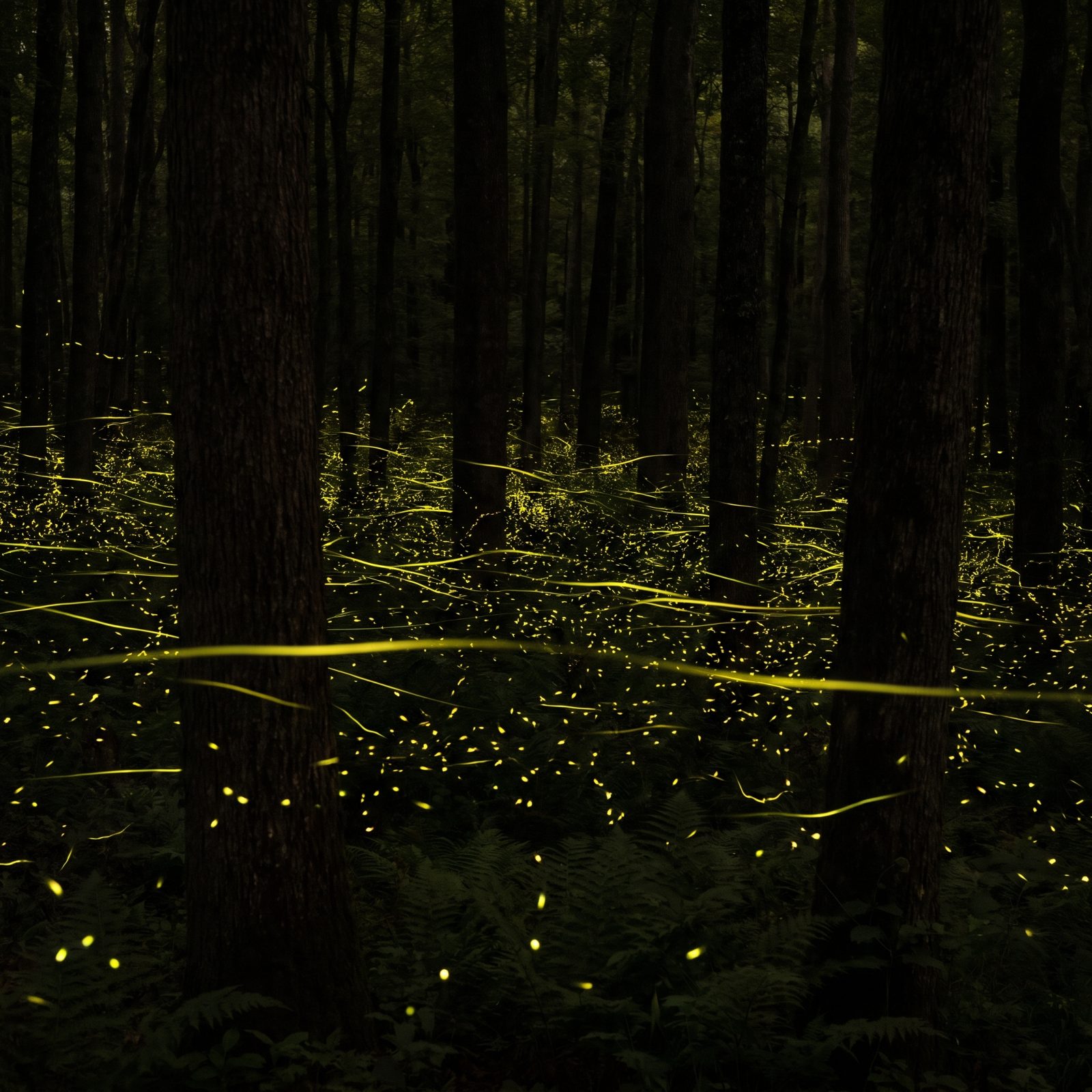
For two weeks each June in the Smokies, the forest keeps time. Thousands of fireflies flash together, go dark together, then flash again in rolling waves. It’s one of only a handful of synchronous firefly species in the Western Hemisphere, and this is its biggest stage.
The males do the synchronizing, matching their rhythm so a single female can pick the signal she wants out of the chaos. Six quick flashes, a pause of darkness, then the whole hillside lights up again. Watching it feels less like nature and more like someone flipping a switch for the entire woods.
Demand got so heavy that the park now runs a lottery for vehicle passes during peak week at Elkmont. People drive from across the country to stand in the dark and watch beetles blink in time.
9. Blue Ghost Fireflies: Steady Blue Trails in the Southern Appalachians

Most fireflies blink. These don’t. Phausis reticulata burns a steady blue-white light that drifts through the understory like a slow comet, with the males looping so smoothly that in a long exposure the whole display reads as thin, short streaks skimming low over the forest floor rather than sparks. That steadiness is the tell. A blinking firefly is flashing a code, while a blue ghost just stays lit, sometimes for a full minute.
They live in the moist hardwood coves of the southern Appalachians, and DuPont State Forest in North Carolina pulls crowds every May and June. The females? They can’t fly at all. They sit in the leaf litter, glowing, waiting for a male to notice.
8. Railroad Worm: Red and Green Lights in Brazil
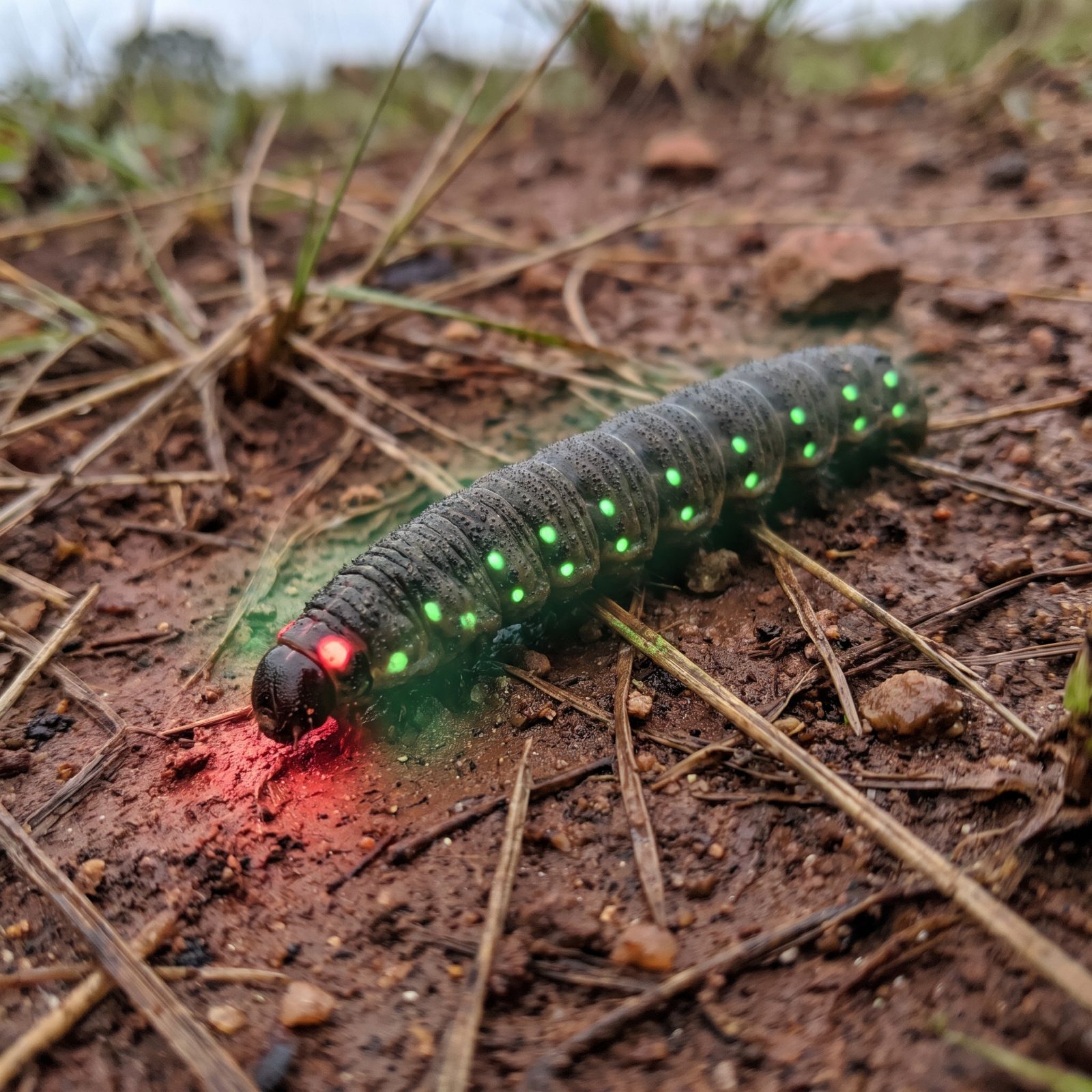
And here’s the one that breaks the rules. The railroad worm (a beetle larva, not a worm) is the only land animal known to produce red light. The segment just behind its head glows red, while the dark head itself stays unlit. Its two flanks glow green, eleven pairs of little lamps running down each side like the windows of a passing train. Hence the name.
That red headlamp probably helps it hunt in the dark without alerting the millipedes and other prey it eats, since most small invertebrates can’t see red at all. The green rows do the opposite job entirely, warning predators that the larva tastes terrible.
Look for them in Brazil’s cerrado and Atlantic forest, usually after warm rains. Two colors, one body, two completely different jobs.
7. Headlight Click Beetle: Twin Green Lamps in Central America
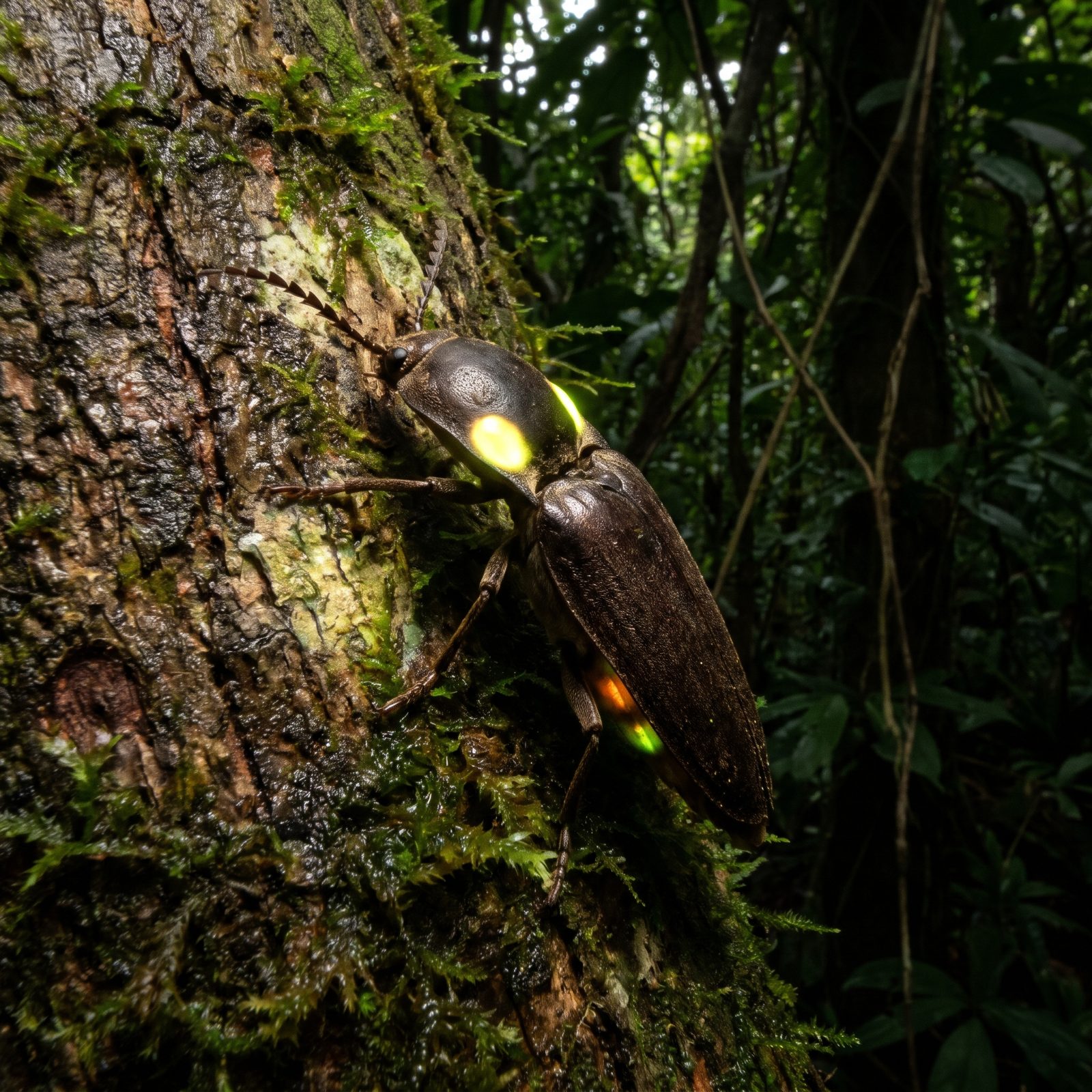
Two green lamps riding on a beetle’s shoulders.
The headlight click beetle, Pyrophorus, carries a matched pair of glowing organs on its pronotum, right behind the head. In flight they look exactly like twin headlights crossing a dark Caribbean clearing. More light glows along the abdomen too, so even a resting beetle can show a row of green and orange spots peeking out along its side, beneath the wing covers.
Caribbean islands and Central American forests are where you want to be. The Taino once tied these beetles to their toes to light night trails, which tells you how bright they are. Gather a handful and you could genuinely read by them.
6. Orfelia fultoni Fungus Gnat: Blue Light in Alabama’s Dismals Canyon

Tucked into one small canyon in northwest Alabama, the larvae of Orfelia fultoni cling to wet sandstone and glow blue. Locals call them dismalites, after Dismals Canyon, one of the very few places on Earth where they turn up in any real numbers. It’s among the bluest lights in the whole animal kingdom.
The chemistry is what makes them strange. Their light-producing system doesn’t match any other known bioluminescent species — different enzyme, different light-emitting molecule, a solution evolution worked out entirely on its own.
And the glow isn’t decoration. The larvae spin sticky silk snares and use that cool blue to lure tiny flying insects straight into the threads. Beautiful to us. A trap to a gnat.
5. Motyxia Millipede: Warning Glows in California’s Sierra Nevada
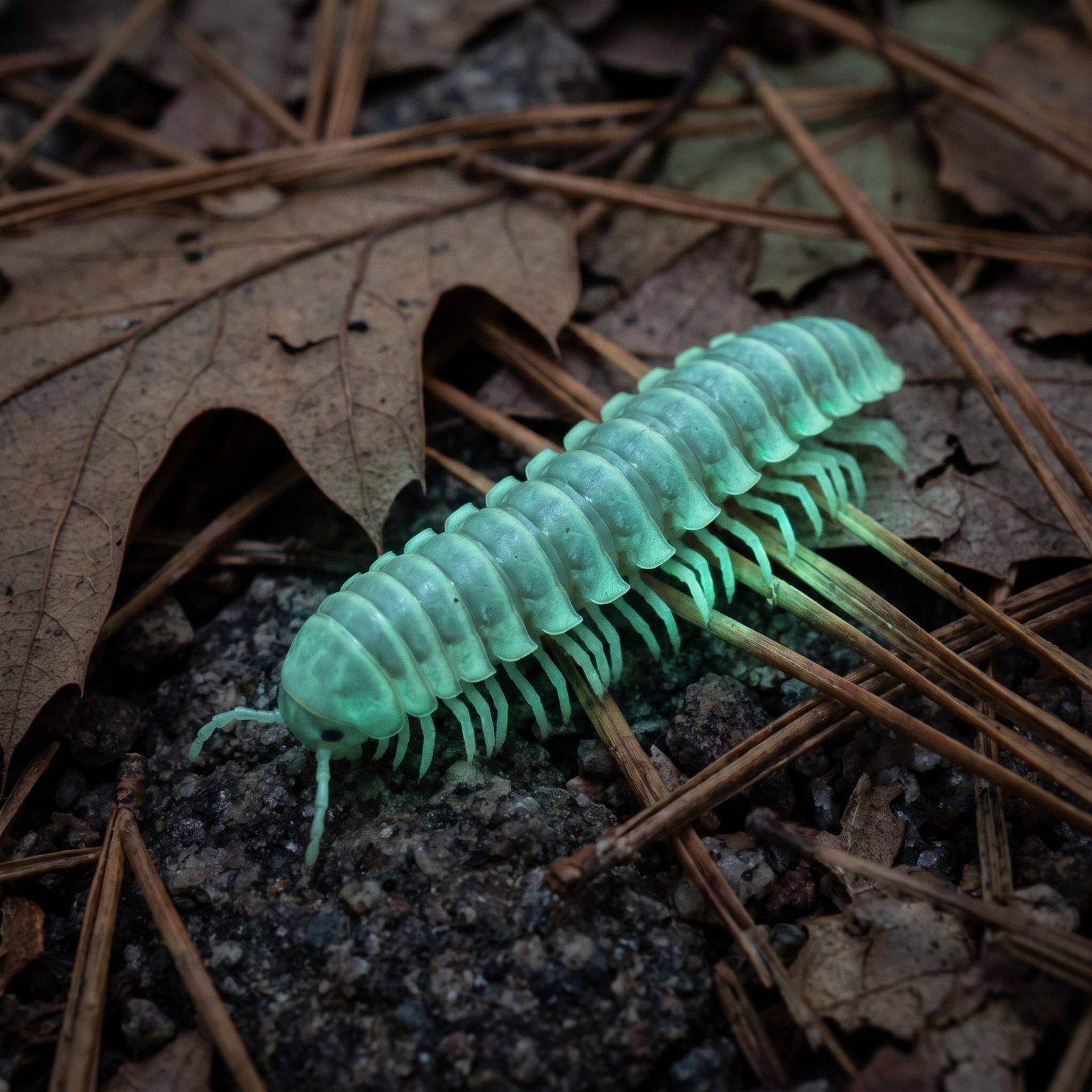
A glowing animal that can’t see its own glow. Motyxia millipedes are completely blind, so the light was never meant for them — it’s a message to anyone with eyes: don’t eat me, I’m loaded with cyanide.
Researchers tested exactly that with clay millipede models in the Sierra Nevada. The glowing fakes got attacked far less than the dark ones, which makes the light an honest warning, the same bluff a monarch’s orange wings run, only written in green across a mountainside at night.
You’ll find them nowhere else but a narrow band of California’s Sierra Nevada, mostly up above a few thousand feet, surfacing after the rains.
4. Latia Freshwater Snail: Luminous Slime in New Zealand Streams
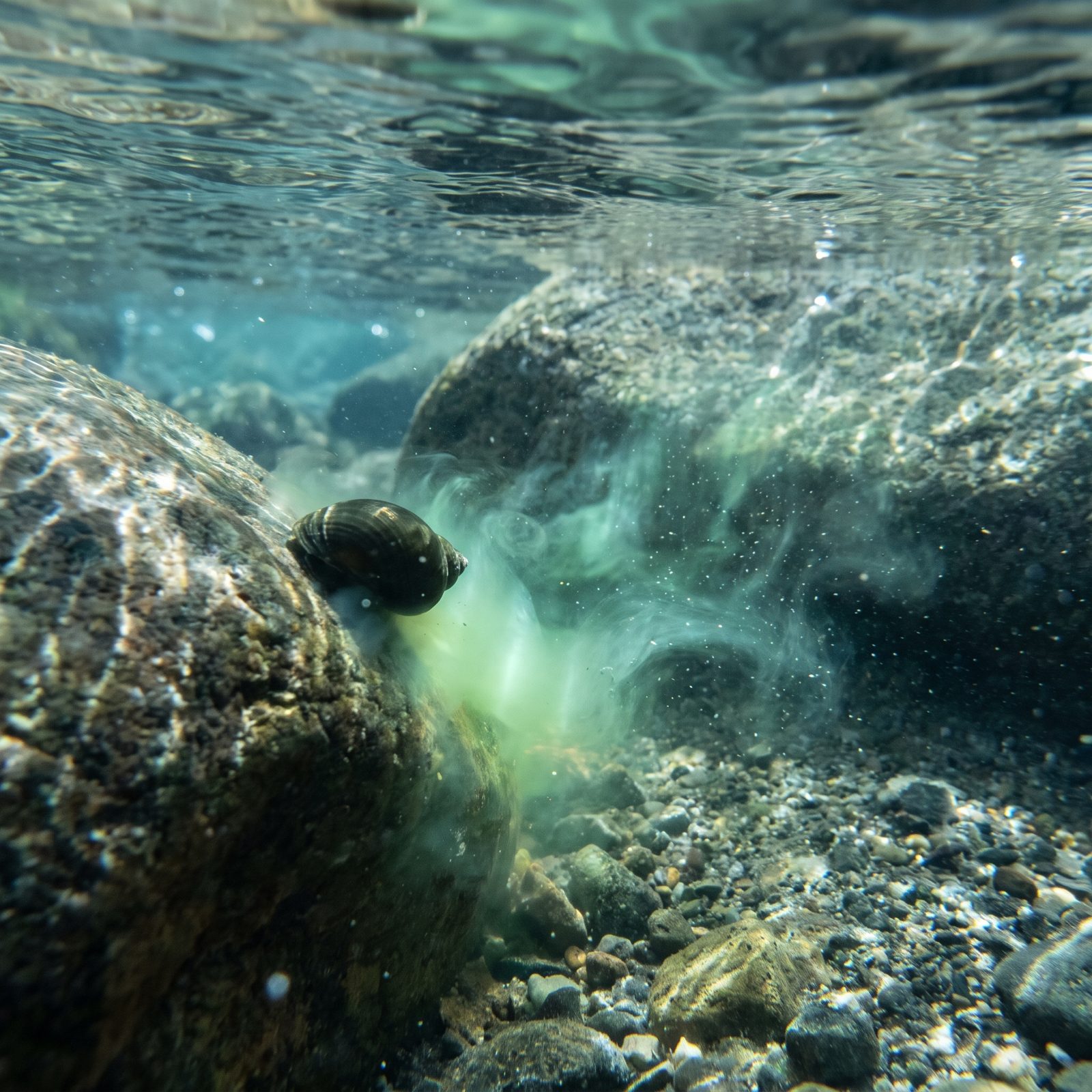
This one glows by letting go of its own slime.
Latia neritoides is a tiny freshwater snail found only in the clear streams of New Zealand’s North Island, and it’s the only known freshwater animal that produces a luminous secretion. Disturb it and it releases a cloud of glowing green mucus into the current.
Defense is the best guess at why. A startled snail dumps a bright smokescreen that drifts downstream, and whatever was about to eat it chases the glowing cloud instead of the quiet, dark coiled shell still clinging to the rock.
Look in cold, fast, unpolluted streams. The water has to be clean, which turns Latia into a quiet signal of a healthy creek.
3. Hinea brasiliana Clusterwink Snail: Shell-Flashing Light in Australia
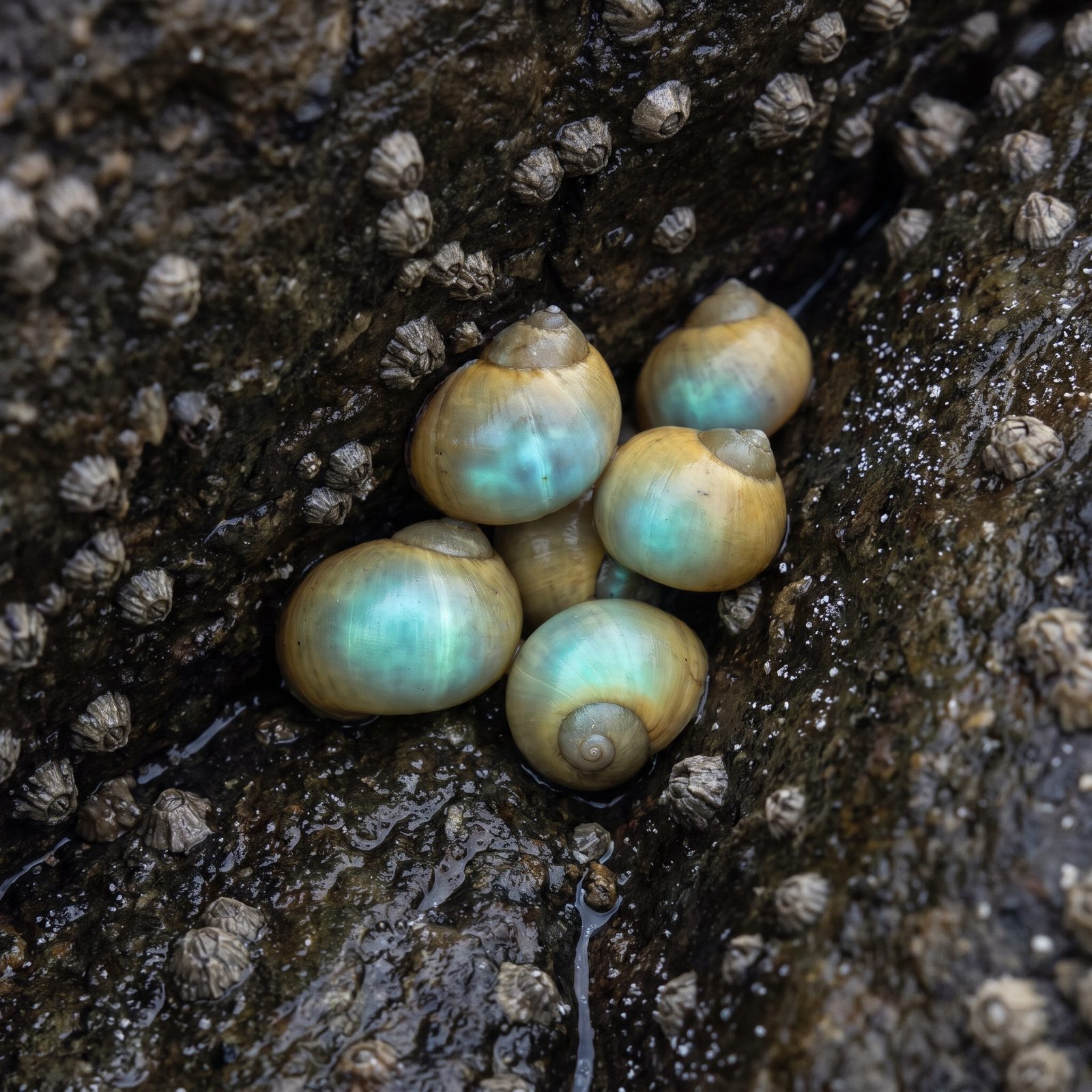
The clusterwink snail does something no other glowing animal does. It uses its shell as a lamp. The light is made inside the body, but the opaque shell scatters it so the whole thing lights up evenly, turning the snail into a tiny frosted lantern instead of a bright dot.
Scientists found the shell is tuned to spread blue-green light in every direction, the most effective color for traveling through seawater. The flashes fire when the snail is touched — probably to startle crabs and other predators, or even to call in a bigger predator to deal with the smaller one. Grim little strategy, if true.
Hunt for them clustered in rock crevices along southeastern Australia’s shores, best on dark, moonless nights at low tide.
2. Pholas dactylus Piddock Clam: Blue-Green Light on Europe’s Atlantic Coast
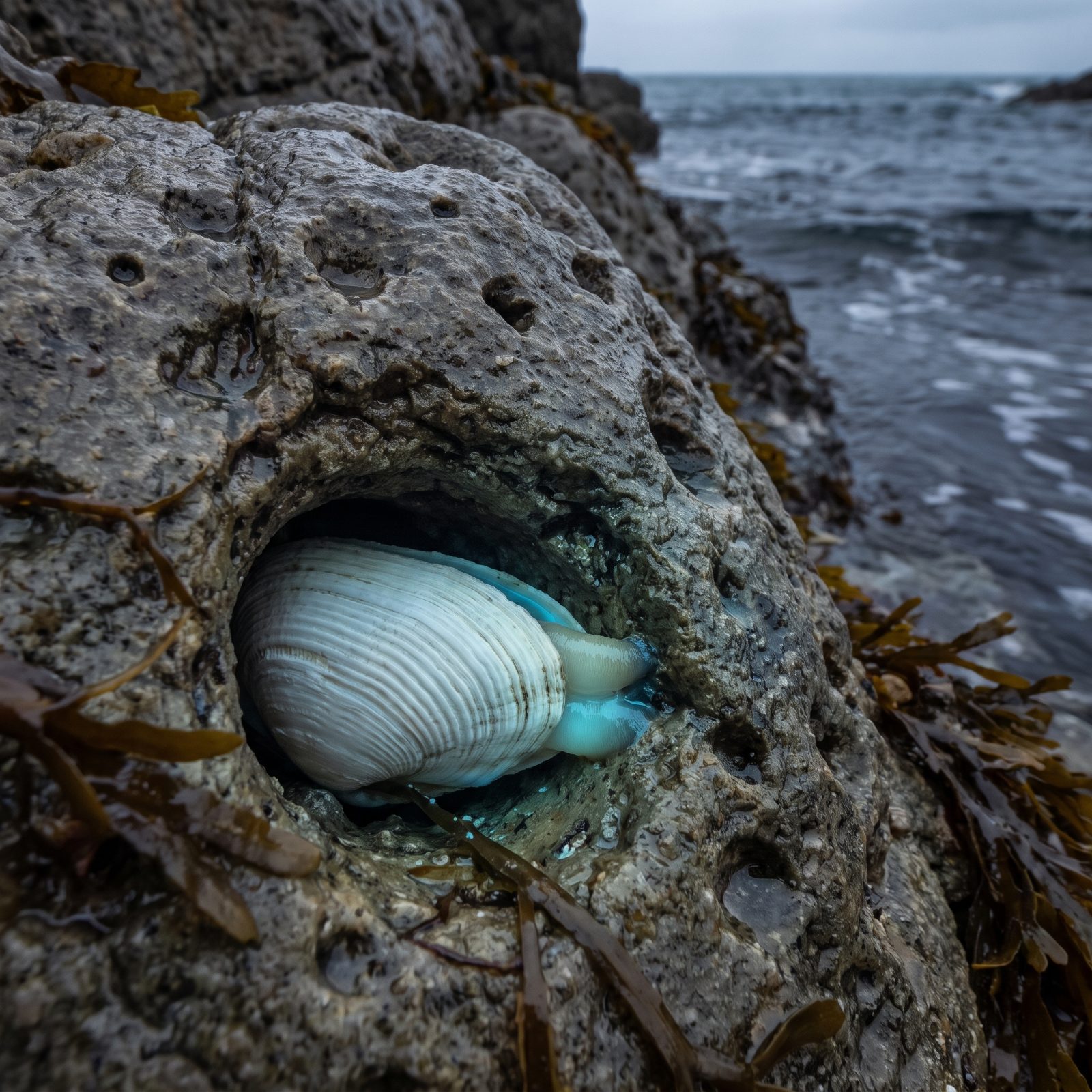
The piddock clam bores into solid rock and glows from inside its hole. Pliny the Elder wrote about this clam almost two thousand years ago, describing how it lit the mouths and hands of people who ate it. He wasn’t exaggerating either. Rub the luminous tissue on your fingers and they glow.
Pholas dactylus produces a blue-green light from a secretion along its siphon and mantle, and its chemistry has been studied so closely that its luminous protein, pholasin, now shows up in medical and laboratory tests that detect reactive oxygen in the body.
Find them along the Atlantic coasts of Europe and the Mediterranean, wedged into soft limestone and clay. An animal that lights a lab bench the same way it lit a Roman dinner.
1. Arachnocampa Glowworms: Starry Cave Ceilings at Waitomo, New Zealand

Picture a dark cave whose ceiling looks like the night sky folded underground, its glow mirrored in the still water below. Those aren’t stars. They’re the larvae of Arachnocampa luminosa, a fungus gnat found only in New Zealand, each one glowing blue-green to lure insects into its trap.
Photos leave out the best part. Below every glowing larva hang long silk threads strung with sticky mucus droplets, like beaded fishing lines. A midge flies toward the light, hits a line, and the larva reels it in. Here’s the unsettling twist: the prettier the glow, the hungrier the larva behind it.
Waitomo is the famous site, but these larvae turn up in damp caves and forested stream banks across both islands. A hungry one glows brightest of all — worth remembering next time a whole ceiling of them stops you cold.