
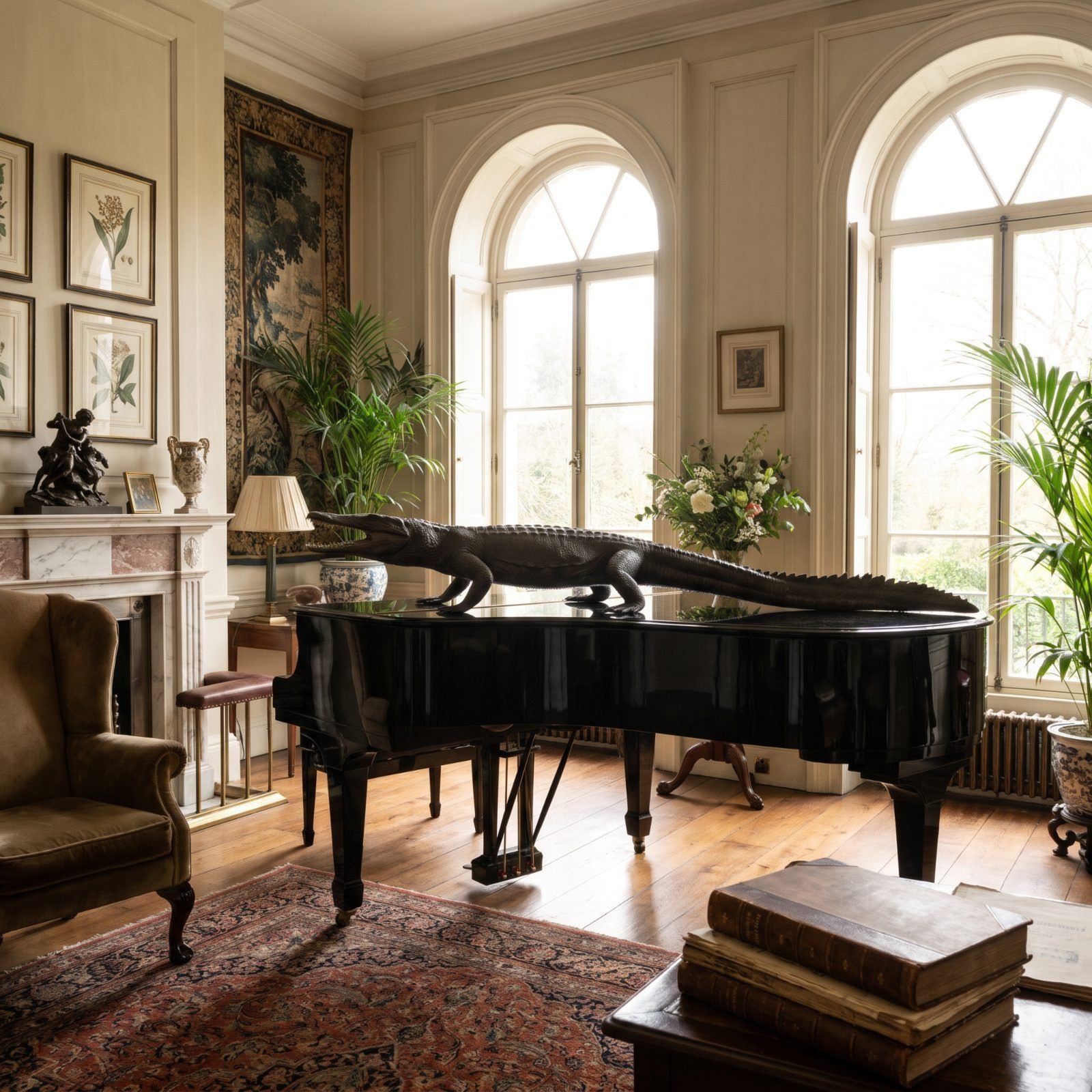
A bowling lane is 60 feet long. You’ve walked beside one, counted the boards, caught that waxy smell. Now imagine a shark that stretched almost the full length of it. That’s the trick with prehistoric ocean giants: the numbers never land until you park them next to something your body already understands. A basketball court. A city bus. The limo that pulled up to your cousin’s wedding. These comparisons lean on the best current fossil evidence, not the inflated guesses that floated around for decades. What follows is accurate, to scale, and genuinely hard to swallow. Several of these animals would have made the car you drove to work look like a toy.
Please note that some of the images in this article were created with the assistance of AI.
22. Megalodon Stretched Along a Full Bowling Lane
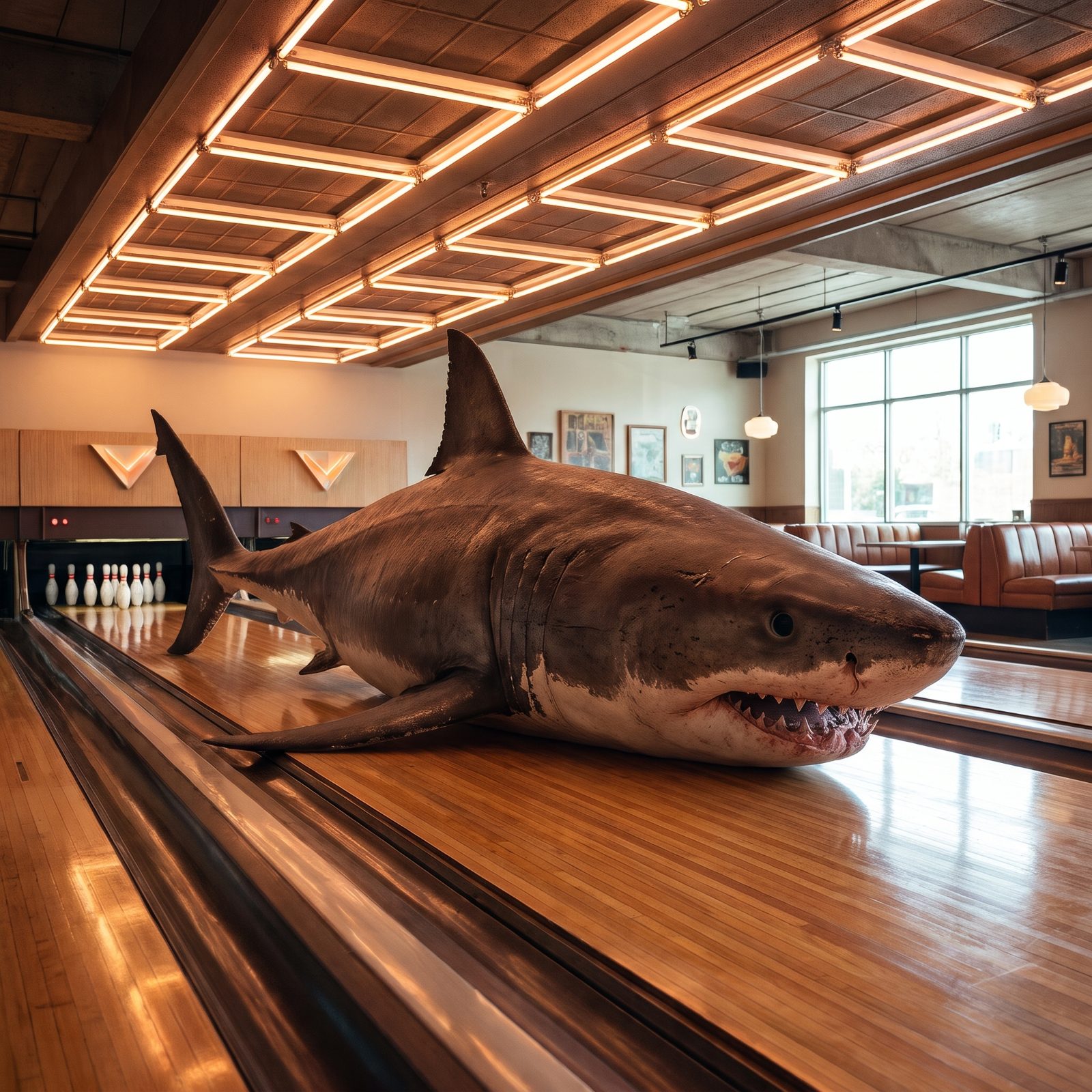
Everyone pictures Megalodon as the size of a submarine. The real animal, going by tooth and vertebral evidence, ran closer to 50 feet, which is still absurd. Line it up against a 60-foot bowling lane and the shark nearly reaches the pins.
Here’s the part people miss. Its teeth were over seven inches along the slant, the size of a grown hand with the fingers spread. You could not palm one.
21. Livyatan Facing Down a Fire Engine
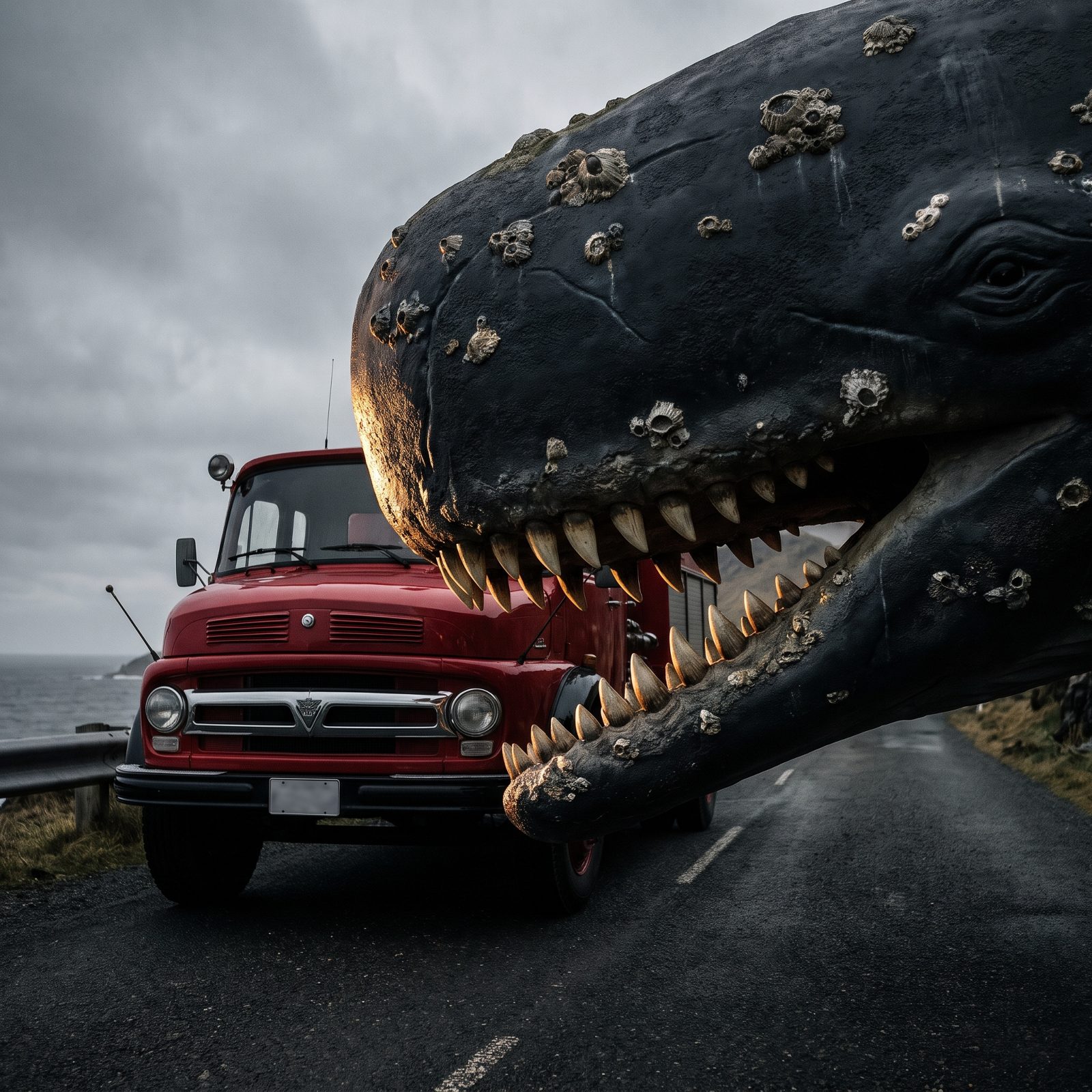
Livyatan was a sperm whale with teeth you’d mistake for banana-sized fence posts. Both jaws carried them, each one over a foot long. Modern sperm whales only have functional teeth in the lower jaw, which makes this thing look overbuilt by comparison.
Set it beside a fire engine and the two run about the same length. Now picture the whole mass coming at a truck that size with a mouth built to crush other whales.
20. Leedsichthys Rolled Out Next to a Semi-Trailer
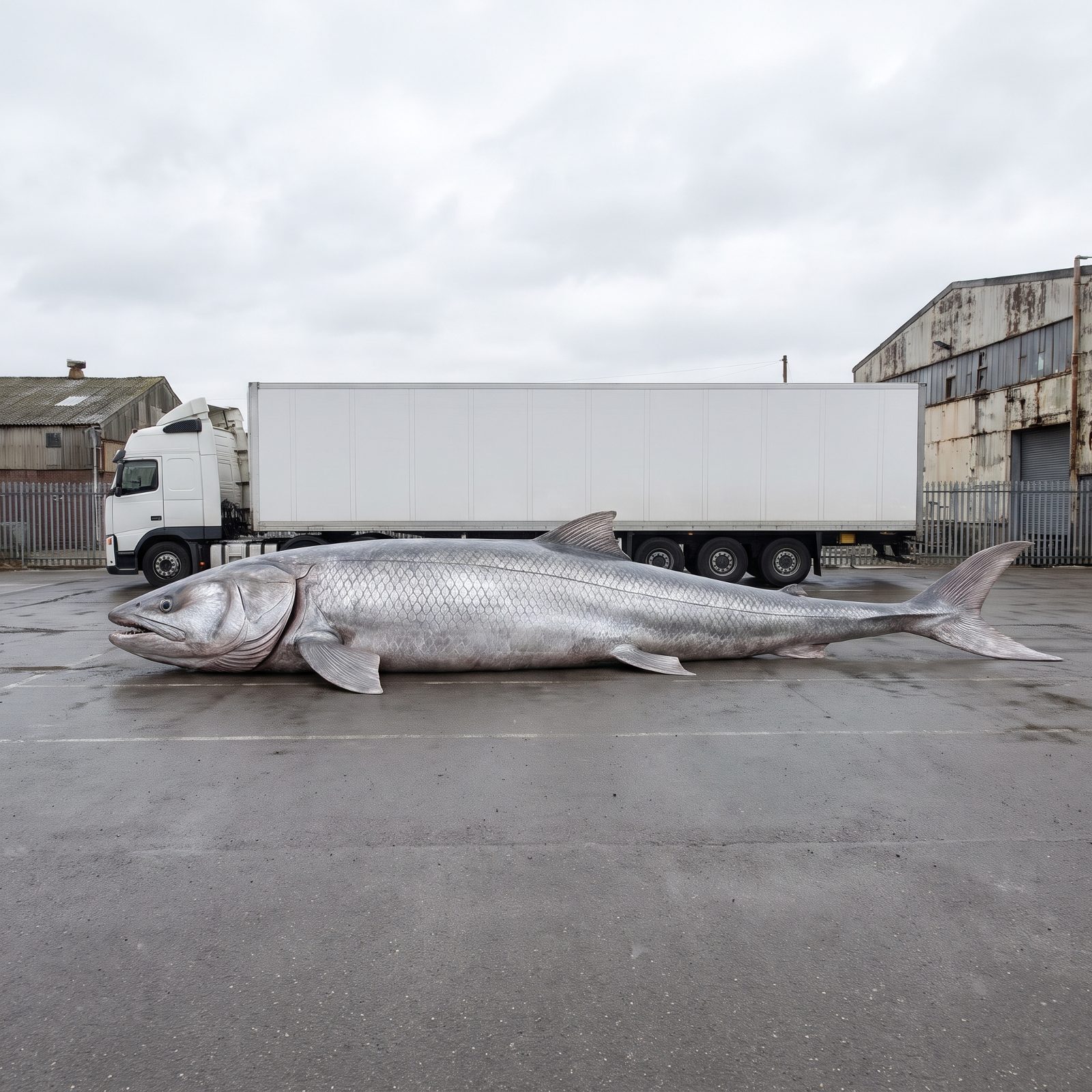
The species name is literally problematicus, because its bones baffled the people who first dug them out of English clay pits. Leedsichthys was a bony fish, not a shark, not a whale, and possibly the largest bony fish that ever lived.
Best estimates put it around 50 feet, roughly a semi-trailer, though the fish rolled out here goes bigger: snout to tail it outruns the whole rig, cab and all, and its body stands nearly as tall as the trailer box. And it doesn’t look gentle. Instead of a huge plankton-straining gape, this one has a small mouth lined with visible sharp teeth, like a predator of the Jurassic seas.
19. Dunkleosteus Sized Up Against a Box Truck
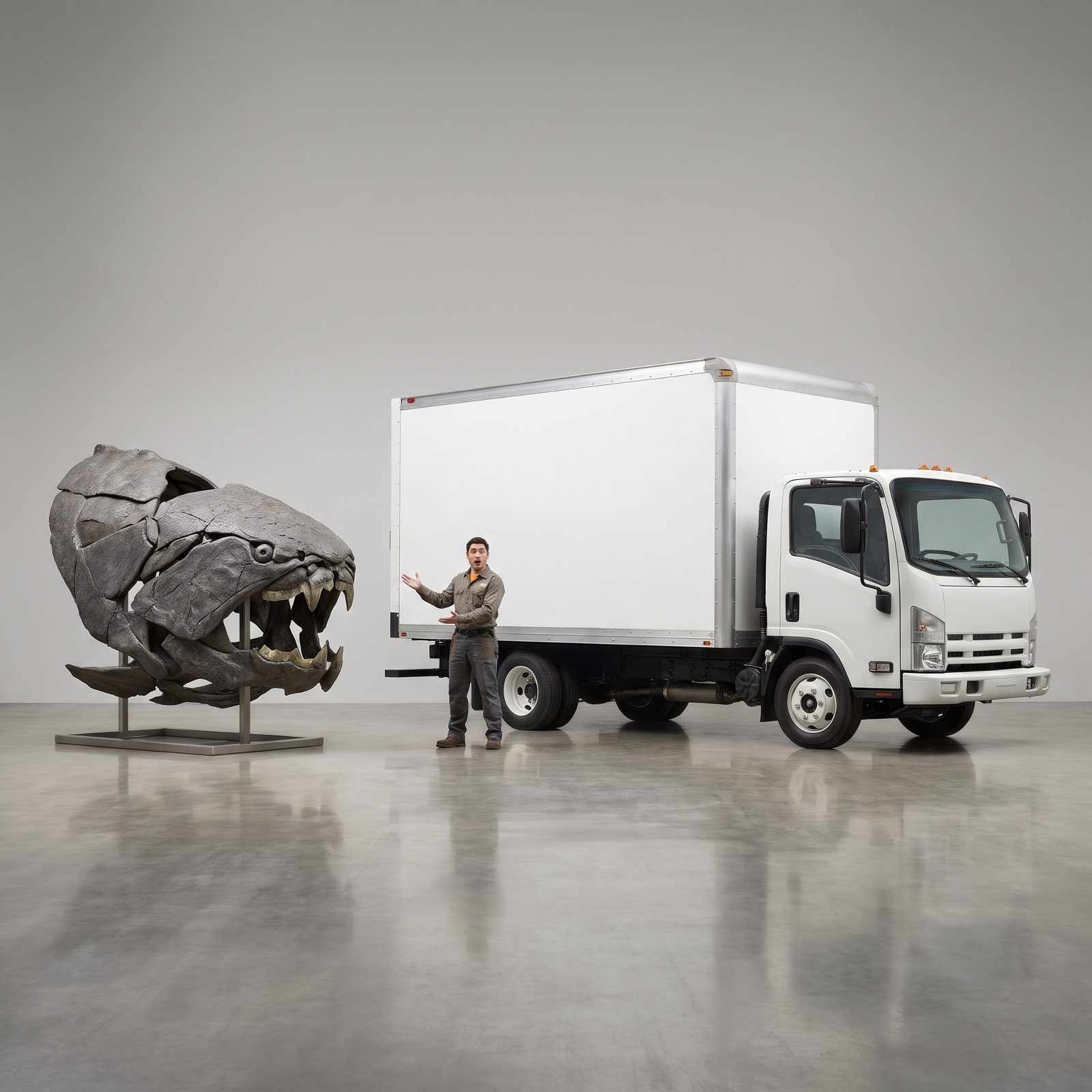
Here’s one where the science got smaller, not bigger. For years artists drew Dunkleosteus at 20 feet or more. Then a 2023 study reworked the body proportions into a stockier, shorter animal than the posters ever suggested.
Only the armored head is on display here, blown up far past life size, and it’s box-truck sized on its own: taller than the man beside it, nearly as tall as the truck’s cargo box, and lined with rows of pointed, yellowish fangs. Those jaws sheared through shell and bone, and it swam the Devonian seas around 360 million years ago, long before the first dinosaur drew breath.
After shrinking the fish’s estimated length, the study’s lead researcher says “These things were built like wrecking balls. The new proportions for Dunkleosteus may look goofy until you realize it has the same body shape as a tuna”
18. Perucetus Beside a Shipping Container
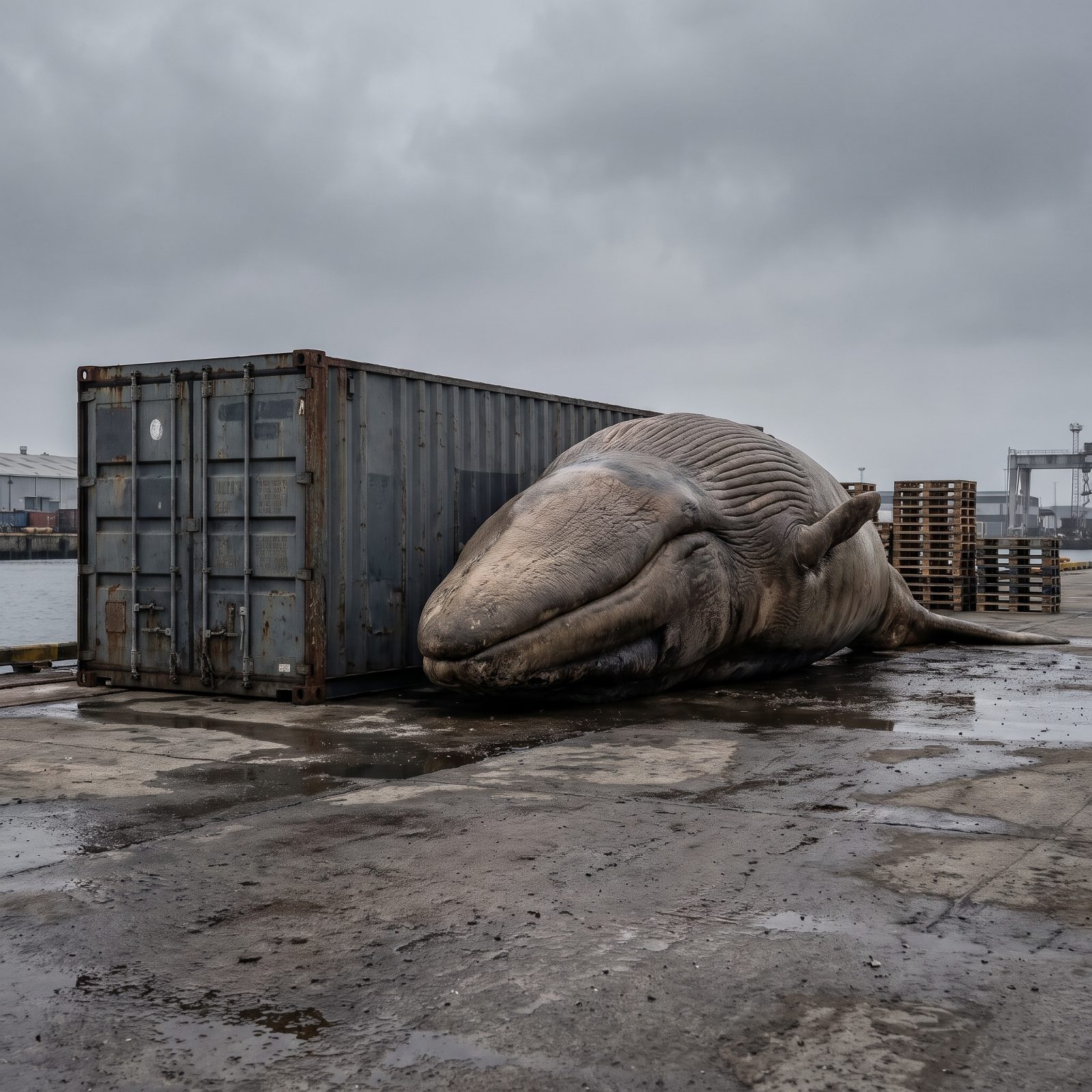
Perucetus made headlines in 2023 as possibly the heaviest animal that ever lived, worked out from fossils buried in the desert of southern Peru. Its bones were extraordinarily dense and massive, the kind you’d expect on a creature built to sink and loiter low in shallow water.
Length-wise it outstrips a 40-foot shipping container, at an estimated 55 to 65 feet. The weight claims have been picked apart since and are probably overstated, but nobody disputes the density of those ribs and vertebrae. Each bone weighs a ridiculous amount.
Looking back on the Peruvian find, the 2023 study’s lead author says “The discovery of the new fossil hence shows us that the coastal environment can sustain such a gigantic animal, something we did not expect at all.”
17. Archelon Parked Next to a Compact Car
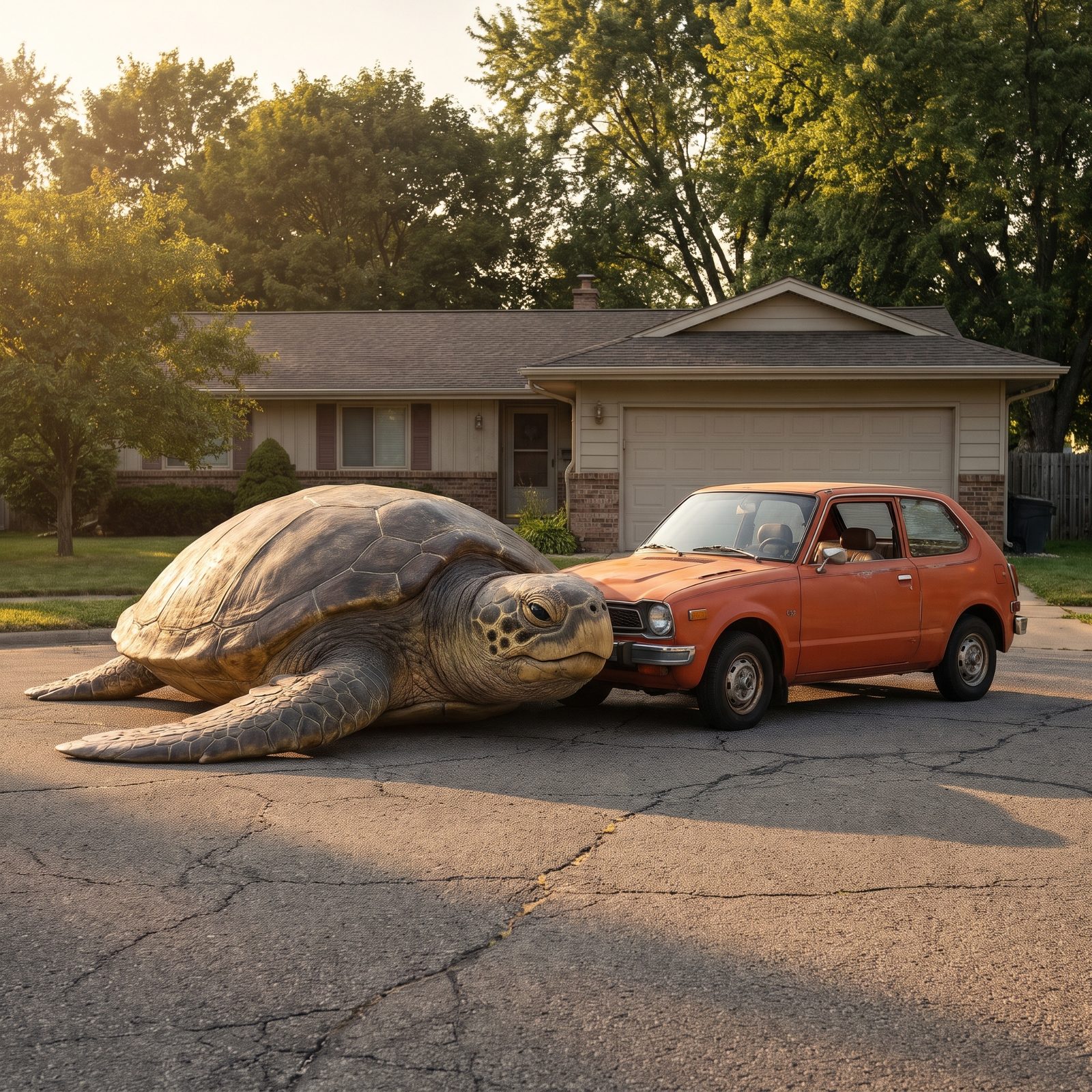
Archelon was a sea turtle the size of a small car, around 13 feet from beak to tail and roughly as wide as a hatchback once you count the flippers.
It carried a leathery, lightly built shell rather than a solid bony one, much like a modern leatherback. It paddled the shallow inland sea that once split North America in two, about 70 million years ago, and the best fossils come out of the Pierre Shale in South Dakota.
16. Helicoprion Laid Out Beside a Stretch Limousine
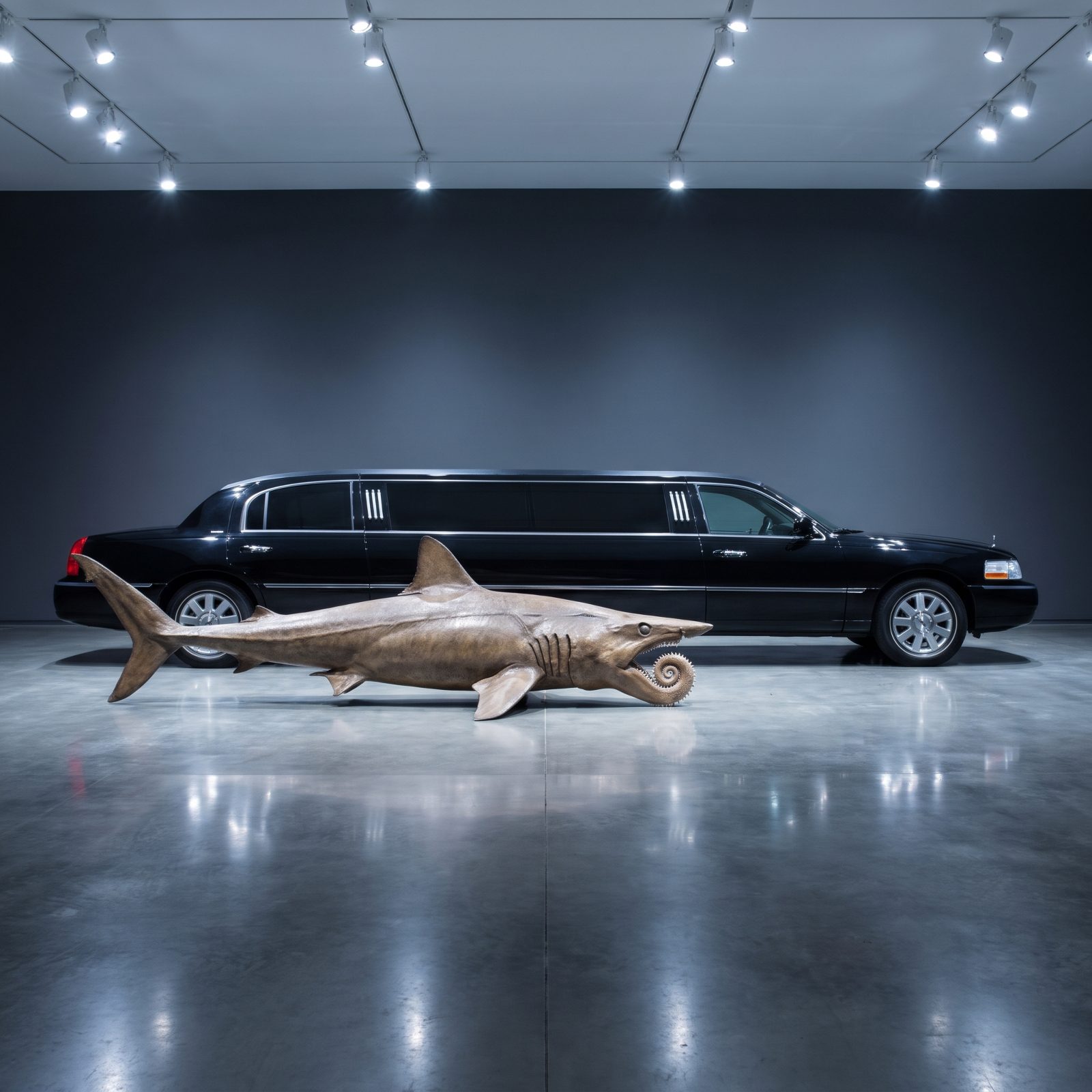
Helicoprion is the one with the buzzsaw. For over a century, nobody could figure out where its bizarre spiral of teeth even sat. People stuck it on the nose, the tail, the upper jaw, you name it.
Then a 2013 CT scan of an Idaho specimen settled the argument for good. The whorl sat inside the lower jaw, a slow conveyor belt of teeth, though this model still shows the older guess, with the spiral curling out past the jaw like a coiled tongue. This model runs well under 20 feet, only about half the length of a stretch limo. And it wasn’t a true shark but a cousin, out of the Permian seas roughly 270 million years ago.
For a hundred years, the only part of this animal anyone ever found was the one part nobody could explain.
After CT scans showed the tooth whorl filling the lower jaw, a museum curator and paleontologist says “The analogy to a circular saw is almost perfect.”
15. Basilosaurus Stretched Out Beside an Articulated Bus
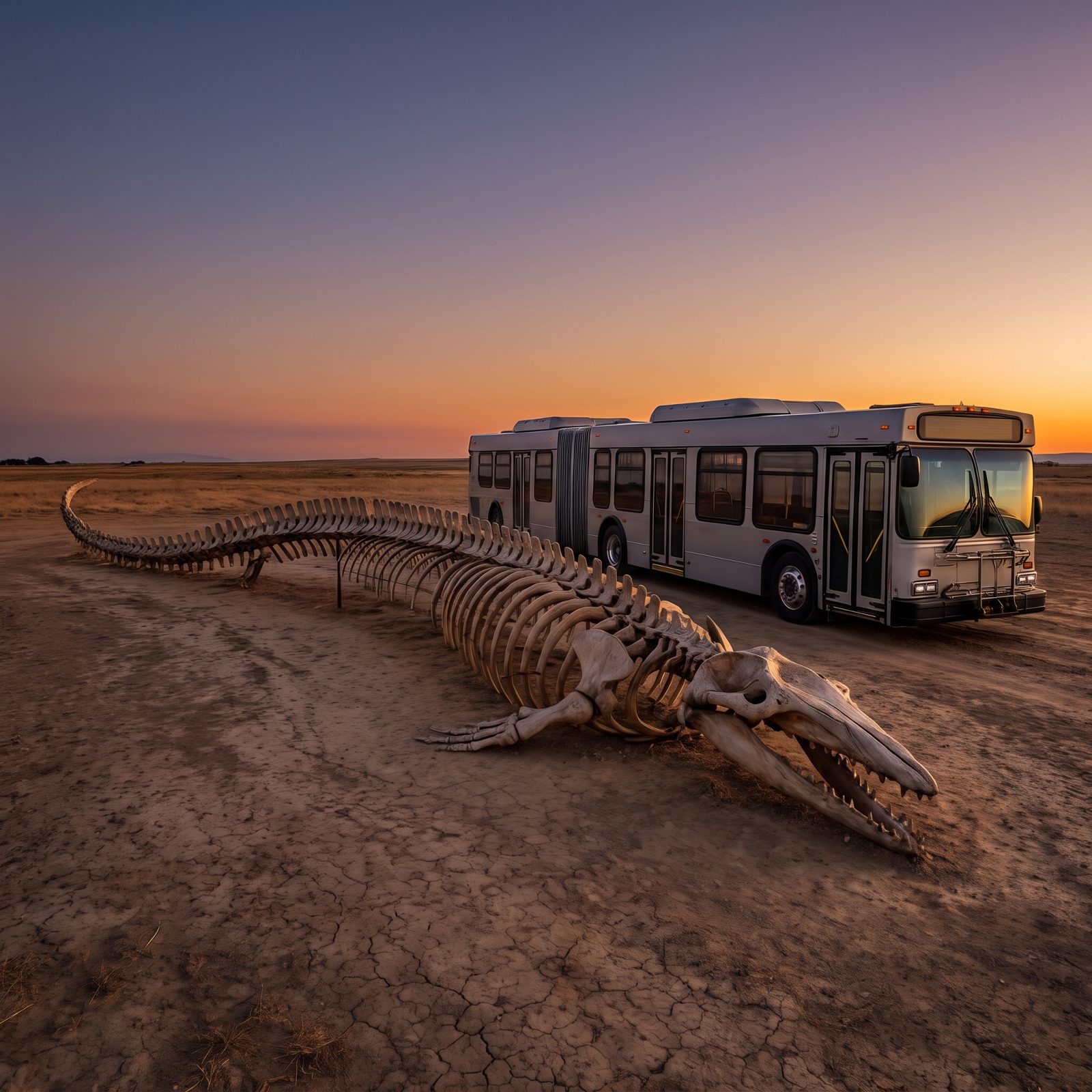
Forget the whale shape you have in your head. Basilosaurus (late Eocene, roughly 40 to 34 million years ago) was built like a sea snake wearing a whale’s skull. Fossils turned up across Alabama and Mississippi in such numbers that Alabama made it the state fossil.
Early scientists figured the bones belonged to some giant marine reptile, which is how it got stuck with the name “king lizard” — a label nobody has bothered to fix in two centuries. It’s a whale. Park an articulated city bus beside this skeleton and the curving spine runs roughly the bus’s full length, but the body is a fraction of the bulk. Long, not heavy.
14. Liopleurodon Parked Next to a Delivery Van
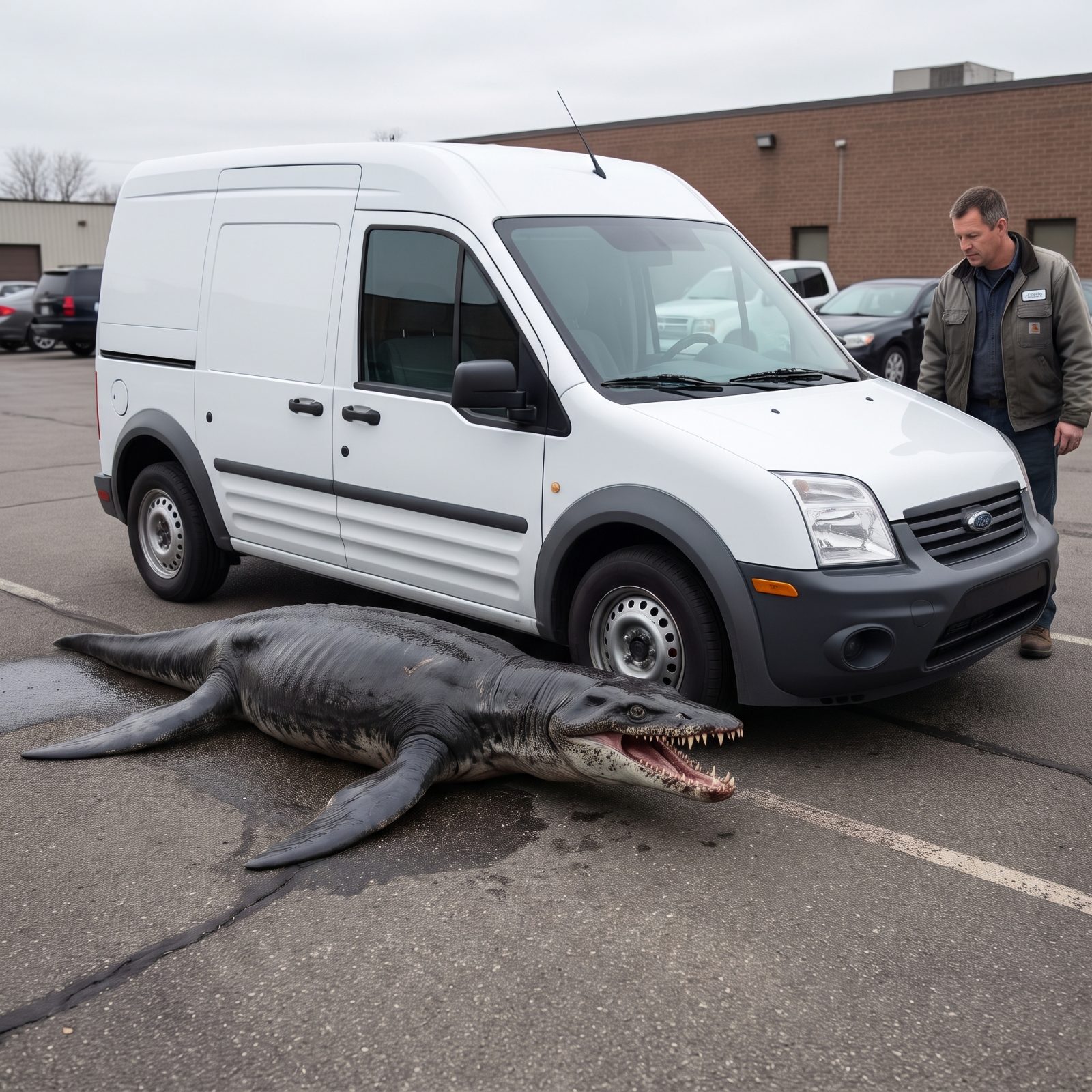
The documentaries lied to you. For years Liopleurodon (Middle to Late Jurassic, fossils from England and France) got drawn at 80 feet — a number pulled from a single dodgy estimate and repeated until everyone believed it.
The one in this photo is noticeably shorter than the delivery van beside it, maybe 12 to 14 feet. Still a monster, still a top predator with a toothy skull as long as your arm. But it fit in a parking space, not a stadium.
I remember the TV version charging the camera like a bus with teeth. The science quietly corrected it, and almost nobody noticed.
13. Xiphactinus Laid Out Next to an Ambulance
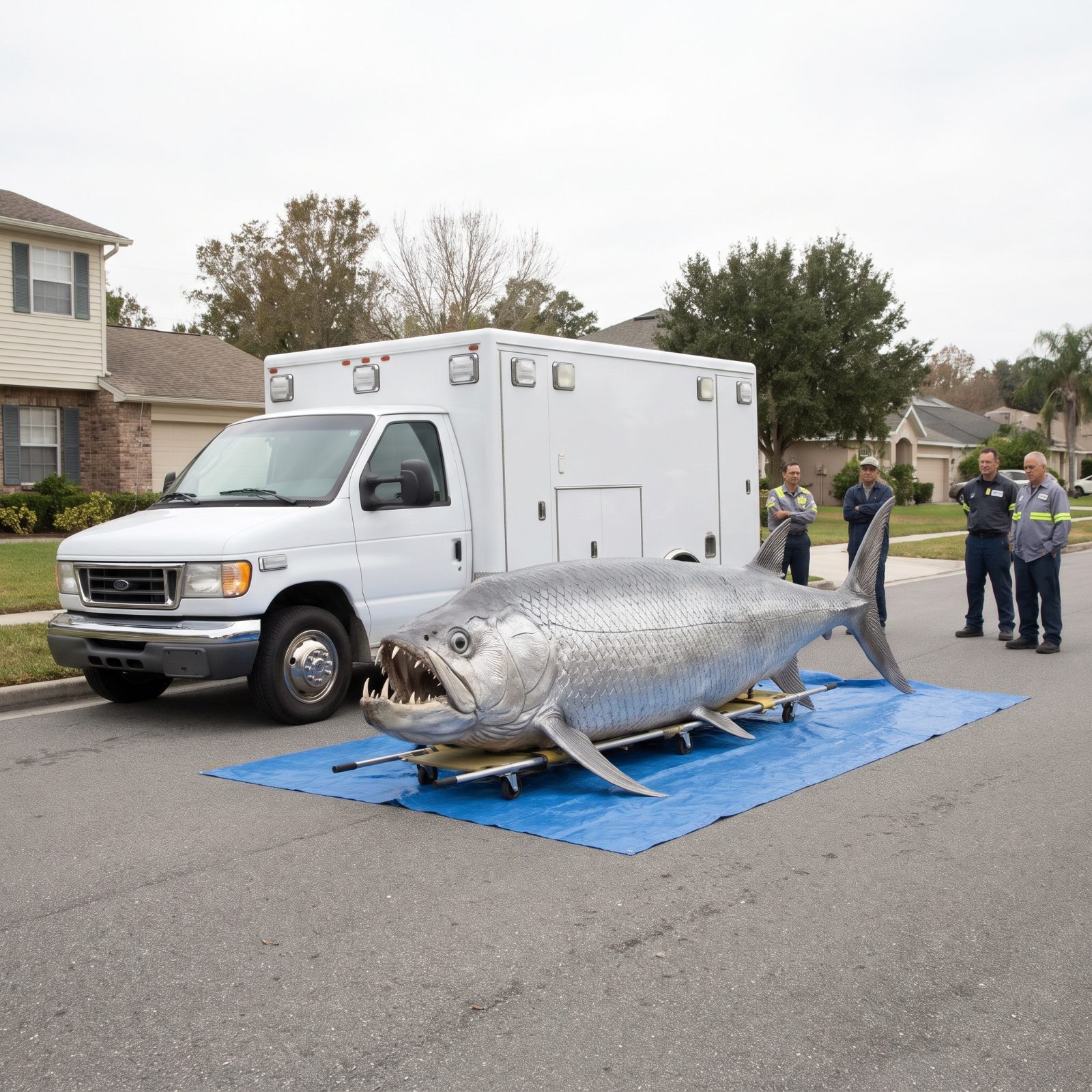
A fish the size of an ambulance sounds like a fish story. It isn’t. Xiphactinus (Late Cretaceous, famous from the Kansas chalk beds of the old Western Interior Seaway) grew to around 17 feet of pure predatory muscle.
The most famous specimen is nicknamed the “fish within a fish.” A Xiphactinus swallowed another six-foot fish whole, then died before digesting it, and both fossilized together, nested like a grim Russian doll.
The lesson it left us is ancient and blunt: don’t eat something that might kill you on the way down.
12. Tanystropheus Alongside a Family Minivan
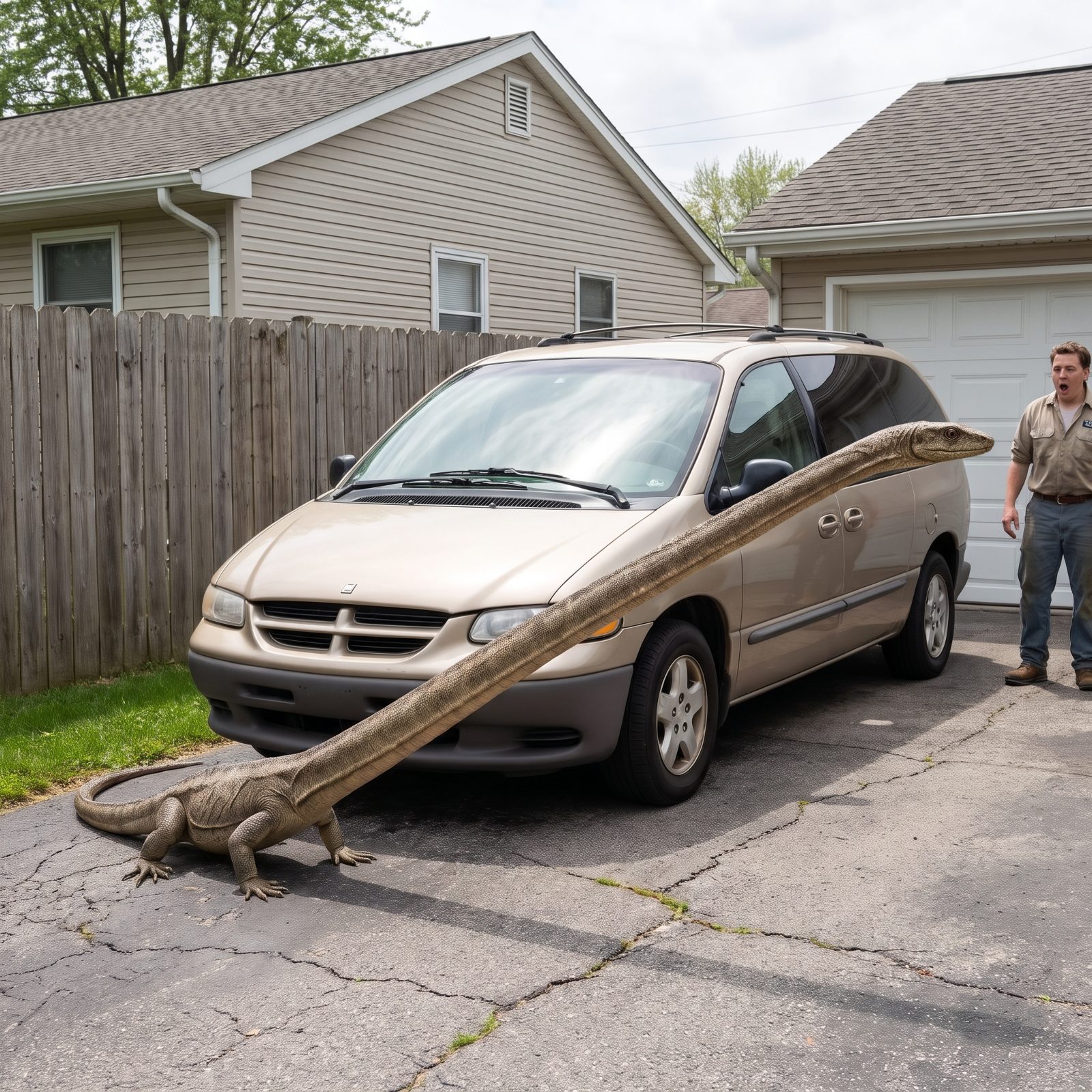
Picture a creature that is mostly neck. Tanystropheus (Middle Triassic, fossils from Switzerland, Italy and China) stretched about 20 feet, and more than half of that was a rigid, straw-stiff neck held out ahead of its body.
Here’s the part people get wrong: that neck barely bent. It had only a dozen or so very long vertebrae, so the animal probably hung near the surface and darted its small head sideways to snatch fish without hauling its bulk around.
Beside a minivan the lengths roughly match. It’s the proportions that break your brain.
11. Nothosaurus Measured Against a Pool Table
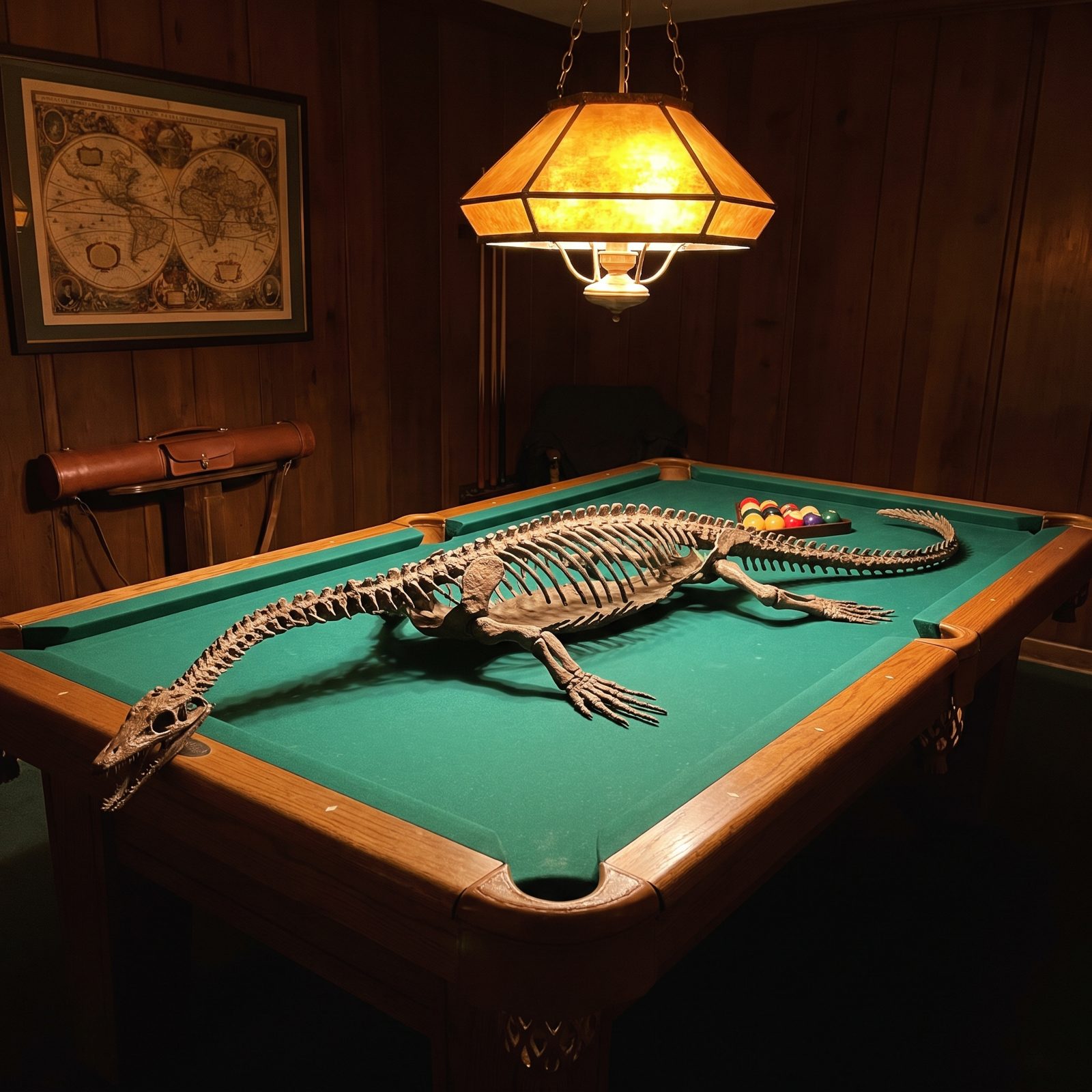
Not every sea reptile was a leviathan. Nothosaurus (Triassic, widespread across Europe, North Africa and China) landed around 7 feet, give or take — roughly the length of a regulation pool table.
Those interlocking needle teeth tell the whole story. Close the jaws and they formed a fish trap, built for grabbing slippery prey and never letting go.
It probably hunted the way a seal does now: agile in water, awkward on land. A small sleek ambush specialist, not a headline monster.
10. Atopodentatus Stretched Along a Three-Seat Sofa
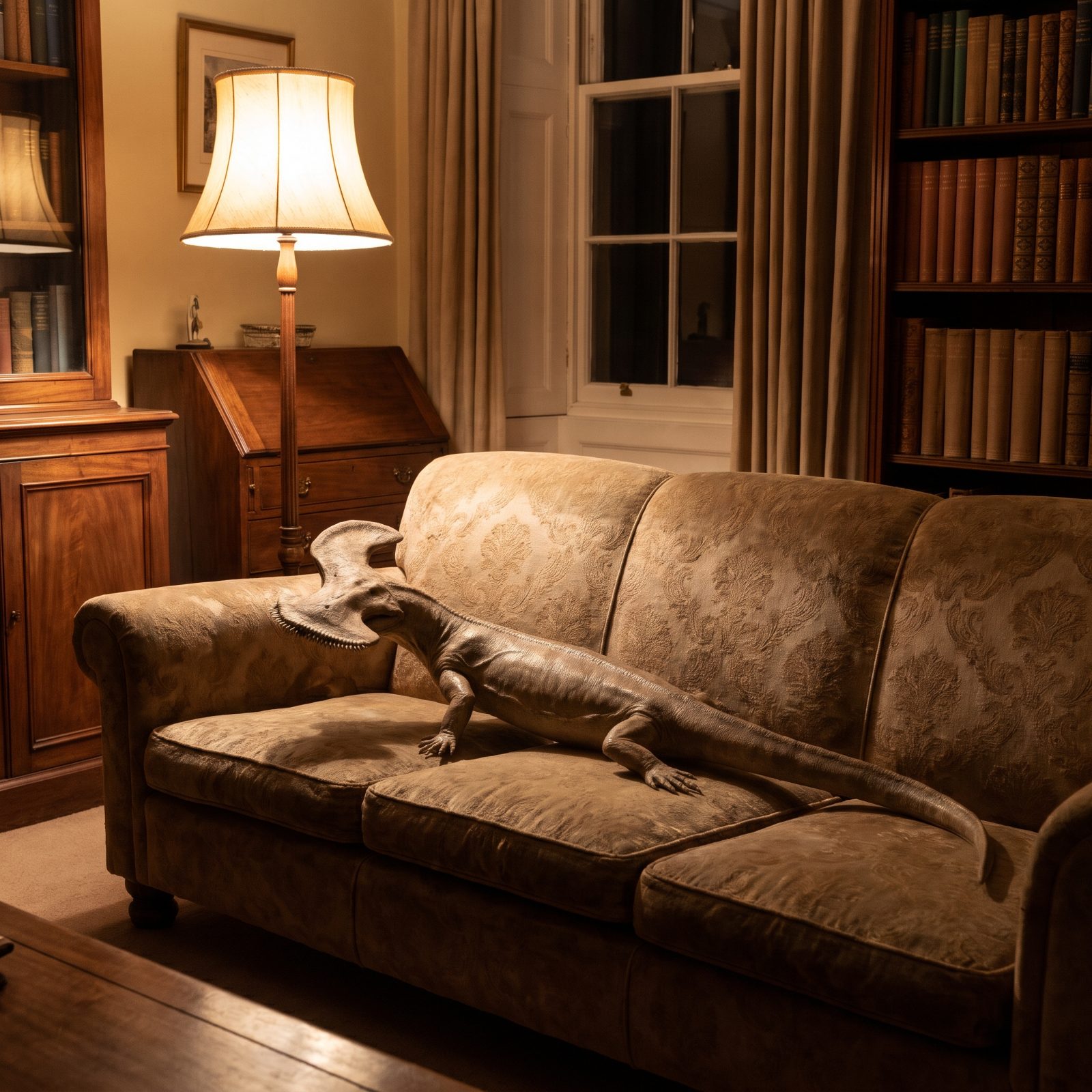
The weirdest face in the Triassic sea. Atopodentatus (Early Triassic, fossils from Yunnan, China) carried a hammerhead-shaped snout lined with tiny chisel teeth — the first known plant-eating marine reptile anywhere in the record.
At roughly 9 to 10 feet it sprawls about the length of a three-seat sofa. It used that flattened jaw to rake algae off the seafloor, then strained the water back out through a comb of needle-fine teeth. A vegetarian reptile scraping salad off rocks, 247 million years ago.
Evolution tried everything at least once.
Calling it a very strange animal, a museum evolutionary biology curator who co-authored the study adds “It’s got a hammerhead, which is unique, it’s the first time we’ve seen a reptile like this.”
9. Dolichorhynchops Drawn Up Beside a Tandem Kayak
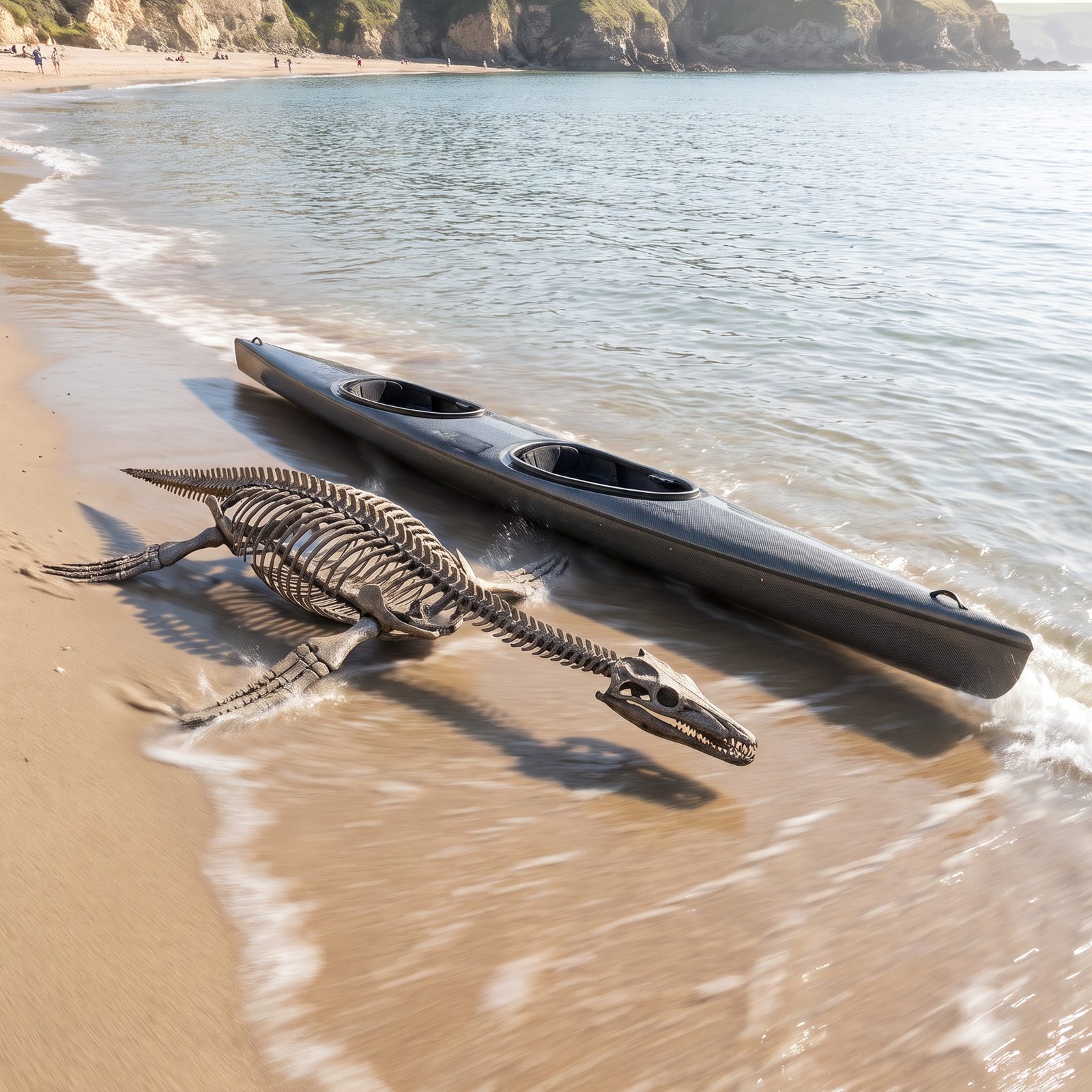
A long-necked, whip-tailed skeleton with a crocodile-like skull, closer to a generic plesiosaur than the short-necked Dolichorhynchops it’s named for. The real Dolichorhynchops (Late Cretaceous, Kansas and the Western Interior Seaway) ran roughly the length of a tandem kayak — around 10 to 16 feet — while this skeleton’s four flippers end in splayed, separate finger bones like a lizard’s hand rather than tight paddles.
The famous “Dolly” specimen showed shark bite marks and a belly full of fish bones and tiny swallowed stones. Those stones, called gastroliths, may have helped with grinding or buoyancy. Honestly, we still argue about which.
Small, fast, and clearly living a dangerous life out there.
8. Metriorhynchus Pulled Up Beside a Motorcycle
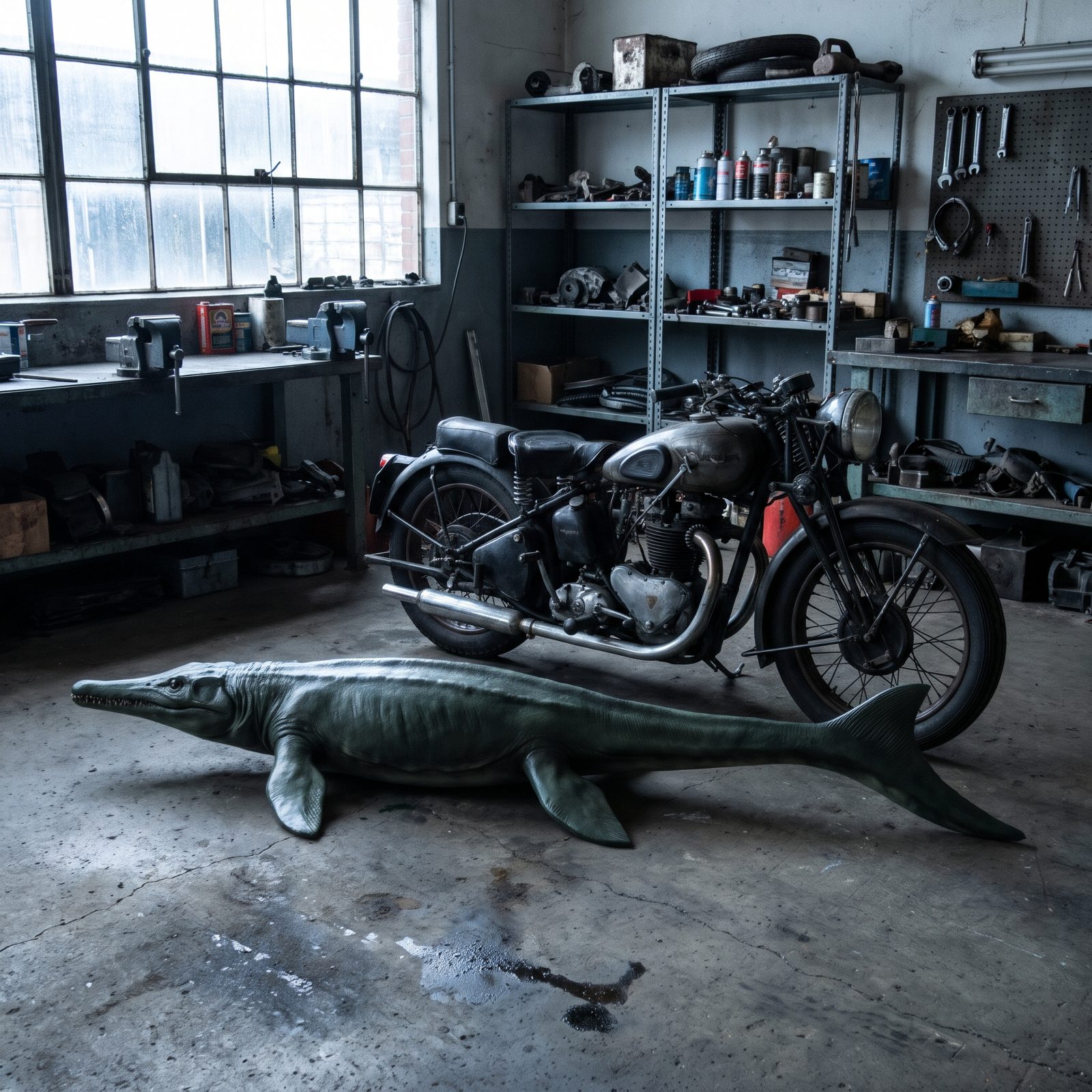
A crocodile that gave up land entirely. Metriorhynchus (Middle to Late Jurassic, fossils across Europe and South America) ditched the armored plates every modern croc wears, grew flippers and a fish-tail fin, and spent its whole life at sea.
At around 10 feet it matches a touring motorcycle. Smooth skin, no bony plating, a tail that bent down into a shark-style fluke — if you only saw the silhouette you’d never guess “crocodile.”
It’s one of the clearest examples we have of a land animal going fully, permanently marine.
7. Geosaurus Laid Out Alongside a Grand Piano
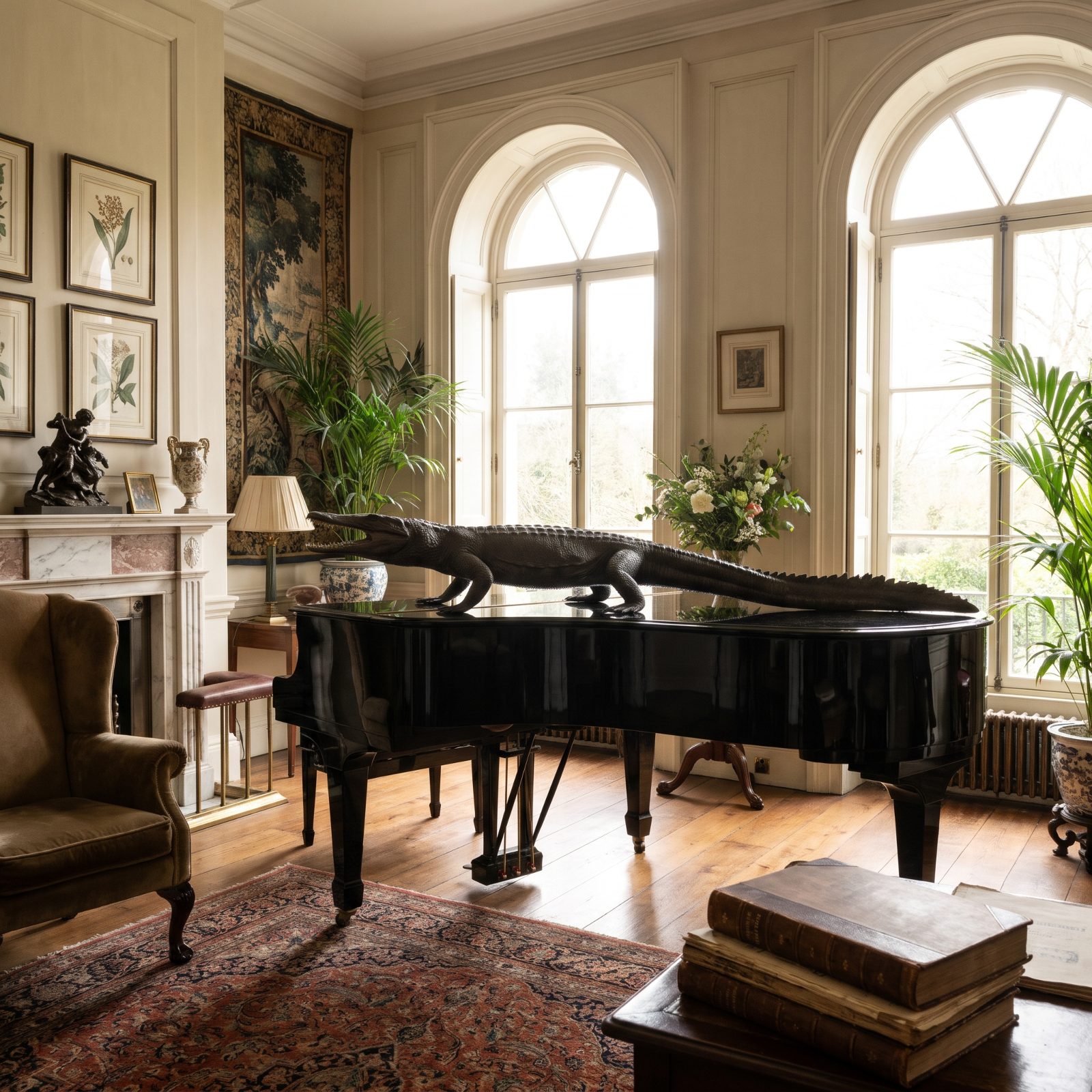
The wolf of the Jurassic seas. Geosaurus (Late Jurassic to Early Cretaceous, fossils from Europe) was a close cousin of Metriorhynchus, but where that one caught fish with pincer jaws, Geosaurus packed blade-like serrated teeth for slicing flesh.
About 10 feet long, it lines up neatly with a grand piano — a strange pairing of elegance and menace. Here it stands on four sturdy legs, armored scutes along its back and a crested crocodilian tail trailing over the lid, though the real animal, like Metriorhynchus, had flippers and no armor.
Two close relatives, two completely different hunting kits. The sea had room for a gentle angler and a cutting predator at once, and that split is exactly how evolution fills an ocean.
6. Platypterygius Alongside a Travel Trailer
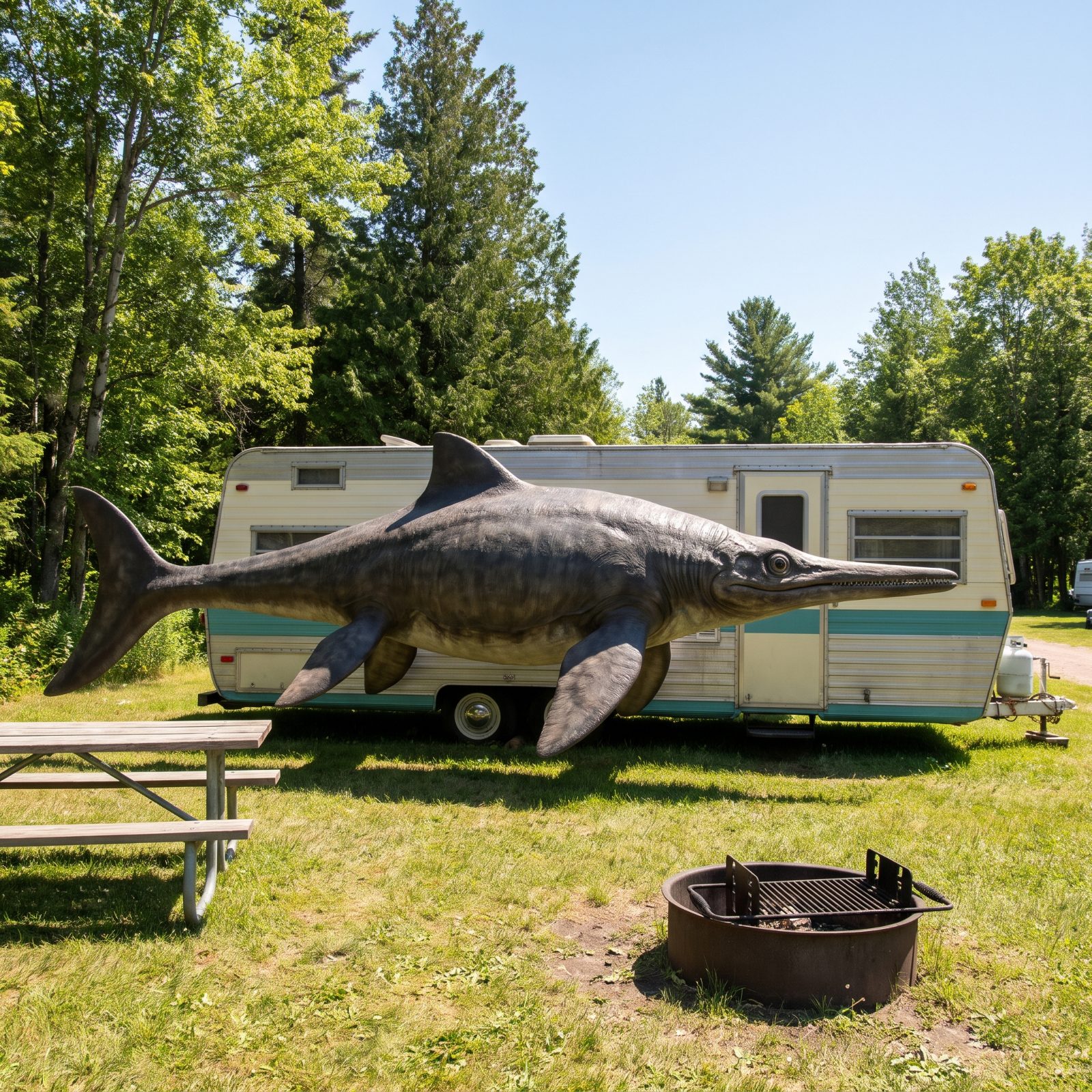
Imagine a travel trailer that could swim. That’s roughly the footprint of Platypterygius, an ichthyosaur that cruised the Cretaceous seas over Australia and across the globe about 110 million years ago.
Fossils from Queensland’s old inland sea preserved stomach contents: fish, baby turtles, even young seabirds. A warm-blooded, fast reptile that gave live birth tail-first in the open water, and those enormous eyes weren’t decoration. They tracked prey down in the dim where sunlight barely reaches.
5. Hybodus Beside a Bicycle
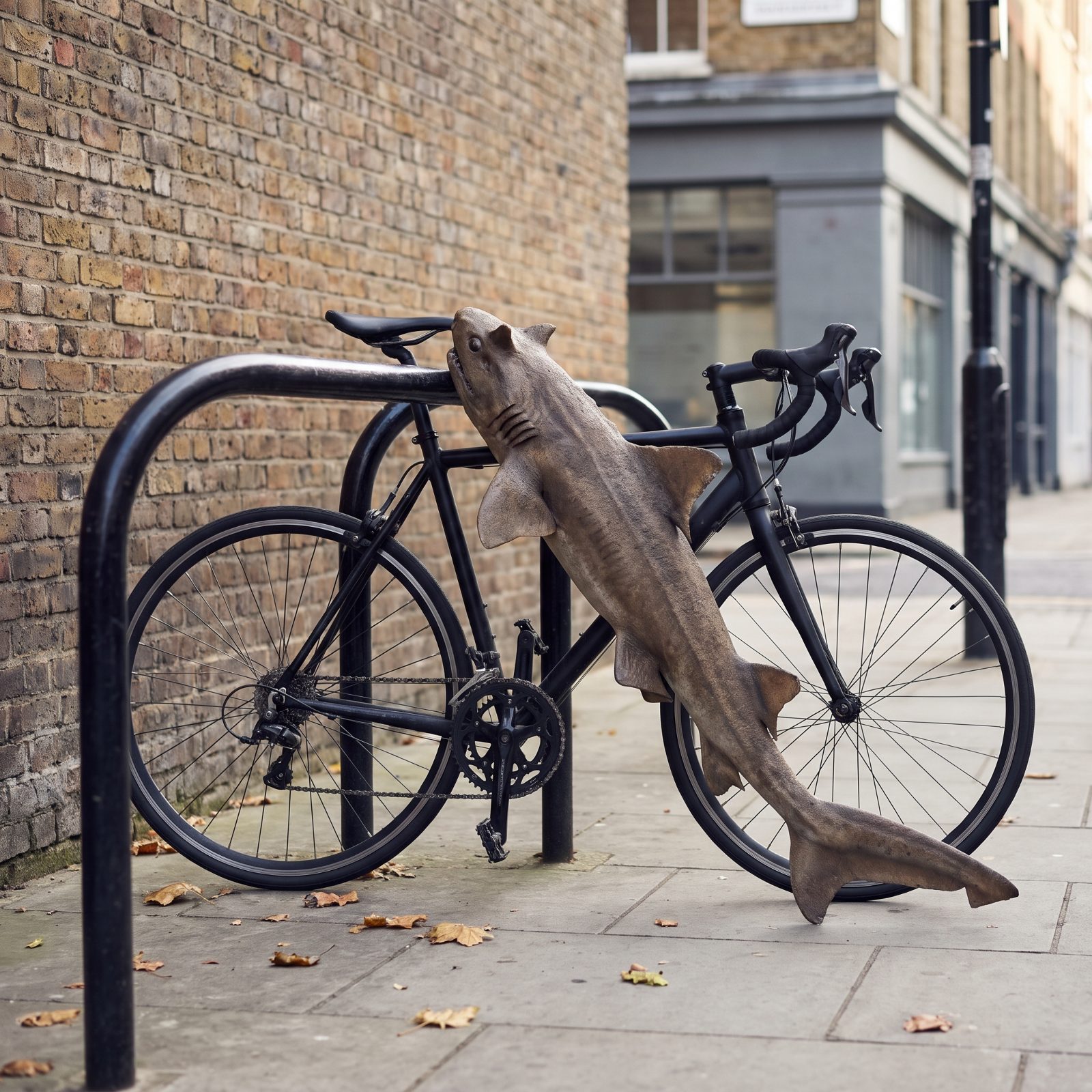
You could prop this shark against a bike rack and they’d match. Hybodus ran about the length of a road bicycle, which makes it modest by shark standards and absolutely relentless by survival standards.
So what kept it around for well over 100 million years? Two kinds of teeth. Sharp ones up front to grab, flat crushing plates in the back to grind shellfish. A shark that can eat almost anything rarely goes hungry.
The males carried spines above their eyes, which paleontologists suspect helped them grip mates. Fossils turn up across Europe, Asia and North America.
4. Cameroceras Alongside a Moving Truck
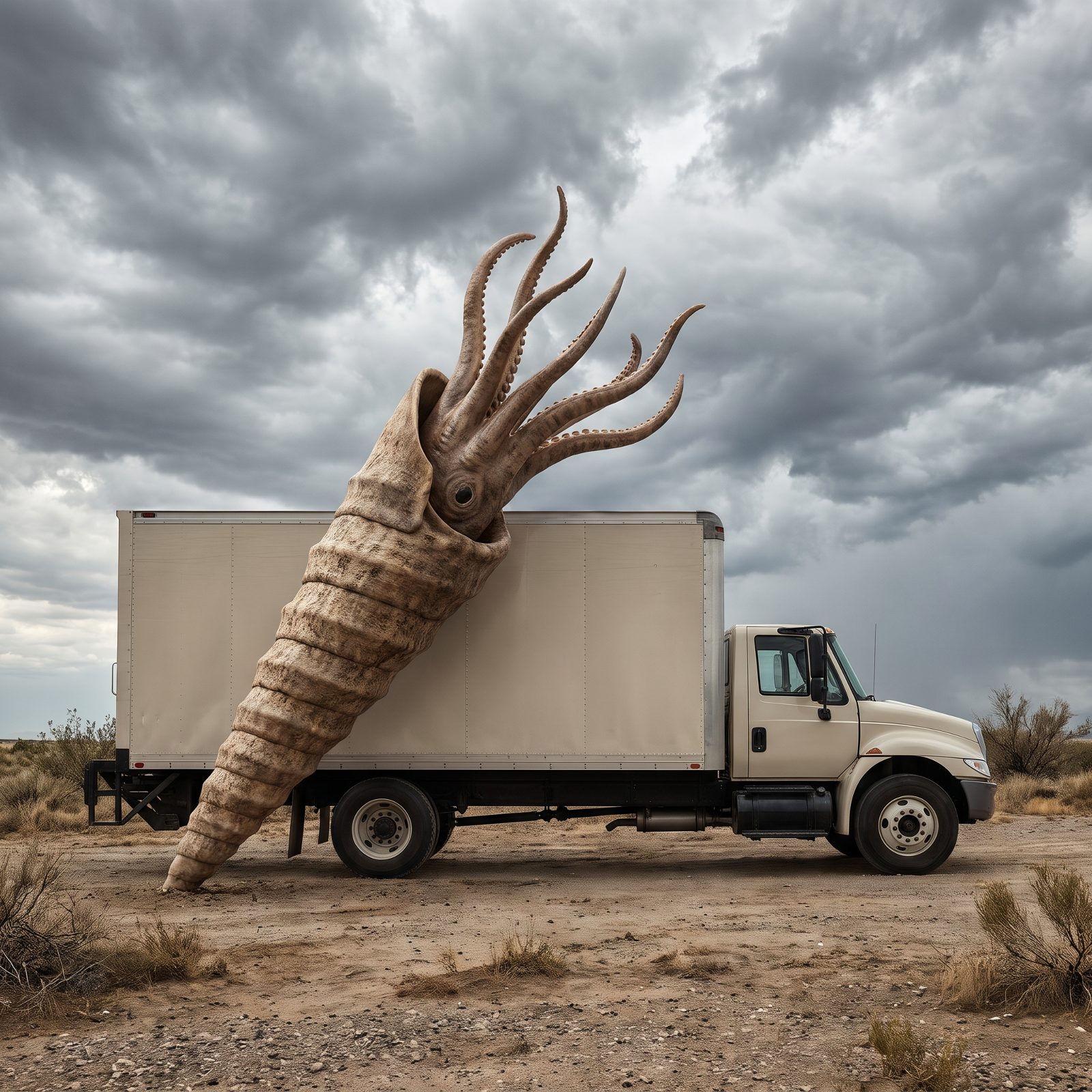
The largest animal on Earth once had a shell shaped like an ice-cream cone the size of a moving truck. Cameroceras ruled the Ordovician oceans around 470 million years ago, back when nothing on land had a backbone and the seas were the only arena that mattered.
That straight conical shell wasn’t just armor. Gas-filled chambers inside controlled buoyancy, letting this predator hang in the water column and strike, grabbing trilobites and early fish with its tentacles.
The old estimates ran wild, some claiming 30 feet or more. Careful recent work pulled it back toward something less cartoonish, though still genuinely monstrous.
3. Parapuzosia seppenradensis Next to a Patio Umbrella
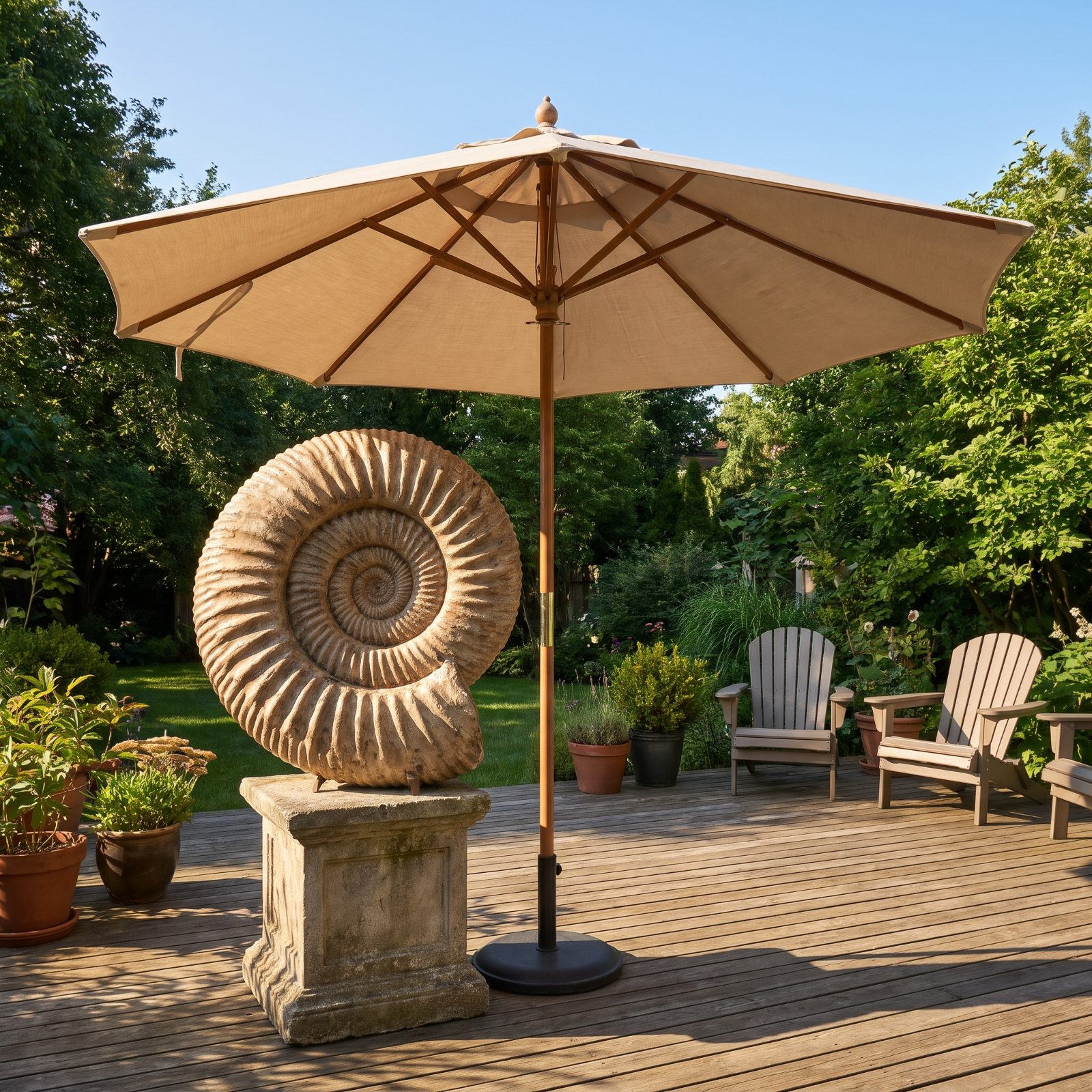
Stand a backyard patio umbrella on its edge. Now picture a spiral shell the same width. That’s Parapuzosia seppenradensis, the biggest ammonite anyone has ever dug up.
The famous specimen came out of Seppenrade, Germany, in Late Cretaceous rock, and it measures close to six feet across even though the outer living chamber is missing. Complete, it would have been wider still.
Ammonites were cephalopods, cousins of today’s squid and octopus, tucked into coiled shells. They vanished alongside the dinosaurs. This one grew to umbrella scale and then the whole lineage was gone.
2. Aegirocassis Beside a Queen-Size Bed
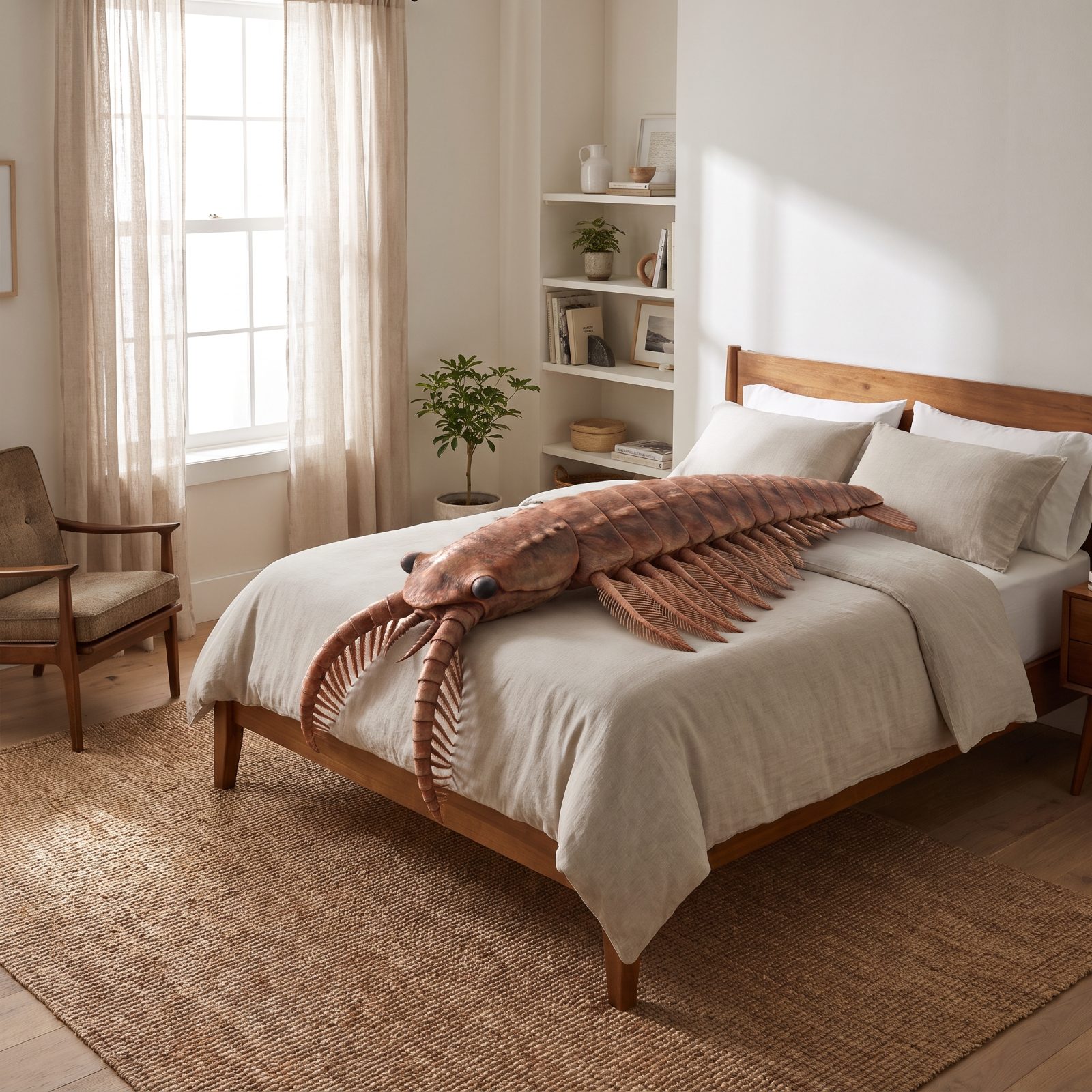
Lay a queen-size bed on the floor of an ancient ocean and you’ve got the footprint of Aegirocassis. This Ordovician giant stretched past six feet, and here’s the twist nobody expects: it ate plankton.
Its ancestors, the Anomalocaris crowd, were armed with spiny grasping claws. Here, Aegirocassis sports a radiating fan of many feathery legs plus long, segmented antenna-like legs around its head, pictured as gear for straining tiny food from seawater. Same body plan, opposite job.
Found in Morocco’s 480-million-year-old rock, it’s one of the earliest giant filter feeders on record. Long before whales, the ocean already worked out that going big on small prey pays off.
1. Hupehsuchus Next to a Skateboard
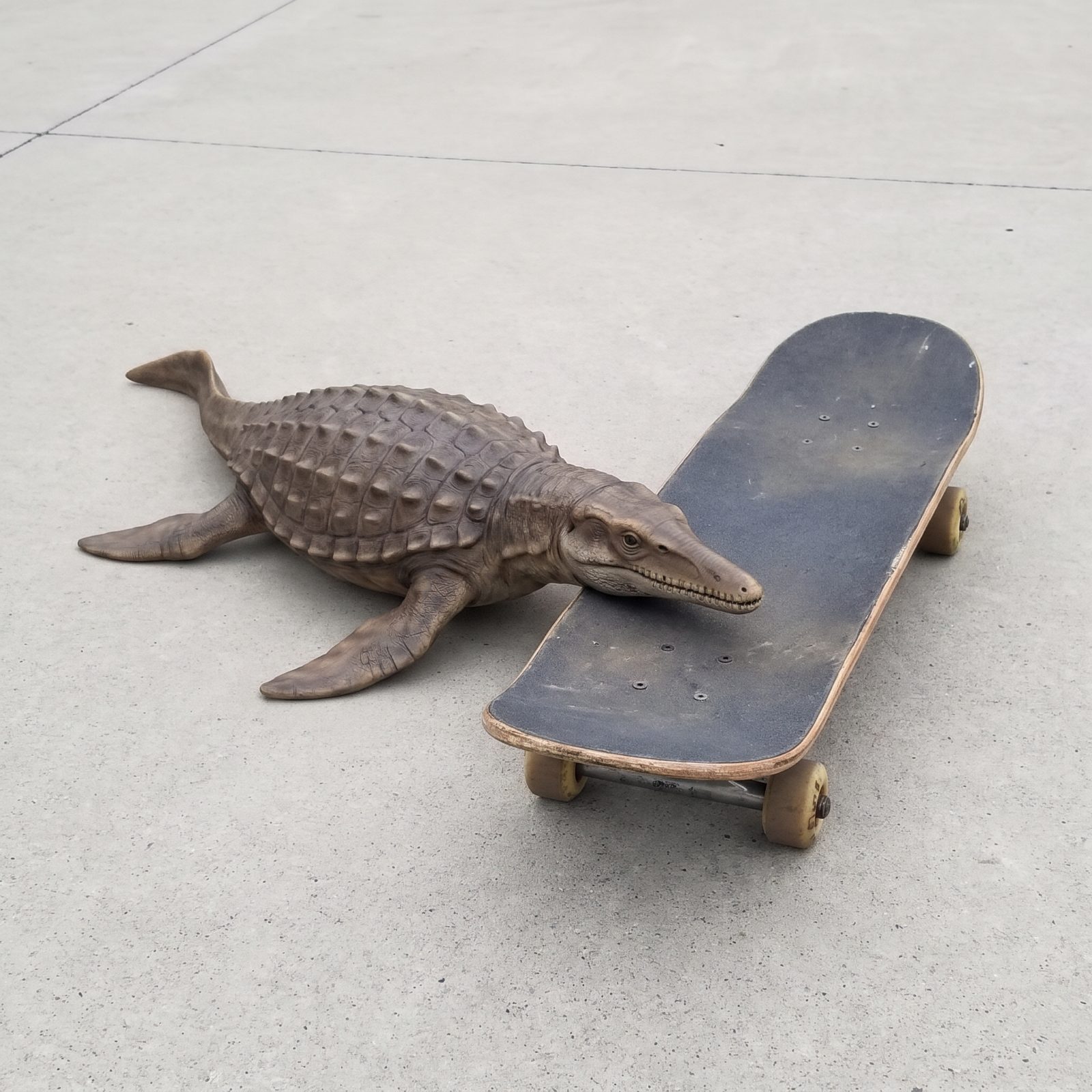
Roughly skateboard length, and genuinely strange even by Triassic standards. Hupehsuchus swam in the seas over what is now China about 248 million years ago, right after the worst mass extinction the planet ever suffered.
This model gives it a crocodile-style snout lined with small sharp teeth, but recent fossil work pointed to something remarkable in the real animal: loose bony grooves along its jaws that look like anchor points for baleen, the same filtering gear whales use. If that holds up, this little reptile was straining plankton tens of millions of years before any mammal tried the trick.
A row of armor plates ran down its back. Small, odd, and quietly ahead of its time.
Putting the animal in context, a collaborating vertebrate paleontologist says “The hupesuchians lived in the Early Triassic, about 248 million years ago, in China and they were part of a huge and rapid re-population of the oceans”