
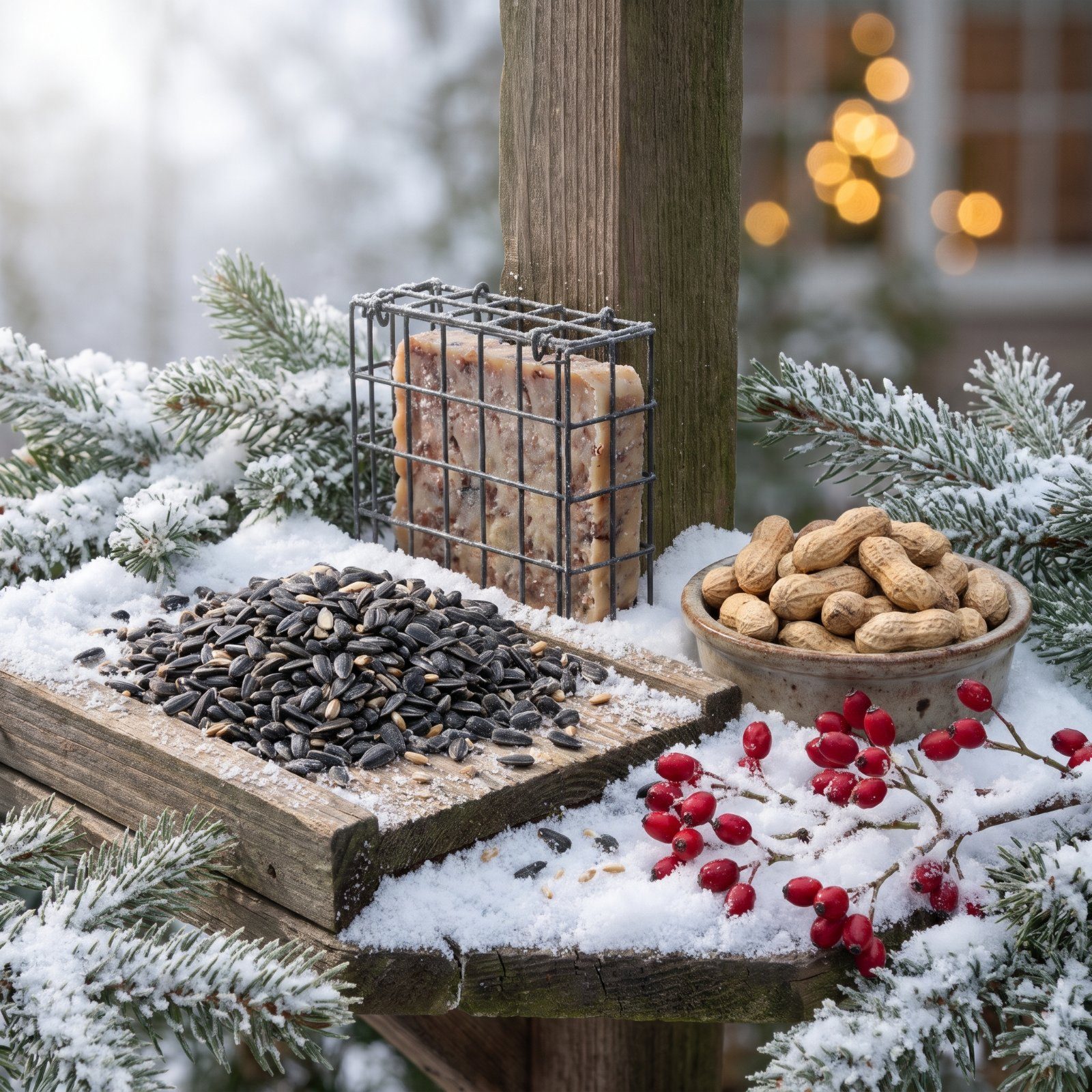
A cardinal lands on a snow-packed feeder and suddenly the whole yard looks like a greeting card. That’s the easy part. The harder part is knowing why one bird cracks a sunflower seed on the spot while another flies off with it, why the junco never touches your feeder but works the ground beneath it, why a woodpecker turns up in December when you’d swear it should be long gone south. Winter strips the trees bare and shoves birds into the open, right where you can watch them. Here’s who arrives, what pulls them in, and the small habits that give each one away.
Please note that some of the images in this article were created with the assistance of AI.
44. Northern Cardinal Glowing Red Against Fresh Snow
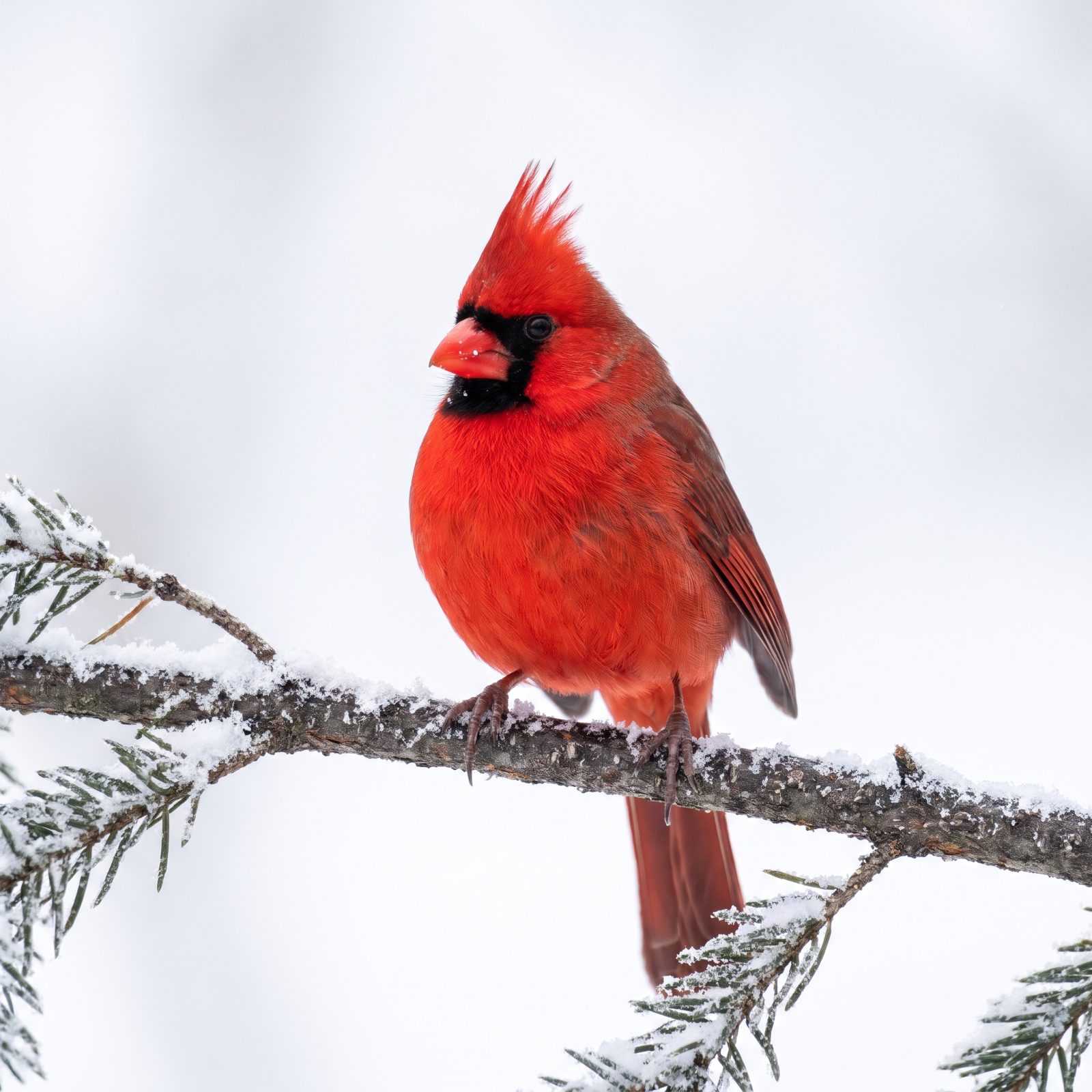
Red against white is the whole reason half of us bother feeding birds, and the cardinal delivers it better than anything else in the yard.
Here’s what people miss: that thick orange cone of a bill is a seed-cracking tool, and it wants heavy, hull-on black oil sunflower seeds in a tray or hopper. Cardinals won’t cling or hang if they can help it, so give them a flat surface to stand on. They show up at the ragged edges of the day too, first light and last, when the color looks almost fake against the snow.
43. Black-Capped Chickadee Plucking a Sunflower Seed
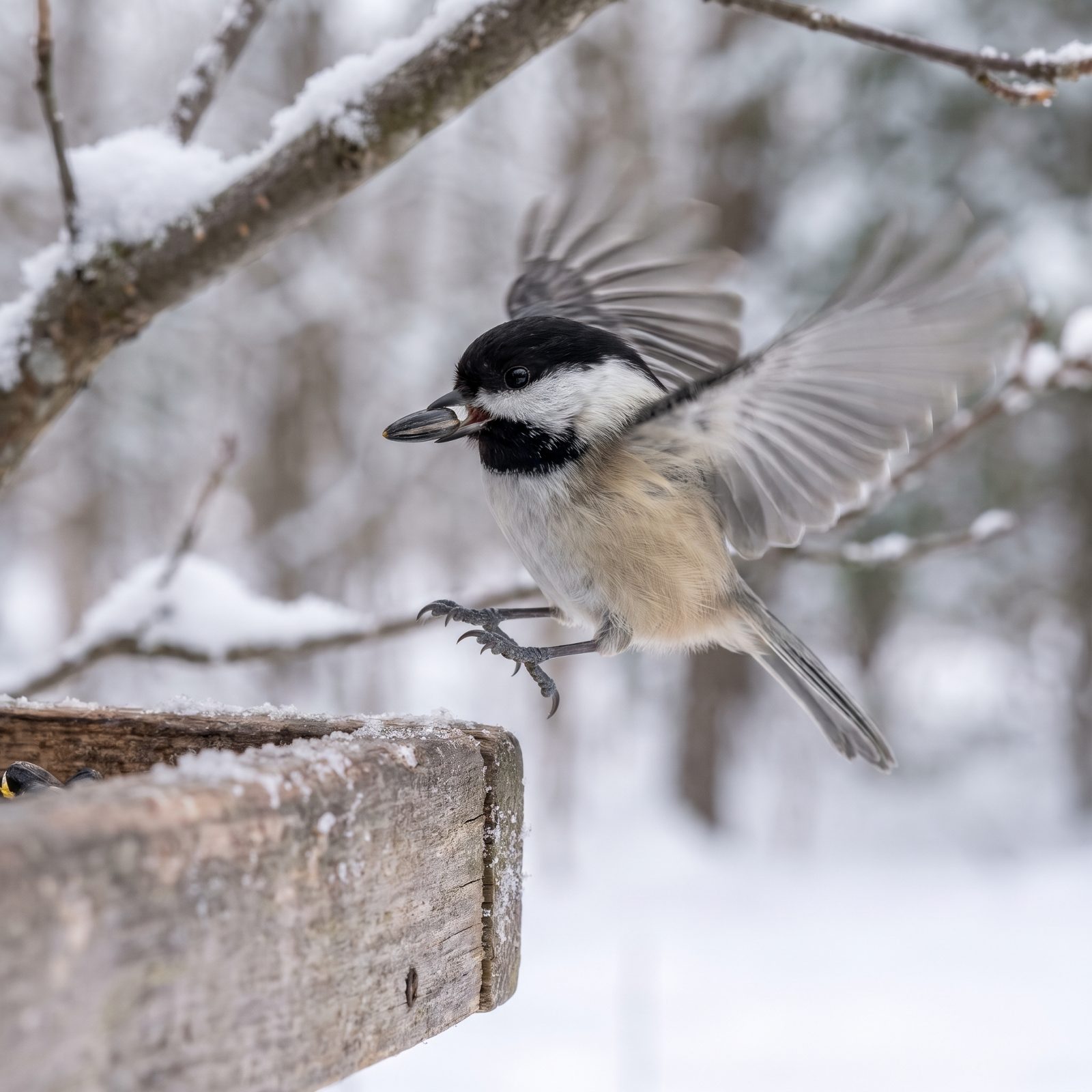
This one grabs and runs, and it’s not rudeness but strategy. A chickadee almost never eats at the feeder. It snatches a single seed, flies to a branch, pins it under both feet, and hammers it open.
They hoard, too. A chickadee stashes thousands of seeds across the fall and winter, and its brain physically grows new memory cells to keep track of where everything is buried. So every seed you put out might end up wedged in the bark of a tree three yards over. Offer hulled sunflower or small chips if you want less mess, since they do all that cracking elsewhere anyway.
42. Blue Jay Carrying Off a Whole Peanut
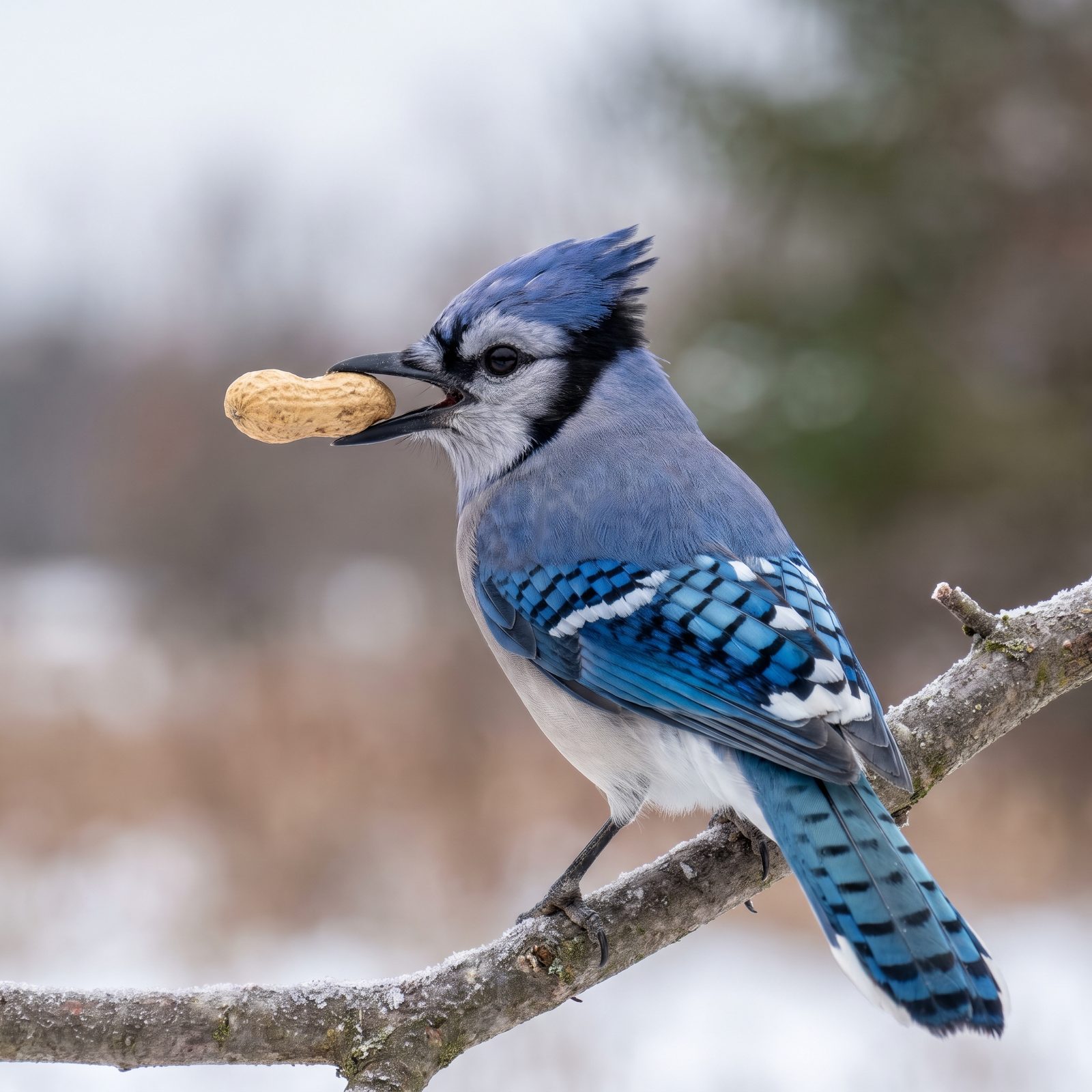
Noisy, bossy, and far smarter than the yard gives them credit for. A blue jay will size up a tray of whole peanuts, test the weight of a few, and leave with the heaviest one it can carry.
Watch the throat. A jay can pack several peanuts into an expandable pouch in its esophagus, then fly off to cache them all. Those forgotten caches are why jays quietly plant a huge share of North America’s oak forests. Acorns they bury and never dig back up grow into trees.
Explaining why a jay picks up each peanut and sets it down again, a longtime bird blogger notes that “blue jays weigh the peanuts and then take the heaviest (best) one.”
41. Tufted Titmouse Choosing the Largest Seed
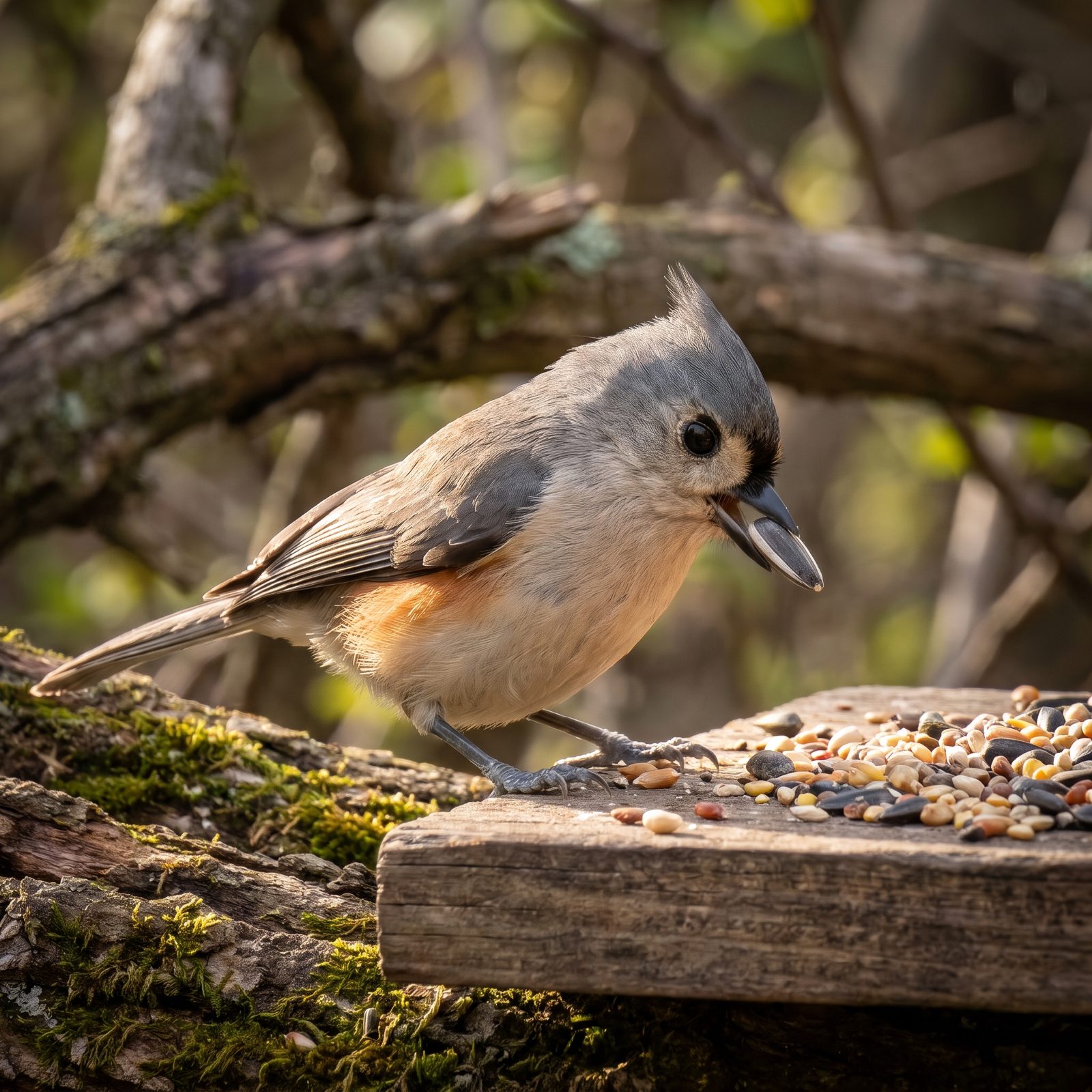
A titmouse never grabs the first seed. It picks through the pile like a shopper at a produce stand, hefting several before committing to the biggest one.
That’s not fussiness. Every trip costs energy, so choosing the heaviest seed squeezes the most payoff out of each flight. Like its chickadee cousins, the titmouse carries the prize off to crack, and often buries it for later. They love sunflower and peanut pieces, and they’ll hit the suet too. Listen for a clear, whistled peter-peter-peter cutting through a cold morning.
40. Downy Woodpecker Balanced on a Suet Cage
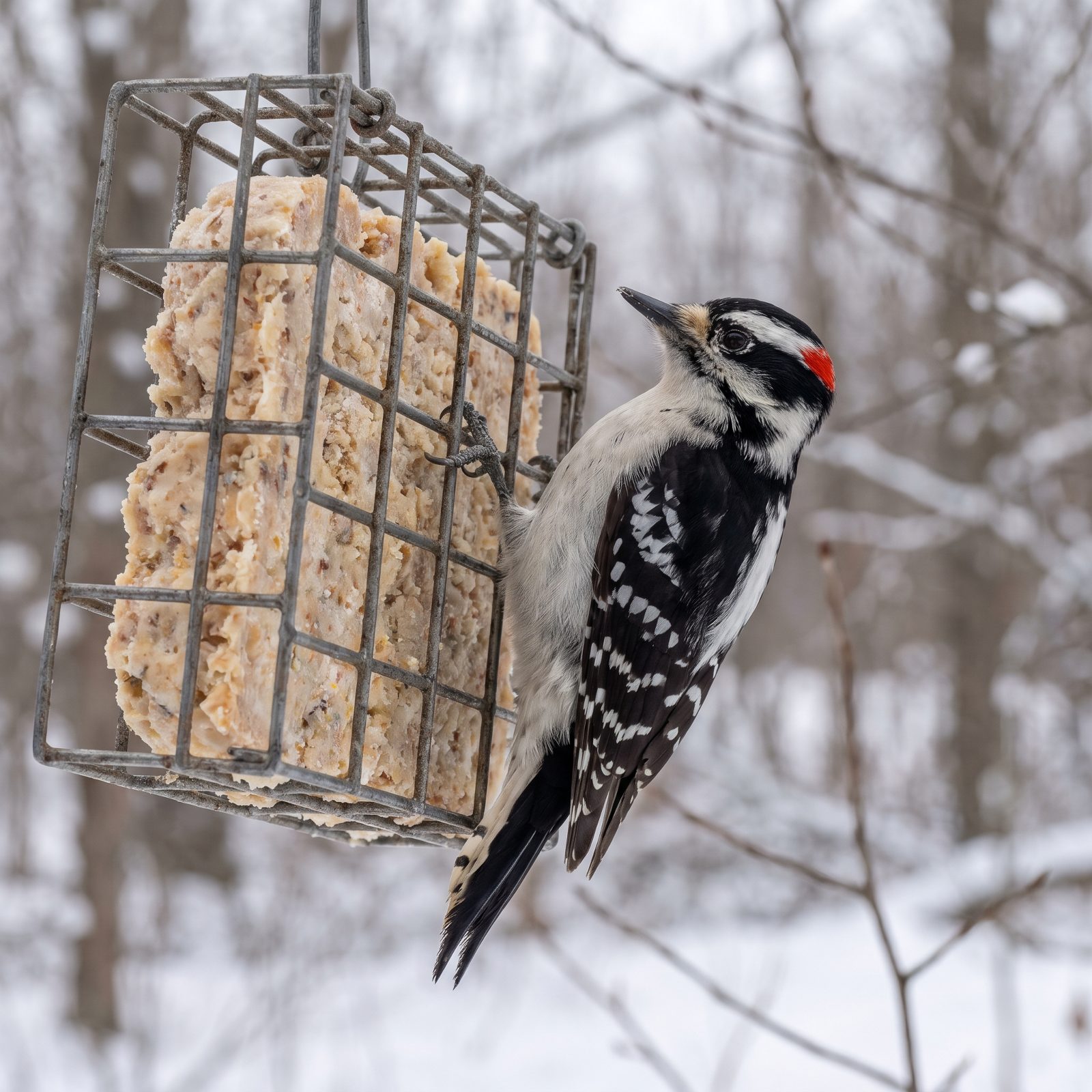
Smallest woodpecker on the continent, and the one most likely to be hanging off your suet in December. That red dot on the back of the head? You’re looking at a male.
Suet is winter fuel, pure rendered fat that replaces the insects a woodpecker can’t pry out of frozen bark. And that stiff tail you see hanging below the cage is normally a built-in kickstand, braced against bark to let the bird climb straight up without tipping over backward.
39. Dark-Eyed Junco Foraging Beneath the Feeder
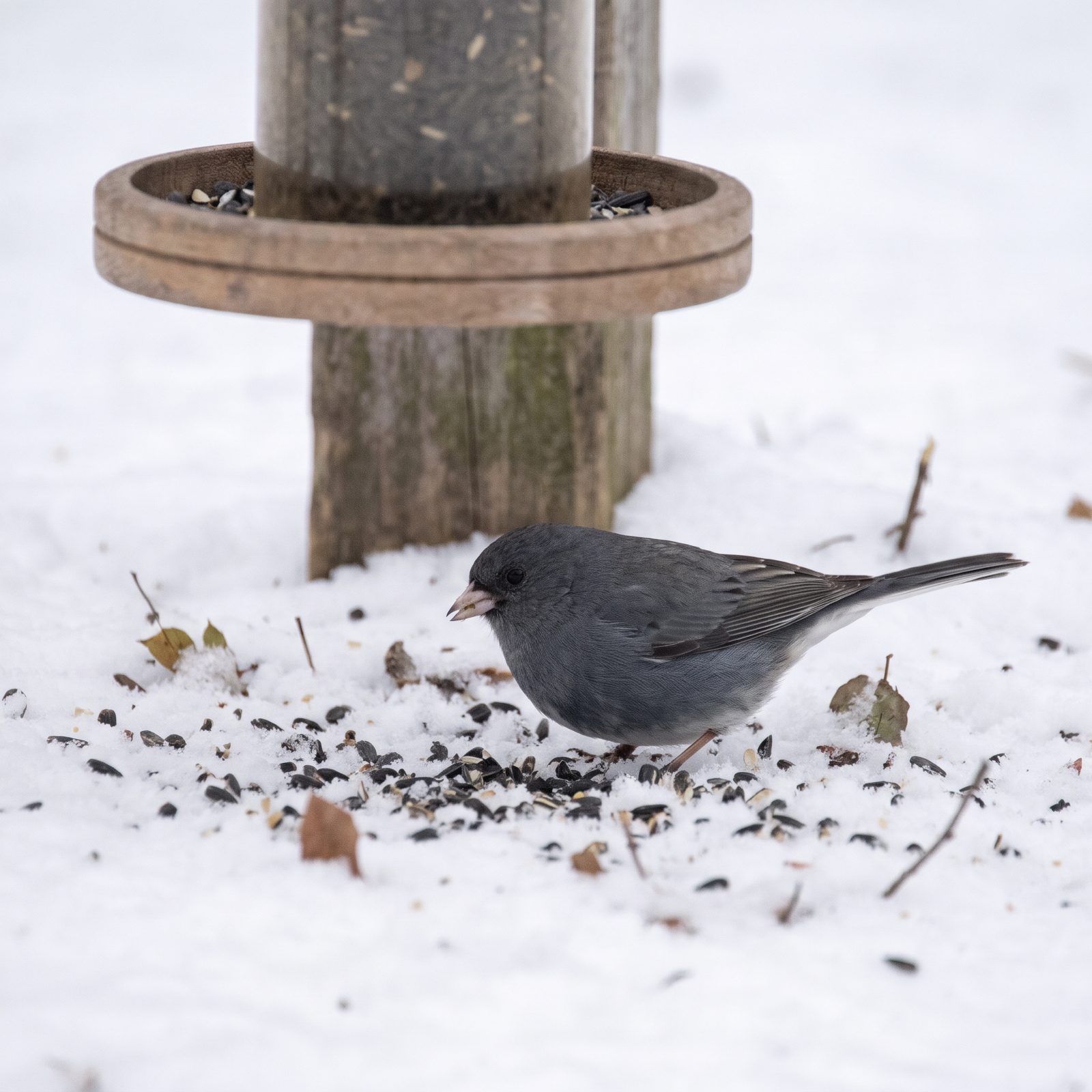
Look down. The junco is that little gray-and-white bird working the snow under your feeder while everyone else squabbles over the perches up top.
Juncos are ground feeders by nature, built to glean spilled and scattered seed. Plenty of people call them snowbirds, since they drop in from the boreal north right as winter sets in and then vanish come spring. Want to keep them around? Scatter white millet or cracked corn straight on the ground or on a low platform. A hanging tube they’ll ignore completely.
38. White-Breasted Nuthatch Climbing Headfirst Down a Feeder
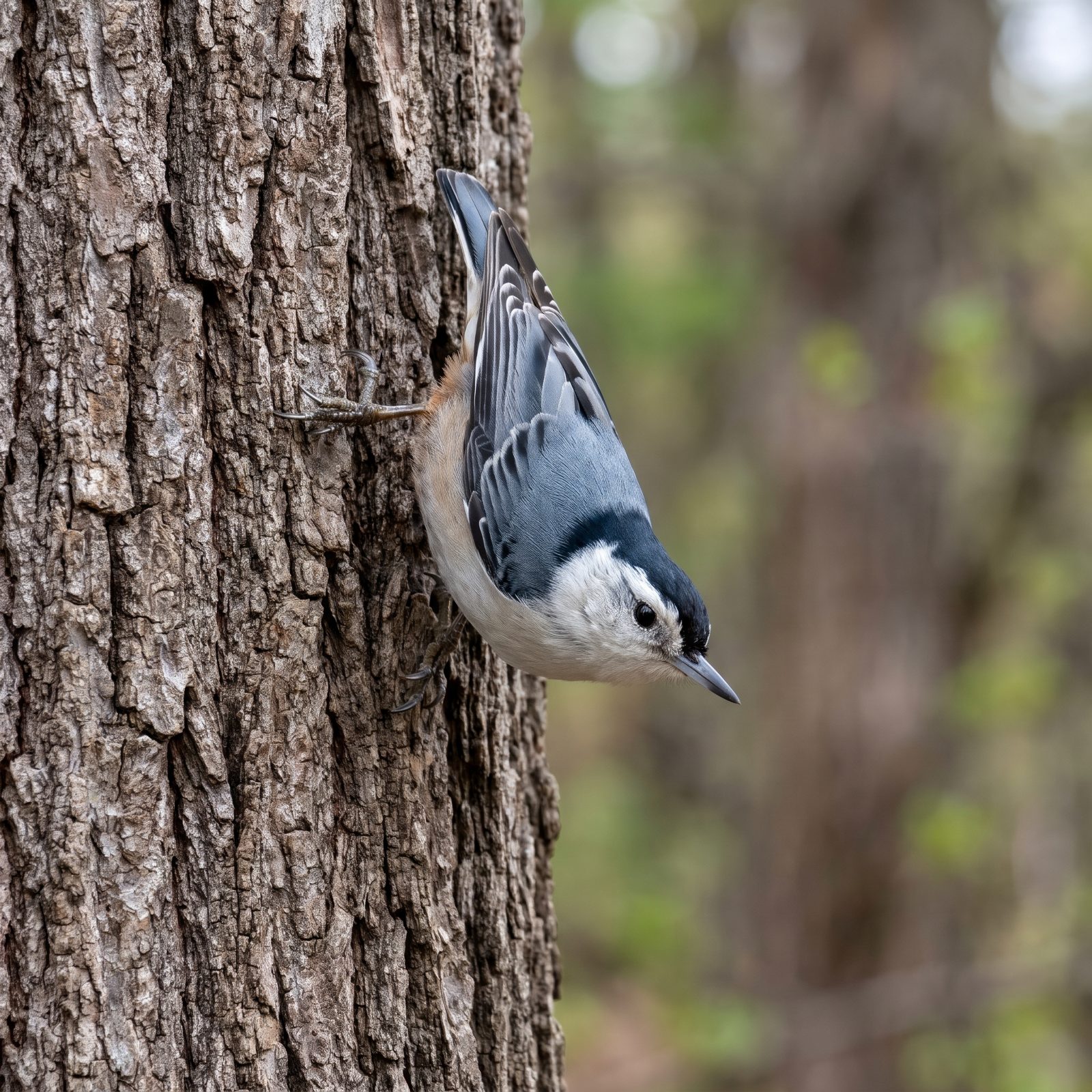
The upside-down bird. A nuthatch comes down the tree trunk face-first, and it’s one of the very few feeder visitors that do it as a matter of routine.
That odd angle buys it a meal. Descending head-first lets the nuthatch spot insects and seeds tucked into bark crevices that upward-climbing woodpeckers walk right past. The name comes from an old habit: it wedges a nut or seed into bark and hacks it open, hatching it. Offer sunflower seed and suet, and listen for that nasal, tin-horn yank-yank-yank.
37. Red-Bellied Woodpecker Reaching for Peanuts
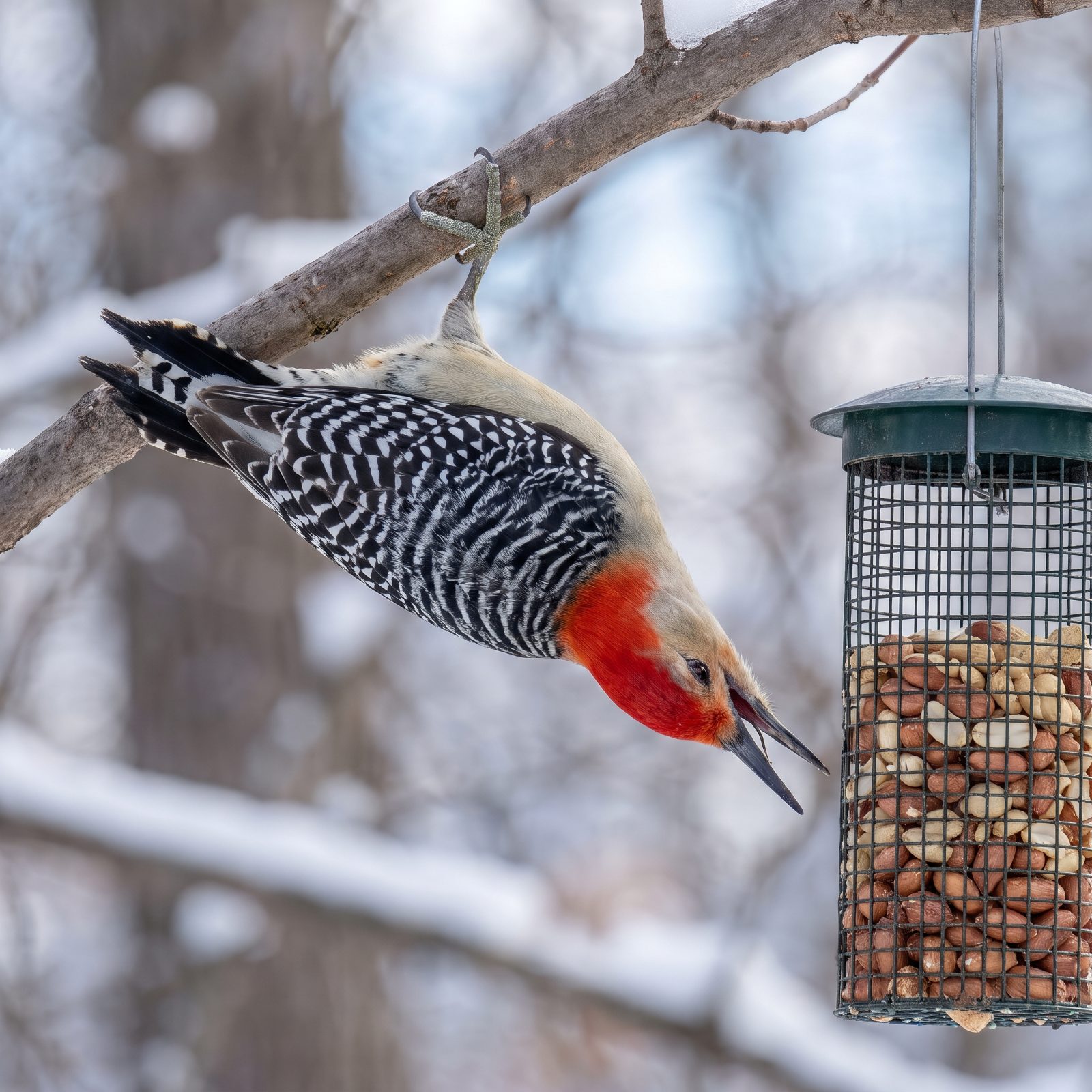
The name is a running joke among birders. The red on this woodpecker splashes all over the head, not the belly, and the faint pink wash it’s actually named for is nearly impossible to spot.
Common across the East and steadily pushing north, this bird loves peanuts, suet, and sunflower. Watch the tongue if you ever get the chance. A woodpecker’s tongue is startlingly long, barbed at the tip, and wraps back around the inside of the skull when retracted. It spears peanuts and insects like a harpoon.
36. American Goldfinch in Muted Winter Plumage
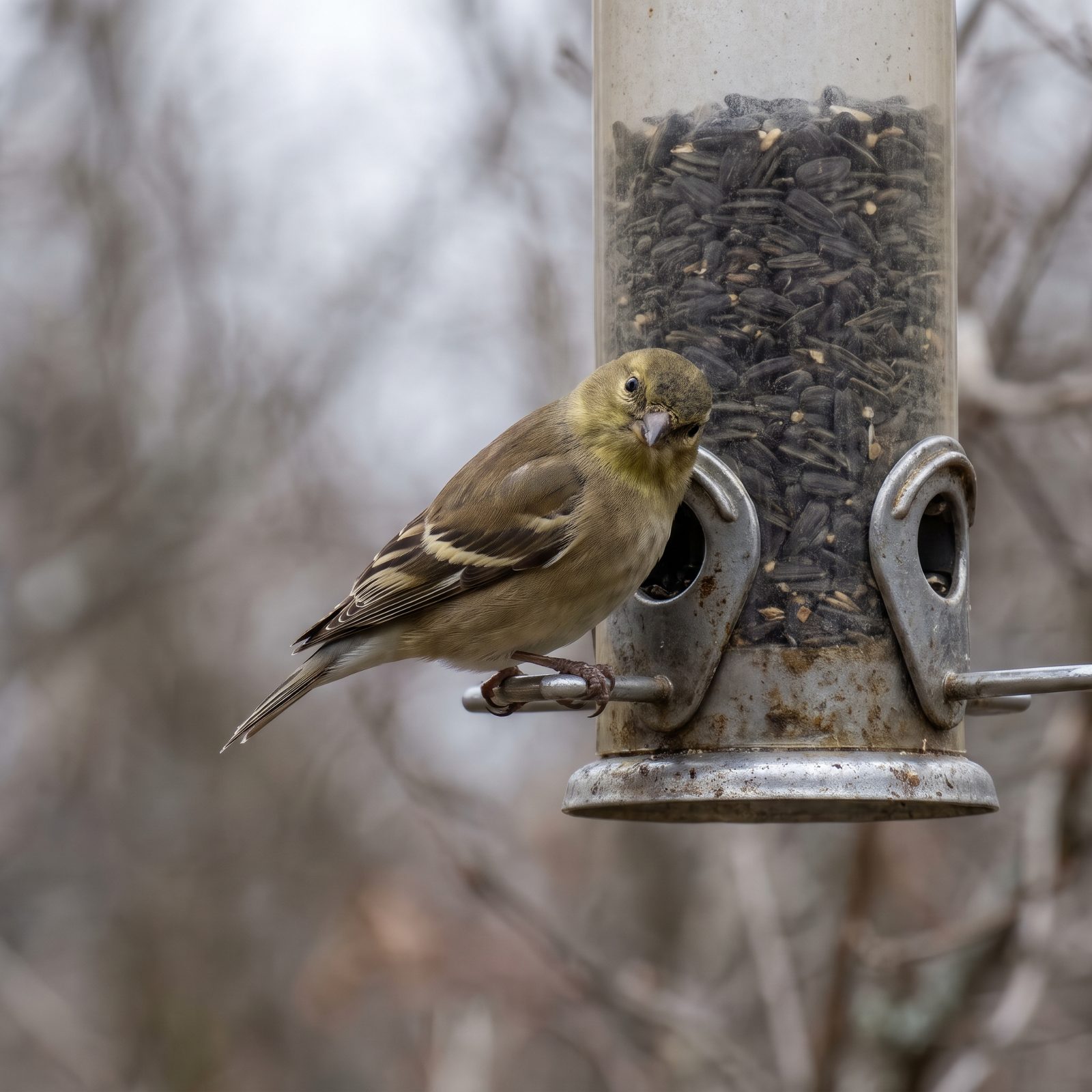
Half the people who see a goldfinch in December flat-out refuse to believe it’s a goldfinch. The brilliant lemon-yellow is gone, traded for a drab olive-brown that hides the bird through the cold months.
Same bird, though. Goldfinches are one of the few songbirds that molt completely twice a year, which is why they look like two different species in July and January. They eat seeds and nothing but, and they go wild for nyjer thistle in a fine mesh feeder. A winter flock is quiet, patient, and painfully easy to overlook.
35. Mourning Dove Resting on a Snow-Dusted Feeding Tray
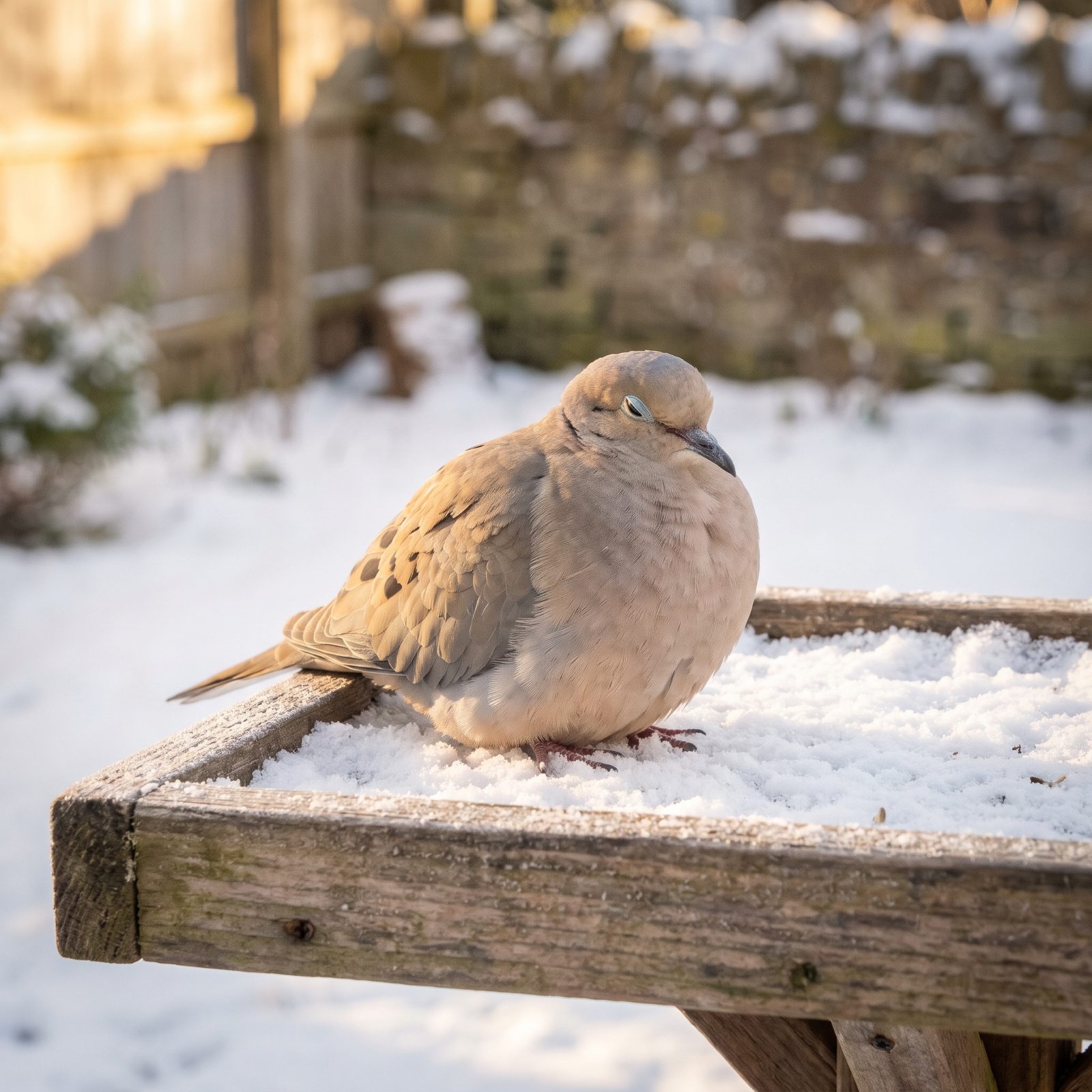
The dove never hurries. While the chickadees dart and the jays bicker, a mourning dove eases onto the tray and just stays put, puffed into a ball against the cold.
They’re ground and platform feeders, made for sitting and scooping up fallen seed rather than clinging or cracking. Millet, cracked corn, spilled sunflower, all fine. And that whistling sound when a flock bursts into flight? Not a call. It’s air rushing through specially modified wing feathers, a built-in alarm that tells the whole group to scatter.
34. House Finch Perched at a Tube Feeder
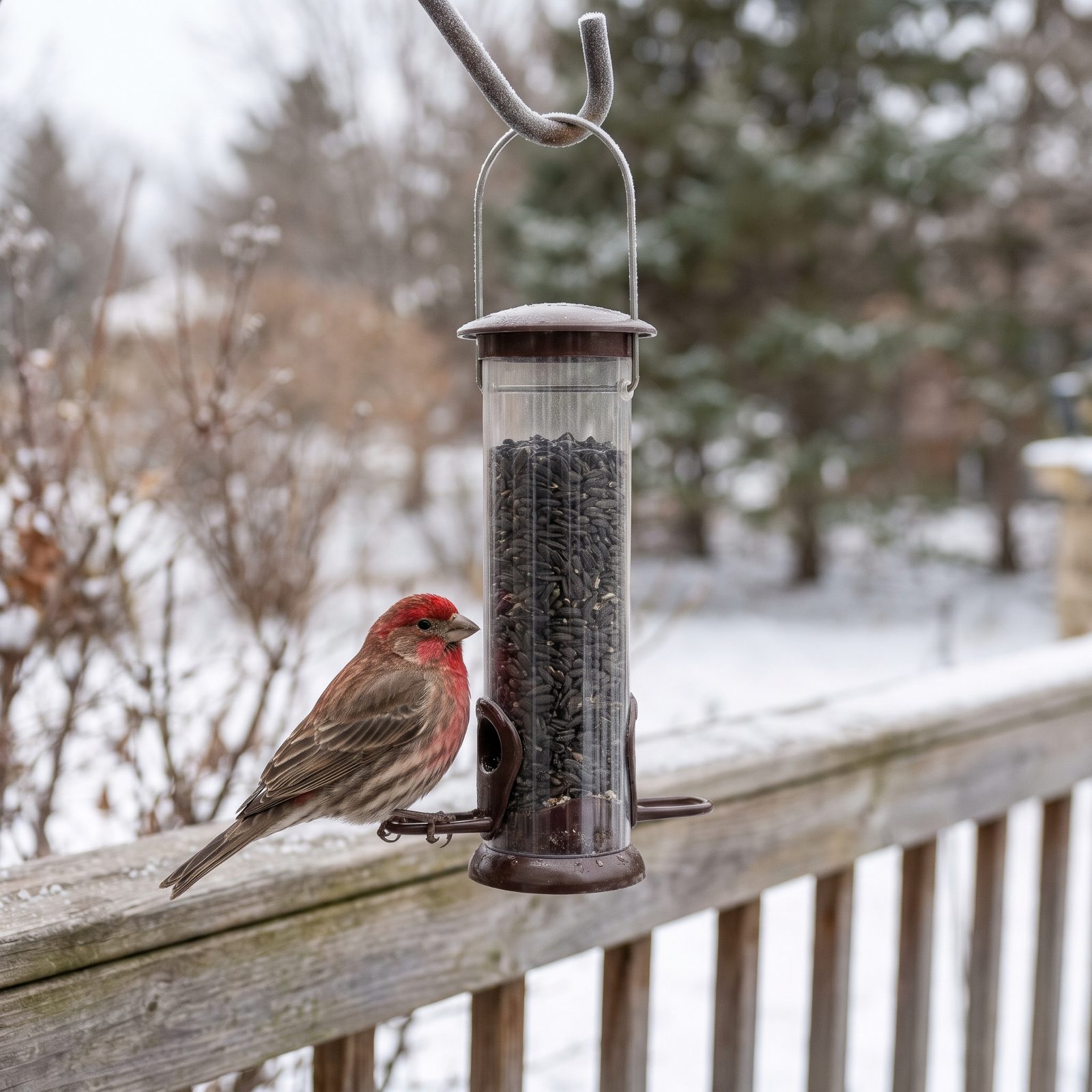
The House Finch is often the first bird to show up and the last to leave. The raspberry wash on the male isn’t paint — it’s diet. Carotenoids from the seeds and berries he eats color those feathers, so a well-fed male runs redder than a hungry one, and the females judge accordingly.
Watch him work the tube feeder and you’ll notice he doesn’t bolt. House Finches sit and crack seed for minutes at a stretch, which makes them easy to tell from the twitchy goldfinches sharing the same perch.
33. White-Throated Sparrow Scratching Through Fallen Seed
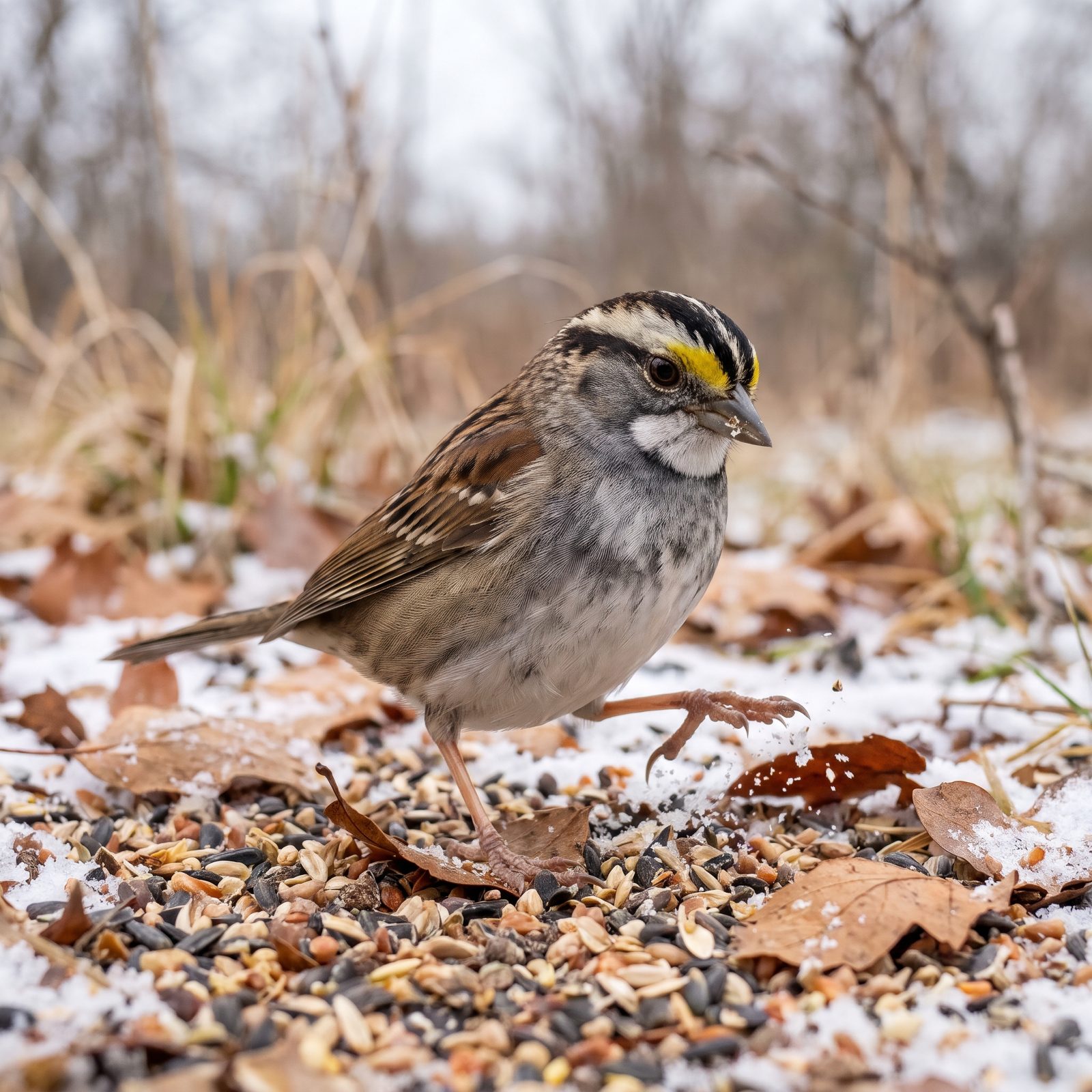
Ground is where this sparrow lives. The White-throated Sparrow rarely bothers with your fancy feeders, preferring to work the spilled seed below with a quick backward kick of both feet, flinging leaves out behind it, that you can hear rustling in dry leaves before you ever spot the bird.
Look at the face. That dab of yellow in front of the eye and the clean white throat are the giveaways. And if you hear a thin, whistled Oh-sweet-Canada-Canada on a January morning, that’s him — singing a winter version of a song most people only expect in spring.
32. Carolina Wren Clinging to a Suet Basket
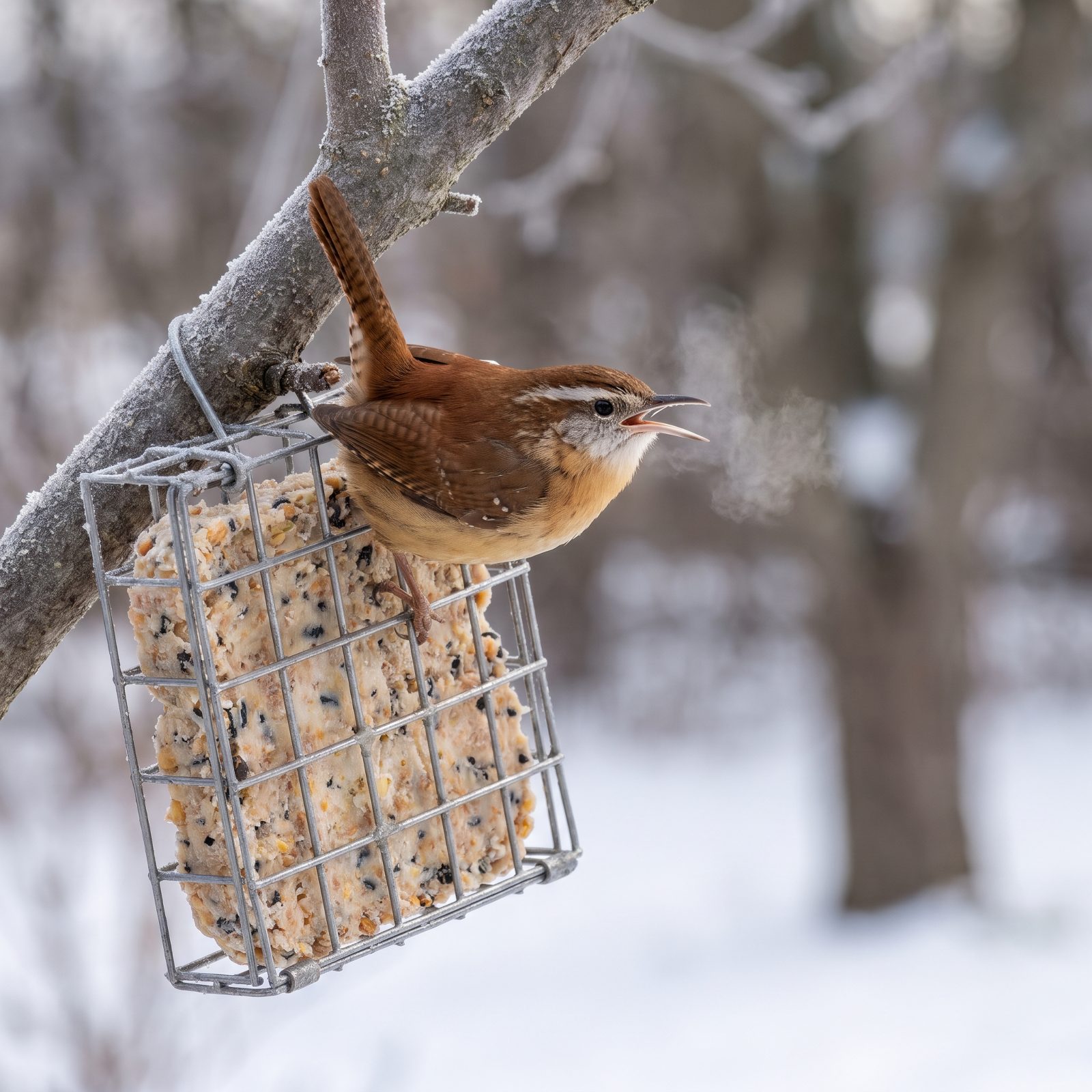
Loud for its size, and that’s being kind. A bird barely heavier than a few quarters will out-sing cardinals twice its weight, a rolling teakettle-teakettle that carries across the whole block.
The Carolina Wren hangs onto suet cages with its toes and tail braced, picking out fat and insect bits. It doesn’t migrate, so it rides out hard winters right where it is. A brutal cold snap can knock local numbers back, and you’ll notice the silence when it does.
31. Red-Breasted Nuthatch Grabbing Suet on a Cold Morning
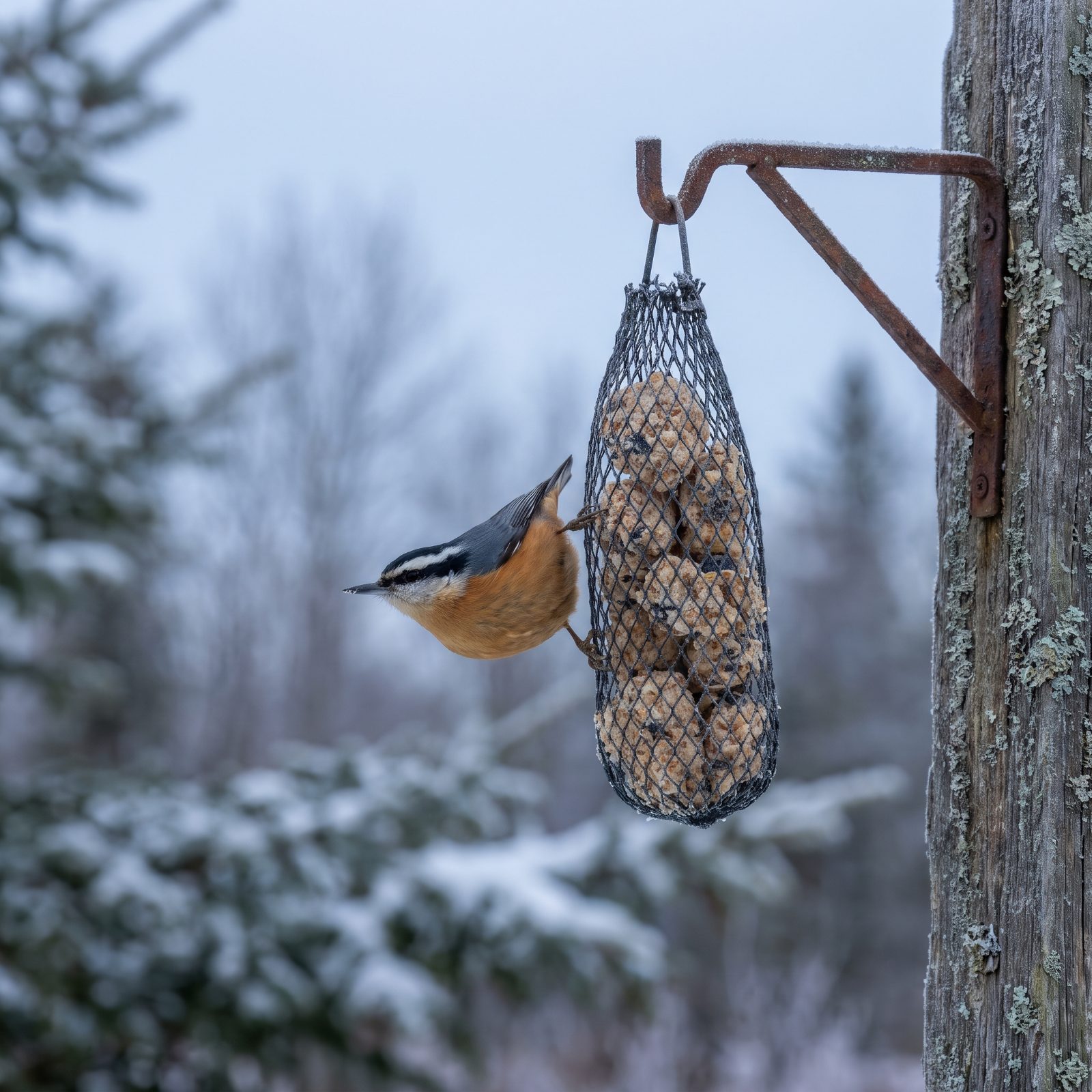
Half the size of its white-breasted cousin, and twice as busy. The Red-breasted Nuthatch grabs a chunk of suet, darts off to wedge or cache it, then comes right back. It moves down tree trunks headfirst, which no other feeder bird does with such swagger.
Here’s what makes birders check their feeders every November: this is an irruptive species. In years when northern conifer seed crops fail, huge numbers push south and turn up in yards that haven’t seen one in a decade. A good cone year up north, and you may not spot a single one.
30. Northern Flicker Feeding on a Backyard Suet Cake
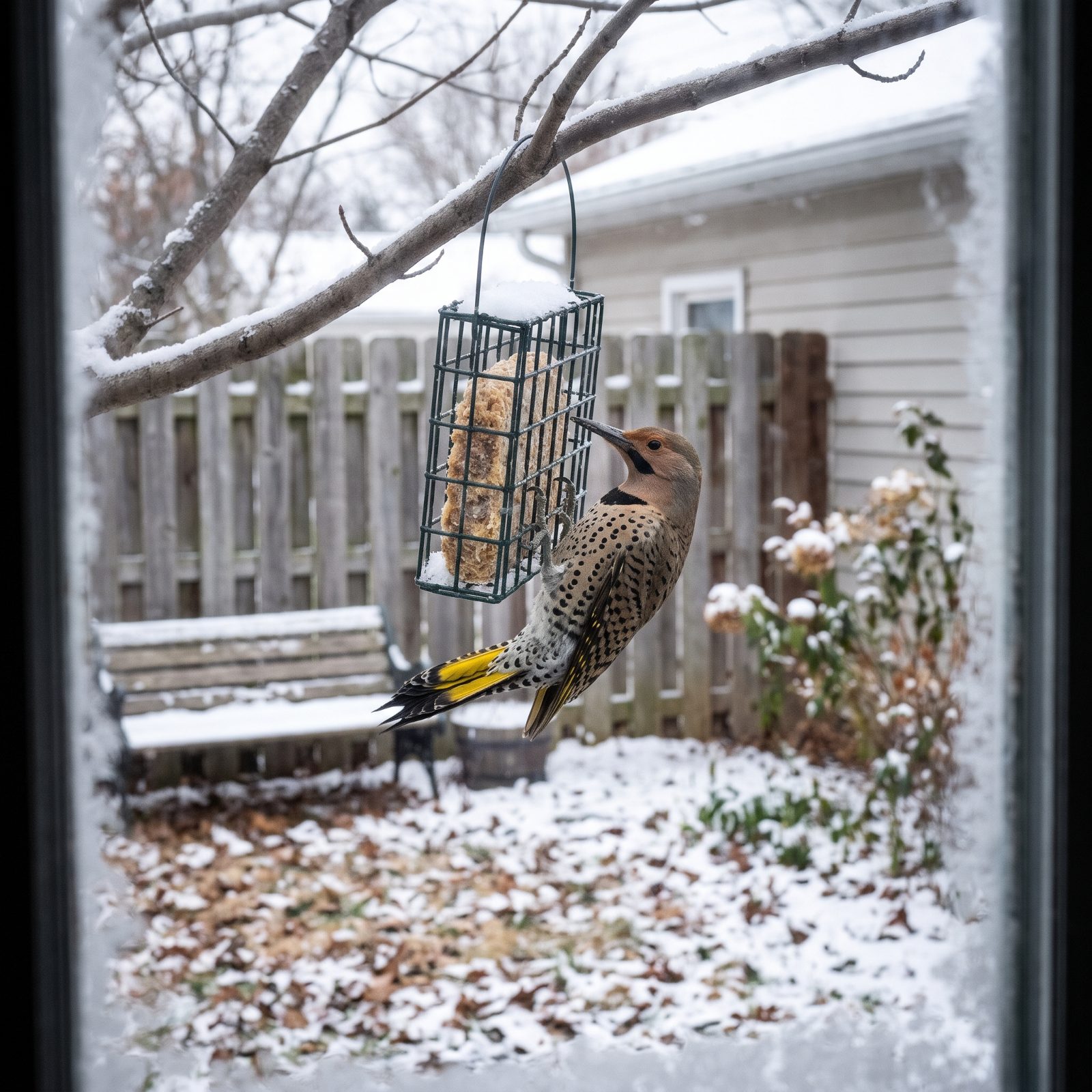
A woodpecker that would rather be on the ground. Most of the year the Northern Flicker digs in the dirt for ants, hammering soil instead of trees, which is exactly why winter throws it a curveball — when the ground freezes solid, suet fills the gap.
It’s a big, showy bird. The eastern form flashes yellow under the wings, the western form flashes salmon-red, and both wear that black crescent across the chest like a bib. Give it a stable, wide feeder, because a flicker needs room to brace its stiff tail against something solid.
29. Yellow-Bellied Sapsucker Sampling Winter Suet
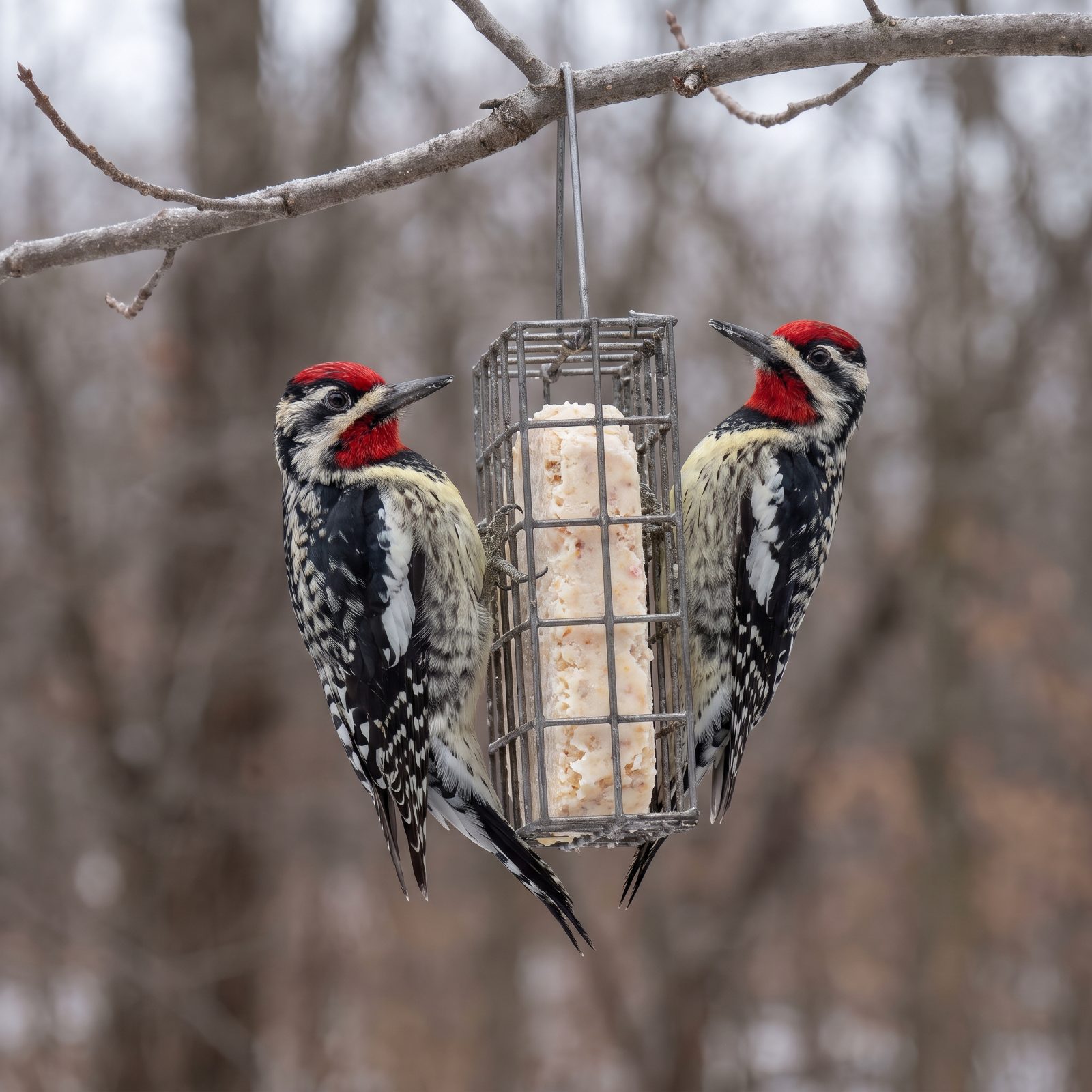
The name makes people laugh, and then they never actually see one. The Yellow-bellied Sapsucker spends winter in the Southeast and does something no other local woodpecker bothers with: it drills neat, orderly rows of shallow holes in bark, then returns to lick up the sap and the insects stuck in it.
At a feeder, it’s a shy, occasional suet visitor, usually quick and quiet. That red throat marks a male. The belly is barely yellow at all — more a faint wash — so don’t expect the bird to live up to its billing.
28. Gila Woodpecker Perched on a Cactus-Side Feeder
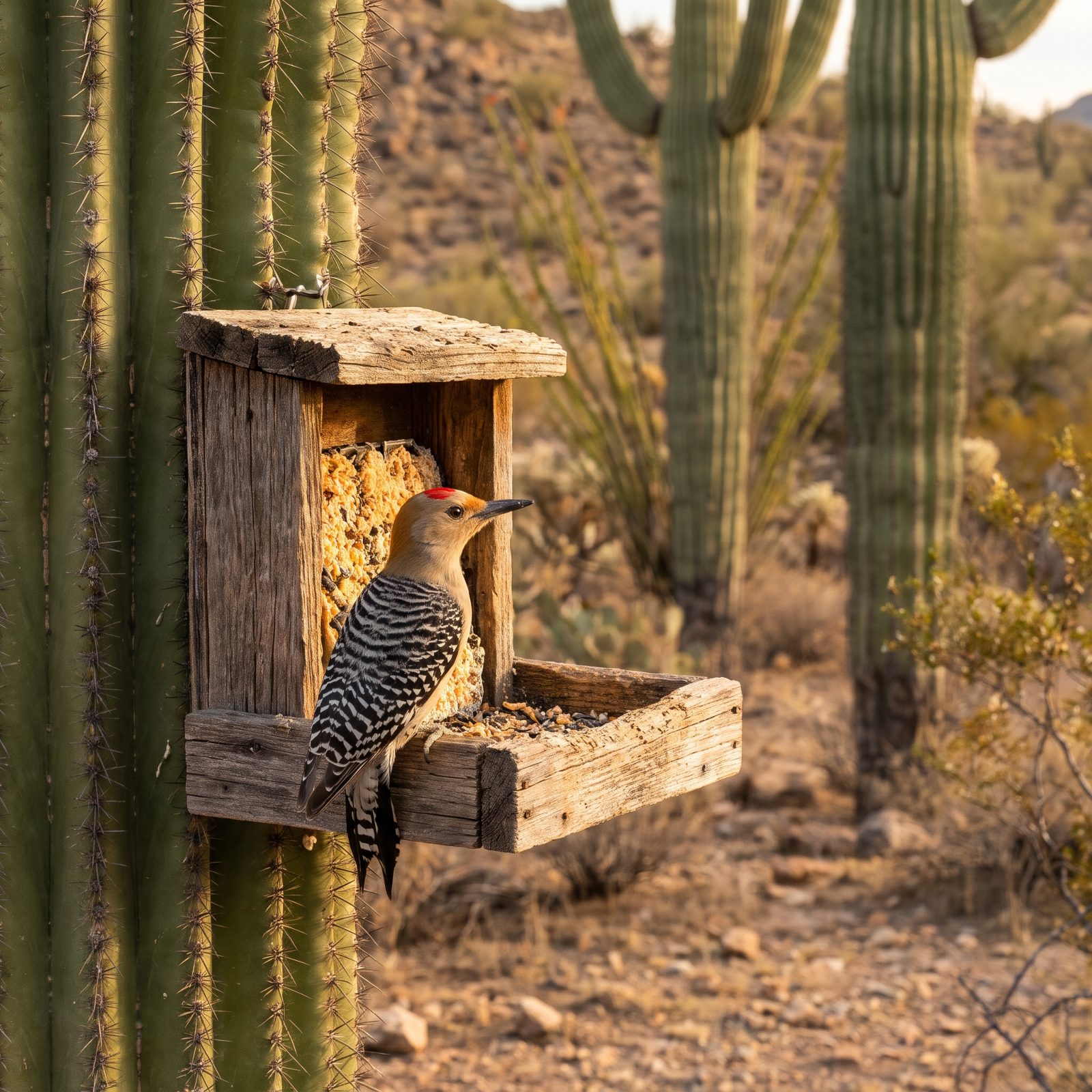
Desert winters have their own cast of feeder birds, and this is the headliner. The Gila Woodpecker is a Sonoran Desert specialist, found in southern Arizona and down into Mexico, with a zebra-striped back and a loud rolling call that bounces off adobe walls.
It’ll take suet, fruit, even sugar water. In saguaro country it nests inside the great cactuses, hollowing out holes that dry into tough-walled chambers other animals later move into. And if you’re reading this somewhere snowy? This one isn’t coming to your yard. That’s rather the point of a regional guide.
27. Purple Finch Cracking a Black-Oil Sunflower Seed
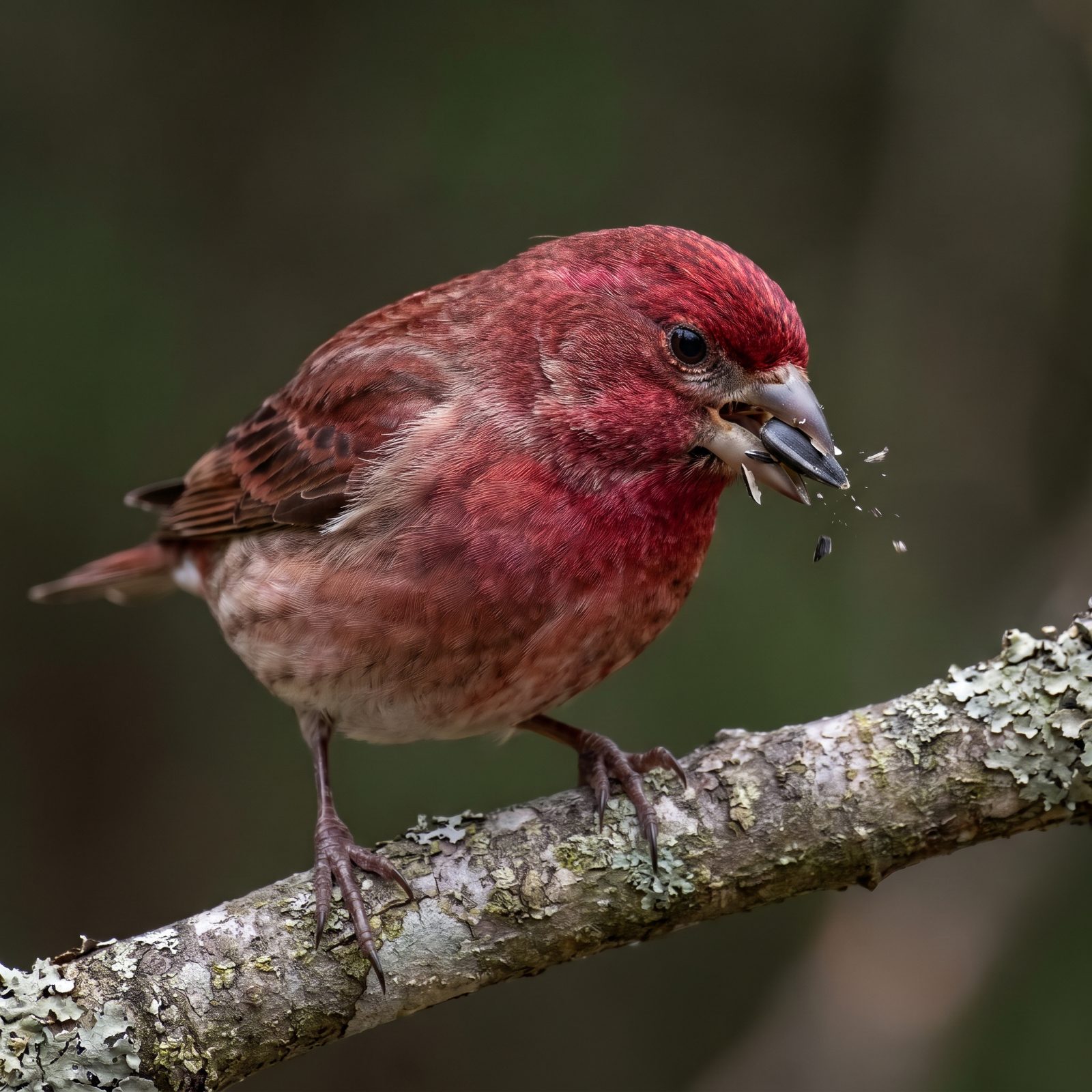
Roger Tory Peterson said it best: a Purple Finch looks like a sparrow dipped in raspberry juice. That wine-red soaks over the whole head and back, not just patches, which is how you separate it from the streakier, oranger House Finch sitting right next to it.
This one’s a winter visitor across much of the country, irregular and unpredictable. Some years they flood south in numbers; other years, barely a bird. A platform or hopper loaded with black-oil sunflower is your best shot at pulling one in.
26. Pine Siskin Flock Covering a Nyjer Feeder
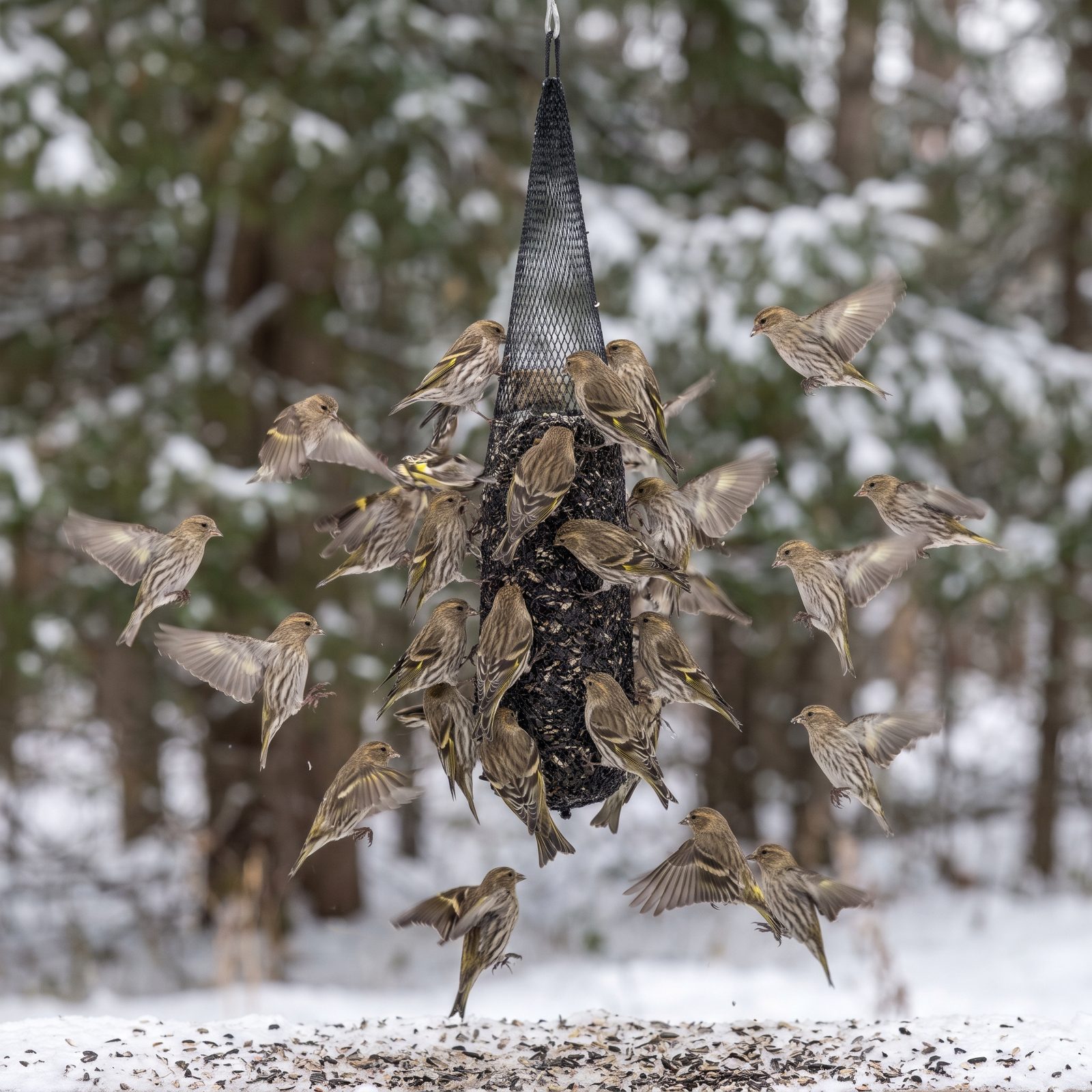
When Pine Siskins arrive, they arrive all at once. A flock swarms a nyjer feeder like filings to a magnet — dozens of streaky little bodies squabbling, flashing yellow wing-patches, emptying a thistle sock in a day. Then they’re gone just as fast.
They’re the classic irruptive finch. In winters when the northern conifer crop collapses, siskins pour south by the thousands, turning up in yards that go years without one. Quiet winter, big cone crop up north. Loud winter, failed crop. The birds are reporting on a forest you’ll never see.
As a winter finch forecaster puts it, “As seen by band recoveries, Pine Siskins, similar to White-winged Crossbills, will move east or west in search of cone crops.”
25. American Tree Sparrow at a Snow-Covered Ground Tray
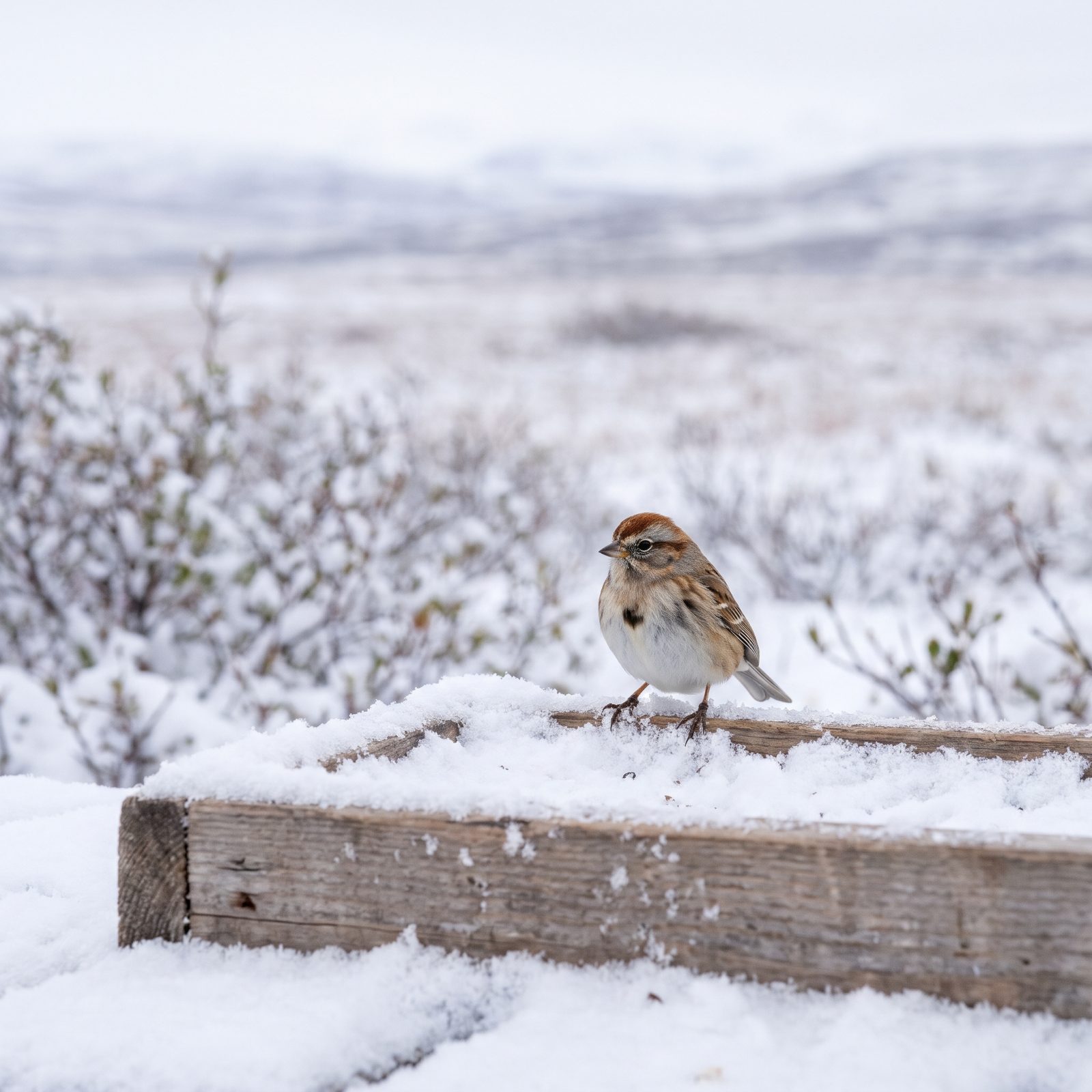
The name is a lie, and birders have made peace with it. The American Tree Sparrow nests on the open Arctic tundra, nowhere near a single tree, and only shows up in the Lower 48 when things get genuinely cold. A bird of the hard winter.
Look for the rusty cap, the two-toned bill, dark above and yellow below, and one dark spot smack in the middle of a plain, unstreaked chest, like a stickpin. It feeds low, taking millet and small seeds off the ground, and often vanishes the moment spring warms up. Across much of the northern tier, this little sparrow is the sign that the deep cold has truly set in.
24. Fox Sparrow Kicking Through Winter Leaf Litter
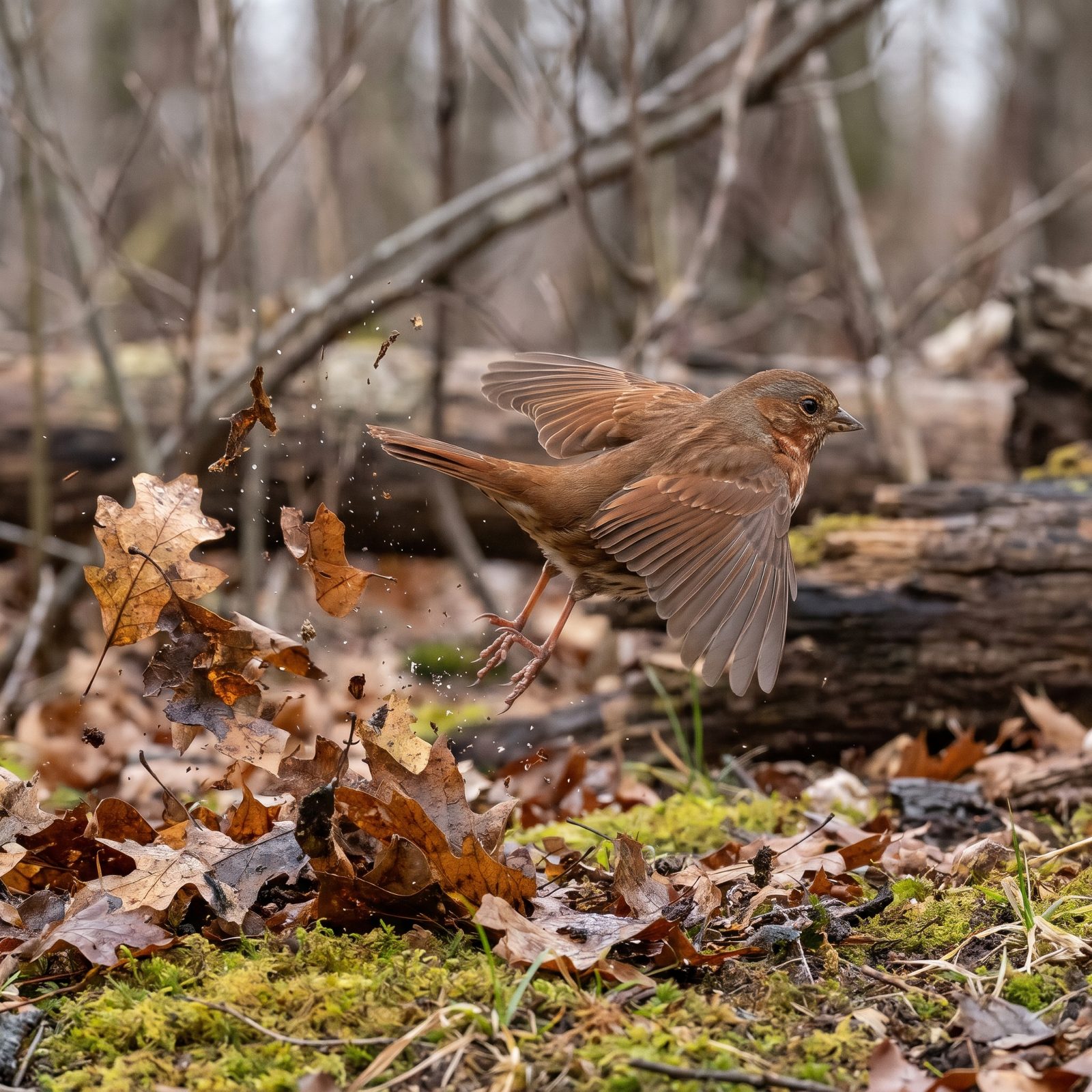
Watch the ground under your feeder, not just the feeder itself. Fox Sparrows feed by hopping forward and then kicking both feet straight back at once, like a tiny martial artist on espresso, sending leaves and debris flying out behind them. The leaves fly, the seed appears, and most people miss the whole performance because they’re busy staring up at the tube feeder.
They’re one of the chunkiest sparrows you’ll ever host, built like they’ve been hitting the gym. Scatter white millet and cracked sunflower in a brushy corner and leave the fallen leaves exactly where they are. The mess is the habitat.
23. Golden-Crowned Sparrow Beneath a West Coast Feeder
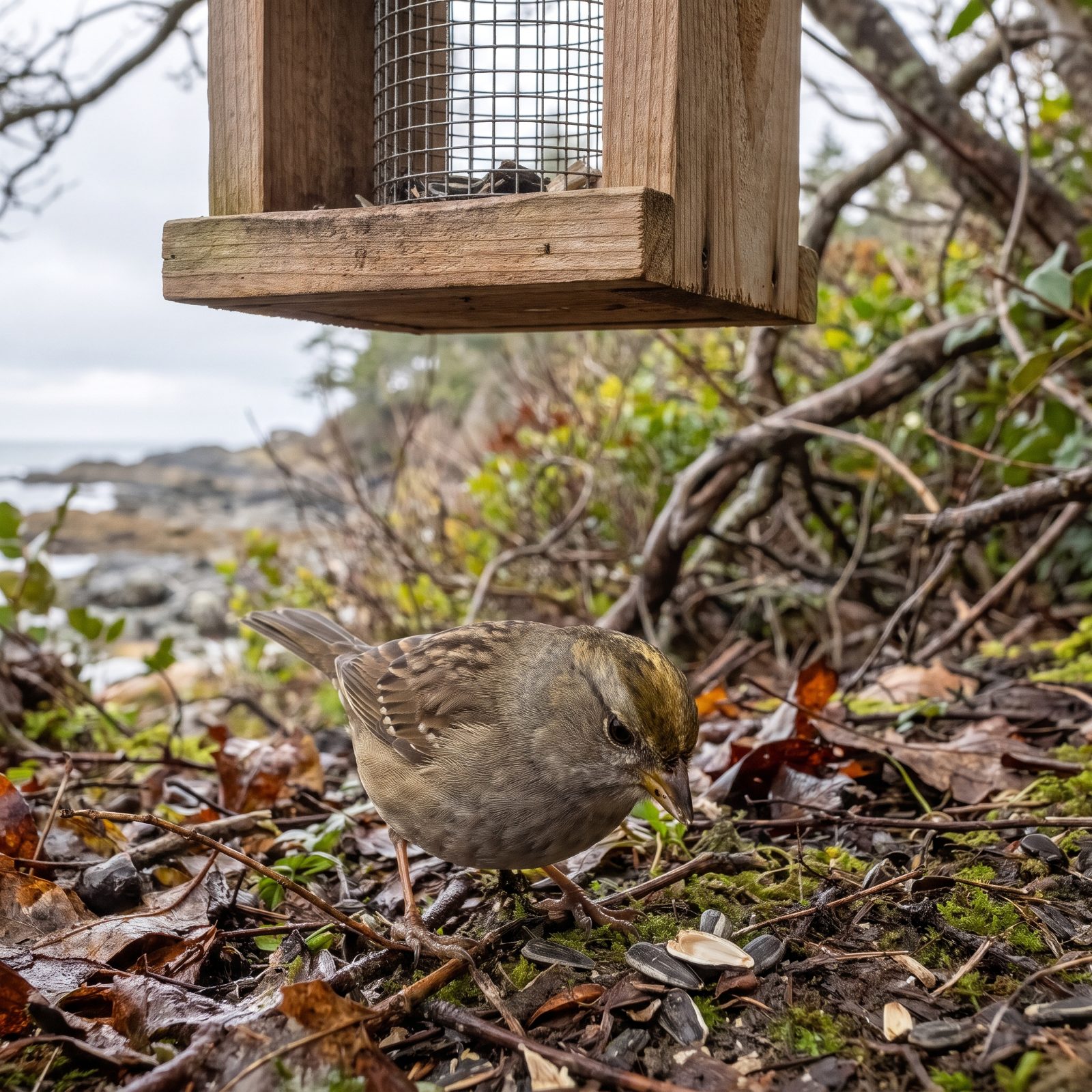
Live along the West Coast? This is your winter sparrow. The dull gold crown looks faded next to a spring bird, almost like it got left out in the rain — which, fair enough, it probably did.
Gold miners in the 1800s nicknamed it the “Weary Willie” for a mournful three-note whistle that seemed to mutter “I’m so tired.” Offer millet and sunflower chips on a low platform and they’ll drift in from blackberry thickets and garden edges all season long, hunched and unbothered.
22. White-Crowned Sparrow Sharing a Ground-Feeding Area
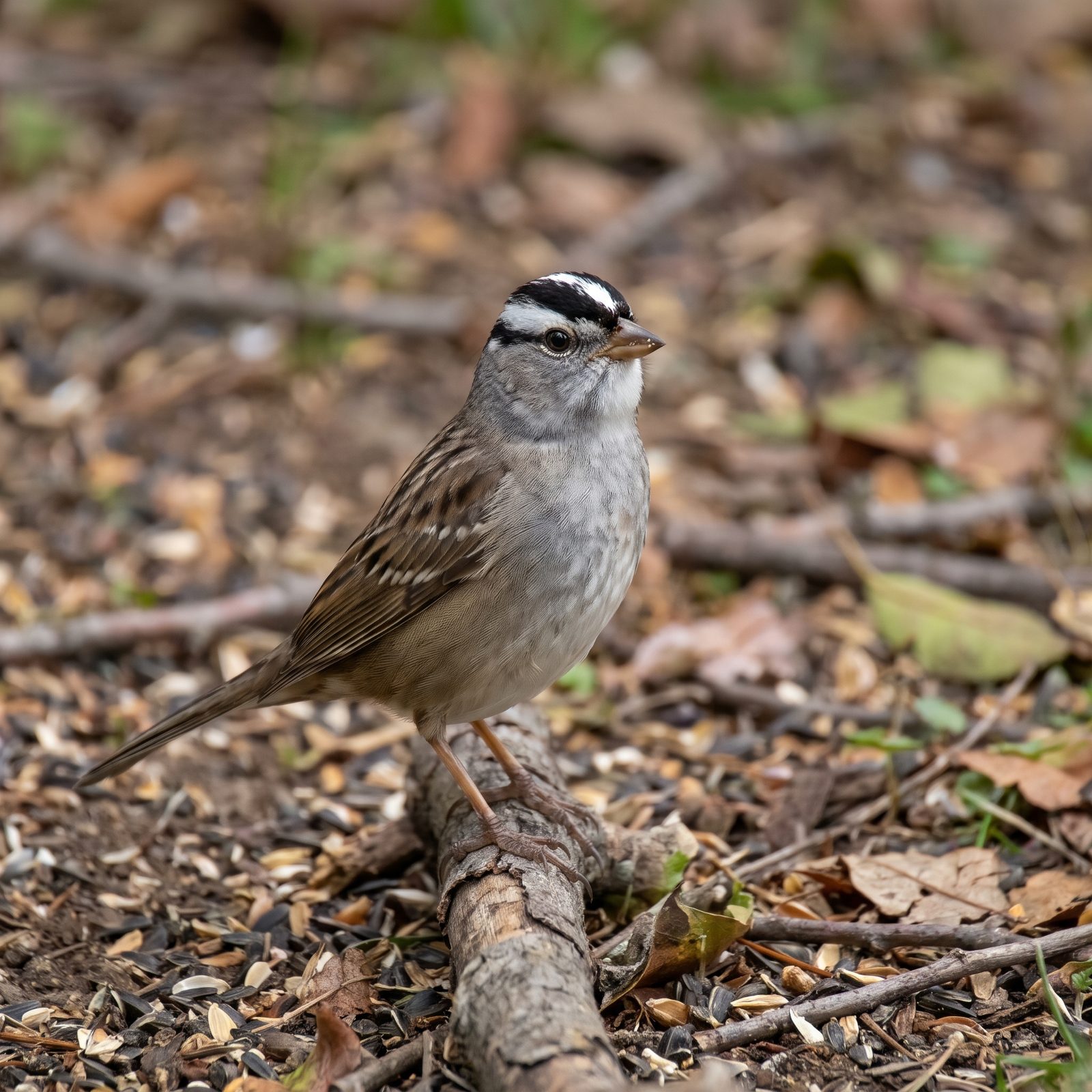
Posture gives this one away before the crown does. The White-Crowned Sparrow stands tall, chin lifted like it’s about to recite something from memory. That bold black-and-white helmet is unmistakable on an adult.
They flock in winter, so where you spot one you’ll usually find a handful more raking the same patch of ground. Spread white millet directly on open soil or short grass near cover. One migrating White-Crowned Sparrow was recorded covering about 300 miles in a single night — so the little bird at your feeder has genuinely earned its lunch.
21. House Sparrow Crowding Around a Seed Hopper
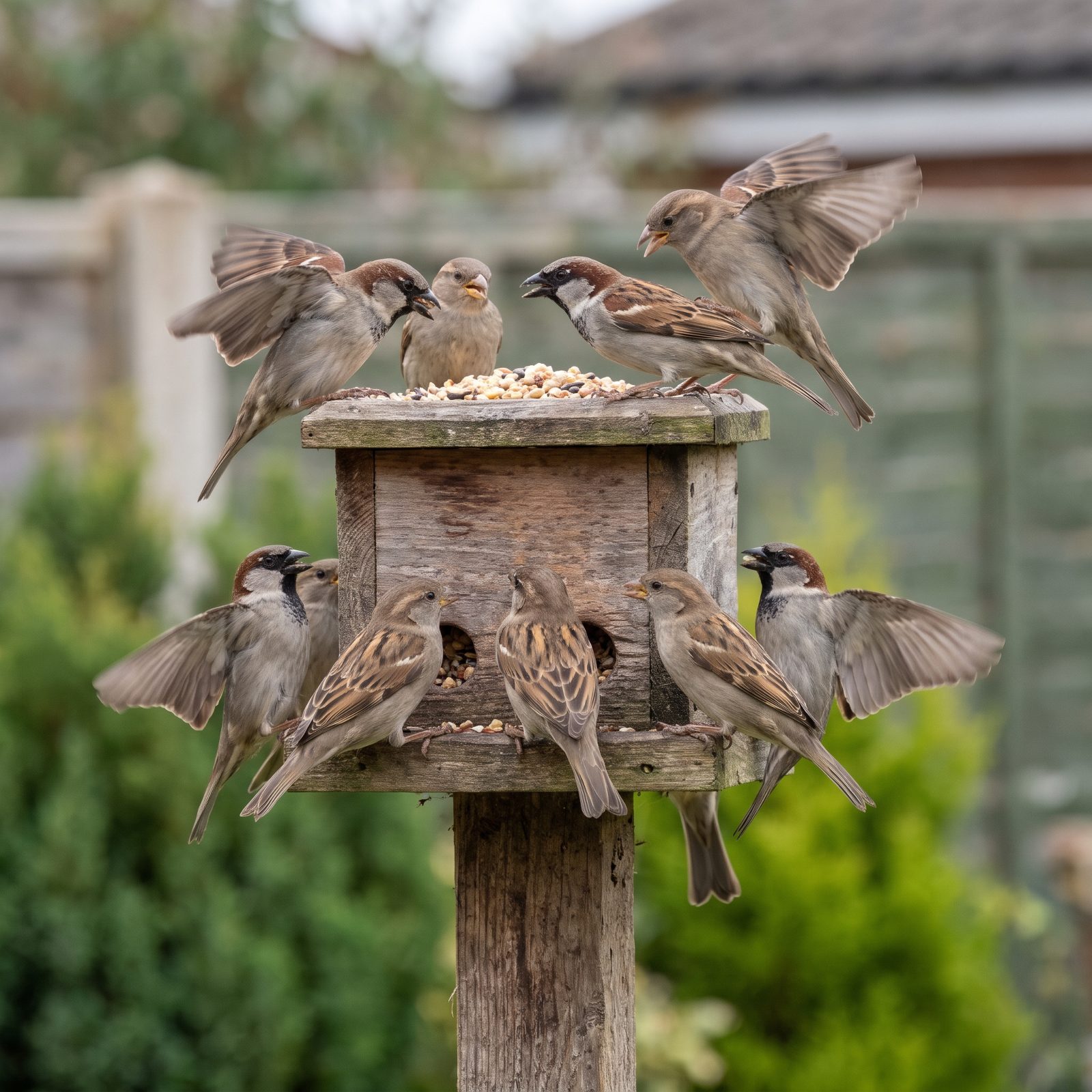
Love them or not, House Sparrows show up. They arrived in North America in the 1850s after a few dozen were released in Brooklyn, then spread across the continent with the stubborn confidence of a species that has simply decided it lives here now, thank you very much.
At the feeder they travel as a loud, squabbling mob. The males wear that black bib — brighter and bigger as winter edges toward spring — and it’s actually a status badge other sparrows read instantly. If they’re monopolizing your hopper, try a smaller port size and toss some millet on the ground to spread the crowd out.
20. Redpolls Descending on a Northern Seed Station
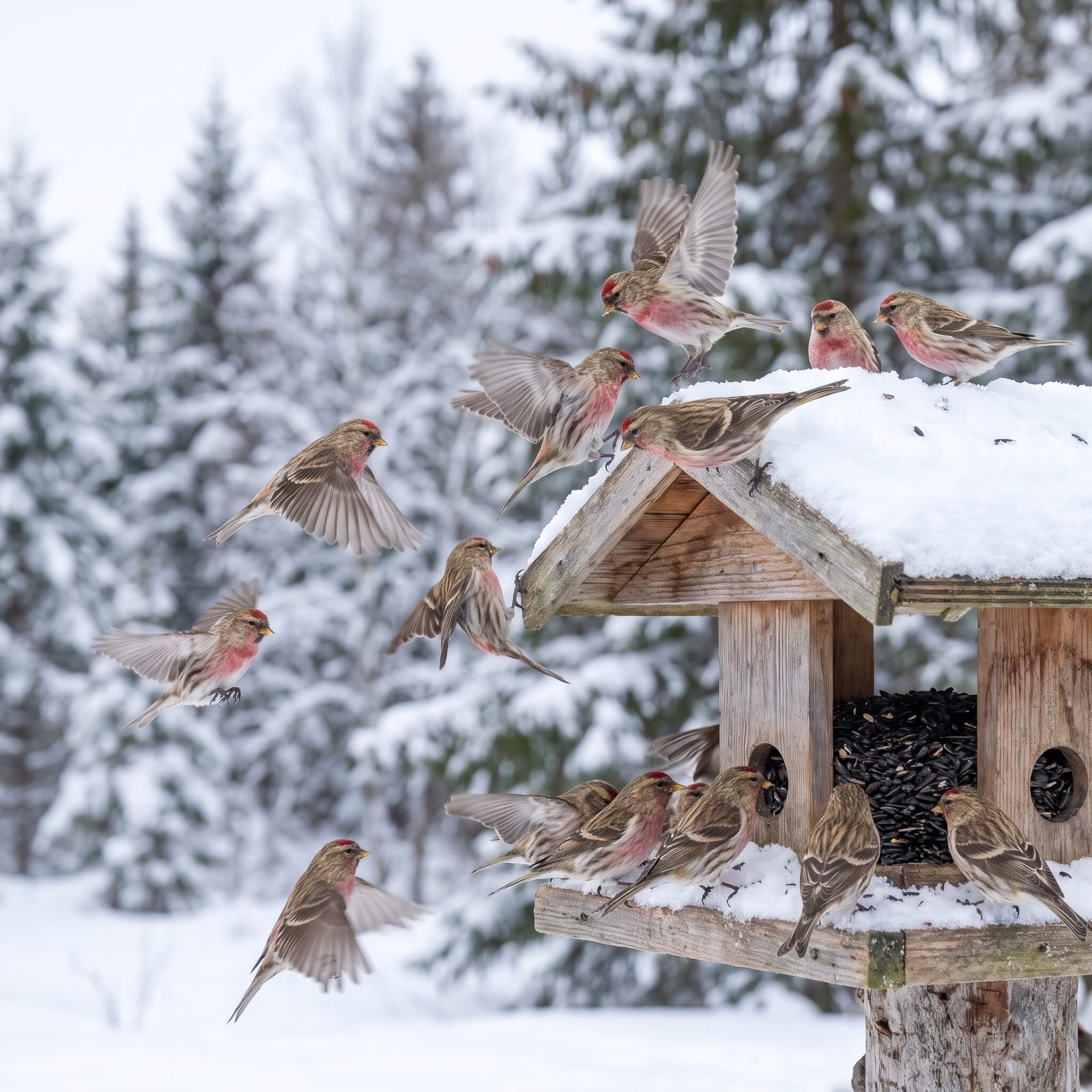
Some winters they come. Some winters they don’t. Redpolls are irruptive finches, meaning their appearance at your feeder hinges entirely on the birch and alder seed crop far to the north — a bad seed year up there sends them pouring south, and your Nyjer feeder suddenly looks like a crowded bus stop.
These tiny finches outlast brutal cold by cramming seed into a pouch in their throat, then digesting it slowly through the night. Fill a mesh thistle feeder and watch for the flash of red forehead.
Linking an early redpoll movement to a failed seed crop up north, a boreal finch forecaster wrote “The early and widespread but not unprecedented flight into Northern Ontario eastward to Newfoundland this August is pointing towards a more widespread crop failure of birches and Alders in Northern Quebec.”
19. Evening Grosbeak Taking Over a Platform Feeder
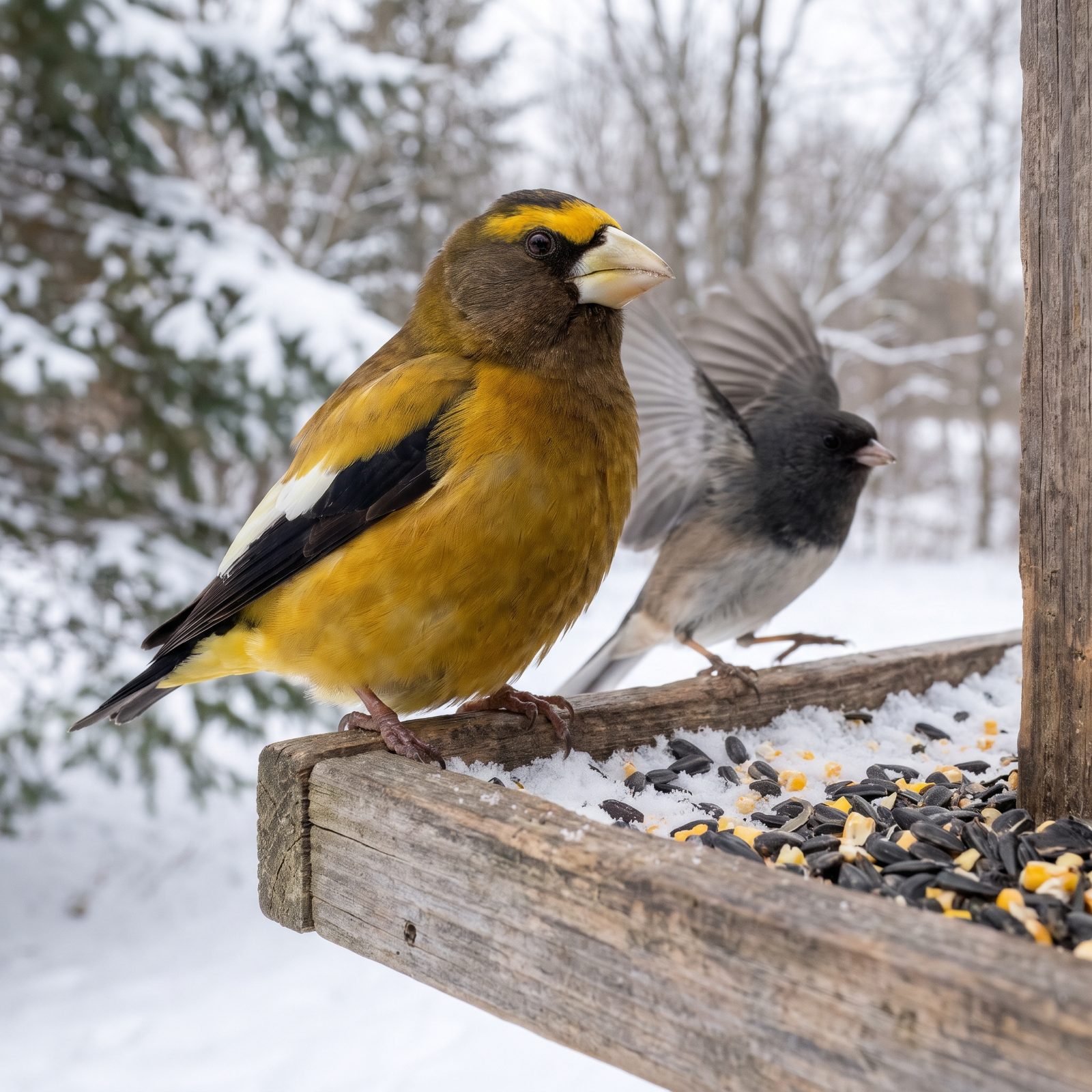
The first time a flock lands, you’ll hear the hull-cracking before you ever see the gold. Evening Grosbeaks carry a bill like a pair of pliers — pale, massive, strong enough to split a cherry pit — and they tear through black-oil sunflower at a rate that can empty a platform feeder before lunchtime.
They belong to the northern conifer forests, and their winter wandering has turned unpredictable as their numbers slide downward over recent decades. So when a yellow-and-black mob suddenly descends on your yard, you’re watching something that used to be ordinary and now feels like plain luck.
18. Pine Grosbeak Eating Fruit in a Snowy Backyard
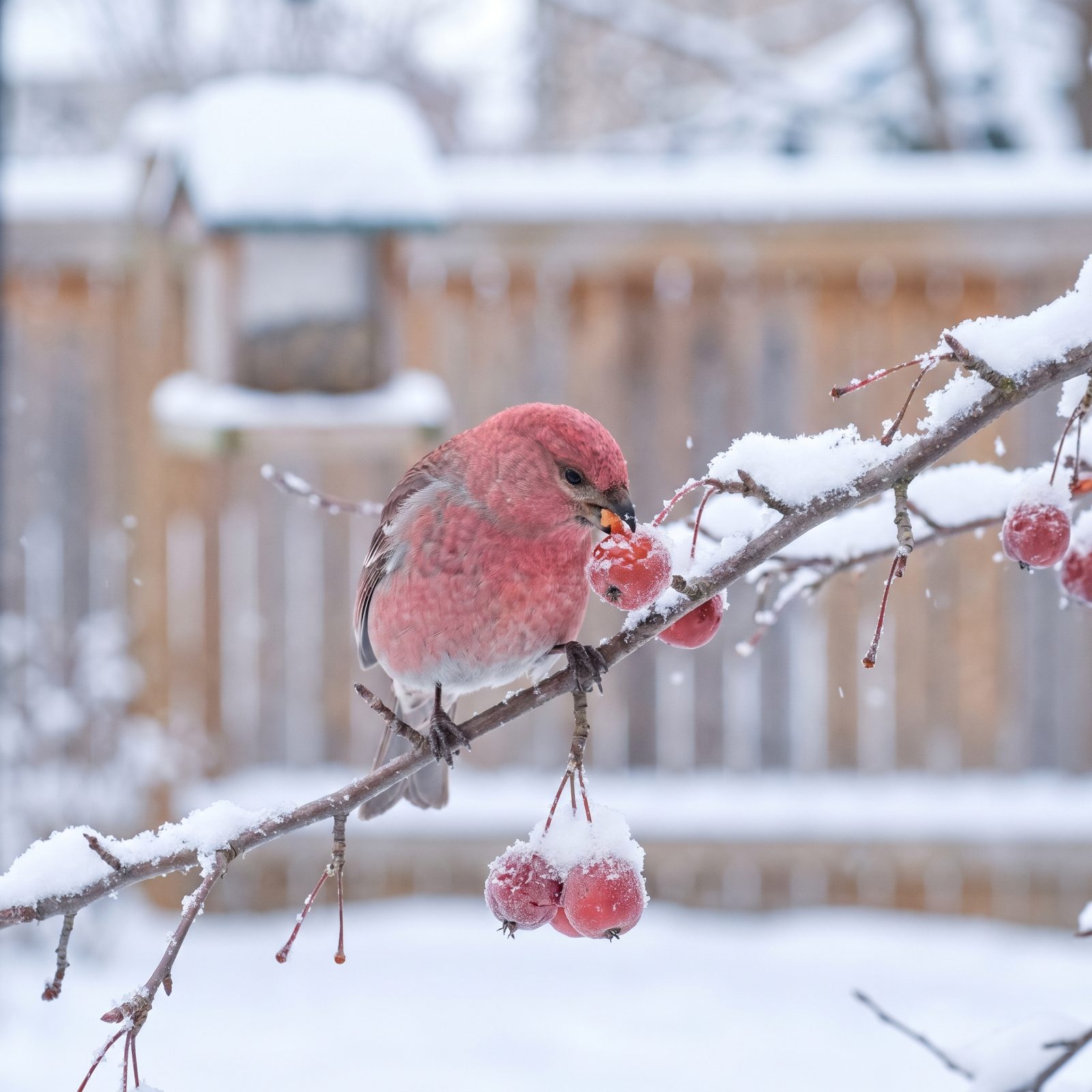
Everything about this bird is slow. Pine Grosbeaks drift through fruit trees with a calm, almost tame deliberateness that has earned them the nickname “mope” in parts of the north. They barely spook. You can stand close while they methodically work a crabapple, and they’ll scarcely glance at you.
They’re the largest of our winter finches, and they’d pick fruit over seed any day. A crabapple or mountain-ash tree hung with frozen red fruit will hold them far longer than any feeder you own. Planting for birds? Plant the tree. It pays off in rosy visitors on the coldest mornings of the year.
17. Red Crossbill Prying Seeds Open with Its Curved Bill
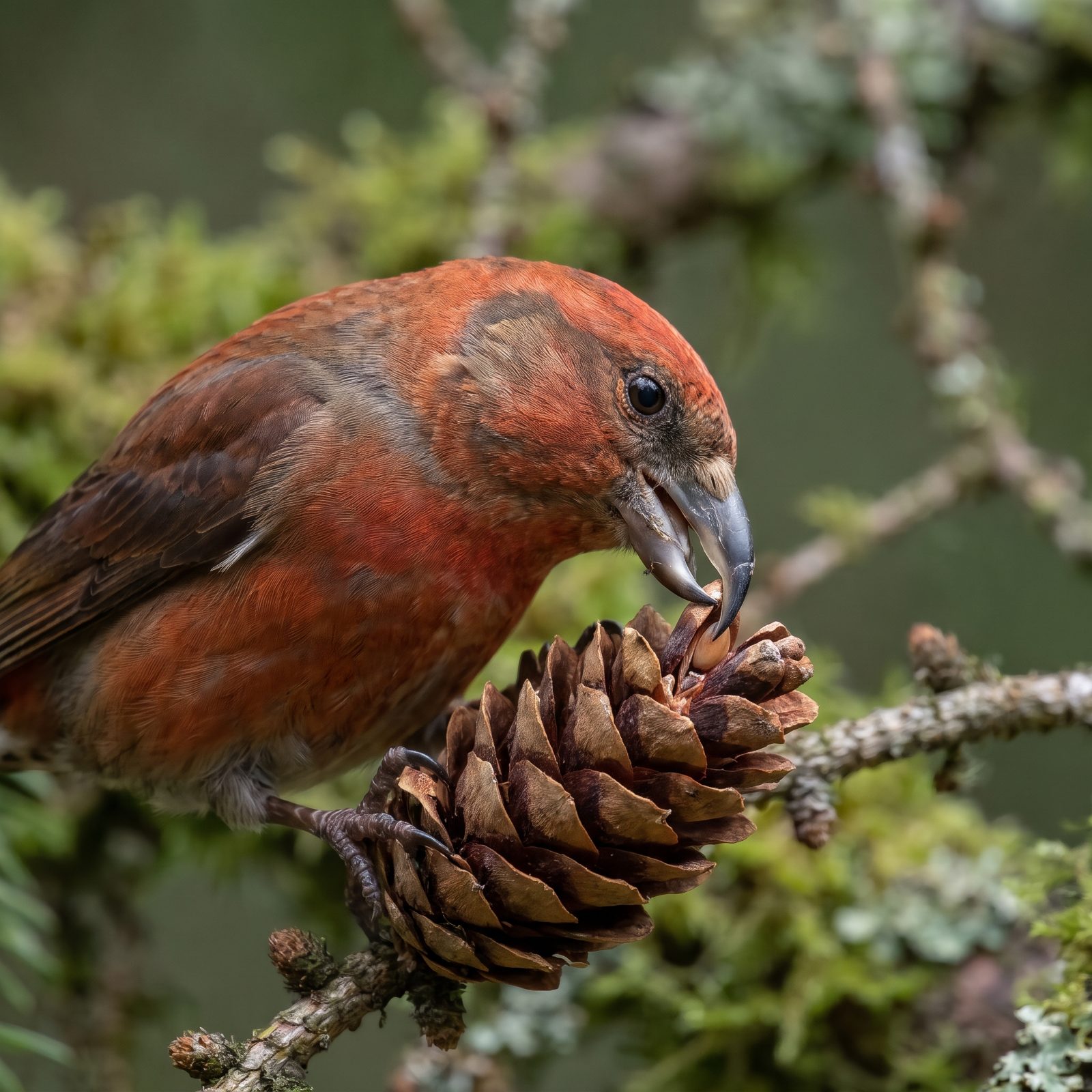
Look at the bill. It doesn’t close straight. The tips cross like scissors that slipped mid-snip, and that one oddity is the whole genius of the bird — a specialized tool grown right onto a finch’s face. A Red Crossbill slides the bill between cone scales, bites down to wrench them apart, then lifts the seed out with its tongue.
They skip standard feeders most of the time, but a platform of hulled sunflower near conifers can tempt them in, especially during irruption years. Leave out a little grit too. They need it to grind down the seeds they’ve worked so hard to free.
16. White-Winged Dove Visiting a Warm-Climate Winter Yard
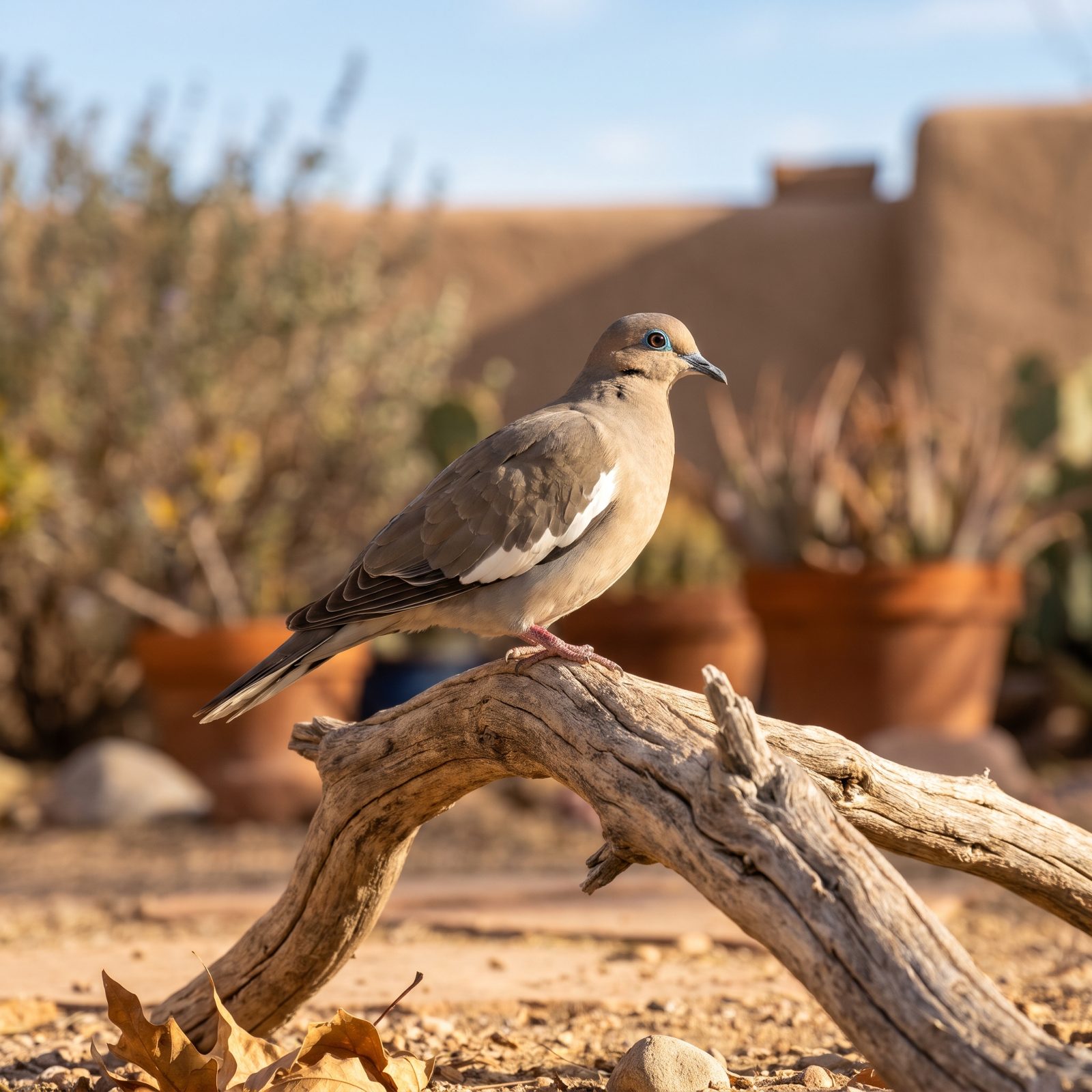
While the north shivers, the Desert Southwest gets doves. White-Winged Doves once cleared out of U.S. backyards every winter and headed south, but milder cities and steady feeders have talked many of them into sticking around through the whole cold season now.
That blue eye-ring and the clean white wing slash set it apart from the plainer Mourning Dove you might expect to see on a post like this. Scatter milo, cracked corn or sunflower on a platform or the bare ground, and don’t be surprised when the dove shows up with friends. They feed in loose, chatty groups, and they are not remotely shy about it.
15. Common Grackle Gleaming Beside a Winter Platform Feeder
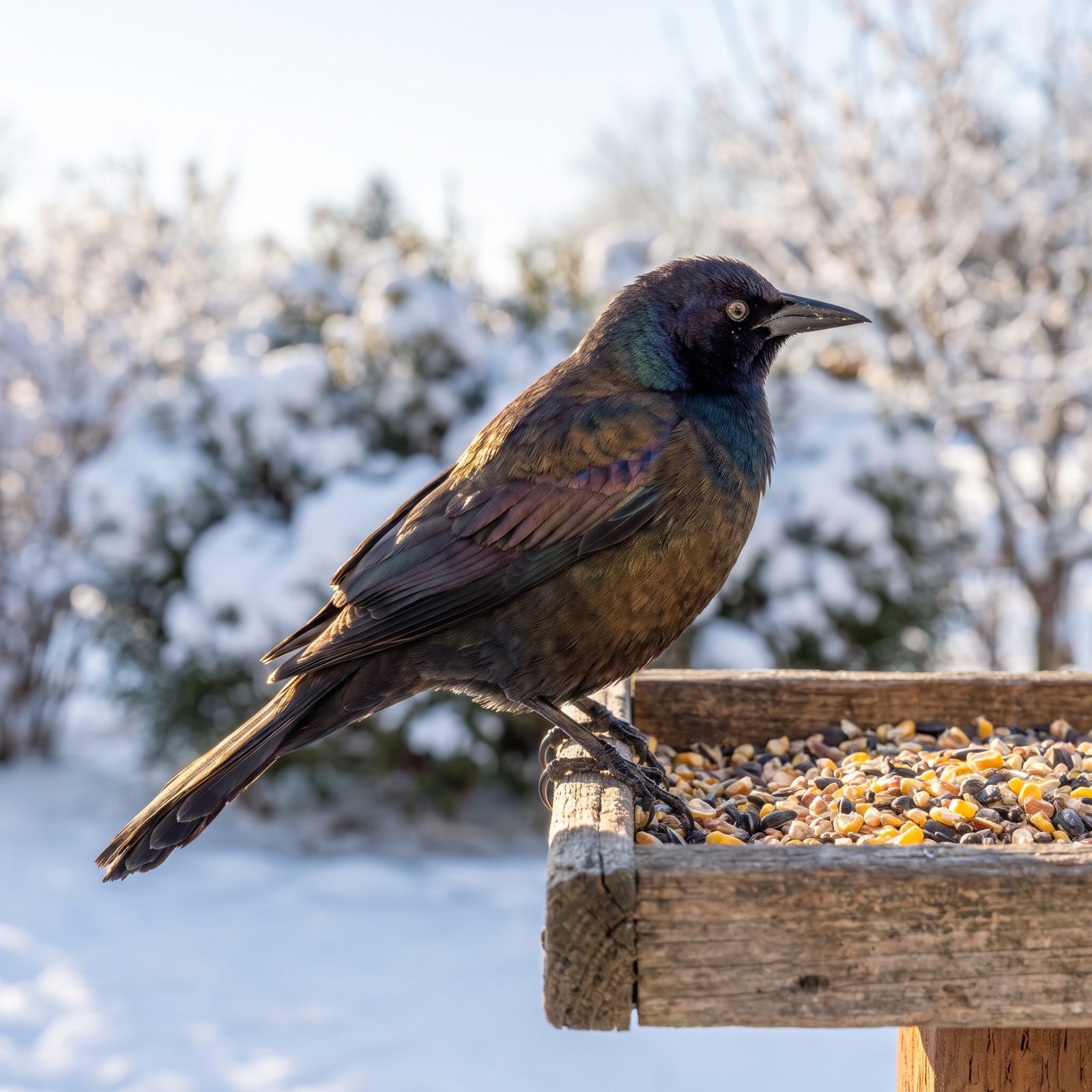
From a distance it reads plain black. Catch it in low winter sun and the whole bird ignites: bronze down the back, oil-slick purple over the head, a pale yellow eye that looks almost electric. Common Grackles aren’t black at all. They’re iridescent, and that color only appears when the light strikes just right.
They roll in with winter flocks and strip a platform feeder in minutes, so they’re nobody’s favorite guest. But stop and actually look at one in good light before you shoo it off. That gleam is doing real biological work, and it’s utterly wasted on anyone who only ever sees a blackbird.
14. California Scrub-Jay Collecting Backyard Peanuts
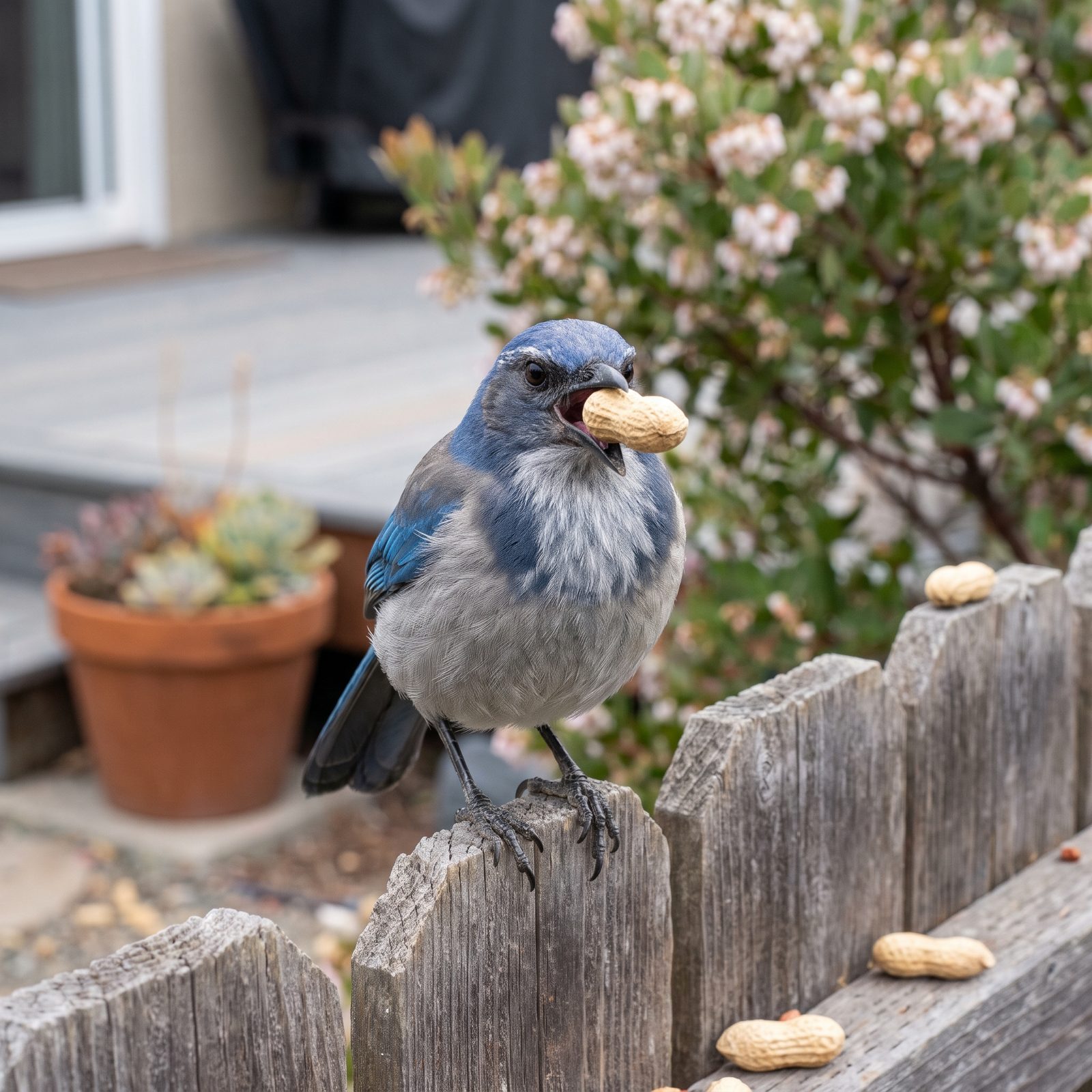
That raspy, scolding call you hear before you see the bird? That’s the California Scrub-Jay announcing it owns your peanut dish now. These are the crestless cousins of the Blue Jay, found up and down the Pacific coast from Washington to Baja, and they treat a backyard feeder like a personal pantry they’ve grudgingly agreed to share with you.
The part people miss is that a scrub-jay doesn’t eat most of what it grabs. It caches. A single bird can stash thousands of peanuts and acorns across a season — lawn, flowerbeds, roof gutters — and it remembers where. So that whole peanut vanishing in two seconds flat isn’t greed. It’s a savings account with feathers.
13. Steller’s Jay Flashing Its Blue Wings Beside a Feeder
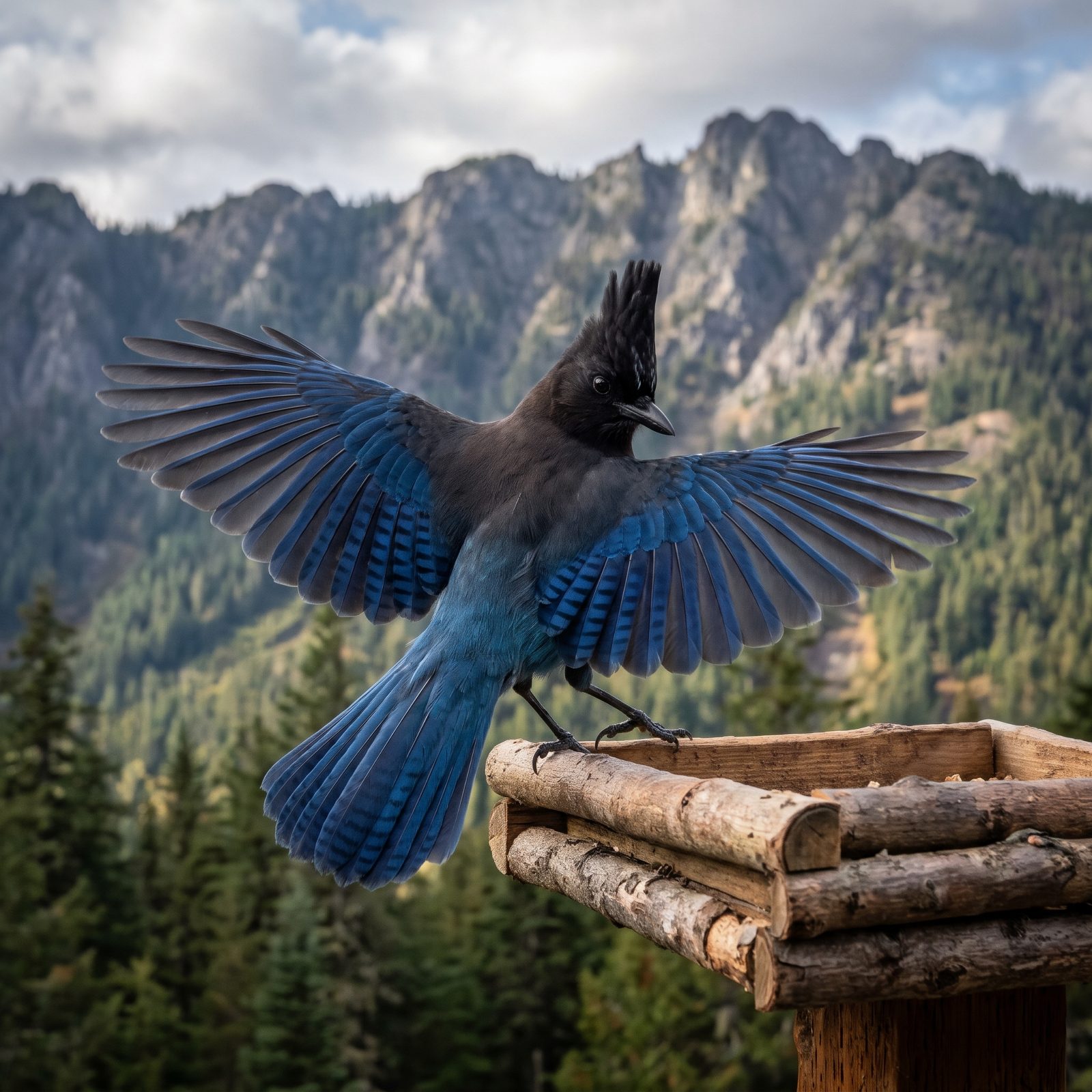
The Steller’s Jay walks in like it owns the mountain, and honestly, who’s going to argue? Tall black crest, a body the blue of a gas flame, and a swagger to match. This is the dark-headed jay of western conifer country — from the coastal ranges clear into the Rockies — and winter is when it drops down to backyards for peanuts and sunflower seed.
The voice is what throws people. A Steller’s Jay can do a dead-on impression of a Red-tailed Hawk, scattering every smaller bird off the feeder so it gets first pick. That black-to-blue gradient flowing down the body is unmistakable, and nothing else at a North American feeder wears a crest that dramatic in that electric shade.
12. Canada Jay Visiting a Boreal Backyard Feeding Station
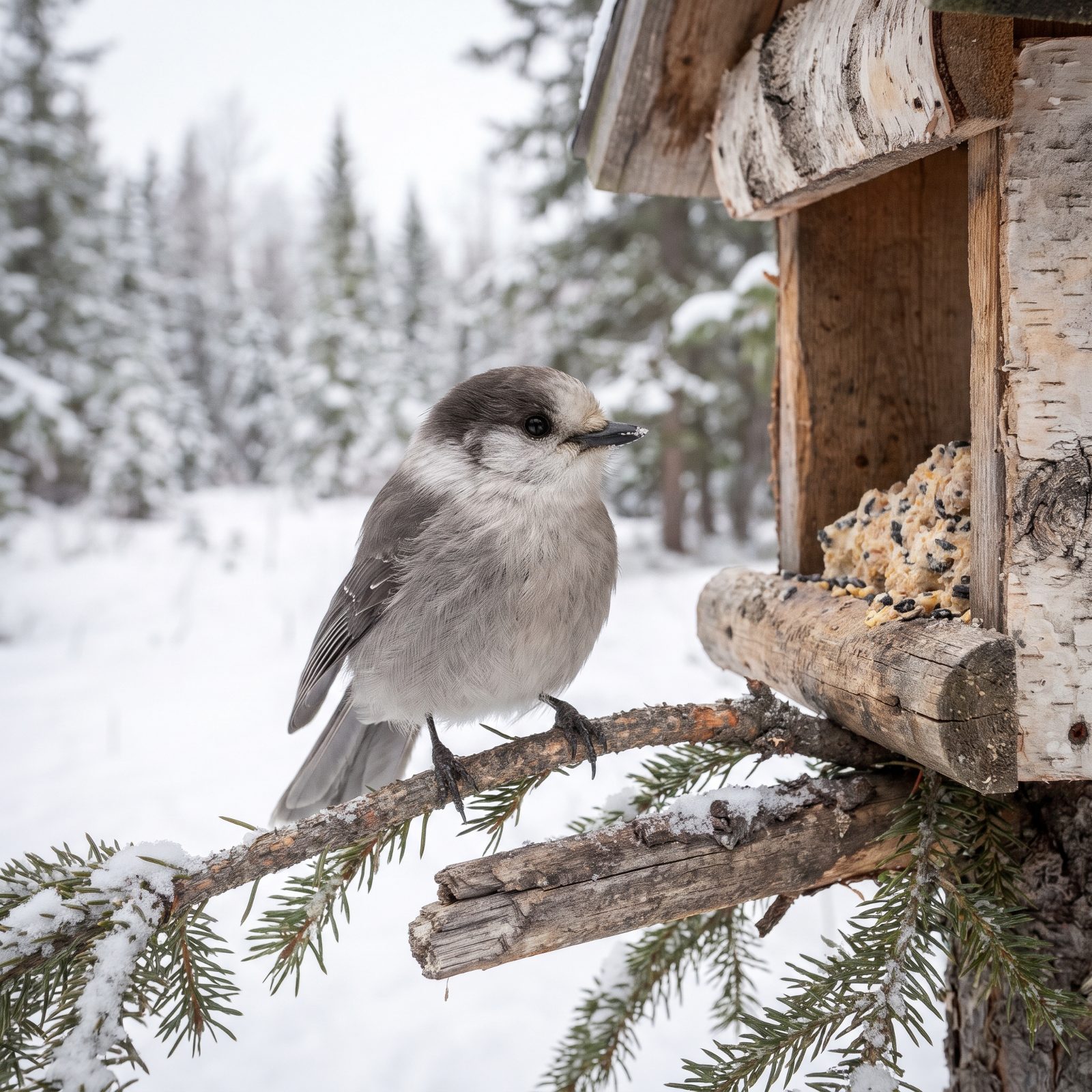
Soft as a grey mitten, bold as a thief. The Canada Jay — long known as the whiskeyjack or gray jay — is the bird of the far north, breeding in spruce bogs across Canada and the northern fringe of the US where the boreal forest dips down.
Live up where it’s truly cold and this bird will land on your hand. It has almost no fear of people and will take bread, suet or peanut butter right off your fingers. The astonishing bit is the timing. Canada Jays nest in late winter, sometimes laying eggs with the snow still deep, fueled entirely by food they cached the previous summer in sticky, saliva-glued clumps tucked under bark. Think about that for a second — a chick hatching into a frozen world on last July’s leftovers.
11. Clark’s Nutcracker Carrying Away a Peanut
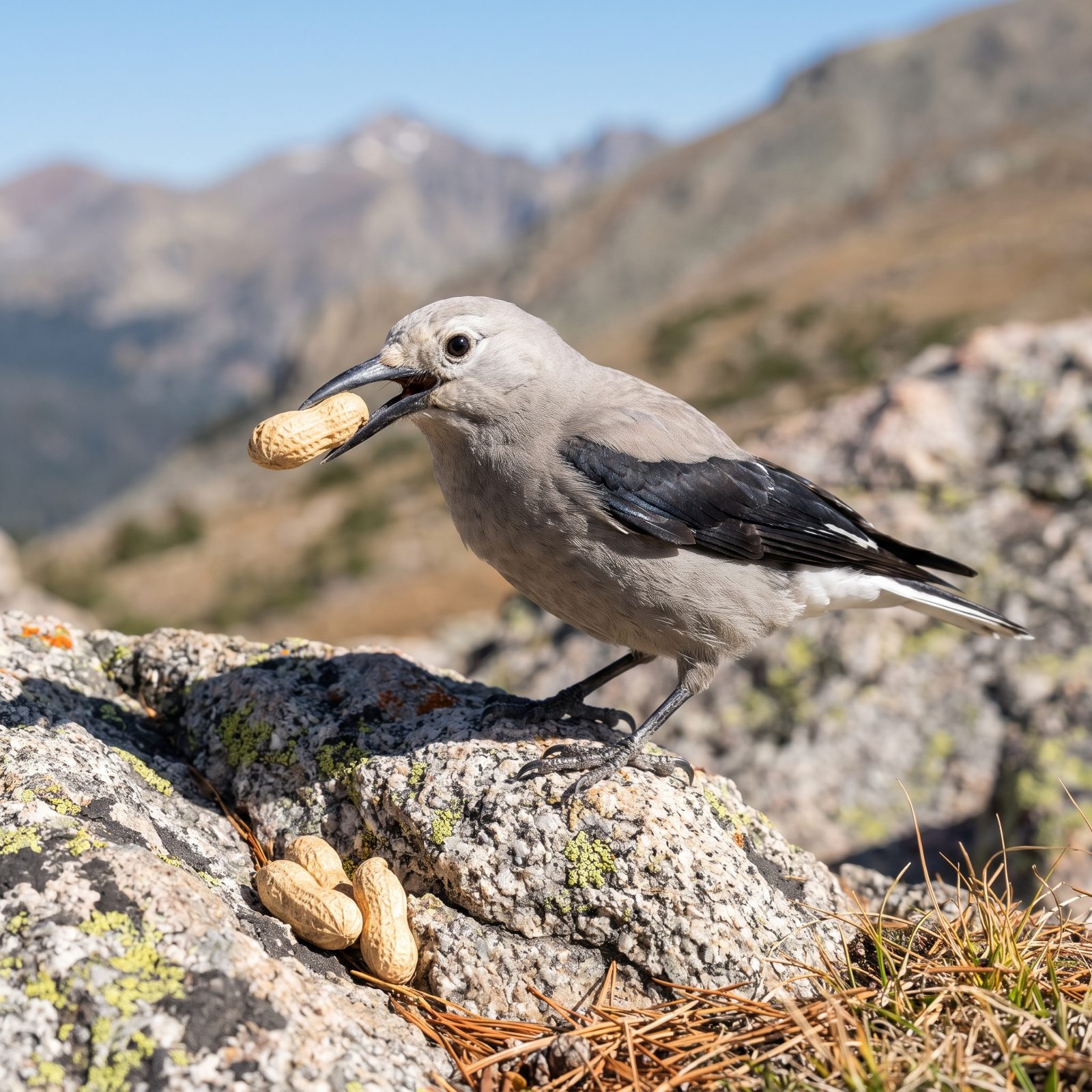
Watch a Clark’s Nutcracker land and you’re watching one of the great memory feats in the animal world. This pale grey crow relative haunts the western high country — whitebark pine zones in the Rockies, Sierra and Cascades — and spends every autumn jamming pine seeds into the ground.
Not a modest handful, either. One bird buries tens of thousands of seeds across miles of mountainside, then digs up the vast majority months later under snow. Its spatial memory is so good that whole whitebark pine forests sprout from the seeds it happens to forget. At a feeder it makes straight for peanuts and will haul off a mouthful in a special throat pouch before most other birds have even landed.
As an avian ecologist puts it, “These birds probably remember up to 10,000 caching locations”
10. Black-Billed Magpie Landing Beside a Platform Feeder
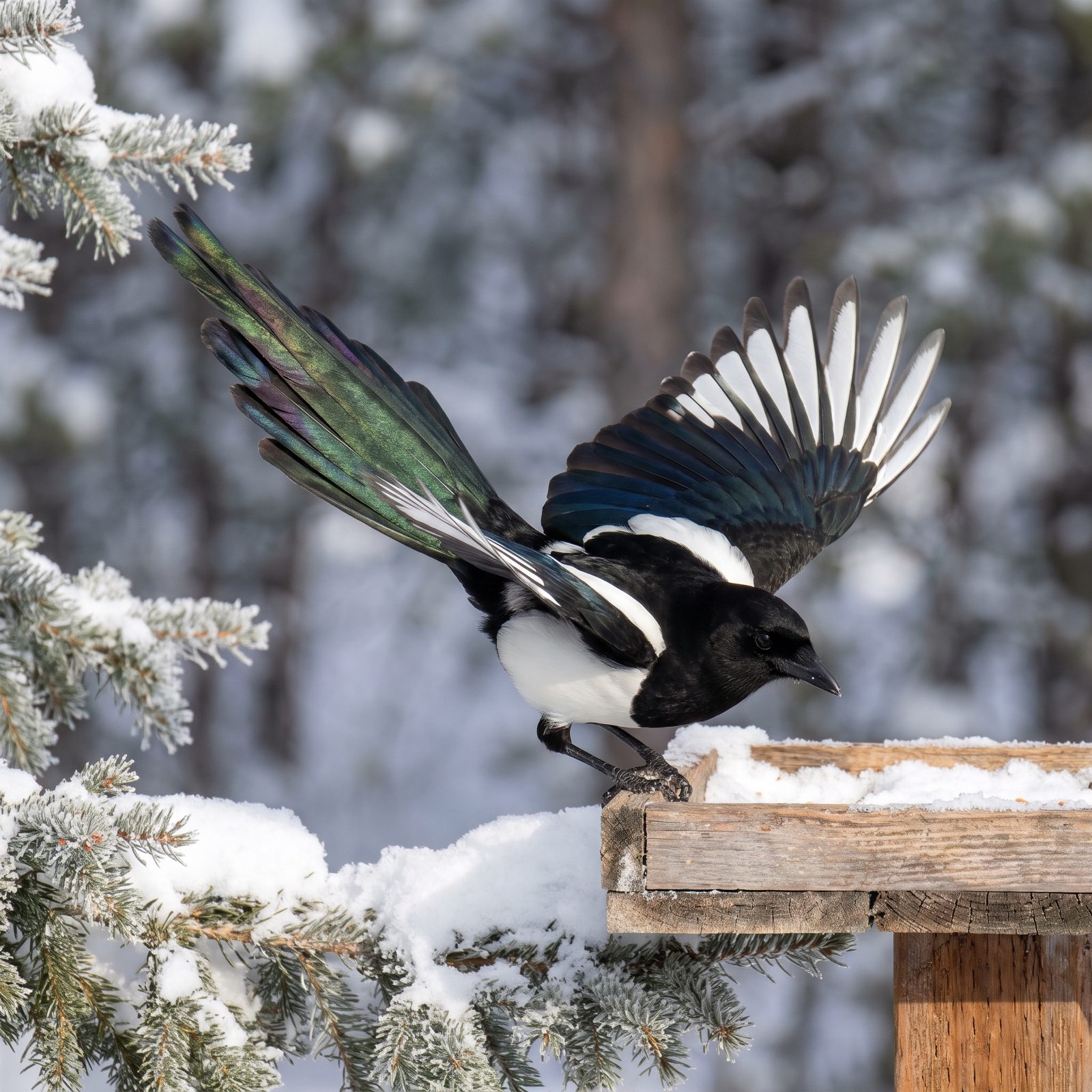
That tail. Nearly as long as the rest of the bird, and when the light hits it right it throws off green and violet like spilled oil on a puddle. The Black-billed Magpie is a fixture of the open interior West, from the northern plains through the Rockies and out into the Great Basin.
Loud, social and endlessly nosy, magpies will clean up suet scraps, peanuts and kitchen leftovers from a platform without a second thought. They’re among the few animals that recognize themselves in a mirror — a rare marker of self-awareness. Stranger still, they hold what look like gatherings around dead flock members, lingering and calling, behavior that has puzzled observers for generations.
9. Eastern Bluebird Eating Mealworms on a Frosty Morning
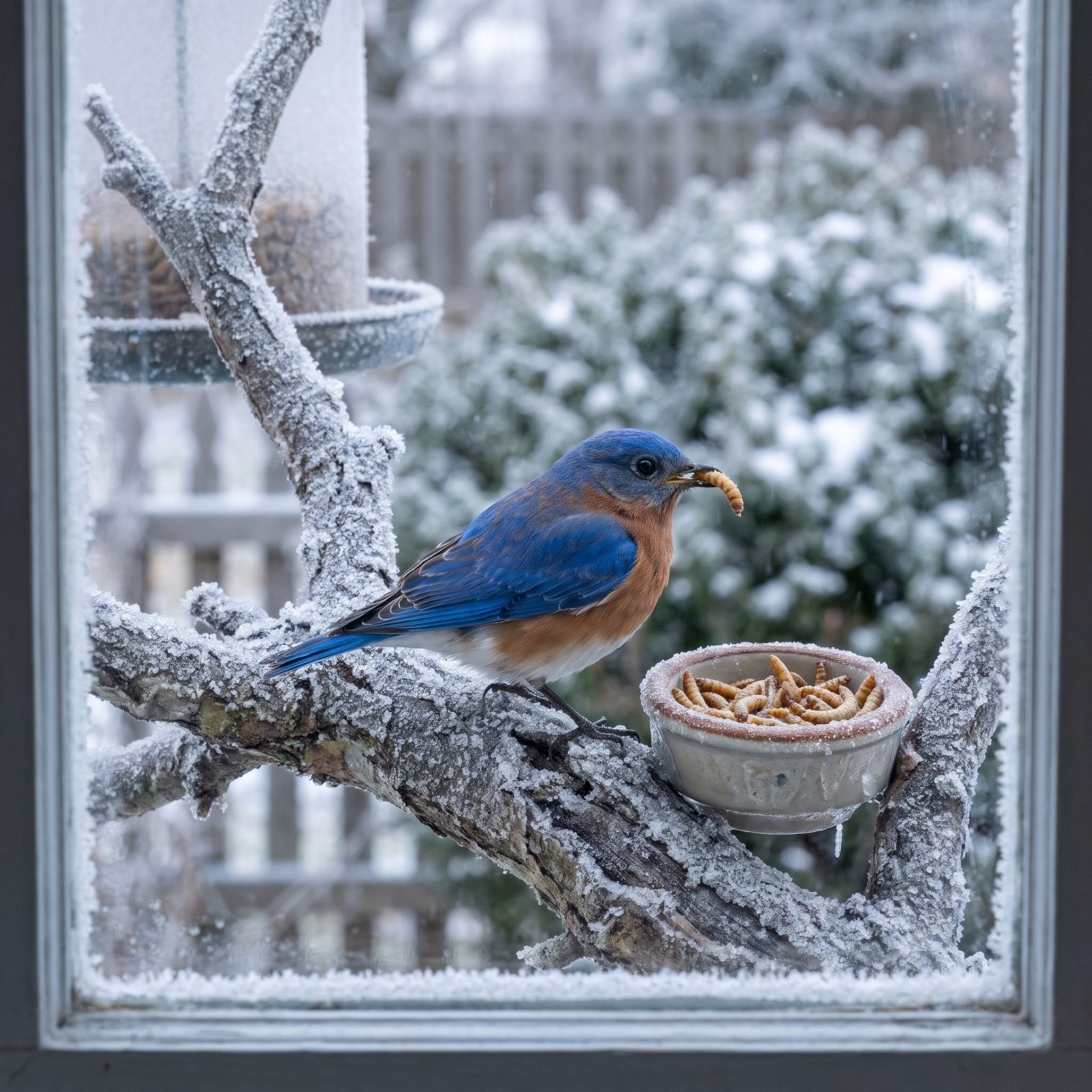
A splash of blue on a grey December morning will stop you cold at the kitchen window. Eastern Bluebirds don’t all migrate — plenty tough out the winter across the Southeast and up into the mid-Atlantic, trading an insect diet for berries and whatever soft food a yard provides.
Mealworms are the key. Offer them live or dried in a shallow dish and a wintering bluebird family will come back like clockwork, especially after a hard freeze locks up their natural food. On the worst nights they’ll even pile into a nest box, several birds crammed into one cavity to share body heat. There’s something almost tender about that.
8. American Robin Eating Berries from a Fruit Feeder
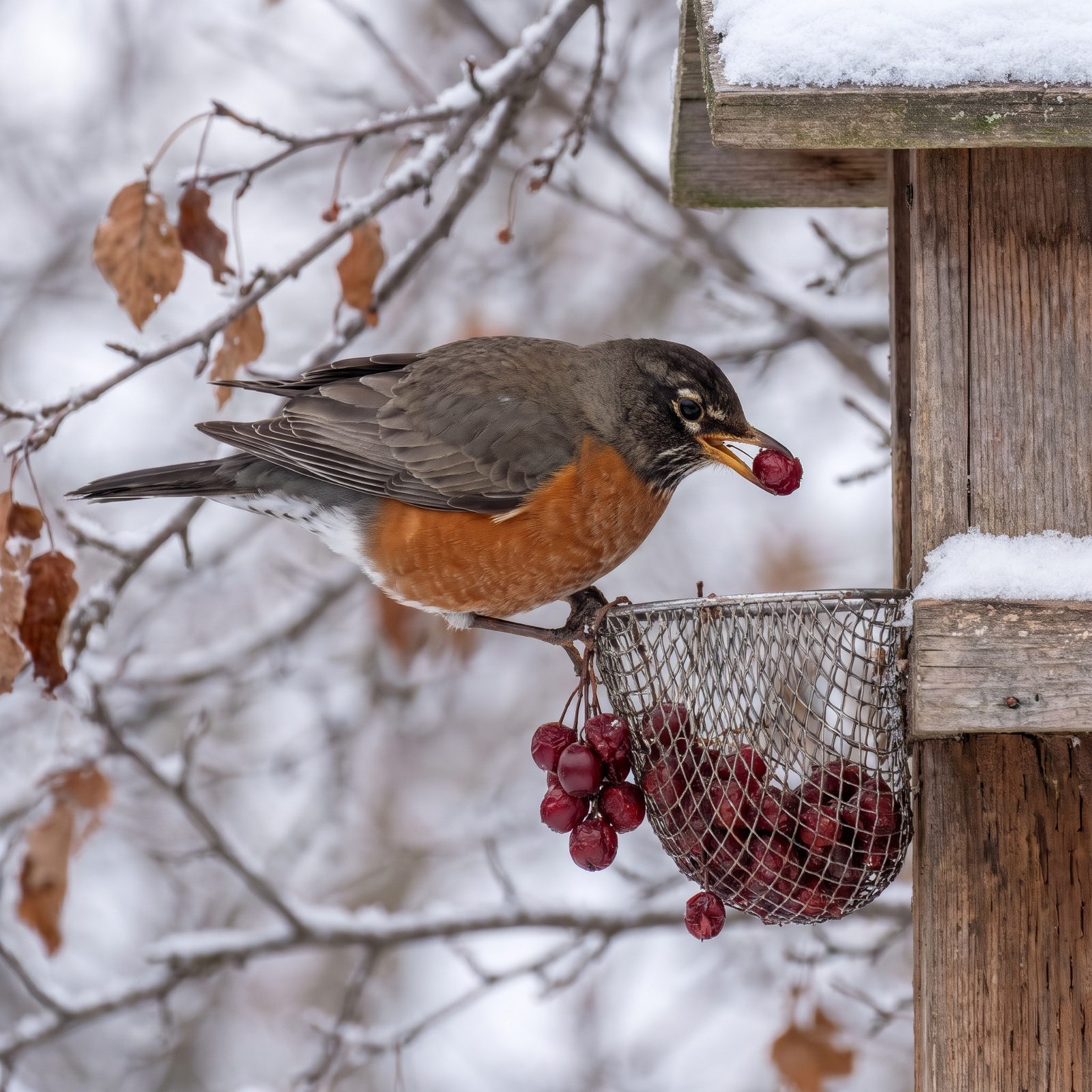
Everybody thinks robins mean spring. Wrong. Robins stick around all winter across much of the country — they just change their habits and disappear from your lawn. Cold ground means no worms, so the whole flock switches to fruit and goes roving in big nomadic bands, chasing down whatever’s still holding berries.
Put out halved apples, raisins soaked soft, or a wreath of winterberry and you can pull a robin flock right into the yard. They’ll strip a crabapple tree bare in an afternoon. And yes — robins genuinely do get tipsy on fermented berries late in the season, flying into windows and staggering around the lawn. It’s documented, not a tall tale.
Pushing back on the idea that robins leave for the winter, a master naturalist program coordinator writes “But these sturdy birds are still around in areas where berries are plentiful while their other main food, invertebrates, are unavailable under the frozen ground.”
7. Cedar Waxwing Reaching for Offered Winter Fruit
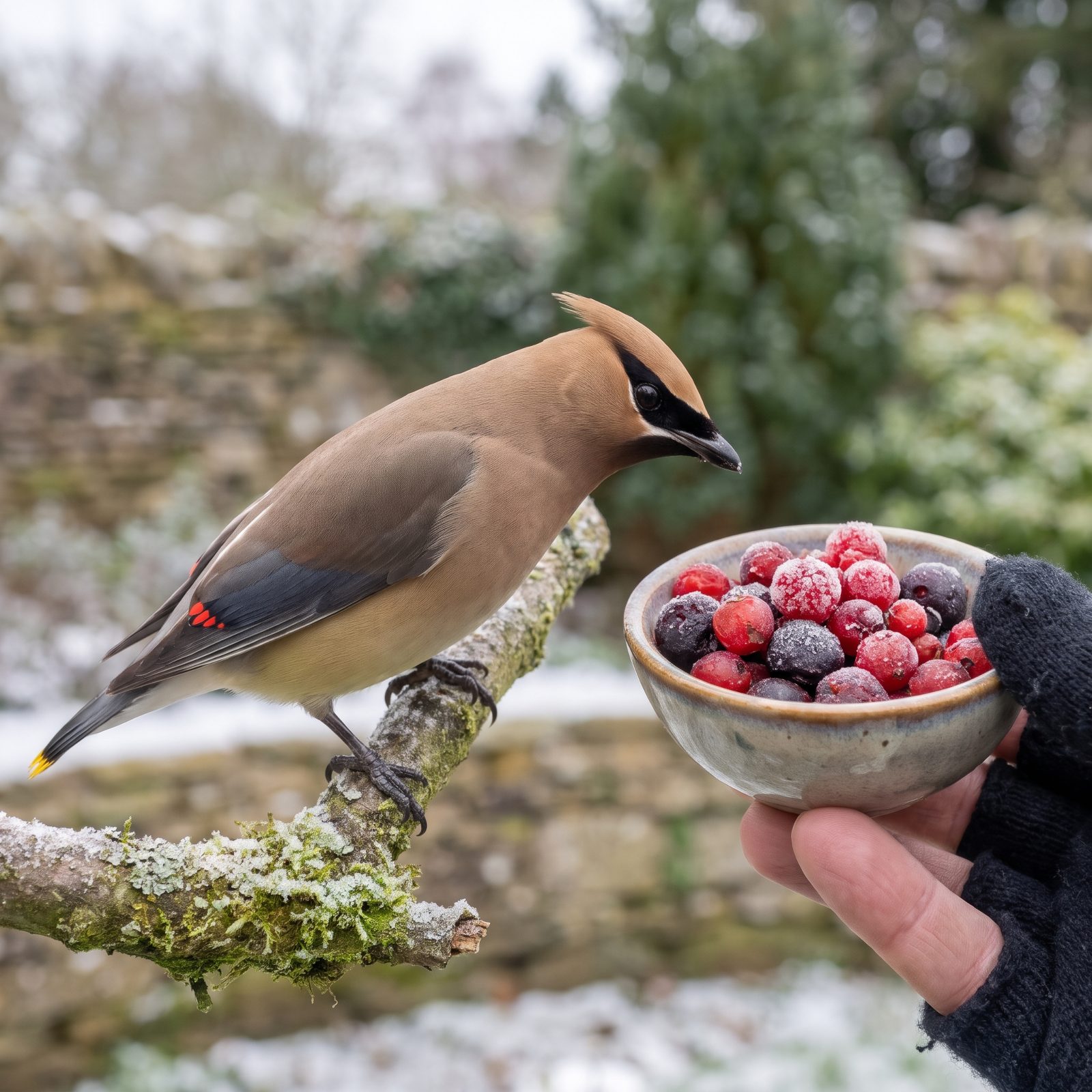
No bird looks more finished than a Cedar Waxwing. The plumage is so smooth it reads like molded satin, topped off with a black bandit mask and those odd red droplets on the wingtips that look painted on. The droplets are genuine waxy secretions, and their size tells the rest of the flock how old and important a bird is.
Waxwings are fruit obsessives, roaming the continent in tight winter flocks that swarm a berry-laden tree, strip it clean, and vanish. You can’t really train them to a feeder. But a mountain ash, a holly, or a tray of fruit can bring a whole wandering flock down for a frantic, oddly polite half hour.
6. Northern Mockingbird Guarding a Backyard Fruit Feeder
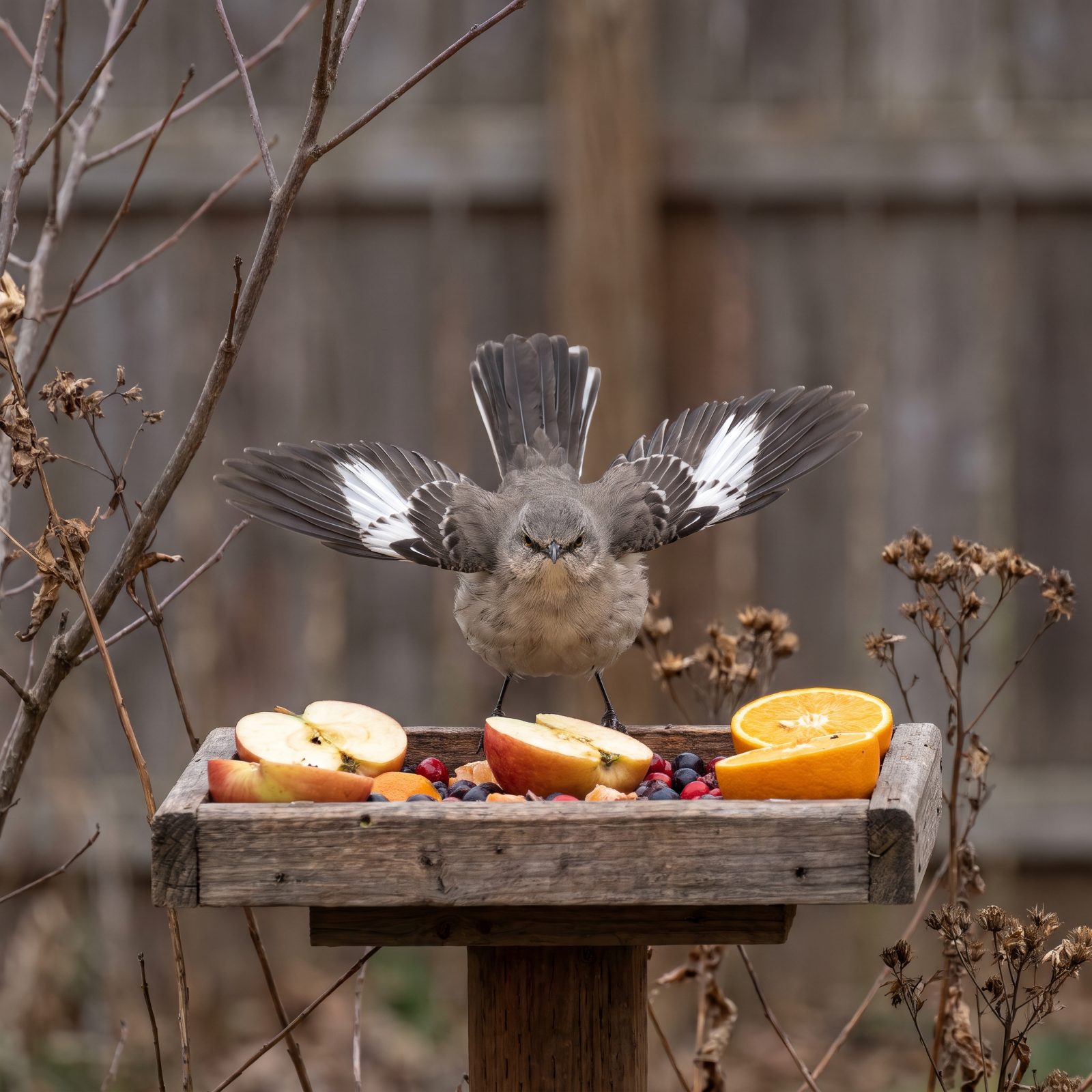
A mockingbird decides a fruit feeder is its territory, and that’s the end of the open-door policy. Through the mild winters of the South and Southwest, a single Northern Mockingbird will claim a berry bush or a tray of fruit and spend the entire season driving off every robin, waxwing and jay that dares approach.
What it’s really guarding is a food reserve it plans to live on all winter. The bird you know for mimicking car alarms and other birds’ songs by day will also sing on moonlit winter nights — usually an unmated male hoping someone’s listening. One mockingbird can learn hundreds of distinct sounds over a lifetime, folding fresh ones in year after year.
5. Bushtit Flock Swarming a Suet Cage
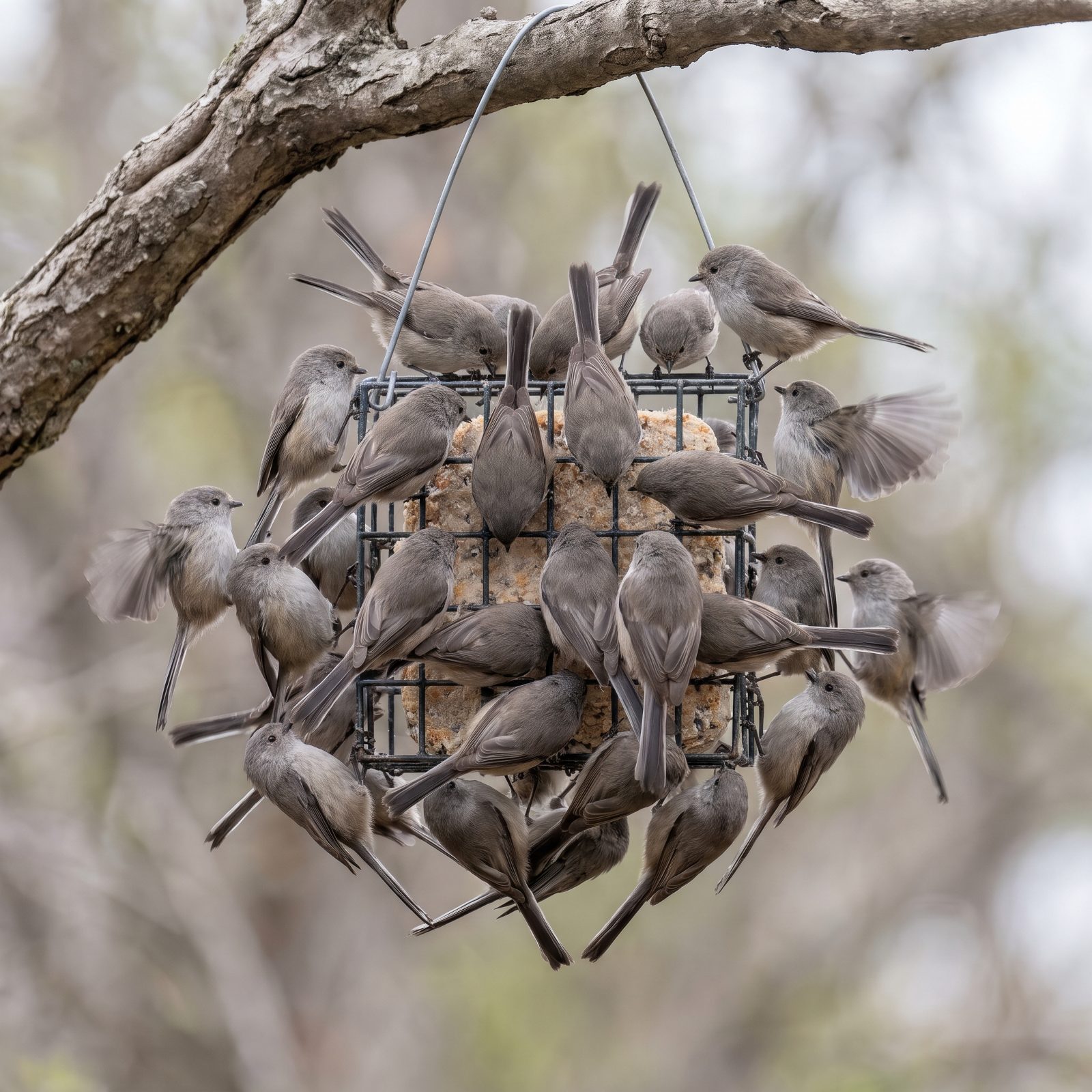
One minute your suet cage is quiet. The next it’s a boiling knot of eight, twelve, twenty tiny grey birds, all cheeping and clinging and dangling upside down at once. Then, as fast as they arrived, they pour off into the next shrub and the yard falls still again.
Bushtits are among the smallest songbirds in North America, barely heavier than two pennies, ranging across the West from the Pacific coast through the Southwest. They get through winter by sticking together — foraging in restless flocks all day, then roosting packed in a huddled row on cold nights to pool their warmth. A suet cage is a rare chance to actually count them before they’re gone.
4. Yellow-Rumped Warbler Sampling Suet in Winter
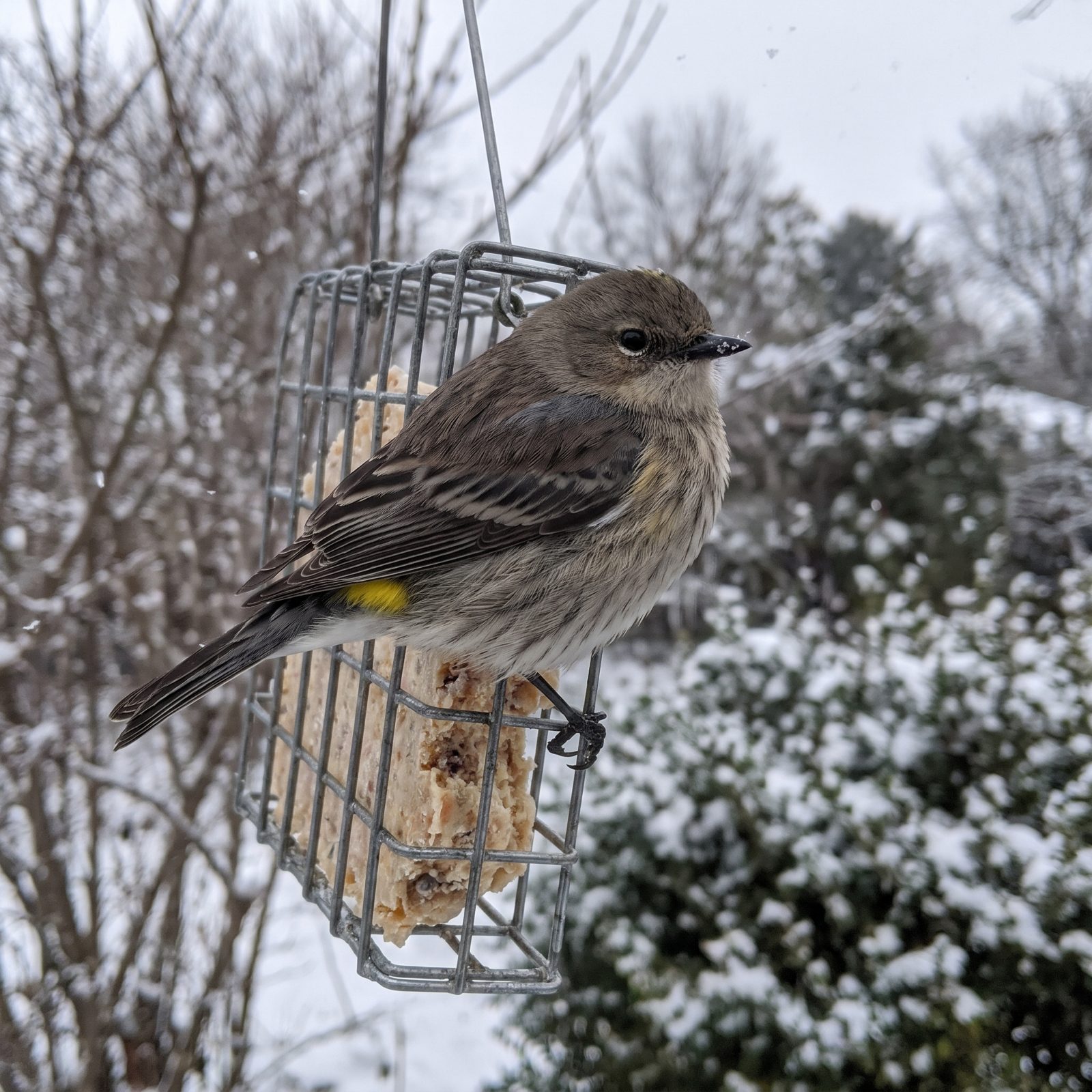
Most warblers are long gone by December, sipping nectar and chasing bugs somewhere in the tropics. The Yellow-rumped Warbler stays behind, and it winters farther north than any other warbler in North America. Birders call it the butter-butt, and once you see that bright yellow patch flash above the tail as it flies off, the nickname sticks.
The trick is its gut. Yellow-rumps can digest the waxy coating on bayberries and wax myrtle berries, a fuel most songbirds can’t use at all. In winter plumage they look like drab brown streaks with a sharp chek call, so watch for them picking at suet, peanut butter mixes and mealworms when the insects disappear.
3. Pine Warbler Eating Sunflower Chips at a Southern Feeder
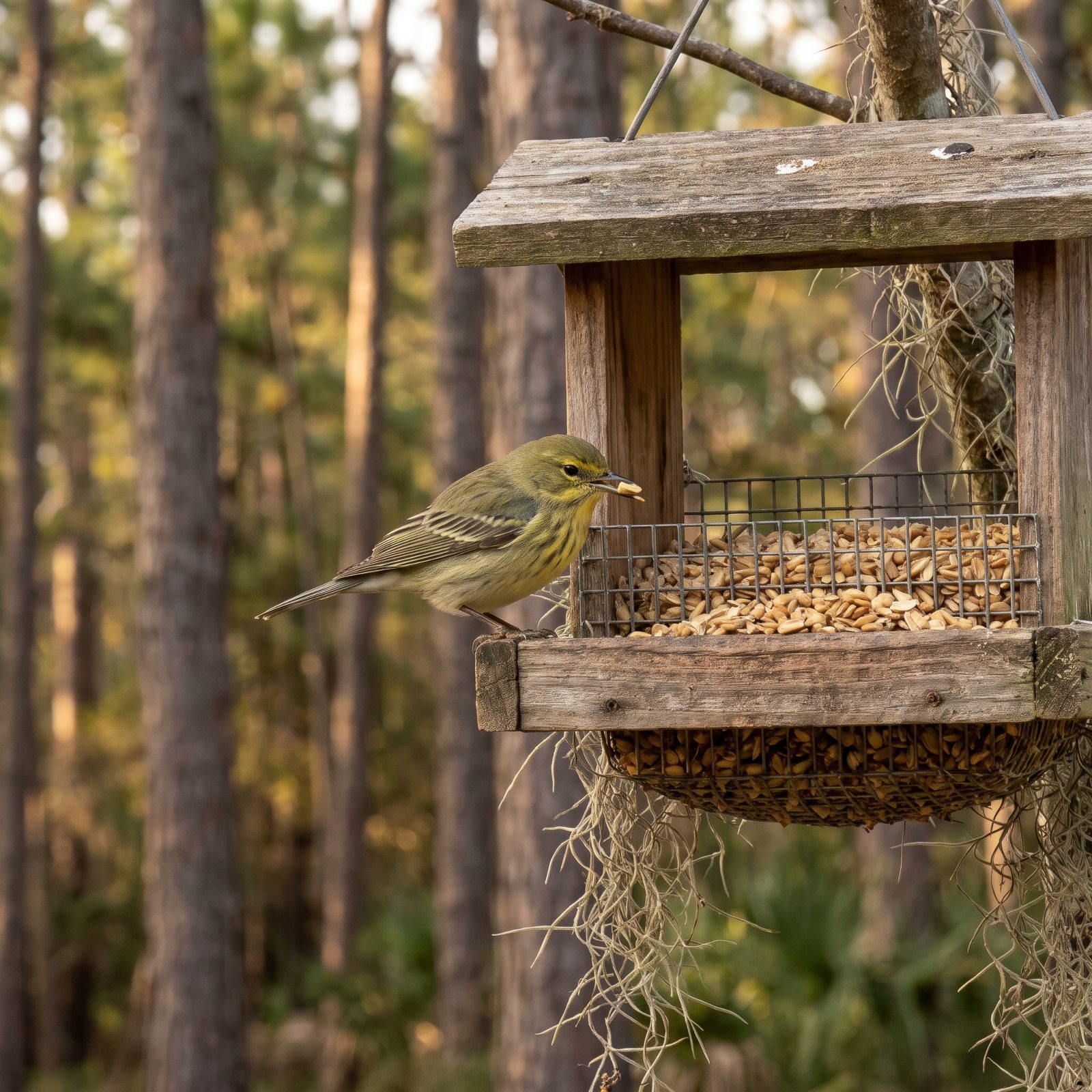
The warbler that eats seed. That alone makes the Pine Warbler a strange one. Nearly every other warbler lives on insects, but this chunky yellow bird will settle onto a feeder and work through sunflower chips and suet like a finch.
It sticks close to pine forests across the Southeast year-round, which is why southern yards get the best shot at one in winter. Look for an olive back, a yellow throat and soft pale-yellow edging on brownish wings, and listen for a musical trill that sounds a lot like a Chipping Sparrow. Hulled sunflower matters here: that slim warbler bill isn’t built for cracking shells, so do the work for it.
2. Anna’s Hummingbird Hovering at a Frost-Protected Nectar Feeder
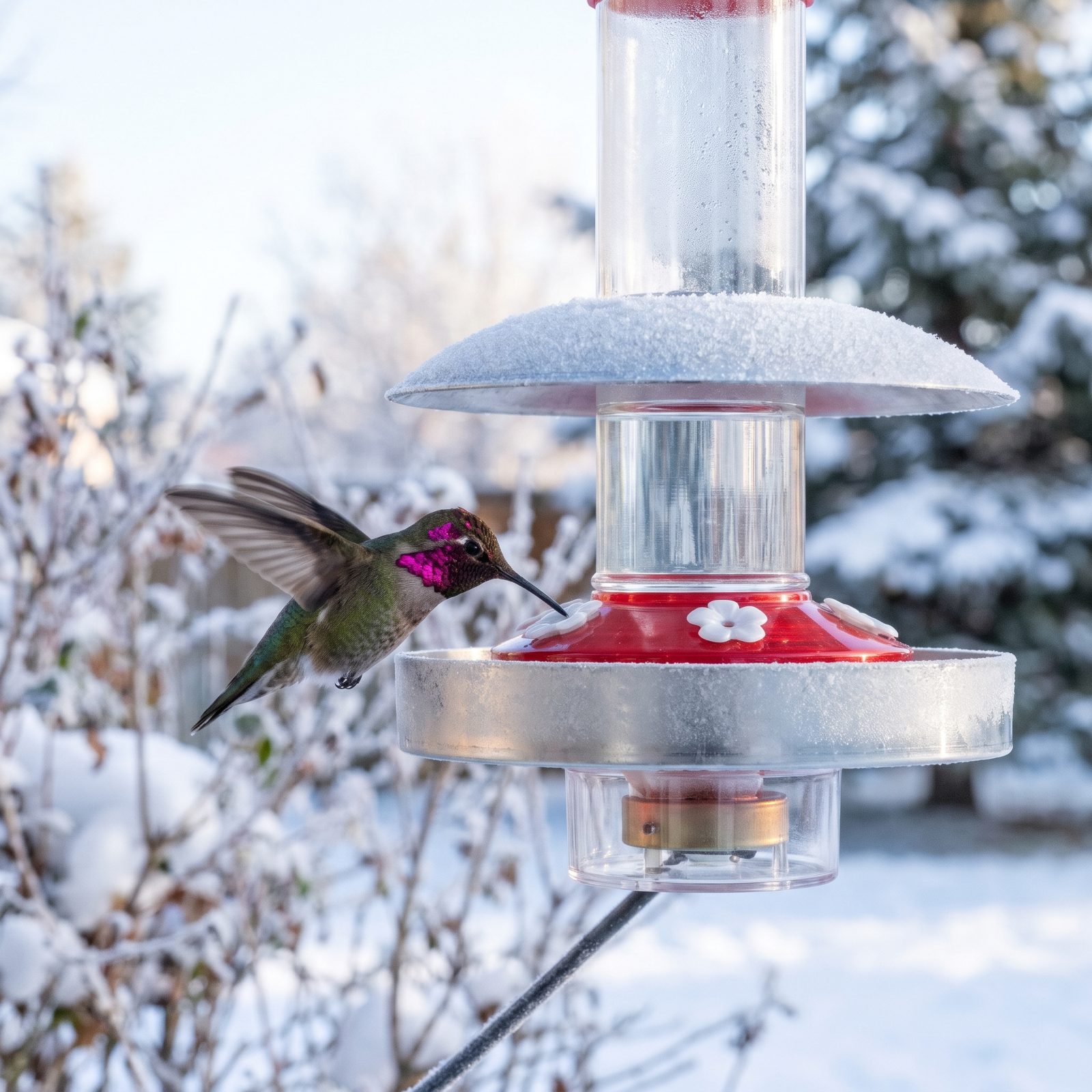
A hummingbird at Christmas sounds like a mistake. Along the Pacific Coast, it’s a regular. Anna’s Hummingbird stays put through winter, and over the past several decades it has pushed its range north into Oregon, Washington and British Columbia, helped along by backyard feeders and garden plantings that bloom in the cold months.
The male’s head looks almost black until he turns, and then the whole crown and throat light up rose-pink. On freezing nights these birds drop into torpor, letting their body temperature and heart rate fall to save energy, then wake hungry. Keep a feeder thawed with a heated model or by swapping in a fresh one at dawn. Stick to plain sugar water, one part sugar to four parts water, with no red dye.
As one hummingbird researcher puts it, “We recapitulated that eucalyptus was probably an early driver of the expansion out of Southern California, but the effect of the feeders far outweighed the effects of the eucalyptus”
1. Pileated Woodpecker Dwarfing a Platform Feeder
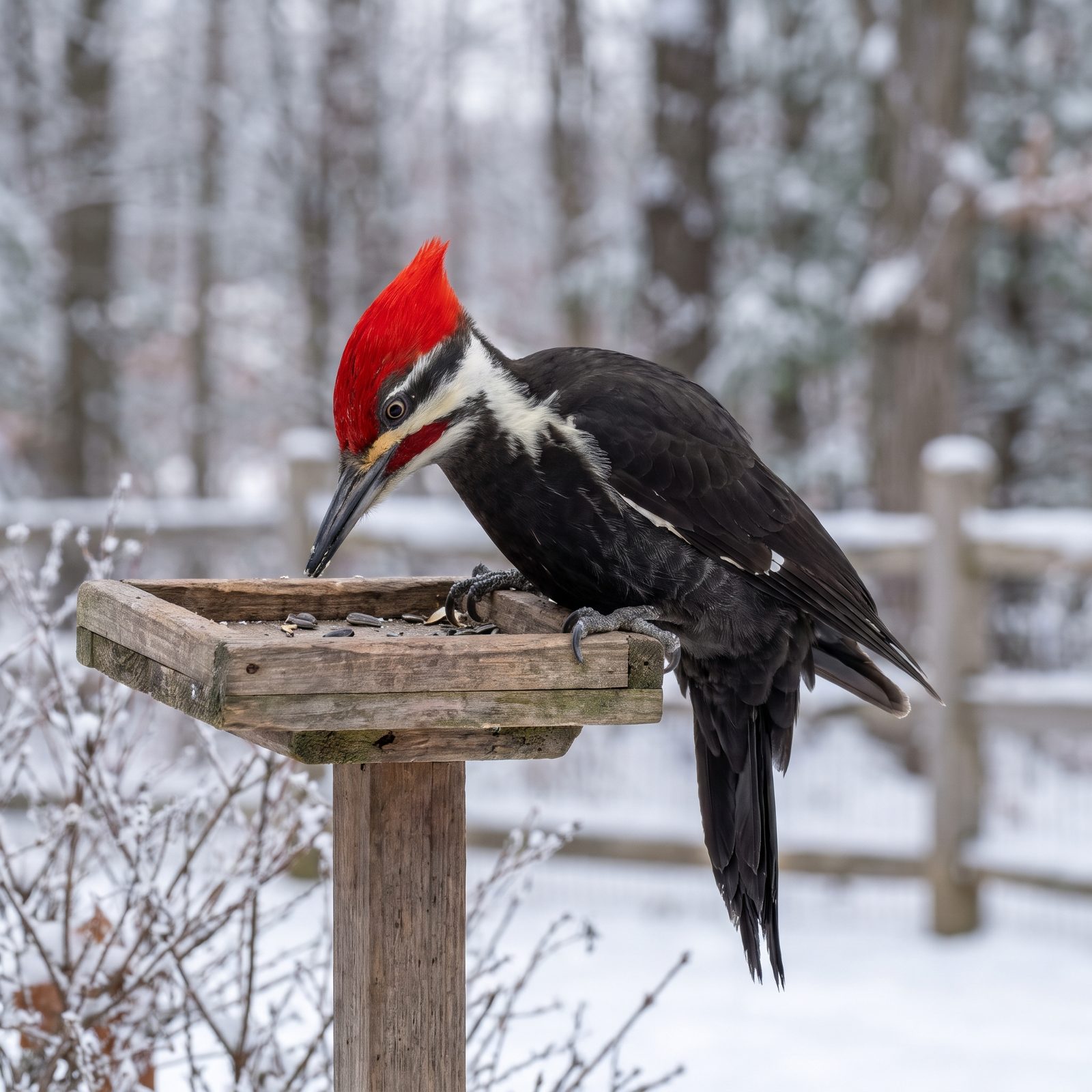
This is the moment your feeder setup gets humbled. A Pileated Woodpecker runs about the size of a crow, so watching one drop onto a platform meant for chickadees feels like a hawk crashing a tea party. That flaming crest you can’t miss. And the heavy bill? It hammers rectangular holes into dead trees, cavities that other birds move into later.
They turn up at feeders more than people expect. Suet and peanut halves pull them in during cold snaps, when carpenter ants and beetle larvae go scarce under the bark and a bird that big needs the calories somewhere. Mount it solid, though. A flimsy hook swings the second the bird lands and sends it flapping off into the trees, and you won’t get a second shot that morning.